How to Crack NIFT 2027 Exam: Complete Preparation Strategy, Exam Pattern, Syllabus & Weightage

Preparing for the NIFT 2027 Entrance Exam is an exciting journey for aspiring designers. Every year, thousands of students compete for admission to the prestigious National Institute of Fashion Technology (NIFT), but only those with the right preparation strategy, creativity, and consistency secure top ranks.

Whether you’re aiming for B.Des, B.F.Tech, M.Des, MFM, or M.F.Tech, understanding the latest exam pattern, syllabus, marking scheme, and weightage is essential. This comprehensive guide by Pahal Design, India’s leading design entrance coaching institute, will help you prepare smartly and maximize your chances of success.

Why Choose NIFT?

The National Institute of Fashion Technology (NIFT) is India’s premier institute for fashion, design, management, and technology education. With campuses across the country, NIFT offers world-class education, industry exposure, internships, placements, and opportunities to build a successful career in fashion, communication, lifestyle products, textile design, accessory design, knitwear, leather design, and fashion management.

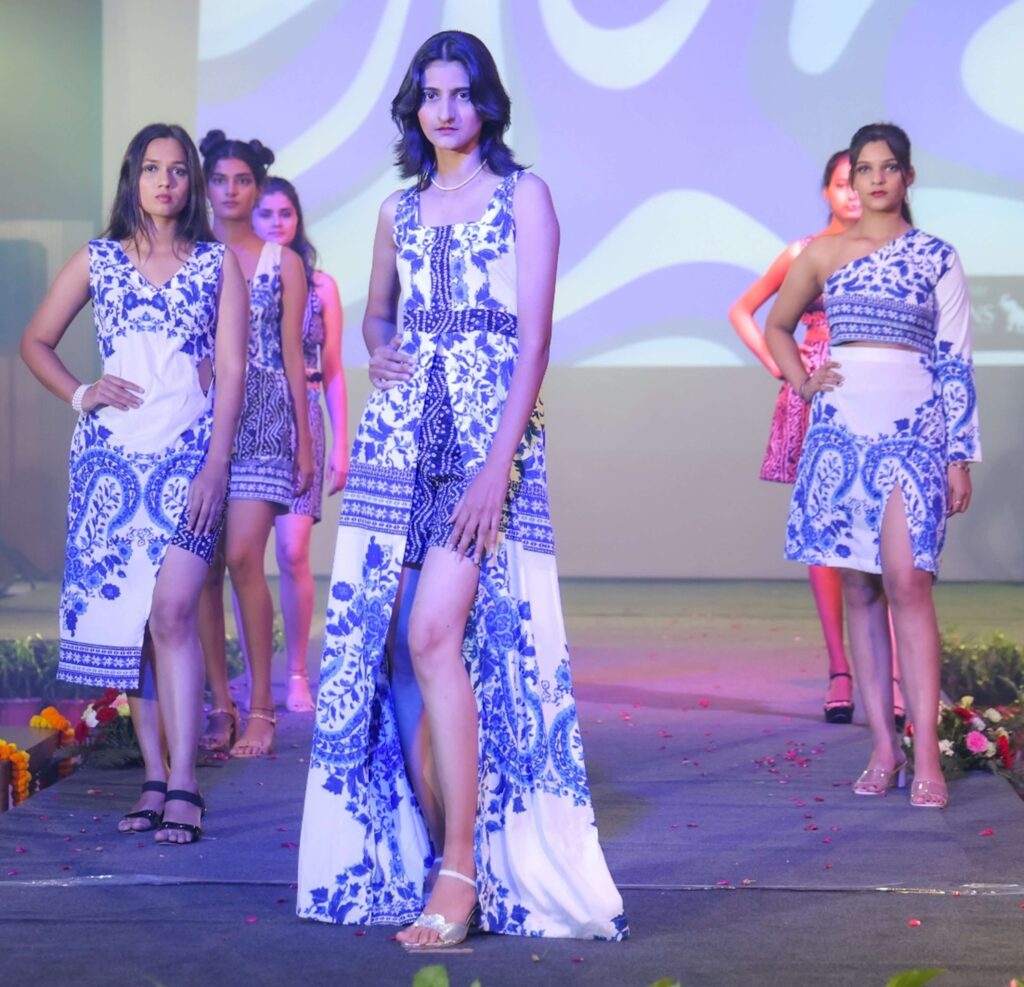
Admission is based on a national-level entrance examination that evaluates creativity, aptitude, analytical thinking, and problem-solving abilities.

NIFT 2027 Exam Pattern

Understanding the exam pattern is the foundation of effective preparation. Since each programme has a different structure, candidates should prepare according to their chosen course.

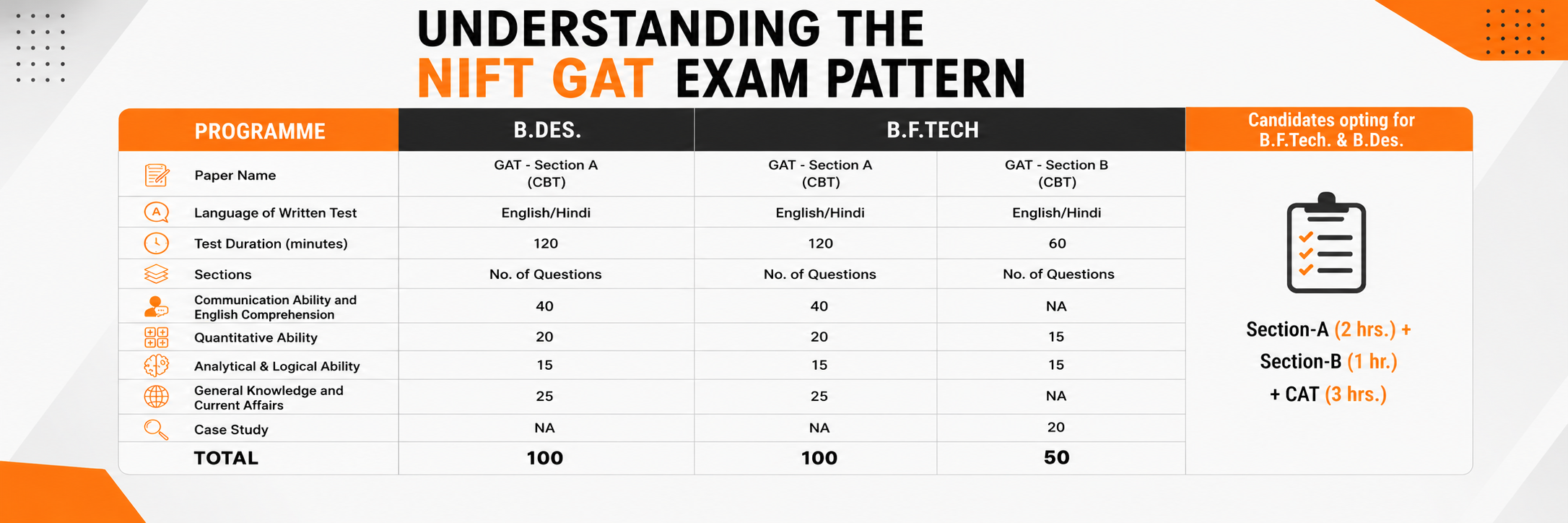
NIFT B.Des Exam Pattern

The Bachelor of Design entrance consists of two written examinations followed by the Situation Test.

General Ability Test (GAT)

Mode: Computer-Based Test (CBT)

Duration: 120 Minutes

Sections

  • Communication Ability & English Comprehension – 40 Questions
  • Quantitative Ability – 20 Questions
  • Analytical & Logical Ability – 15 Questions
  • General Knowledge & Current Affairs – 25 Questions

Total Questions: 100

Creative Ability Test (CAT)

Duration: 3 Hours

CAT evaluates:

  • Creativity
  • Drawing Skills
  • Visualization
  • Observation
  • Imagination
  • Storytelling
  • Design Thinking
  • Colour Sense
  • Innovation

NIFT B.F.Tech Exam Pattern

Candidates applying for B.F.Tech appear in two sections.

GAT Section A

Duration: 120 Minutes

  • Communication Ability & English Comprehension – 40 Questions
  • Quantitative Ability – 20 Questions
  • Analytical & Logical Ability – 15 Questions
  • General Knowledge & Current Affairs – 25 Questions

Total: 100 Questions

GAT Section B

Duration: 60 Minutes

  • Quantitative Ability – 15 Questions
  • Analytical & Logical Ability – 15 Questions
  • Case Study – 20 Questions

Total: 50 Questions

Students applying for both B.Des and B.F.Tech must appear for Section A, Section B, and CAT.

NIFT PG Exam Pattern

M.Des

Duration: 120 Minutes

  • Communication Ability & English Comprehension – 50 Questions
  • Quantitative Ability – 20 Questions
  • Analytical & Logical Ability – 25 Questions
  • General Knowledge & Current Affairs – 25 Questions

Total: 120 Questions

Qualified candidates appear for:

  • Creative Ability Test (CAT)
  • Personal Interview (PI)

MFM

Duration: 180 Minutes

Section A

  • Communication Ability & English Comprehension – 50
  • Quantitative Ability – 20
  • Analytical & Logical Ability – 25
  • General Knowledge & Current Affairs – 25

Section B

  • Case Study – 30

Total Questions: 150

M.F.Tech

Duration: 180 Minutes

  • Communication Ability & English Comprehension – 45
  • Quantitative Ability – 30
  • Analytical & Logical Ability – 25
  • General Knowledge & Current Affairs – 25
  • Case Study – 25

Total Questions: 150

Engineering-related questions are also included in the M.F.Tech examination.

NIFT 2027 Selection Process & Weightage

Understanding the official weightage allows students to focus on the sections that contribute the most to the final merit.

Undergraduate Courses

B.Des

  • General Ability Test (GAT): 30%
  • Creative Ability Test (CAT): 50%
  • Situation Test: 20%

B.F.Tech

  • GAT Section A: 30%
  • GAT Section B: 70%

Candidates Applying for Both B.Des & B.F.Tech

  • GAT Section A: 30%
  • CAT: 50%
  • Situation Test: 20%

Postgraduate Courses

M.Des

  • GAT: 30%
  • CAT: 40%
  • Personal Interview: 30%

MFM

  • GAT (Section A & B): 70%
  • Personal Interview: 30%

M.F.Tech

  • GAT: 70%
  • Personal Interview: 30%

NIFT 2027 Syllabus

Creative Ability Test (CAT)

Students should practice:

  • Human Figures
  • Perspective Drawing
  • Product Design
  • Story Illustration
  • Colour Composition
  • Poster Design
  • Object Drawing
  • Memory Drawing
  • Creative Visualization
  • Design Thinking

General Ability Test (GAT)

Topics include:

  • English Comprehension
  • Vocabulary
  • Grammar
  • Quantitative Aptitude
  • Logical Reasoning
  • Analytical Ability
  • General Knowledge
  • Current Affairs

Best Preparation Strategy for NIFT 2027

1. Understand the Weightage

Do not divide your preparation equally.

For B.Des aspirants:

  • CAT deserves the highest priority because it carries 50% weightage.
  • GAT contributes 30%.
  • Situation Test contributes 20%.

Planning your preparation according to weightage improves efficiency.

2. Practice Drawing Every Day

Spend at least 2 hours daily practicing:

  • Human Figures
  • Objects
  • Nature
  • Perspective
  • Product Concepts
  • Storytelling
  • Colour Rendering

Creativity improves only through regular practice.

3. Improve Observation Skills

Great designers observe everything around them.

Develop habits like:

  • Sketching everyday objects
  • Visiting exhibitions
  • Studying advertisements
  • Watching documentaries
  • Maintaining a visual journal

4. Master General Ability Test

Daily practice should include:

  • Reading newspapers
  • Current Affairs
  • English Vocabulary
  • Logical Reasoning
  • Quantitative Aptitude

Speed and accuracy are equally important.

5. Solve Previous Year Papers

Previous papers help you understand:

  • Difficulty Level
  • Question Trends
  • Frequently Asked Topics
  • Time Management

Practice at least 10–15 years of previous papers.

6. Attempt Mock Tests

Mock tests simulate the real exam.

Benefits include:

  • Better speed
  • Improved confidence
  • Reduced exam anxiety
  • Performance analysis
  • Time management

Aim to complete 30–50 full-length mock tests before the exam.

7. Prepare for Situation Test & Interview

Many students focus only on the written examination.

After qualifying, prepare for:

Situation Test

  • Model Making
  • Material Handling
  • Creativity
  • Neatness
  • Concept Presentation

Personal Interview

  • Portfolio Discussion
  • Design Awareness
  • Career Goals
  • Communication Skills
  • General Awareness

Common Mistakes to Avoid

  • Starting preparation late
  • Ignoring CAT practice
  • Not attempting mock tests
  • Weak time management
  • Neglecting current affairs
  • Memorizing instead of understanding concepts
  • Ignoring creativity development

Daily Study Plan

ActivityTime
Drawing Practice2 Hours
GAT Preparation2 Hours
Current Affairs30 Minutes
Previous Year Papers1 Hour
Mock Test & Analysis1.5 Hours

Why Choose Pahal Design?

For over 26 years, Pahal Design has been one of India’s most trusted coaching institutes for design entrance examinations.

Students benefit from:

  • Expert Faculty from NIFT & NID
  • Comprehensive Study Material
  • Unlimited Drawing Practice
  • Regular Mock Tests
  • Portfolio Development
  • Situation Test Training
  • Personal Interview Guidance
  • Online & Classroom Coaching
  • Individual Mentorship
  • Proven Selection Record

Thousands of students trained at Pahal Design have secured admissions to prestigious institutions including NIFT, NID, UCEED, CEED, NATA, BFA, and leading international design universities.

Whether you’re beginning your preparation or aiming for a top rank, Pahal Design provides the guidance, resources, and mentorship needed to achieve your dream.

Final Thoughts

Success in the NIFT 2027 Entrance Exam is not just about hard work—it’s about preparing smartly. Understanding the latest exam pattern, focusing on high-weightage sections, practicing creativity daily, solving mock tests, and staying consistent are the keys to success.

Start your preparation early, follow a structured study plan, and seek expert guidance whenever needed. With dedication and the right coaching from Pahal Design, you can confidently secure admission to your dream NIFT campus and build a successful career in the design industry.

Book Your Free Career Counselling Session Today

Not sure which design entrance exam is right for you?

Our expert counsellors will help you:

  • Choose the right design career path
  • Understand the NIFT, NID, UCEED, CEED, NATA, and BFA admission process
  • Create a personalized preparation plan
  • Learn about scholarships and coaching programs
  • Get answers to all your admission-related questions

📞 Call Now: 8800-22-6864

🌐 Visit: www.pahaldesign.com

🎯 Your Design Dream Begins with Pahal Design!

Frequently Asked Questions (FAQs) About NIFT 2027

1. What is the NIFT 2027 Entrance Exam?

The NIFT 2027 Entrance Exam is the admission test conducted by the National Institute of Fashion Technology for undergraduate and postgraduate programmes such as B.Des, B.F.Tech, M.Des, MFM, and M.F.Tech. The exam evaluates creativity, design aptitude, analytical ability, English, logical reasoning, quantitative aptitude, and general awareness.

2. What is the eligibility for NIFT 2027?

For B.Des and B.F.Tech, candidates should have passed or be appearing for Class 12 from a recognized board.

For M.Des, MFM, and M.F.Tech, candidates must possess a bachelor’s degree in the relevant discipline as prescribed by NIFT.

3. What is the exam pattern for NIFT 2027?

The NIFT entrance exam consists of:

  • General Ability Test (GAT)
  • Creative Ability Test (CAT) for design programmes
  • Situation Test (for B.Des shortlisted candidates)
  • Personal Interview (for postgraduate programmes)

The exam pattern varies depending on the course selected.

4. What subjects should I prepare for the NIFT GAT?

The General Ability Test (GAT) includes:

  • Communication Ability
  • English Comprehension
  • Quantitative Ability
  • Analytical & Logical Reasoning
  • General Knowledge
  • Current Affairs
  • Case Study (for selected programmes)

5. What is CAT in the NIFT Entrance Exam?

The Creative Ability Test (CAT) evaluates:

  • Creativity
  • Drawing Skills
  • Visualization
  • Observation
  • Design Thinking
  • Innovation
  • Colour Sense
  • Storytelling through illustrations

CAT carries the highest weightage for B.Des aspirants.

6. What is the weightage of CAT and GAT in NIFT B.Des?

The latest weightage is:

  • CAT – 50%
  • GAT – 30%
  • Situation Test – 20%

Students should dedicate maximum preparation time to CAT.

7. How many months are required to prepare for NIFT 2027?

Ideally, students should begin preparation 6–12 months before the examination. Starting early allows sufficient time for drawing practice, aptitude preparation, mock tests, and revision.

8. Is coaching necessary to crack NIFT?

While self-study is possible, professional coaching provides:

  • Structured study plans
  • Expert faculty guidance
  • Regular mock tests
  • Performance analysis
  • Portfolio development
  • Situation Test practice
  • Personal Interview preparation

Many top-ranking students prefer coaching for systematic preparation.

9. How important are previous year’s question papers?

Previous year papers help students:

  • Understand the latest exam pattern
  • Identify important topics
  • Improve speed and accuracy
  • Build confidence
  • Practice time management

Students should solve at least 10–15 years of previous papers.

10. How can I improve my drawing skills for NIFT CAT?

Practice daily by sketching:

  • Human figures
  • Objects
  • Nature
  • Perspective
  • Product concepts
  • Story illustrations
  • Colour compositions

Observation and creativity are more important than perfect artistic skills.

11. How many mock tests should I attempt before NIFT?

Experts recommend attempting 30–50 full-length mock tests before the examination. Regular mock tests improve speed, accuracy, confidence, and time management.

12. Which books are best for NIFT preparation?

Some recommended resources include:

  • Previous Year Question Papers
  • Design Aptitude Books
  • Drawing Practice Books
  • Quantitative Aptitude Books
  • Logical Reasoning Books
  • Current Affairs Magazines
  • Mock Test Series

Joining a reputed coaching institute like Pahal Design provides comprehensive study material and updated preparation resources.

13. Which is the best coaching institute for NIFT preparation?

Pahal Design is one of India’s leading coaching institutes for NIFT, NID, UCEED, CEED, NATA, and BFA entrance examinations.

With 26+ years of excellence, 18,000+ successful students, expert faculty, structured study material, mock tests, portfolio guidance, Situation Test preparation, and Personal Interview coaching, Pahal Design has helped thousands of students secure admission to top design institutes.

14. Why should I join Pahal Design for NIFT 2027 preparation?

At Pahal Design, students receive:

  • Expert Mentors from NIFT & NID
  • Comprehensive Study Material
  • Regular Mock Tests
  • CAT & GAT Preparation
  • Situation Test Guidance
  • Personal Interview Training
  • Portfolio Development
  • Classroom & Online Coaching
  • Personalized Mentorship
  • 25+ Centers Across India

15. How can I contact Pahal Design?

You can connect with our expert counsellors for admissions and career guidance.

📞 Phone: 8800-22-6864

🌐 Website: www.pahaldesign.com

📧 Email: corporate@pahaldesign.com


NIFT Admission Withdrawal 2026: Everything You Need to Know

The National Institute of Fashion Technology (NIFT) has officially released Notification 10 regarding the Admission Withdrawal Process for NIFT Admissions 2026. If you have secured admission through the NIFT counselling process but are planning to withdraw due to admission in another institute or any personal reason, it is important to understand the refund rules and deadlines.

In this article, Pahal Design explains the complete withdrawal process, refund policy, important dates, and documents required.

Important Dates for NIFT Admission Withdrawal 2026

Candidates who wish to withdraw their admission should keep the following deadlines in mind:

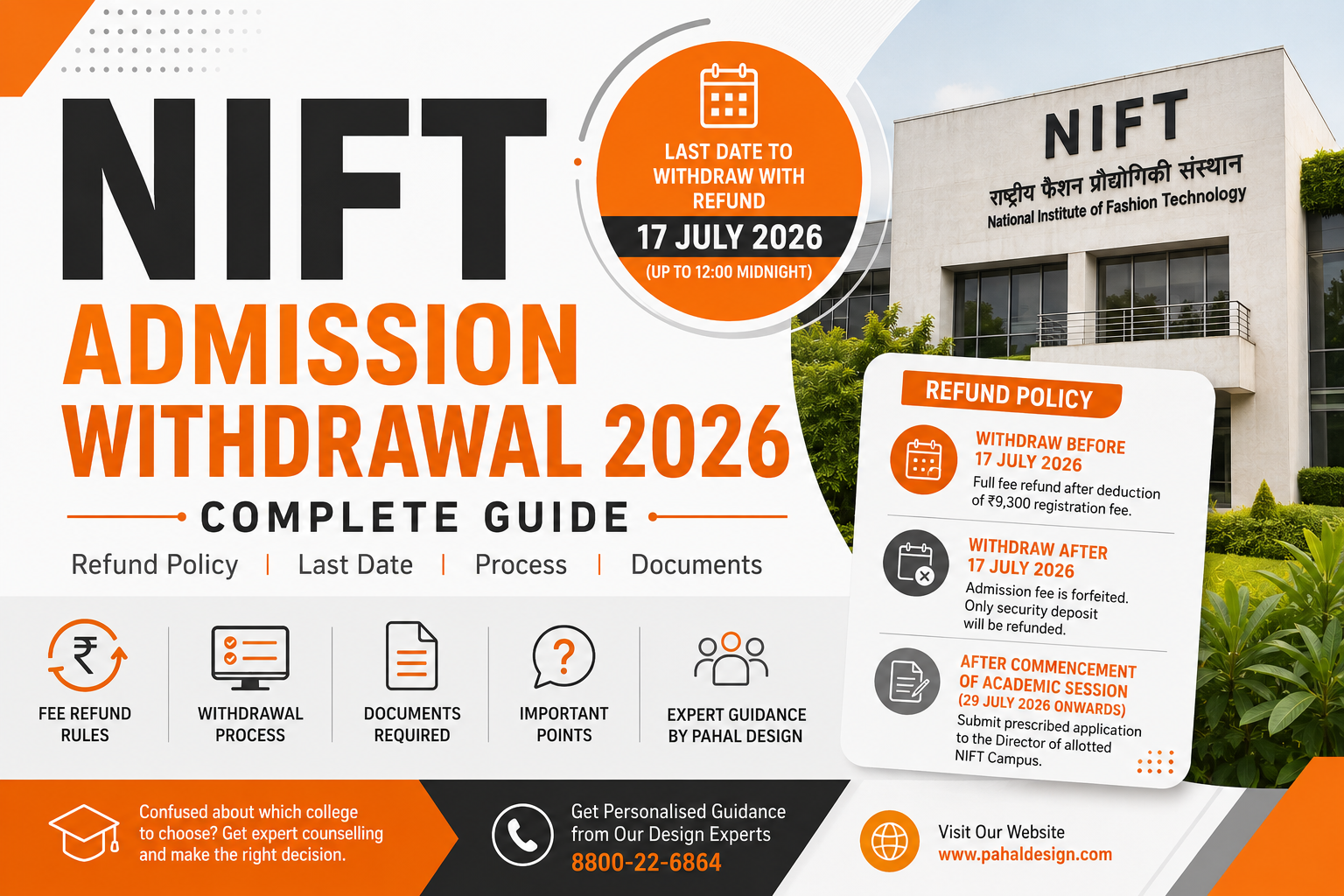
  • Last Date to Withdraw with Fee Refund: 17 July 2026 (up to 12:00 Midnight)
  • Withdrawal after 17 July 2026: Registration fee is forfeited, and refund policies change.
  • Withdrawal after Academic Session Begins (from 29 July 2026 onwards): Candidates must submit a prescribed withdrawal application directly to the Director of their allotted NIFT campus.

NIFT Fee Refund Policy 2026

The refund amount depends on when the withdrawal request is submitted.

1. Withdrawal Before 17 July 2026

Candidates who submit their withdrawal request on or before 17 July 2026 (12:00 Midnight) are eligible for:

  • Full admission fee refund
  • Registration Fee of ₹9,300 will be deducted
  • Remaining fee will be refunded as per NIFT guidelines.

2. Withdrawal After 17 July 2026

If the withdrawal request is submitted after 17 July 2026, then:

  • The admission fee is forfeited.
  • Only the Security Deposit will be refunded.

How to Submit NIFT Admission Withdrawal Request

Candidates should carefully follow the official process.

Before 17 July 2026

  • Login to the NIFT Admission Portal.
  • Submit the withdrawal request online.
  • Offline requests through email or any other mode will not be accepted.

After 29 July 2026

If the academic session has already started:

  • Download and fill the prescribed withdrawal application.
  • Submit it to the Director of your allotted NIFT Campus.
  • Attach all required documents.
  • The refund will be processed according to NIFT rules.

Documents Required for Withdrawal After Session Commencement

Candidates applying after the commencement of classes should keep the following documents ready:

  • Admission Letter
  • Fee Receipt
  • Cancelled Cheque
  • Bank Account Details
  • Identity Details
  • Signed Undertaking Form.

Important Points Every Candidate Should Remember

  • Withdrawal requests should be submitted only through the official procedure.
  • Missing the deadline can significantly reduce your refund amount.
  • Keep copies of all submitted documents.
  • Check your bank account details carefully to avoid refund delays.
  • Read the counselling guidelines thoroughly before withdrawing.

Confused About Whether You Should Withdraw?

Many students receive offers from multiple institutes such as:

  • NIFT
  • NID
  • IIT UCEED
  • CEED
  • Architecture Colleges
  • Private Design Universities

Choosing the right institute depends on your career goals, specialization, fees, campus, placements, and future opportunities.

If you are unsure whether to continue with your NIFT admission or opt for another institute, seek expert guidance before making your final decision.

Get Expert NIFT Counselling Guidance from Pahal Design

At Pahal Design, we have helped thousands of students secure admissions into India’s leading design institutes for over 26 years. Our expert mentors provide personalized counselling to help students make informed decisions about college selection, admissions, and career planning.

We Help Students With:

  • NIFT College Preference Guidance
  • NID vs NIFT Comparison
  • UCEED & CEED Counselling
  • Architecture & Fine Arts Admissions
  • Career Counselling
  • Design Portfolio Guidance
  • Admission Strategy

Why Choose Pahal Design?

  • 26+ Years of Excellence
  • 26,000+ Successful Students
  • Expert Mentors from NIFT & NID
  • India’s Leading Design Entrance Coaching Institute
  • Personalized Career Guidance
  • Pan-India Presence

Contact Pahal Design

Website: www.pahaldesign.com

Helpline: 8800-22-6864

Prepare smarter. Choose the right college with confidence. Let Pahal Design guide you toward a successful design career.

FAQs

Can I withdraw my NIFT admission after seat allotment?

Yes. Candidates can withdraw according to the official NIFT counselling schedule.

What is the last date to withdraw NIFT Admission 2026 with refund?

The last date is 17 July 2026 (up to 12:00 Midnight).

Will I get a full refund?

You will receive a refund after deduction of the registration fee if you withdraw before the deadline.

Can I withdraw through email?

No. Withdrawal requests must be submitted through the official admission process as prescribed by NIFT.


NIFT Placements 2026: Career Opportunities, Top Recruiters & Industry Insights

The National Institute of Fashion Technology (NIFT) continues to strengthen its position as India’s premier fashion and design institution. With an extensive alumni network of over 45,000 professionals, strong industry partnerships, and a future-ready curriculum, NIFT Placements 2026 showcase the growing demand for design, fashion, technology, and management graduates across diverse industries.

At Pahal Design, India’s leading coaching institute for NIFT, NID, UCEED, CEED, and Design Entrance Exams, we bring you a detailed analysis of NIFT Placement 2026 and the exciting career opportunities awaiting aspiring designers.

Why NIFT Continues to Lead Fashion & Design Education

Established in 1986 under the Ministry of Textiles, Government of India, NIFT has emerged as the country’s most prestigious institution for fashion, design, technology, and management education. Today, NIFT operates through 20 campuses across India and offers undergraduate, postgraduate, and doctoral programmes.

Some key advantages of studying at NIFT include:

  • Industry-oriented curriculum
  • On-campus placement opportunities
  • Global industry exposure
  • Strong alumni network
  • Future-ready learning framework
  • Interdisciplinary learning opportunities
  • Industry collaborations and internships

These factors collectively make NIFT graduates highly employable across national and international organizations.

NIFT Placement 2026: Industry Demand at an All-Time High

The fashion, retail, lifestyle, textile, and creative industries are undergoing significant transformation driven by:

  • Artificial Intelligence (AI)
  • Sustainability initiatives
  • Digital transformation
  • Global supply chain expansion
  • E-commerce growth
  • Smart manufacturing technologies
  • Consumer experience design

As a result, companies are actively seeking professionals who combine creativity, technical expertise, business understanding, and design thinking—qualities that NIFT students develop throughout their academic journey.

Programmes Participating in NIFT Placements 2026

Bachelor of Design (B.Des)

  • Fashion Design (FD)
  • Fashion Communication (FC)
  • Textile Design (TD)
  • Accessory Design (AD)
  • Knitwear Design (KD)
  • Leather Design (LD)
  • Fashion Interiors (FI)

Bachelor of Fashion Technology (B.F.Tech)

Master’s Programmes

  • Master of Design (M.Des)
  • Master of Fashion Management (MFM)
  • Master of Fashion Technology (M.F.Tech)

Doctoral Programme

  • Ph.D. in Design and Fashion Studies

All these programmes contribute to the diverse talent pool available during the NIFT Placement Season 2026.

Emerging Skills Driving NIFT Placements

NIFT has continuously upgraded its curriculum to align with industry requirements. Students are exposed to emerging domains such as:

Design & Technology

  • AI-driven Design Tools
  • Virtual Prototyping
  • Augmented Reality (AR)
  • User Experience (UX) Design
  • Design Strategy
  • Smart Textiles
  • Wearable Technology

Fashion & Manufacturing

  • Advanced Apparel Manufacturing
  • Digital Pattern Making
  • 3D Garment Visualization
  • Sustainable Fashion
  • Smart Jewellery
  • Bespoke Menswear
  • Technical Textiles

Business & Analytics

  • Big Data Analytics
  • Fashion Business Analytics
  • Supply Chain Management
  • Retail Strategy
  • Omnichannel Retailing

These industry-relevant skills significantly improve placement outcomes and help graduates become job-ready from day one.

Career Opportunities After NIFT

NIFT graduates are recruited across multiple sectors, including:

Fashion & Apparel

  • Fashion Designer
  • Apparel Designer
  • Textile Designer
  • Fashion Stylist
  • Fashion Consultant

Retail & Lifestyle

  • Retail Manager
  • Visual Merchandiser
  • Brand Manager
  • Buying & Merchandising Professional
  • Luxury Brand Specialist

Technology & Digital Design

  • UX/UI Designer
  • Product Designer
  • Design Strategist
  • Digital Experience Designer

Manufacturing & Supply Chain

  • Production Manager
  • Quality Assurance Specialist
  • Product Development Manager
  • Sourcing Manager

Entrepreneurship

Many NIFT alumni have successfully launched:

  • Fashion Labels
  • Design Studios
  • Sustainable Fashion Startups
  • E-commerce Brands
  • Creative Agencies

Top Recruiters at NIFT Placements

NIFT graduates are highly preferred by:

Fashion & Lifestyle Brands

  • Aditya Birla Fashion & Retail
  • Reliance Retail
  • Arvind Limited
  • Raymond
  • Shahi Exports

Luxury & International Brands

  • H&M
  • Zara
  • Tommy Hilfiger
  • Calvin Klein
  • Lifestyle International

E-commerce Companies

  • Myntra
  • Flipkart
  • Amazon Fashion
  • Ajio

Design & Consulting Firms

  • Deloitte
  • Accenture
  • Design Consulting Studios
  • Creative Agencies

Recruiters appreciate NIFT graduates for their blend of creativity, innovation, business understanding, and technical competence.

NIFT Placement Process 2026

The NIFT placement process typically includes:

  1. Company Registration
  2. Job Profile Announcement
  3. Student Applications
  4. Portfolio Evaluation
  5. Written Assessments
  6. Group Discussions (where applicable)
  7. Personal Interviews
  8. Final Selection

Students also secure Pre-Placement Offers (PPOs) through internships and industry-sponsored projects.

Why NIFT Graduates Stand Out

According to NIFT’s Placement Report 2026, graduates are trained to work in real-world environments through:

  • Industry Projects
  • Internships
  • Graduation Projects
  • Live Design Assignments
  • Cross-disciplinary Learning
  • Industry Exposure Programmes

This practical approach ensures that students can contribute effectively from the very beginning of their careers.

How Pahal Design Helps Students Reach NIFT

Pahal Design has been guiding NIFT aspirants for over 26 years and has produced thousands of successful selections in:

  • NIFT
  • NID
  • UCEED
  • CEED
  • NATA
  • Fine Arts Entrance Exams

Our preparation includes:

  • Creative Ability Test (CAT)
  • General Ability Test (GAT)
  • Studio Test Preparation
  • Portfolio Development
  • Mock Interviews
  • Design Thinking Workshops
  • Mentorship by NIFT/NID Alumni

Conclusion

NIFT Placements 2026 reflect the growing importance of design, innovation, technology, and sustainability in today’s global economy. With strong industry connections, a future-focused curriculum, and excellent placement support, NIFT continues to produce professionals who are shaping the future of fashion, design, retail, and technology.

If your dream is to build a successful career in fashion, design, or creative industries, NIFT remains one of the best pathways to achieve it—and Pahal Design is here to help you secure your seat.

About Pahal Design

Pahal Design is India’s leading design entrance coaching institute with 25+ centres across India, offering expert preparation for:

  • NIFT
  • NID
  • UCEED
  • CEED
  • NATA
  • Fine Arts
  • Design Portfolio Preparation

Website: www.pahaldesign.com
Admissions Helpline: 8800-22-6864

The NIFT Situation Test 2026, scheduled for 26th April 2026, is the final and most crucial step for aspirants aiming to secure admission into the prestigious National Institute of Fashion Technology. While many students clear the written exam, the Situation Test often becomes the make-or-break stage.

This round evaluates your creativity, material handling, time management, and presentation skills. The good news? With the right approach, you can stand out confidently.

Here are proven, practical tips to help you ace the Situation Test.

1. Understand the Theme Clearly

Before touching any material, read the question carefully. Many students lose marks simply because they misinterpret the theme.

Take a minute to:

  • Break down the requirement
  • Visualize your idea
  • Plan your concept mentally

A strong concept always beats random creativity.

2. Master Time Management

You’ll have limited time, so divide it wisely:

  • Planning: 5–10 minutes
  • Execution: 70% of the time
  • Write-up: Last 10–15 minutes

Avoid spending too much time decorating one section while leaving others incomplete.

3. Neatness Matters More Than You Think

Your model should look clean, precise, and well-finished.

  • Avoid visible glue stains
  • Cut materials neatly
  • Ensure proper alignment

Remember, presentation reflects your design discipline.

4. Build a Strong Foundation

A weak base can ruin your entire model.

  • Use corrugated sheets or thick materials for the base
  • Keep heavier elements at the bottom
  • Use lighter materials for upper structures

Stability is key — your model should stand firm without support.

5. Think Beyond Sticking Materials

Creativity is not about how many materials you use, but how you use them.

Try:

  • Folding
  • Weaving
  • Layering
  • Rolling

These techniques add depth and dimension, making your model visually appealing.

6. Play with Texture

Combining materials smartly can elevate your design.

  • Mix OHP sheets with paper
  • Combine rough and smooth textures
  • Add contrast to create visual interest

Texture gives your model a professional and thoughtful look.

7. Avoid Pen Marks on the Model

Never write or draw directly on your model surface.

It:

  • Looks unprofessional
  • Reduces overall neatness
  • Distracts from your design

Keep all explanations strictly for the write-up sheet.

8. Maintain a Clean Workspace

Examiners do observe your working style.

  • Keep your desk organized
  • Remove waste materials
  • Present your final model neatly

A clean workspace reflects clarity of thought and discipline.

9. Use Glue Smartly

Adhesives can make or break your model.

  • Use regular glue for paper
  • Use strong adhesive for heavy materials
  • Apply glue neatly — no excess

Messy sticking can ruin even the best concepts.

10. Write a Clear and Crisp Write-up

Your write-up explains your concept — don’t ignore it.

Keep it:

  • Short and precise
  • Easy to read
  • Structured in points

Include:

  • Concept idea
  • Material usage
  • Design inspiration

Avoid overwriting — clarity wins over complexity.

Final Thoughts

The NIFT Situation Test 2026 is not about perfection — it’s about clarity, creativity, and execution under pressure.

Stay calm, trust your preparation, and focus on:

  • Smart planning
  • Clean execution
  • Strong presentation

If you avoid common mistakes and follow these tips, you’re already ahead of most candidates.

About Pahal Design

At Pahal Design, we specialize in preparing students for NIFT, NID, UCEED, CEED and other design entrance exams with expert guidance, mock tests, and hands-on practice for the Situation Test.

NIFT Situation Test 2026: Complete Preparation Guide

Expert Guidance by PAHAL DESIGN for NIFT B.Des Aspirants

The NIFT Situation Test 2026 is the most crucial stage for students aspiring to secure admission into top design programs at the National Institute of Fashion Technology (NIFT). After clearing CAT & GAT, this final practical round tests your creativity, material handling skills, problem-solving ability, and design thinking. At PAHAL DESIGN, we help students master this stage with expert guidance and real exam simulations.

1. What is the NIFT Situation Test?

The Situation Test is a hands-on model-making exam where students must:

  • ✔ Create a 3D model using given materials
  • ✔ Follow a specific theme or problem statement
  • ✔ Finish within limited time (approx. 2 hours)
  • ✔ Write a concept explanation (write-up)

This test evaluates: Creative thinking, Spatial awareness, Innovation, Neatness & finishing, Material usage, and Concept clarity.

NIFT PAN India Presence

Explore NIFT campuses across India and the 2026 Seat Matrix for your preferred specialization.

2. Expected Question Trends

Based on past patterns, students can expect questions from these categories:

Product Design

Design a trophy for a profession, a utility bag, a toy for children, or a futuristic product.

Space Design

Create a kids play area, a shop display unit, a vendor workspace, or a themed café/stall.

Themes & Social

Focus on Harmony in Chaos, Future Sustainability, Recycling, or Inclusive Design.

3. Previous Years’ Tasks & Materials

Real-style tasks asked in past NIFT tests include:

  • Design a headgear inspired by mythology
  • Create a flower vase inspired by “Storm”
  • Make a toy to teach science to kids
  • Design a park bench for senior citizens
  • Create a badge for “Save Environment – 22nd Century”
  • Design a modern display unit for a perfume store
  • Create a bag for a working mother
Materials Provided Evaluation Criteria
Mount board, Thermocol, Colored sheets ✔ Concept originality & Creativity
Clay, Threads, Straws ✔ Material handling & Neat finishing
Ice-cream sticks, Foil paper ✔ Structural balance & Write-up quality

4. Preparation with PAHAL DESIGN

Our training includes everything you need to ace the challenge:

  • Real Exam Simulations: Time-bound model making practice.
  • Material Handling Workshops: Creative use of simple materials.
  • Concept Development: Converting ideas into strong visual models.
  • Write-up Practice: Learn to explain your concept effectively.
  • Expert Mentorship: Guidance from experienced NIFT mentors.

Practice Questions for 2026:

• Design an eco-friendly fashion display • Create a smart student backpack • Build a sustainable workspace • Design a toy promoting environmental awareness • Create a future wearable accessory.

5. Common Mistakes & Final Tips

❌ Common Mistakes

  • Overcomplicated ideas
  • Poor finishing / Weak structure
  • Ignoring theme / Poor time management
  • Weak write-up

✅ Final Tips

  • Keep your concept simple
  • Focus on finishing
  • Use materials smartly
  • Write a clear concept note

Frequently Asked Questions (FAQs)

Q: Is the NIFT Situation Test compulsory for 2026?
Yes. All shortlisted B.Des candidates must appear for the Situation Test to qualify for final admission.
Q: How important is the write-up?
The write-up is very important. It explains your concept and helps examiners understand your design thinking.
Q: Can I bring my own materials?
No. Only materials provided during the test can be used (basic stationery allowed as per guidelines).

Start Your NIFT 2026 Preparation Today

Join PAHAL DESIGN for 23+ years of experience, expert faculty, and studio-based learning.
Visit Pahal Design for more information.

Description: Are you preparing for the NIFT Situation Test and feeling overwhelmed? 

When it comes to the National Institute of Fashion Technology (NIFT) entrance exam, the Situation Test is a key component that can make or break your chances of getting admission. This test evaluates your creative and problem-solving skills through a series of hands-on tasks. To ensure success, it is imperative to approach this test strategically. Here are some expert tips and techniques to help you master the NIFT Situation Test:

1. Time Management: The Situation Test is time-bound, so it’s essential to manage your time effectively. Plan your tasks wisely and allocate time for each task according to its complexity.

2. Read and Understand: Before diving into the tasks, take a few moments to carefully read and understand the instructions provided. Pay attention to details such as materials provided, theme or concept, and any specific requirements.

3. Brainstorm Ideas: Spend some time brainstorming ideas before starting the tasks. Think creatively and come up with innovative solutions that align with the given theme.

4. Focus on Execution: Once you have a clear idea of your approach, focus on executing the tasks with precision. Pay attention to details, craftsmanship, and presentation to create a visually appealing outcome.

5. Practice Regularly: Practice is key to improving your skills for the Situation Test. Try solving sample tasks, engage in hands-on activities, and refine your techniques to build confidence and expertise.

6. Seek Feedback: Don’t hesitate to seek feedback from mentors, teachers, or peers on your work. Constructive feedback can help you identify areas for improvement and fine-tune your skills.

7. Stay Calm and Confident: Lastly, stay calm and confident throughout the test. Believe in your abilities and trust your creative instincts to deliver a standout performance.

By incorporating these tips and techniques into your preparation strategy, you can maximize your chances of excelling in the NIFT Situation Test. Remember, practice, patience, and perseverance are key to mastering this crucial phase of the NIFT entrance exam. Good luck!

The academic strategy of NIFT embraces a global approach. The core activities of the institute have enhanced its international visibility and standing. NIFT has strategic agreements and partnerships with about 19 leading international fashion institutes & organisations that share the same academic direction, integrating NIFT students with the global mainstream of fashion.

International collaborations allow students to experience ‘study abroad’ options through exchange programmes. This initiative provides an excellent opportunity to NIFT students, selected for the exchange programme, to interact with students from various geographies, encouraging them to broaden their vision and understand different cultures. The opportunity can be undertaken by the students across NIFT campuses and all course disciplines. To provide an academic gradient, the institute’s international linkages allow the students to participate in international competitions / seminars / research / exhibitions and other events.

NIFT students at all campuses are encouraged to participate in international events and competitions.The students have participated and won laurels in several prestigious international competitions like Edinburgh Design Competition, Scotland, World of Wearable Arts, New Zealand, Mittelmoda Premio, World of Wearable Art, New Zealand; Arts of Fashion Foundation USA; Triumph Inspirational awards, IAF Designer Awards in Medellin Colombia; Click! Japan Photo Contest Exhibition, Knitting For Juliet Italy; MAX Design Awards; E.A.T-Exporting Art Together.

The institute also attracts international students who come and experience its academic and cultural richness. Through the exchange programmes, students from overseas institutes have developed valuable insight not just into Indian culture, arts & crafts but have also understood the Indian market and its dynamics. The students of Management & Technology have had invaluable exposure to production techniques that cater to high fashion demands of the global marketplace.

The strategic alliances encourage academic enhancement at faculty level as well. Faculty exchange and joint research initiatives ensure that the institute’s teaching methods and facilities are constantly updated & upgraded to be at par with the best institutes in the world. To facilitate exchange of teaching pedagogy, concepts and professional ideas, the faculty at NIFT participates in academic exchange programmes, international fairs, seminars, exhibitions, conferences and trade shows thereby bringing their substantial experience to the classroom thus enriching the knowledge pool at NIFT.

DUAL DEGREE OPPORTUNITY

NIFT had entered into a strategic alliance with Fashion Institute of Technology (FIT), New York, USA. The partnership encompasses a landmark achievement and first of its kind at NIFT. This new international dimension allows select meritorious students from NIFT, the unique opportunity to obtain a Dual Degree from both NIFT and FIT. Students from NIFT undertake two years study at the home institute intercepted by one year of study at FIT. Thereafter, the students resume their studies at NIFT to obtain the Dual Degree from both the institutes. 44 students have been selected by FIT, USA for undertaking the one year AAS programme as part of dual degree from August 2023 to June 2024.

Some of the key international linkages of NIFT:

S no. International Universities Area
1 The Fashion Institute of Technology (FIT)                                                 USA
2 Nuova Accademia di Belle Arti (NABA) Italy
3 Ecole Nationale Superieure des Arts et Industries Textiles (ENSAIT) France
4 Schweizerische Textil fachschule STF Switzerland
5 KEA- Copenhagen School of Design and Technology Denmark
6 EnaMoma France
7 Politecnico di Milano (PDM) Italy
8 Saxion University of Applied Sciences Netherlands
9 Queensland University of Technology (QUT) Australia
10 Royal Melbourne Institute of Technology (RMIT) Australia
11 BGMEA University of Fashion & Technology (BUFT) Bangladesh
12 Namuna College of Fashion Technology (NCFT) Nepal
13 Arts University Bournemouth UK
14 Nordic Centre in India Secretariat at Tampere University Finland
15 University of Boras Sweden
16 Whitecliffe College of Arts and Design New Zealand
17 Massey University New Zealand

NIFT has annual membership of the following organisations:

1 Annual Membership of International Foundation of Fashion Technology Institutes (IFFTI), A global network of International Fashion and Textile Institutes
2 Annual Membership of Cumulus, International Association of Universities and Colleges of Art, Design and Media

The financial strategy of the institute places student development as a key priority. A considerable sum from NIFT Development Fund is effectively put to use in this core area every year. To maximize the potential of its students, the institute’s Means-cum-Merit Financial Assistance scheme allows students from humble backgrounds to avail subsidized tuition fee at every Campus. Determined by the parental income, students can fall into three slabs of monetary assistance. Many students in the past have benefited from this scheme. Further, many leading organisations from the apparel sector have come forward to encourage NIFT students in their academic and creative quest. Pioneers in the related field have instituted awards & scholarships namely ITC, HomeShop 18 etc. to recognize and compliment academic brilliance. This provides motivation to the students, from their first year of study.

Address:- G-13, Ground Floor, Hauz Khas, New Delhi-110016
Nearest Metro Station Hauz Khas Gate No-3, Mayfair Garden / RBI Colony
Landmark:
Opposite Joups
Contact No: 8800-22-6864
Contact Person: Karishma Gupta
Email: corporate@pahaldesign.com

SEAT Matrix 2025

Factors Influencing Cutoffs:

Several elements impact the determination of NIFT cutoffs each year:

Seat Intake: The total number of seats available for a particular program at a campus.

Number of Applicants: Higher competition can lead to higher cutoffs.

Program Popularity: More sought-after courses may have stricter cutoffs.

Difficulty Level of Entrance Exam: Challenging exams might result in lower scores, affecting rank distributions.

Accessing Official Cutoffs:

Candidates are advised to regularly check the official NIFT website for the most accurate and updated cutoff information. The cutoffs are typically released after the declaration of results and are available in the form of opening and closing ranks for each program and campus.

Conclusion:

Aspiring NIFT candidates should aim for high scores to secure favorable ranks, increasing their chances of admission into desired programs and campuses. Staying informed about previous years’ trends and understanding the factors influencing cutoffs can provide valuable insights during preparation.

  1. Cut off Merit Ranks-2024

  2. Cut off Merit Ranks – 2023

  3. Cut off Merit Ranks-2022

  4. Cut off Merit Ranks-2021

  5. Cut off Merit Ranks-2020

Set up in 1986, NIFT is the pioneering institute of fashion education in the country and has been in the vanguard of providing professional human resource to the textile and apparel industry. It was made a statutory institute in 2006 by an Act of the Indian Parliament with the President of India as ‘Visitor’ and has full fledged campuses all across the country. Over the years NIFT has also been working as a knowledge service provider to the Union and State governments in the area of design development and positioning of handlooms and handicrafts.

The Degrees awarded by the Institute are recognised worldwide. The Institute confers Degrees to the graduates in the Convocation Ceremony marking the occasion.

NIFT had entered into a strategic alliance with Fashion Institute of Technology (FIT), New York, USA. The partnership encompasses a landmark achievement and first of its kind at NIFT. This new international dimension allows select meritorious students from NIFT, the unique opportunity to obtain a Dual Degree from both NIFT and FIT. Students from NIFT undertake two years study at the home institute intercepted by one year of study at FIT. Thereafter, the students resume their studies at NIFT to obtain the Dual Degree from both the institutes. 44 students have been selected by FIT, USA for undertaking the one year AAS programme as part of dual degree from August 2023 to June 2024.

Hauz Khas (Corporate Office)
Address:- G-13, Ground Floor, Hauz Khas, New Delhi-110016
Nearest Metro Station Hauz Khas Gate No-3, Mayfair Garden / RBI Colony
Landmark:
Opposite Joups
Contact No: 8800-22-6864
Contact Person: Karishma Gupta
Email: corporate@pahaldesign.com

NIFT (B.Des)

4,000.00

Total Booklets

  1.  Quantitative Ability – 7 Booklets
  2.  Verbal & Analytical Ability – 4 Booklets
  3.  Communication Ability & English Comprehension – 2 Booklets
  4. General Knowledge and Current Affairs – Monthly
  5. Creative Booklet – 5 (1 Booklet in Hard Copy and 4 Booklets on LMS )
  6. Online Portal Access – 24 x 7 
  7. NIFT B.Des Previous Year Question Papers – The last 5 years’ original exam papers will be available over LMS.
  8. 5 Mock Tests as per the new Exam Pattern will be available over LMS.
  9. Monthly Tests will be available over LMS.
  10. NIFT Guide Book. 

Key Features of DLP by Pahal Design

  1. Study Material as per new exam pattern
  2. Detailed analysis
  3. Prepared by Expert faculties
  4. Easy to understand
  5. Time savvy
  6. Interactive student LMS
  7. Learn at your own pace
  8. Mock Test Series

S.N. Course Subjects Study Materials Description
1. NIFT (B.Des)  Quantitative Ability Booklet – 1 Booklet – 2 Booklet – 3 Booklet – 4 Booklet – 5 Booklet – 6 Booklet – 7 Quantitative Ability 7 booklets have various categories that deal with all important topics with concept, explanation, practice exercises, and Model Test Papers. It has important tips and tricks which facilitate students to increase the solving speed in a superior way.
  Verbal & Analytical Ability Booklet – 1 Booklet – 2 Booklet – 3 Booklet – 4 These 4 booklets include all topics of analytical reasoning which help students to identify key information, apply logic and find patterns.
Communication Ability & English Comprehension Booklet – 1 Booklet – 2 This section is very important for NIFT B.des exam. Booklet 1 & 2 will cover all the topics with intensive practice exercises.
General Knowledge and Current Affairs Monthly Wise The GK and CA are made by experts on latest NIFT exam pattern. Monthly booklet will be shared with the students which will have all important events, facts and happenings in the country and across the globe. It also has exclusive series of fashion and business news. Available on LMS.
  Creative Workbook – 1 Workbook – 2 Workbook – 3 Workbook – 4 Workbook – 5 Workbooks 1 and 3 will be available in hard copy. workbooks 2, 4 and 5 will be available over LMS.
NIFT B.Des Previous Year Question Papers   The last 5 years original exam papers will be available over LMS.

2. Test Series (A) Monthly Test: The monthly test enables students to track their progress in most efficient way and pay attention to the section required. (B) Mock Test: It’s mandatory for all students to attempt mock test after competition of syllabus. The student can appear the mock test online. Each mock test will give you complete performance analysis, All India Ranking, practice to updated exam pattern, and section-wise performance report.

3. Doubt clearance & Feedback sessions: Students can attend doubt clearance sessions with our expert by booking their slot at nearest Pahal design centre or choose online mode for same.

4. Digital Learning Program (DLP): Access to digital learning platform which has complete learning solution for the students . The Platform will enable students to avail video lectures , Quiz practice sessions, any time access to practice sets and tests with more than 3000+ questions. The student will be allotted with unique User Id and Password for their DLP account which they login from pahal.design/login/index.php.

5. Expert Team: Each student will get expert guidance for design career and will be assisted to explore their course interest. The team will also analyse and review the student’s performance and help them to improve their performance.

6. Preparation for other colleges: Students can get connect to us for the design college counseling or inform us regarding the colleges they are applying for and Pahal Design Team will provide complete guidance according to the updated exam pattern.

7. Situation Test Kit: The Pahal Design study material includes the preparation for the Nift second phase as well. Once student gets the result for NIFT first-round exam, the Situation Test kit gets delivered at his/her doorstep.

Features of Situation Test Kit
Situation Test  Kit * Situation Test Hand Book * Video for step-by-step preparation * Access to LIVE classes *Access to classroom sessions. * E-book on creative write-up guidance * Last 15 years of exam papers * Material kit * Practice Set * Mock Test * Feedback and doubt clearance session.

Pahal Design Hauz Khas is now at better location with great infrastructure. The new address for Centre is G-13, G Block Hauz Khas, New Delhi-110016 at Ground Floor. 

Pahal Design Hauz Khas centre is just 5 minutes away from Hauz Khas Metro Station. Hauz Khas centre is 500m from NIFT, Delhi Campus. Pahal Design offering coaching classes for NIFT Undergraduate and Post Graduate Coaching Classes.

NIFT Undergraduate Courses for Coaching Classes:

  1. B Design
  2. B Ftech
  3. NIFT Situation test

NIFT Postgraduate Courses for Coaching Classes:

  1. MFM
  2. M Des
  3. M Ftech
  4. Personal Interview

If you are looking for any Further guidance you can reach us at 8800-22-6864. 

G-13, Ground Floor, Hauz Khas, G Block New Delhi – 16


NIFT Admissions 2024

Frequently Asked Questions

  1. Is NIFT Degree recognized?

Yes. NIFT has been granted statutory status under the Act of Parliament of India in 2006, empowering the Institute to award degrees and other academic distinctions. NIFT is also a member of the Association of Indian Universities (AIU).

2. What is the Admission Schedule?

The admissions schedule for Admissions- 2024 is available on NIFT website/ Portal. www.nift.ac.in `

3. When are NIFT Admissions announced?

Admission to various programmes of NIFT is announced in the month of November / December every year. The admission announcements are widely publicized through National, regional print media, social media platforms and NIFT web site www.nift.ac.in

Q.4. What are the programmes offered by NIFT?

The programmes to be offered by NIFT are as given below :

  1. Bachelor of Fashion Design

     2. Bachelor of Fashion Technology

  1. Masters of Design (M.Des.)
  2. Masters of Fashion Management (M.F.M)
  3. Masters of Fashion Technology (M.F.Tech.)
  4. Ph.D

Q 5. What is the Minimum Age required for Undergraduate & Post Graduate course

Maximum age of the applicant should be less than 24 years as on 1st August of the year of admission for Undergraduate Programmes. The upper age limit may be relaxed by a period of 5 years for candidates of SC/ST/PWD categories.

There is no age limit for Postgraduate programmes.

Q.6  What are the Eligibility criteria for admission?

Kindly refer Prospectus (available on NIFT website ( www.nift.ac.in ) for Programme wise eligibility criteria.

Q.7  How can I get a prospectus?

The prospectus is available on NIFT website under the Admissions Tab ( www.nift.ac.in ).

Q.8 Can I apply manually?

No, candidates can only apply online through admission portal available on NIFT Website ( www.nift.ac.in ).Q.8  How do I pay the fees? What is the mode of payment when applying online?

Payments of application fees can only be paid online through payment gateway. The link is provided on the admission portal.

Q.9  What is an auto generated Application Number?

Once the application form is filled by an applicant, an application number will be generated ,which will be communicated to the candidate.

Q.10 WhatifIforgettotakeprintoutofOnlineApplicationformaftersubmission?

Candidate can take the print out of their Application form again after logging into the admission portal.

Q.11 Howmanycoursescanbeselected?

For undergraduate programme, the applicant is able to enroll for all B Des and B F Tech Programmes.

Candidates applying for B.F.Tech Programme (with Physics and Maths), will be eligible to enroll their candidature for B.Des courses.

The Candidates appearing for Post Graduate Programme can only apply for ONE post graduate programme.

Q. 12 How would I verify my payment?

Once the application form along with the requisite fees is submitted by the candidate, the confirmation of the same will be sent to the candidates directly through registered E mail.

Q. 13 Do you have the reservation of Seats for SC/ST?

Yes, it is as applicable as per the Government of India norms. Details can be seen in the Prospectus.

The National Institute Fashion Technology (NIFT) has been fulfilling its mission to offer a learning experience of the highest standards in fashion pertaining to design, technology and management, for the last more than three decades. We encourage remarkably creative students to draw inspiration from India’s textiles and crafts, while focusing on emerging global trends relevant to the fashion, textiles and accessories industries.


Schedule a free counselling session WhatsApp WhatsApp