Top 20 Design Colleges in India 2026–27: Courses, Entrance Exams & Admission Guide

Choosing the right design college is one of the most important decisions for students planning a career in Product Design, Fashion Design, Communication Design, UX/UI Design, Animation, Interior Design, Transportation Design or other creative fields.

India has several prestigious government and private design institutes. Some institutions admit students through highly competitive entrance examinations such as NID DAT, UCEED and NIFT, while private universities may conduct their own design aptitude tests, portfolio reviews and interviews.

In this guide, Pahal Design presents a carefully curated list of the Top Design Colleges in India for 2026–27 to help students and parents understand their options.

Note: The list below is an editorial guide based on factors such as academic reputation, design ecosystem, industry exposure, entrance competitiveness, programmes and student opportunities. It should not be interpreted as an official Government of India ranking.

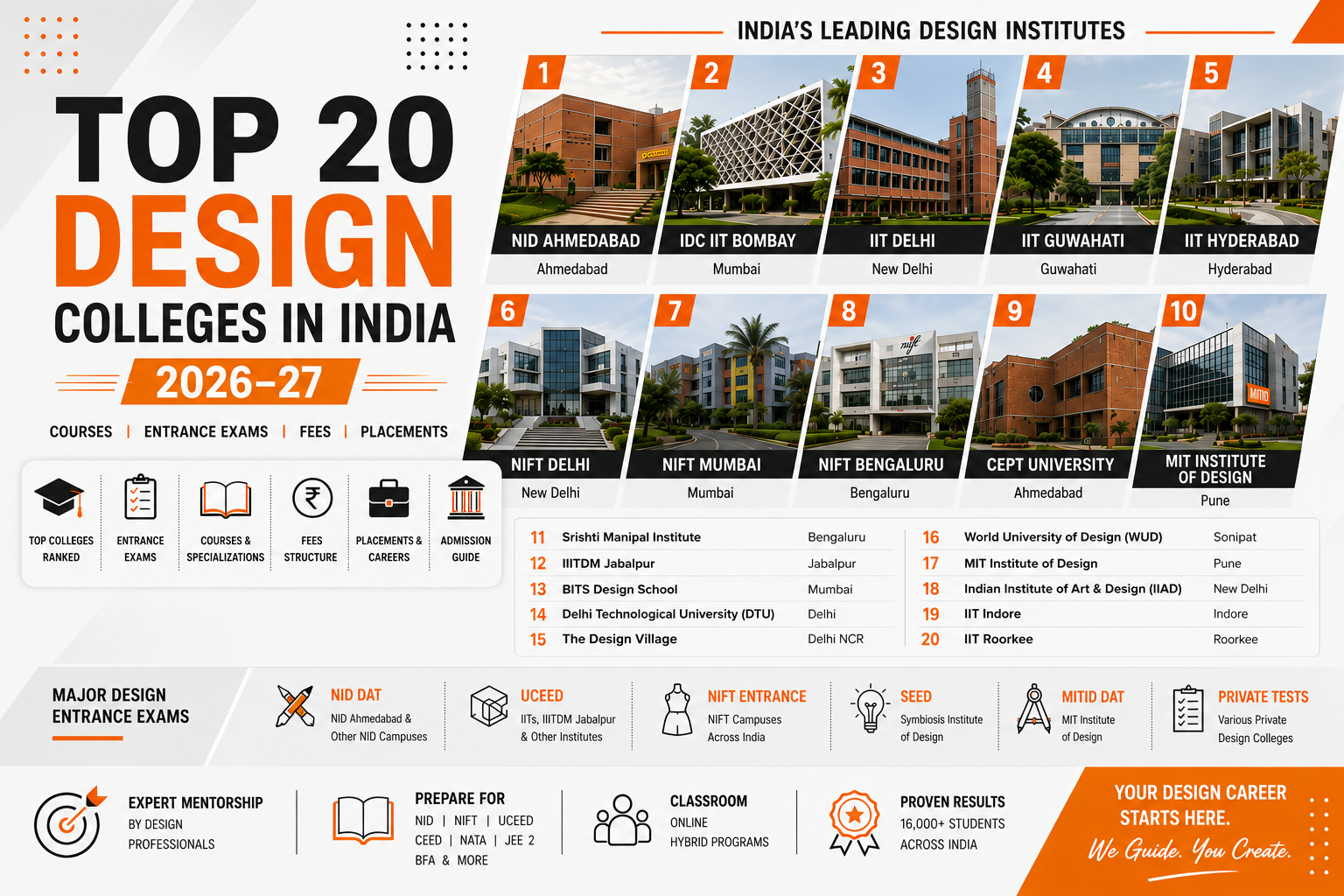
Top 20 Design Colleges in India 2026–27

RankDesign InstituteLocationMajor Entrance Route
1National Institute of Design (NID)AhmedabadNID DAT
2IDC School of Design, IIT BombayMumbaiUCEED
3Department of Design, IIT DelhiNew DelhiUCEED
4Department of Design, IIT GuwahatiGuwahatiUCEED
5Department of Design, IIT HyderabadHyderabadUCEED
6National Institute of Fashion Technology (NIFT) DelhiNew DelhiNIFT Entrance
7National Institute of Fashion Technology (NIFT) MumbaiMumbaiNIFT Entrance
8National Institute of Fashion Technology (NIFT) BengaluruBengaluruNIFT Entrance
9CEPT UniversityAhmedabadUCEED
10MIT Institute of Design, ADTPuneMITID DAT
11Srishti Manipal Institute of Art, Design and TechnologyBengaluruInstitute Admission Process
12IIITDM JabalpurJabalpurUCEED
13BITS Design SchoolMumbaiInstitute Admission Process
14Delhi Technological University (DTU)DelhiUniversity-prescribed route
15IIAD – Indian Institute of Art & Design, UDIT UniversityGurugramIIAD Admission Process
16The Design VillageDelhi NCRInstitute Admission Process
17World University of DesignSonipatInstitute Admission Process


For 2026, the official UCEED joint B.Des admission process includes IIT Bombay, IIT Delhi, IIT Guwahati, IIT Hyderabad, IIT Indore, IIT Roorkee and IIITDM Jabalpur as participating institutes. Students should therefore check the latest admission information before finalising their preference order.

1. National Institute of Design (NID), Ahmedabad

NID Ahmedabad is widely regarded as one of India’s premier institutions for design education.

The institute is particularly well known for its multidisciplinary and studio-based approach to design education.

Popular Design Disciplines

  • Product Design
  • Graphic Design
  • Animation Film Design
  • Film & Video Communication
  • Exhibition Design
  • Furniture & Interior Design
  • Textile Design
  • Ceramic & Glass Design

Entrance Exam: NID Design Aptitude Test (NID DAT)

For the 2026–27 admission cycle, NID’s official admission portal lists B.Des admissions at NID Ahmedabad as well as NID Andhra Pradesh, Haryana, Madhya Pradesh and Assam.

Why Choose NID?

NID is an excellent option for students seeking intensive design education with strong emphasis on creativity, problem solving, observation, visualisation and hands-on studio learning.

2. IDC School of Design, IIT Bombay

IDC School of Design at IIT Bombay is among India’s most prestigious destinations for students interested in design, technology and innovation.

Entrance Exam: UCEED

Best Suited For

Product Design, Interaction Design, Communication Design, UX/UI and technology-oriented design careers.

The combination of IIT Bombay’s technology ecosystem and IDC’s design environment makes it especially attractive for students interested in solving complex problems through design.

3. Department of Design, IIT Delhi

IIT Delhi is an increasingly important destination for undergraduate design aspirants.

Entrance Exam: UCEED

Its location in India’s capital and strong interdisciplinary environment make it an attractive option for students interested in the intersection of design, technology, innovation and entrepreneurship.

4. Department of Design, IIT Guwahati

IIT Guwahati has an established Department of Design and is one of the major institutes participating in UCEED B.Des admissions.

Entrance Exam: UCEED

Students interested in product, interaction and communication-oriented design should consider IIT Guwahati among their leading choices.

5. Department of Design, IIT Hyderabad

The Department of Design at IIT Hyderabad offers B.Des admission through UCEED.

According to its official 2026 admission information, students from Science, Commerce, Arts and Humanitiesbackgrounds can apply subject to UCEED eligibility requirements.

Entrance Exam: UCEED

This makes IIT Hyderabad an attractive choice for students seeking an interdisciplinary design education in a technology-focused environment.

6. NIFT Delhi

For students whose primary interest is Fashion Design and the fashion industry, NIFT Delhi remains one of India’s most sought-after destinations.

Entrance: NIFT Entrance Examination

Popular Areas

  • Fashion Design
  • Fashion Communication
  • Textile Design
  • Accessory Design
  • Knitwear Design
  • Leather Design

Students interested primarily in fashion should evaluate NIFT separately from product and technology-focused institutes such as IITs and NID.

7. NIFT Mumbai

NIFT Mumbai is another highly sought-after NIFT campus, particularly because of its location in one of India’s largest fashion, media and entertainment hubs.

Entrance: NIFT Entrance Examination

It can be an excellent choice for students interested in fashion, communication, styling, lifestyle and related creative industries.

8. NIFT Bengaluru

NIFT Bengaluru combines NIFT’s established fashion education ecosystem with Bengaluru’s growing technology, startup and creative industries.

Entrance: NIFT Entrance Examination

It is especially worth considering for students looking at fashion and communication-related design careers.

9. CEPT University, Ahmedabad

CEPT University offers a distinctive Bachelor’s in Design (Honours) programme.

For the 2026–27 academic year, CEPT states that admission to its Bachelor’s in Design programme uses a qualified UCEED score.

CEPT describes its programme as a studio-oriented design education with emphasis on human-centred thinking, systems awareness, critical reflection and professional practice.

Entrance Route: UCEED

Best For: Students interested in multidisciplinary design and an environment closely connected with architecture, planning and the built environment.

10. MIT Institute of Design, Pune

MIT Institute of Design is one of the established private design institutes considered by students preparing for NID, UCEED and other design entrances.

Entrance: MITID DAT / institute selection process

Students can explore disciplines across industrial, communication and other specialised areas of design.

11. Srishti Manipal Institute, Bengaluru

Srishti Manipal Institute of Art, Design and Technology is known for an experimental and interdisciplinary approach to art and design education.

It can be particularly attractive to students interested in contemporary, creative and multidisciplinary practices.

12. IIITDM Jabalpur

The Design Discipline at IIITDM Jabalpur is part of the official UCEED 2026 joint B.Des admission process.

Entrance Exam: UCEED

It is particularly relevant for students interested in the intersection of design, engineering, manufacturing and technology.

13. BITS Design School

BITS Design School is an emerging option backed by the BITS Pilani ecosystem.

It offers a four-year Bachelor of Design (Honours) programme and is worth considering for students looking for a modern interdisciplinary design environment.

For UCEED 2026, BITS Design School is listed as a UCEED result-sharing institute, rather than an institute participating in IIT Bombay’s joint B.Des admission process.

14. Delhi Technological University – DTU

DTU is another option for students interested in studying design within a major technology university.

Students should check DTU’s current admission notification carefully for programme availability, eligibility, entrance criteria, Delhi-region reservation rules where applicable, and seat availability.

15. The Design Village – Delhi NCR

The Design Village is a specialised design institution located in Delhi NCR.

Its curriculum and learning environment make it an option for students interested in contemporary and interdisciplinary design education.

16. World University of Design – WUD

World University of Design in Sonipat offers undergraduate programmes across multiple creative disciplines.

Students can explore programmes related to product, communication, fashion, interior and other design areas depending on current offerings.

17. IIAD – Indian Institute of Art & Design- UDIT University

IIAD in New Delhi is another private option for students interested in contemporary design education.

Students should evaluate the current programme structure, academic affiliation/qualification, specialisation, fees and admission requirements directly before applying.

New IIT Options Through UCEED 2026

The design-college landscape is expanding.

For the 2026 B.Des admission cycle, the official UCEED participating institutes are:

  1. IIT Bombay
  2. IIT Delhi
  3. IIT Guwahati
  4. IIT Hyderabad
  5. IIT Indore
  6. IIT Roorkee
  7. IIITDM Jabalpur

This is particularly important for students preparing for UCEED 2027, because their college preference list should not be based only on the older four-IIT structure.

Which Is the Best Design College in India?

There is no single college that is best for every design specialisation.

For Core & Multidisciplinary Design

NID Ahmedabad is one of the strongest choices.

For Product Design + Technology

IDC IIT Bombay should be among the first preferences.

For UX/UI & Interaction Design

Consider IIT Bombay, IIT Delhi, IIT Guwahati, IIT Hyderabad and NID, depending on programme structure and career interests.

For Fashion Design

NIFT Delhi should be among the first choices, followed by other leading NIFT campuses depending on the preferred specialisation.

For Design + Built Environment

CEPT University Ahmedabad deserves serious consideration.

For Private Design Colleges

Students can compare MIT Institute of Design, Srishti Manipal, BITS Design School, Symbiosis Institute of Design, UID, IIAD, The Design Village and World University of Design according to specialisation, fees, curriculum and career objectives.

Major Design Entrance Exams in India

Students targeting the best design colleges should understand that there is no single entrance examination covering every institution.

Entrance ExamMajor Institutes
NID DATNID Ahmedabad and other NID campuses
UCEEDIIT Bombay, IIT Delhi, IIT Guwahati, IIT Hyderabad, IIT Indore, IIT Roorkee, IIITDM Jabalpur + result-sharing institutes
NIFT EntranceNIFT campuses
WUDWUD DAT
MITID DATMIT Institute of Design


How to Choose the Right Design College

Do not select a design college only because of its overall popularity.

Students and parents should compare:

  1. Preferred Design Specialisation – Product, UX/UI, Fashion, Communication, Animation, Interior, Transportation etc.
  2. Faculty & Studio Infrastructure
  3. Industry Exposure
  4. Internship Opportunities
  5. Alumni Network
  6. Portfolio Development
  7. Campus Environment
  8. Fees and Overall Cost
  9. Scholarships
  10. Placement and Career Opportunities
  11. Degree/Qualification Awarded
  12. Location and Industry Ecosystem

A college that is excellent for Fashion Design may not necessarily be the best choice for Product Design or UX/UI.

How to Prepare for NID, NIFT & UCEED

Admission to India’s leading design colleges is highly competitive. Students should develop both their creative ability and problem-solving skills.

Preparation should include:

  • Observation and visualisation
  • Creative thinking
  • Design aptitude
  • Drawing and sketching
  • Perspective drawing
  • Human figures
  • Storytelling
  • Composition
  • Colour understanding
  • Logical and analytical reasoning
  • Design awareness
  • General awareness
  • Problem solving
  • Portfolio development where required
  • Studio-test preparation
  • Mock tests and previous-year papers

Starting early allows students to develop these skills gradually rather than relying only on last-minute preparation.

Prepare for India’s Top Design Colleges with Pahal Design

Pahal Design prepares students for India’s major Design, Fashion, Fine Arts and Architecture entrance examinations, including:

NID | NIFT | UCEED | CEED | NATA | JEE Paper 2 | BFA

Students receive structured preparation for aptitude tests, drawing, creative ability, design thinking, studio tests, portfolios and interview preparation depending on the entrance examination.

Pahal Design offers Classroom, Online and Hybrid preparation, helping students prepare for multiple design entrances through an integrated strategy.

Students targeting the 2027 and 2028 design entrance examinations should start building their creative and aptitude skills well in advance.

Frequently Asked Questions

Which is the No. 1 design college in India?

NID Ahmedabad and IDC School of Design at IIT Bombay are both among India’s most prestigious design institutions. The better choice depends on the student’s intended specialisation and learning preferences.

Is NID better than NIFT?

They serve different design interests. NID has a strong multidisciplinary design focus, whereas NIFT is particularly renowned for fashion and allied disciplines. Students interested in Fashion Design may prefer NIFT, while students interested in Product, Communication and other multidisciplinary design fields may prioritise NID.

Is IIT Bombay good for design?

Yes. IDC School of Design at IIT Bombay is one of India’s leading design schools and B.Des admission is through UCEED.

Which IITs offer B.Des through UCEED?

For the 2026 joint admission process, the participating institutions include IIT Bombay, IIT Delhi, IIT Guwahati, IIT Hyderabad, IIT Indore, IIT Roorkee and IIITDM Jabalpur.

Can Arts and Commerce students appear for UCEED?

UCEED is open to students from different academic streams subject to the examination’s eligibility rules. However, institute-level admission eligibility can vary, so students must check the requirements of each participating institute for the relevant admission year.

Which entrance exams should a design aspirant prepare for?

Students seeking the widest range of opportunities should consider preparing for NID DAT, UCEED and NIFT, along with selected private-college examinations according to their target list.
 

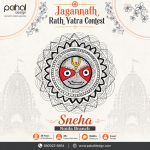
Jagannath Rath Yatra Art Competition at Pahal Design: Celebrating Creativity Through Indian Heritage

Every festival tells a story, and every artwork preserves that story for generations. At Pahal Design, creativity meets culture through engaging art competitions that inspire students to explore India’s rich artistic traditions.

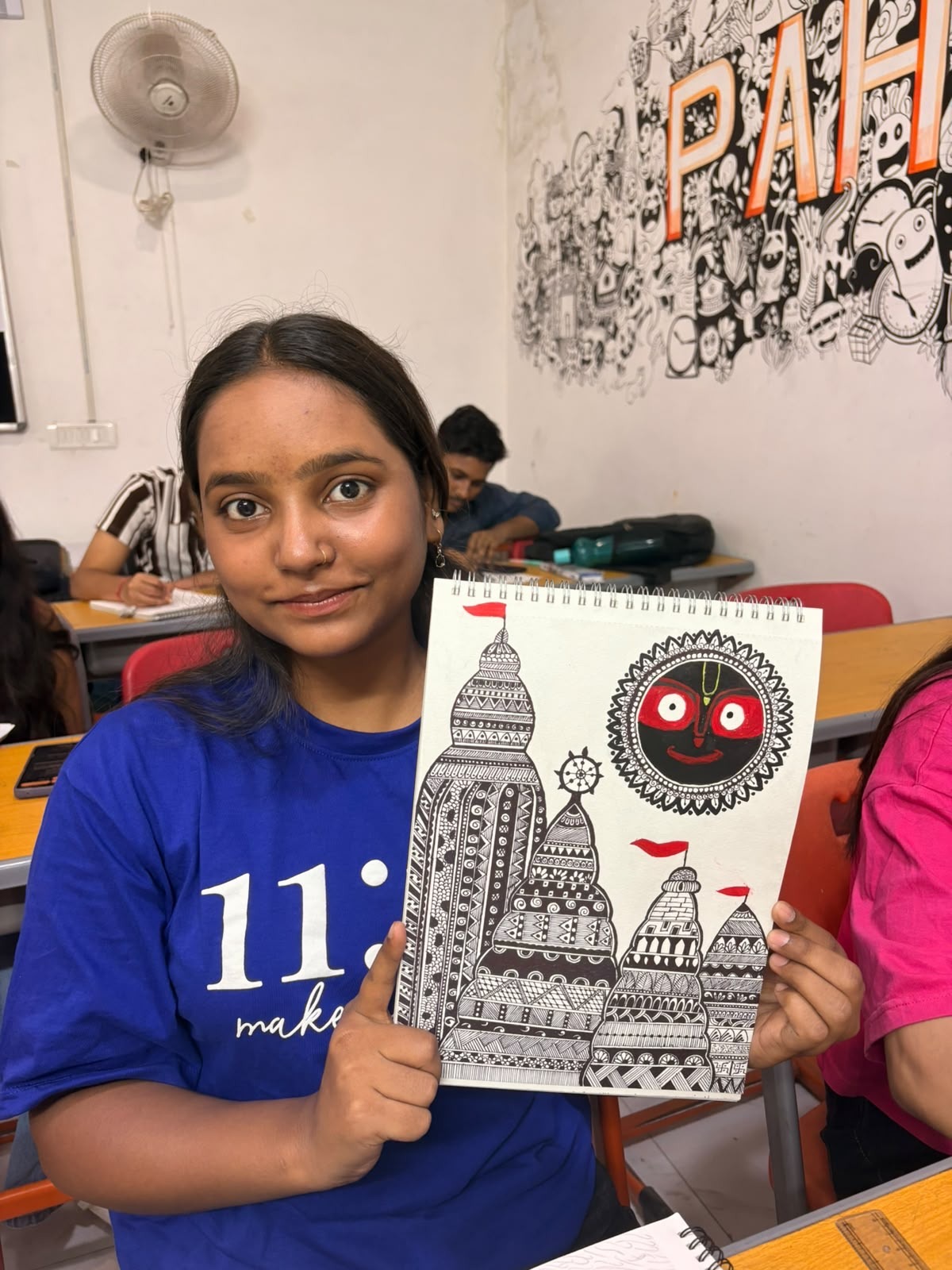
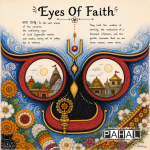
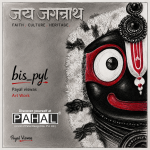
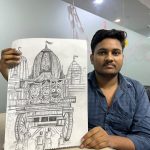
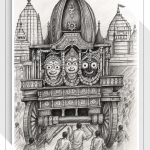
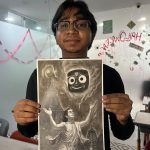
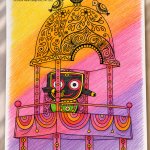
This year, our Jagannath Rath Yatra Art Competition witnessed exceptional participation from students across multiple branches. Young artists beautifully interpreted the spirit of Lord Jagannath, the magnificent Rath Yatra, temple architecture, folk motifs, and Odisha’s cultural heritage through sketches, illustrations, pen art, watercolor, mixed media, and digital compositions.

Why Jagannath Rath Yatra Inspires Artists

Jagannath Rath Yatra is one of India’s most celebrated spiritual festivals. The iconic chariots, vibrant colors, temple architecture, symbolic eyes of Lord Jagannath, traditional ornaments, and festive atmosphere provide endless inspiration for artists.

For design aspirants preparing for NID, NIFT, UCEED, CEED, NATA, and BFA, cultural themes like these help strengthen:

  • Observation skills
  • Concept development
  • Storytelling through design
  • Composition and balance
  • Line work and detailing
  • Colour harmony
  • Visual communication
  • Portfolio quality

Student Creativity on Display

The competition showcased remarkable diversity in artistic expression.

Students explored themes including:

  • Lord Jagannath portrait illustrations
  • Jagannath Temple architecture
  • Rath Yatra procession
  • Mandala-inspired compositions
  • Traditional Odisha folk patterns
  • Mixed media illustrations
  • Fine line pen artwork
  • Watercolour paintings
  • Colour pencil illustrations
  • Conceptual storytelling
  • Contemporary interpretations of Indian heritage

Every artwork reflected originality, patience, and a strong understanding of design fundamentals.

Learning Beyond the Classroom

At Pahal Design, competitions are not just about winning—they are about learning.

Students gain valuable experience in:

  • Creative thinking
  • Time management
  • Visual presentation
  • Portfolio enhancement
  • Theme-based ideation
  • Artistic confidence
  • Design problem solving

These activities prepare students for entrance examinations and future careers in design, architecture, fine arts, animation, illustration, fashion, communication design, and product design.

Why Cultural Art Competitions Matter

Modern designers are expected to create meaningful work rooted in culture and storytelling.

By participating in heritage-based competitions, students learn to:

  • Research historical references
  • Translate culture into visual language
  • Build stronger portfolios
  • Improve artistic discipline
  • Experiment with various media
  • Develop unique design identities

This creative exposure gives students an advantage during design entrance exams and interviews.

Join India’s Leading Design Coaching Institute

For over 26 years, Pahal Design has been helping students achieve success in India’s top design and architecture entrance examinations.

We offer expert coaching for:

  • NID
  • NIFT
  • UCEED
  • CEED
  • NATA
  • JEE Paper 2 (B.Arch)
  • BFA Entrance
  • Fine Arts
  • Portfolio Preparation
  • Studio Practice
  • Creative Workshops

Our experienced faculty encourages students to develop technical skills while nurturing creativity through regular workshops, competitions, live projects, and portfolio-building activities.

Conclusion

The Jagannath Rath Yatra Art Competition beautifully showcased how tradition and creativity can come together to inspire the next generation of designers. Every artwork reflected imagination, dedication, and artistic excellence.

At Pahal Design, we believe that great designers are created through continuous practice, cultural appreciation, and creative exploration. We congratulate every participant for their outstanding effort and look forward to many more inspiring artistic journeys.

How to Crack NIFT 2027 Exam: Complete Preparation Strategy, Exam Pattern, Syllabus & Weightage

Preparing for the NIFT 2027 Entrance Exam is an exciting journey for aspiring designers. Every year, thousands of students compete for admission to the prestigious National Institute of Fashion Technology (NIFT), but only those with the right preparation strategy, creativity, and consistency secure top ranks.

Whether you’re aiming for B.Des, B.F.Tech, M.Des, MFM, or M.F.Tech, understanding the latest exam pattern, syllabus, marking scheme, and weightage is essential. This comprehensive guide by Pahal Design, India’s leading design entrance coaching institute, will help you prepare smartly and maximize your chances of success.

Why Choose NIFT?

The National Institute of Fashion Technology (NIFT) is India’s premier institute for fashion, design, management, and technology education. With campuses across the country, NIFT offers world-class education, industry exposure, internships, placements, and opportunities to build a successful career in fashion, communication, lifestyle products, textile design, accessory design, knitwear, leather design, and fashion management.

Admission is based on a national-level entrance examination that evaluates creativity, aptitude, analytical thinking, and problem-solving abilities.

NIFT 2027 Exam Pattern

Understanding the exam pattern is the foundation of effective preparation. Since each programme has a different structure, candidates should prepare according to their chosen course.

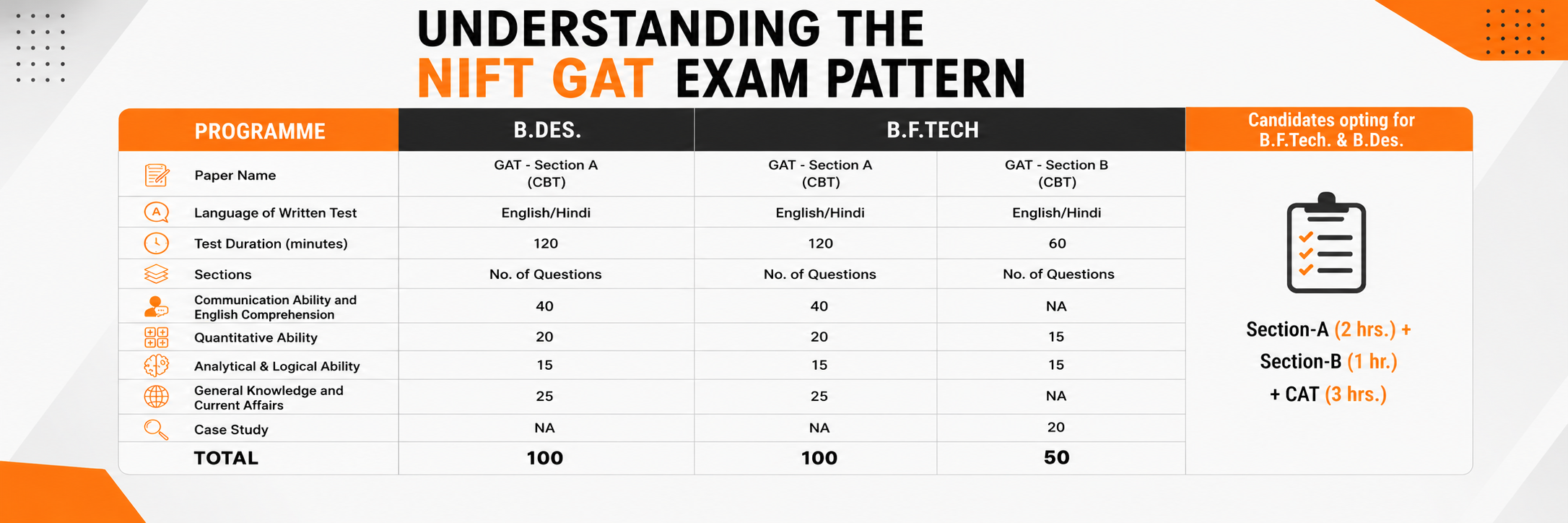
NIFT B.Des Exam Pattern

The Bachelor of Design entrance consists of two written examinations followed by the Situation Test.

General Ability Test (GAT)

Mode: Computer-Based Test (CBT)

Duration: 120 Minutes

Sections

  • Communication Ability & English Comprehension – 40 Questions
  • Quantitative Ability – 20 Questions
  • Analytical & Logical Ability – 15 Questions
  • General Knowledge & Current Affairs – 25 Questions

Total Questions: 100

Creative Ability Test (CAT)

Duration: 3 Hours

CAT evaluates:

  • Creativity
  • Drawing Skills
  • Visualization
  • Observation
  • Imagination
  • Storytelling
  • Design Thinking
  • Colour Sense
  • Innovation

NIFT B.F.Tech Exam Pattern

Candidates applying for B.F.Tech appear in two sections.

GAT Section A

Duration: 120 Minutes

  • Communication Ability & English Comprehension – 40 Questions
  • Quantitative Ability – 20 Questions
  • Analytical & Logical Ability – 15 Questions
  • General Knowledge & Current Affairs – 25 Questions

Total: 100 Questions

GAT Section B

Duration: 60 Minutes

  • Quantitative Ability – 15 Questions
  • Analytical & Logical Ability – 15 Questions
  • Case Study – 20 Questions

Total: 50 Questions

Students applying for both B.Des and B.F.Tech must appear for Section A, Section B, and CAT.

NIFT PG Exam Pattern

M.Des

Duration: 120 Minutes

  • Communication Ability & English Comprehension – 50 Questions
  • Quantitative Ability – 20 Questions
  • Analytical & Logical Ability – 25 Questions
  • General Knowledge & Current Affairs – 25 Questions

Total: 120 Questions

Qualified candidates appear for:

  • Creative Ability Test (CAT)
  • Personal Interview (PI)

MFM

Duration: 180 Minutes

Section A

  • Communication Ability & English Comprehension – 50
  • Quantitative Ability – 20
  • Analytical & Logical Ability – 25
  • General Knowledge & Current Affairs – 25

Section B

  • Case Study – 30

Total Questions: 150

M.F.Tech

Duration: 180 Minutes

  • Communication Ability & English Comprehension – 45
  • Quantitative Ability – 30
  • Analytical & Logical Ability – 25
  • General Knowledge & Current Affairs – 25
  • Case Study – 25

Total Questions: 150

Engineering-related questions are also included in the M.F.Tech examination.

NIFT 2027 Selection Process & Weightage

Understanding the official weightage allows students to focus on the sections that contribute the most to the final merit.

Undergraduate Courses

B.Des

  • General Ability Test (GAT): 30%
  • Creative Ability Test (CAT): 50%
  • Situation Test: 20%

B.F.Tech

  • GAT Section A: 30%
  • GAT Section B: 70%

Candidates Applying for Both B.Des & B.F.Tech

  • GAT Section A: 30%
  • CAT: 50%
  • Situation Test: 20%

Postgraduate Courses

M.Des

  • GAT: 30%
  • CAT: 40%
  • Personal Interview: 30%

MFM

  • GAT (Section A & B): 70%
  • Personal Interview: 30%

M.F.Tech

  • GAT: 70%
  • Personal Interview: 30%

NIFT 2027 Syllabus

Creative Ability Test (CAT)

Students should practice:

  • Human Figures
  • Perspective Drawing
  • Product Design
  • Story Illustration
  • Colour Composition
  • Poster Design
  • Object Drawing
  • Memory Drawing
  • Creative Visualization
  • Design Thinking

General Ability Test (GAT)

Topics include:

  • English Comprehension
  • Vocabulary
  • Grammar
  • Quantitative Aptitude
  • Logical Reasoning
  • Analytical Ability
  • General Knowledge
  • Current Affairs

Best Preparation Strategy for NIFT 2027

1. Understand the Weightage
Do not divide your preparation equally.

For B.Des aspirants:

  • CAT deserves the highest priority because it carries 50% weightage.
  • GAT contributes 30%.
  • Situation Test contributes 20%.

Planning your preparation according to weightage improves efficiency.

2. Practice Drawing Every Day

Spend at least 2 hours daily practicing:

  • Human Figures
  • Objects
  • Nature
  • Perspective
  • Product Concepts
  • Storytelling
  • Colour Rendering

Creativity improves only through regular practice.

3. Improve Observation Skills

Great designers observe everything around them.

Develop habits like:

  • Sketching everyday objects
  • Visiting exhibitions
  • Studying advertisements
  • Watching documentaries
  • Maintaining a visual journal

4. Master General Ability Test

Daily practice should include:

  • Reading newspapers
  • Current Affairs
  • English Vocabulary
  • Logical Reasoning
  • Quantitative Aptitude

Speed and accuracy are equally important.

5. Solve Previous Year Papers

Previous papers help you understand:

  • Difficulty Level
  • Question Trends
  • Frequently Asked Topics
  • Time Management

Practice at least 10–15 years of previous papers.

6. Attempt Mock Tests

Mock tests simulate the real exam.

Benefits include:

  • Better speed
  • Improved confidence
  • Reduced exam anxiety
  • Performance analysis
  • Time management

Aim to complete 30–50 full-length mock tests before the exam.

7. Prepare for Situation Test & Interview

Many students focus only on the written examination.

After qualifying, prepare for:

Situation Test

  • Model Making
  • Material Handling
  • Creativity
  • Neatness
  • Concept Presentation

Personal Interview

  • Portfolio Discussion
  • Design Awareness
  • Career Goals
  • Communication Skills
  • General Awareness

Common Mistakes to Avoid

  • Starting preparation late
  • Ignoring CAT practice
  • Not attempting mock tests
  • Weak time management
  • Neglecting current affairs
  • Memorizing instead of understanding concepts
  • Ignoring creativity development

Daily Study Plan

ActivityTime
Drawing Practice2 Hours
GAT Preparation2 Hours
Current Affairs30 Minutes
Previous Year Papers1 Hour
Mock Test & Analysis1.5 Hours

Why Choose Pahal Design?

For over 26 years, Pahal Design has been one of India’s most trusted coaching institutes for design entrance examinations.

Students benefit from:

  • Expert Faculty from NIFT & NID
  • Comprehensive Study Material
  • Unlimited Drawing Practice
  • Regular Mock Tests
  • Portfolio Development
  • Situation Test Training
  • Personal Interview Guidance
  • Online & Classroom Coaching
  • Individual Mentorship
  • Proven Selection Record

Thousands of students trained at Pahal Design have secured admissions to prestigious institutions including NIFT, NID, UCEED, CEED, NATA, BFA, and leading international design universities.

Whether you’re beginning your preparation or aiming for a top rank, Pahal Design provides the guidance, resources, and mentorship needed to achieve your dream.

Final Thoughts

Success in the NIFT 2027 Entrance Exam is not just about hard work—it’s about preparing smartly. Understanding the latest exam pattern, focusing on high-weightage sections, practicing creativity daily, solving mock tests, and staying consistent are the keys to success.

Start your preparation early, follow a structured study plan, and seek expert guidance whenever needed. With dedication and the right coaching from Pahal Design, you can confidently secure admission to your dream NIFT campus and build a successful career in the design industry.

Book Your Free Career Counselling Session Today

Not sure which design entrance exam is right for you?

Our expert counsellors will help you:

  • Choose the right design career path
  • Understand the NIFT, NID, UCEED, CEED, NATA, and BFA admission process
  • Create a personalized preparation plan
  • Learn about scholarships and coaching programs
  • Get answers to all your admission-related questions

📞 Call Now: 8800-22-6864

🌐 Visit: www.pahaldesign.com

🎯 Your Design Dream Begins with Pahal Design!

Frequently Asked Questions (FAQs) About NIFT 2027

1. What is the NIFT 2027 Entrance Exam?

The NIFT 2027 Entrance Exam is the admission test conducted by the National Institute of Fashion Technology for undergraduate and postgraduate programmes such as B.Des, B.F.Tech, M.Des, MFM, and M.F.Tech. The exam evaluates creativity, design aptitude, analytical ability, English, logical reasoning, quantitative aptitude, and general awareness.

2. What is the eligibility for NIFT 2027?

For B.Des and B.F.Tech, candidates should have passed or be appearing for Class 12 from a recognized board.

For M.Des, MFM, and M.F.Tech, candidates must possess a bachelor’s degree in the relevant discipline as prescribed by NIFT.

3. What is the exam pattern for NIFT 2027?

The NIFT entrance exam consists of:

  • General Ability Test (GAT)
  • Creative Ability Test (CAT) for design programmes
  • Situation Test (for B.Des shortlisted candidates)
  • Personal Interview (for postgraduate programmes)

The exam pattern varies depending on the course selected.

4. What subjects should I prepare for the NIFT GAT?

The General Ability Test (GAT) includes:

  • Communication Ability
  • English Comprehension
  • Quantitative Ability
  • Analytical & Logical Reasoning
  • General Knowledge
  • Current Affairs
  • Case Study (for selected programmes)

5. What is CAT in the NIFT Entrance Exam?

The Creative Ability Test (CAT) evaluates:

  • Creativity
  • Drawing Skills
  • Visualization
  • Observation
  • Design Thinking
  • Innovation
  • Colour Sense
  • Storytelling through illustrations

CAT carries the highest weightage for B.Des aspirants.

6. What is the weightage of CAT and GAT in NIFT B.Des?

The latest weightage is:

  • CAT – 50%
  • GAT – 30%
  • Situation Test – 20%

Students should dedicate maximum preparation time to CAT.

7. How many months are required to prepare for NIFT 2027?

Ideally, students should begin preparation 6–12 months before the examination. Starting early allows sufficient time for drawing practice, aptitude preparation, mock tests, and revision.

8. Is coaching necessary to crack NIFT?

While self-study is possible, professional coaching provides:

  • Structured study plans
  • Expert faculty guidance
  • Regular mock tests
  • Performance analysis
  • Portfolio development
  • Situation Test practice
  • Personal Interview preparation

Many top-ranking students prefer coaching for systematic preparation.

9. How important are previous year’s question papers?

Previous year papers help students:

  • Understand the latest exam pattern
  • Identify important topics
  • Improve speed and accuracy
  • Build confidence
  • Practice time management

Students should solve at least 10–15 years of previous papers.

10. How can I improve my drawing skills for NIFT CAT?

Practice daily by sketching:

  • Human figures
  • Objects
  • Nature
  • Perspective
  • Product concepts
  • Story illustrations
  • Colour compositions

Observation and creativity are more important than perfect artistic skills.

11. How many mock tests should I attempt before NIFT?

Experts recommend attempting 30–50 full-length mock tests before the examination. Regular mock tests improve speed, accuracy, confidence, and time management.

12. Which books are best for NIFT preparation?

Some recommended resources include:

  • Previous Year Question Papers
  • Design Aptitude Books
  • Drawing Practice Books
  • Quantitative Aptitude Books
  • Logical Reasoning Books
  • Current Affairs Magazines
  • Mock Test Series

Joining a reputed coaching institute like Pahal Design provides comprehensive study material and updated preparation resources.

13. Which is the best coaching institute for NIFT preparation?

Pahal Design is one of India’s leading coaching institutes for NIFT, NID, UCEED, CEED, NATA, and BFA entrance examinations.

With 26+ years of excellence, 18,000+ successful students, expert faculty, structured study material, mock tests, portfolio guidance, Situation Test preparation, and Personal Interview coaching, Pahal Design has helped thousands of students secure admission to top design institutes.

14. Why should I join Pahal Design for NIFT 2027 preparation?

At Pahal Design, students receive:

  • Expert Mentors from NIFT & NID
  • Comprehensive Study Material
  • Regular Mock Tests
  • CAT & GAT Preparation
  • Situation Test Guidance
  • Personal Interview Training
  • Portfolio Development
  • Classroom & Online Coaching
  • Personalized Mentorship
  • 25+ Centers Across India

15. How can I contact Pahal Design?

You can connect with our expert counsellors for admissions and career guidance.

📞 Phone: 8800-22-6864

🌐 Website: www.pahaldesign.com

📧 Email: corporate@pahaldesign.com


NIFT Admission Withdrawal 2026: Everything You Need to Know

The National Institute of Fashion Technology (NIFT) has officially released Notification 10 regarding the Admission Withdrawal Process for NIFT Admissions 2026. If you have secured admission through the NIFT counselling process but are planning to withdraw due to admission in another institute or any personal reason, it is important to understand the refund rules and deadlines.

In this article, Pahal Design explains the complete withdrawal process, refund policy, important dates, and documents required.

Important Dates for NIFT Admission Withdrawal 2026

Candidates who wish to withdraw their admission should keep the following deadlines in mind:

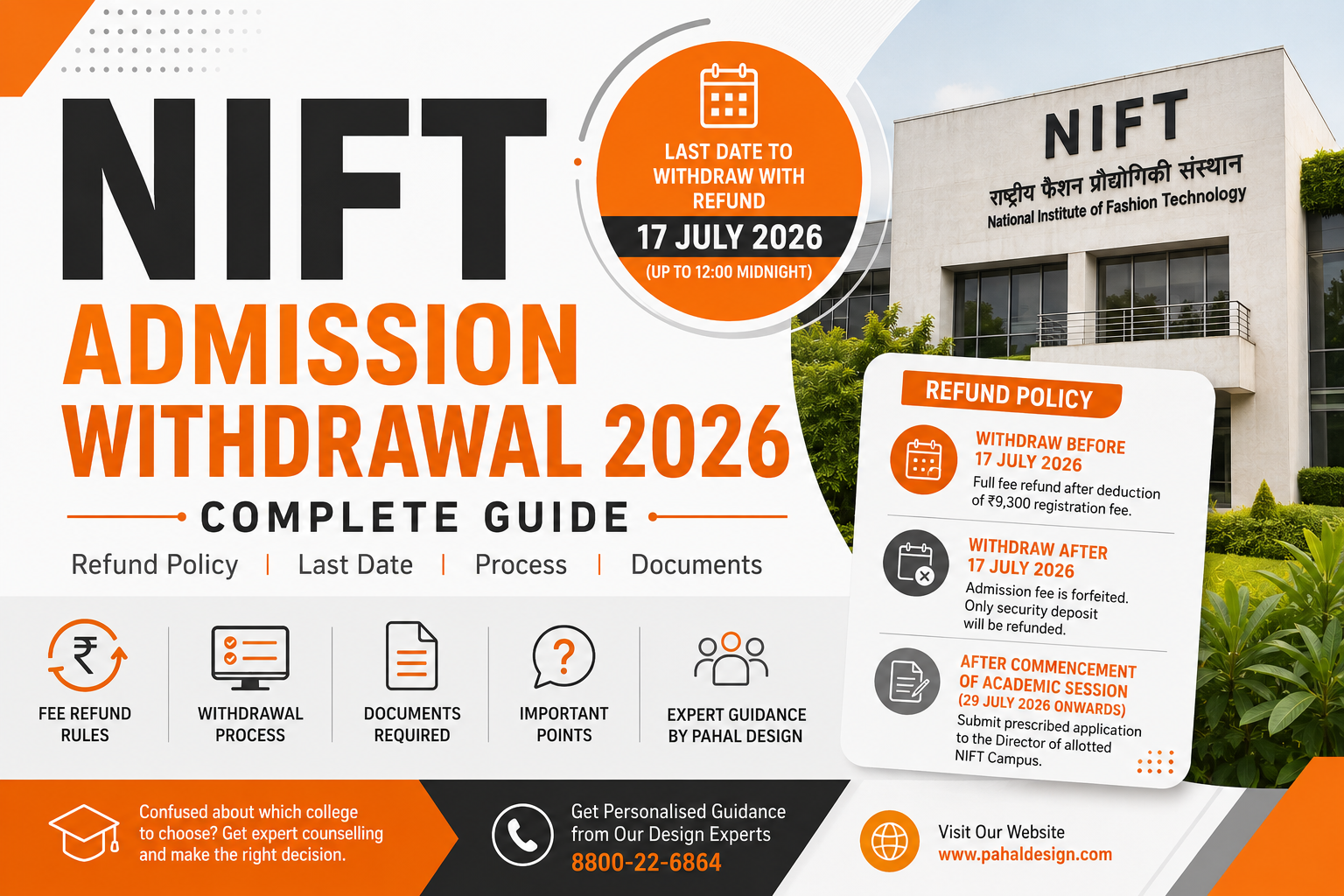
  • Last Date to Withdraw with Fee Refund: 17 July 2026 (up to 12:00 Midnight)
  • Withdrawal after 17 July 2026: Registration fee is forfeited, and refund policies change.
  • Withdrawal after Academic Session Begins (from 29 July 2026 onwards): Candidates must submit a prescribed withdrawal application directly to the Director of their allotted NIFT campus.

NIFT Fee Refund Policy 2026

The refund amount depends on when the withdrawal request is submitted.

1. Withdrawal Before 17 July 2026

Candidates who submit their withdrawal request on or before 17 July 2026 (12:00 Midnight) are eligible for:

  • Full admission fee refund
  • Registration Fee of ₹9,300 will be deducted
  • Remaining fee will be refunded as per NIFT guidelines.

2. Withdrawal After 17 July 2026

If the withdrawal request is submitted after 17 July 2026, then:

  • The admission fee is forfeited.
  • Only the Security Deposit will be refunded.

How to Submit NIFT Admission Withdrawal Request

Candidates should carefully follow the official process.

Before 17 July 2026

  • Login to the NIFT Admission Portal.
  • Submit the withdrawal request online.
  • Offline requests through email or any other mode will not be accepted.

After 29 July 2026

If the academic session has already started:

  • Download and fill the prescribed withdrawal application.
  • Submit it to the Director of your allotted NIFT Campus.
  • Attach all required documents.
  • The refund will be processed according to NIFT rules.

Documents Required for Withdrawal After Session Commencement

Candidates applying after the commencement of classes should keep the following documents ready:

  • Admission Letter
  • Fee Receipt
  • Cancelled Cheque
  • Bank Account Details
  • Identity Details
  • Signed Undertaking Form.

Important Points Every Candidate Should Remember

  • Withdrawal requests should be submitted only through the official procedure.
  • Missing the deadline can significantly reduce your refund amount.
  • Keep copies of all submitted documents.
  • Check your bank account details carefully to avoid refund delays.
  • Read the counselling guidelines thoroughly before withdrawing.

Confused About Whether You Should Withdraw?

Many students receive offers from multiple institutes such as:

  • NIFT
  • NID
  • IIT UCEED
  • CEED
  • Architecture Colleges
  • Private Design Universities

Choosing the right institute depends on your career goals, specialization, fees, campus, placements, and future opportunities.

If you are unsure whether to continue with your NIFT admission or opt for another institute, seek expert guidance before making your final decision.

Get Expert NIFT Counselling Guidance from Pahal Design

At Pahal Design, we have helped thousands of students secure admissions into India’s leading design institutes for over 26 years. Our expert mentors provide personalized counselling to help students make informed decisions about college selection, admissions, and career planning.

We Help Students With:

  • NIFT College Preference Guidance
  • NID vs NIFT Comparison
  • UCEED & CEED Counselling
  • Architecture & Fine Arts Admissions
  • Career Counselling
  • Design Portfolio Guidance
  • Admission Strategy

Why Choose Pahal Design?

  • 26+ Years of Excellence
  • 26,000+ Successful Students
  • Expert Mentors from NIFT & NID
  • India’s Leading Design Entrance Coaching Institute
  • Personalized Career Guidance
  • Pan-India Presence

Contact Pahal Design

Website: www.pahaldesign.com

Helpline: 8800-22-6864

Prepare smarter. Choose the right college with confidence. Let Pahal Design guide you toward a successful design career.

FAQs

Can I withdraw my NIFT admission after seat allotment?

Yes. Candidates can withdraw according to the official NIFT counselling schedule.

What is the last date to withdraw NIFT Admission 2026 with refund?

The last date is 17 July 2026 (up to 12:00 Midnight).

Will I get a full refund?

You will receive a refund after deduction of the registration fee if you withdraw before the deadline.

Can I withdraw through email?

No. Withdrawal requests must be submitted through the official admission process as prescribed by NIFT.


NIFT Placements 2026: Career Opportunities, Top Recruiters & Industry Insights

The National Institute of Fashion Technology (NIFT) continues to strengthen its position as India’s premier fashion and design institution. With an extensive alumni network of over 45,000 professionals, strong industry partnerships, and a future-ready curriculum, NIFT Placements 2026 showcase the growing demand for design, fashion, technology, and management graduates across diverse industries.

At Pahal Design, India’s leading coaching institute for NIFT, NID, UCEED, CEED, and Design Entrance Exams, we bring you a detailed analysis of NIFT Placement 2026 and the exciting career opportunities awaiting aspiring designers.

Why NIFT Continues to Lead Fashion & Design Education

Established in 1986 under the Ministry of Textiles, Government of India, NIFT has emerged as the country’s most prestigious institution for fashion, design, technology, and management education. Today, NIFT operates through 20 campuses across India and offers undergraduate, postgraduate, and doctoral programmes.

Some key advantages of studying at NIFT include:

  • Industry-oriented curriculum
  • On-campus placement opportunities
  • Global industry exposure
  • Strong alumni network
  • Future-ready learning framework
  • Interdisciplinary learning opportunities
  • Industry collaborations and internships

These factors collectively make NIFT graduates highly employable across national and international organizations.

NIFT Placement 2026: Industry Demand at an All-Time High

The fashion, retail, lifestyle, textile, and creative industries are undergoing significant transformation driven by:

  • Artificial Intelligence (AI)
  • Sustainability initiatives
  • Digital transformation
  • Global supply chain expansion
  • E-commerce growth
  • Smart manufacturing technologies
  • Consumer experience design

As a result, companies are actively seeking professionals who combine creativity, technical expertise, business understanding, and design thinking—qualities that NIFT students develop throughout their academic journey.

Programmes Participating in NIFT Placements 2026

Bachelor of Design (B.Des)

  • Fashion Design (FD)
  • Fashion Communication (FC)
  • Textile Design (TD)
  • Accessory Design (AD)
  • Knitwear Design (KD)
  • Leather Design (LD)
  • Fashion Interiors (FI)

Bachelor of Fashion Technology (B.F.Tech)

Master’s Programmes

  • Master of Design (M.Des)
  • Master of Fashion Management (MFM)
  • Master of Fashion Technology (M.F.Tech)

Doctoral Programme

  • Ph.D. in Design and Fashion Studies

All these programmes contribute to the diverse talent pool available during the NIFT Placement Season 2026.

Emerging Skills Driving NIFT Placements

NIFT has continuously upgraded its curriculum to align with industry requirements. Students are exposed to emerging domains such as:

Design & Technology

  • AI-driven Design Tools
  • Virtual Prototyping
  • Augmented Reality (AR)
  • User Experience (UX) Design
  • Design Strategy
  • Smart Textiles
  • Wearable Technology

Fashion & Manufacturing

  • Advanced Apparel Manufacturing
  • Digital Pattern Making
  • 3D Garment Visualization
  • Sustainable Fashion
  • Smart Jewellery
  • Bespoke Menswear
  • Technical Textiles

Business & Analytics

  • Big Data Analytics
  • Fashion Business Analytics
  • Supply Chain Management
  • Retail Strategy
  • Omnichannel Retailing

These industry-relevant skills significantly improve placement outcomes and help graduates become job-ready from day one.

Career Opportunities After NIFT

NIFT graduates are recruited across multiple sectors, including:

Fashion & Apparel

  • Fashion Designer
  • Apparel Designer
  • Textile Designer
  • Fashion Stylist
  • Fashion Consultant

Retail & Lifestyle

  • Retail Manager
  • Visual Merchandiser
  • Brand Manager
  • Buying & Merchandising Professional
  • Luxury Brand Specialist

Technology & Digital Design

  • UX/UI Designer
  • Product Designer
  • Design Strategist
  • Digital Experience Designer

Manufacturing & Supply Chain

  • Production Manager
  • Quality Assurance Specialist
  • Product Development Manager
  • Sourcing Manager

Entrepreneurship

Many NIFT alumni have successfully launched:

  • Fashion Labels
  • Design Studios
  • Sustainable Fashion Startups
  • E-commerce Brands
  • Creative Agencies

Top Recruiters at NIFT Placements

NIFT graduates are highly preferred by:

Fashion & Lifestyle Brands

  • Aditya Birla Fashion & Retail
  • Reliance Retail
  • Arvind Limited
  • Raymond
  • Shahi Exports

Luxury & International Brands

  • H&M
  • Zara
  • Tommy Hilfiger
  • Calvin Klein
  • Lifestyle International

E-commerce Companies

  • Myntra
  • Flipkart
  • Amazon Fashion
  • Ajio

Design & Consulting Firms

  • Deloitte
  • Accenture
  • Design Consulting Studios
  • Creative Agencies

Recruiters appreciate NIFT graduates for their blend of creativity, innovation, business understanding, and technical competence.

NIFT Placement Process 2026

The NIFT placement process typically includes:

  1. Company Registration
  2. Job Profile Announcement
  3. Student Applications
  4. Portfolio Evaluation
  5. Written Assessments
  6. Group Discussions (where applicable)
  7. Personal Interviews
  8. Final Selection

Students also secure Pre-Placement Offers (PPOs) through internships and industry-sponsored projects.

Why NIFT Graduates Stand Out

According to NIFT’s Placement Report 2026, graduates are trained to work in real-world environments through:

  • Industry Projects
  • Internships
  • Graduation Projects
  • Live Design Assignments
  • Cross-disciplinary Learning
  • Industry Exposure Programmes

This practical approach ensures that students can contribute effectively from the very beginning of their careers.

How Pahal Design Helps Students Reach NIFT

Pahal Design has been guiding NIFT aspirants for over 26 years and has produced thousands of successful selections in:

  • NIFT
  • NID
  • UCEED
  • CEED
  • NATA
  • Fine Arts Entrance Exams

Our preparation includes:

  • Creative Ability Test (CAT)
  • General Ability Test (GAT)
  • Studio Test Preparation
  • Portfolio Development
  • Mock Interviews
  • Design Thinking Workshops
  • Mentorship by NIFT/NID Alumni

Conclusion

NIFT Placements 2026 reflect the growing importance of design, innovation, technology, and sustainability in today’s global economy. With strong industry connections, a future-focused curriculum, and excellent placement support, NIFT continues to produce professionals who are shaping the future of fashion, design, retail, and technology.

If your dream is to build a successful career in fashion, design, or creative industries, NIFT remains one of the best pathways to achieve it—and Pahal Design is here to help you secure your seat.

About Pahal Design

Pahal Design is India’s leading design entrance coaching institute with 25+ centres across India, offering expert preparation for:

  • NIFT
  • NID
  • UCEED
  • CEED
  • NATA
  • Fine Arts
  • Design Portfolio Preparation

Website: www.pahaldesign.com
Admissions Helpline: 8800-22-6864

NIFT 2026 Results Declared: Complete Analysis, Statistics, Admission Process & What’s Next

NIFT 2026 Result Announced by NTA

The National Testing Agency (NTA) has officially declared the final results of the National Institute of Fashion Technology Entrance Examination (NIFTEE) 2026 for Undergraduate (UG) and Postgraduate (PG) programmes. The results mark the completion of the admission process for prestigious programmes including B.Des, B.F.Tech, M.Des, M.F.M., and M.F.Tech across NIFT campuses in India.

For thousands of design aspirants, NIFT remains one of India’s most sought-after design entrance examinations. The declaration of NIFT 2026 results now paves the way for counselling, seat allocation, and admissions into various NIFT campuses.

NIFT 2026 Examination Overview

NIFT Entrance Examination 2026 was conducted across 129 centres located in 97 cities throughout India.

Programmes Covered

Undergraduate Programmes

  • Bachelor of Design (B.Des)
  • Bachelor of Fashion Technology (B.F.Tech)
  • B.Des (Artisans)
  • B.Des (NLEA)
  • B.F.Tech (NLEA)

Postgraduate Programmes

  • Master of Design (M.Des)
  • Master of Fashion Management (M.F.M.)
  • Master of Fashion Technology (M.F.Tech)

NIFT 2026 Registration & Attendance Statistics

The NIFT 2026 entrance examination witnessed tremendous participation from students across India.

Stage 1 Examination Statistics

  • Total Unique Registered Candidates: 21,307
  • Total Test Entries (GAT + CAT): 40,247
  • Total Candidates Appeared: 35,596
  • Overall Attendance: 88.44%

This highlights the growing popularity of design education and fashion careers among Indian students.

NIFT 2026 Category-wise Participation

The Open Category recorded the highest participation, followed by OBC-NCL candidates.

Major Categories

  • Open Category
  • OBC-NCL
  • EWS
  • SC
  • ST

The data indicates broad representation from all sections of society, reinforcing NIFT’s role as India’s leading fashion and design institution.

Gender Distribution in NIFT 2026

NIFT continues to attract a significantly higher number of female candidates.

Female Candidates

  • Registered: 17,612
  • Appeared: 15,643

Male Candidates

  • Registered: 3,695
  • Appeared: 3,224

The statistics further establish the growing influence of design, fashion, communication, and creative careers among young aspirants.

NIFT 2026 Stage 2 Examination

Candidates shortlisted after Stage 1 appeared for Stage 2 assessments.

PG Programmes

Personal Interviews were conducted in New Delhi from:

06 April 2026 to 11 April 2026

Assessment areas included:

  • Aptitude
  • Career Orientation
  • Communication Skills
  • Programme Suitability
  • General Awareness

UG Programmes

The Stage 2 Examination was conducted on:

26 April 2026

Components included:

  • B.Des Situation Test
  • B.Des (NLEA) Studio Test & Interview
  • B.F.Tech (NLEA) Technical Ability Test
  • B.Des (Artisan) Skill Test

NIFT 2026 Stage 2 Attendance

Total Shortlisted Candidates

12,065

Total Appeared

10,432

Attendance Percentage

86.46%

The high attendance rate demonstrates the seriousness and commitment of students pursuing careers in design and fashion.

Important Update for B.F.Tech Aspirants

One crucial point students should note:

No Stage 2 Examination for B.F.Tech

Admission to the Bachelor of Fashion Technology (B.F.Tech) programme is based solely on the General Ability Test (GAT) conducted during Stage 1.

This makes performance in GAT extremely important for B.F.Tech applicants.

How NIFT 2026 Results Were Prepared

NTA and NIFT followed a rigorous and transparent evaluation process.

Evaluation Included

  • Digital assessment of CAT responses
  • Situation Test evaluation
  • Studio Test evaluation
  • Artisan Skill Test assessment
  • Personal Interviews
  • Verification and scrutiny procedures

The final merit list was prepared strictly according to NIFT admission policies and programme-specific weightages.

What Happens After NIFT 2026 Results?

Candidates who have qualified should now prepare for the counselling and seat allocation process.

Next Steps

  1. Check your NIFT 2026 Rank and Merit Status.
  2. Monitor official counselling notifications.
  3. Prepare required documents.
  4. Complete choice filling for campuses and programmes.
  5. Participate in seat allocation rounds.
  6. Confirm admission and pay fees within deadlines.

Top NIFT Campuses Students Prefer

Some of the most sought-after NIFT campuses include:

  • NIFT Delhi
  • NIFT Mumbai
  • NIFT Bengaluru
  • NIFT Hyderabad
  • NIFT Chennai
  • NIFT Gandhinagar
  • NIFT Kolkata
  • NIFT Patna
  • NIFT Bhubaneswar

Campus selection should be based on specialization, faculty, industry exposure, internships, placements, and personal preferences.

Why NIFT Remains India’s Most Prestigious Fashion & Design Institute

NIFT offers:

  • Industry-oriented curriculum
  • Strong placement opportunities
  • International collaborations
  • Fashion and design incubation support
  • Experienced faculty
  • State-of-the-art infrastructure
  • Extensive alumni network

Graduates from NIFT have gone on to work with leading fashion houses, design studios, lifestyle brands, technology companies, and global organizations.

Preparing for NIFT 2027?

With NIFT 2026 admissions now underway, students targeting NIFT 2027 should begin preparation immediately.

Early preparation provides advantages in:

  • Creative Ability Test (CAT)
  • General Ability Test (GAT)
  • Design Thinking
  • Sketching
  • Situation Test Preparation
  • Portfolio Development
  • Interview Readiness

Prepare for NIFT 2027 with Pahal Design

Pahal Design is one of India’s leading institutes for NIFT, NID, UCEED, CEED, NATA, and Design Entrance Examination preparation.

Why Students Choose Pahal Design

  • Experienced Design Mentors
  • Comprehensive Study Material
  • Online & Offline Classes
  • Mock Tests & Analysis
  • Portfolio Guidance
  • Situation Test Training
  • Interview Preparation
  • Proven Results Across India

Admissions Open

NIFT / NID / UCEED 2027-28 Batches

📞 8800-22-6864
🌐 www.pahaldesign.com

Start your design journey with expert guidance and join thousands of successful Pahal Design students pursuing careers in design, fashion, architecture, and innovation.

Summer break often feels like a well-earned pause—but what if it could also become the turning point for your future? Instead of letting these months slip away, you can use this time to unlock your creative potential and take your first step toward a successful design career. At Pahal Design, summer isn’t just a break—it’s an opportunity.

Why Summer is the Best Time to Start Your Design Journey

Most students spend their summer relaxing, traveling, or catching up on hobbies. While that’s important, this period also offers uninterrupted time to explore new skills, build discipline, and get ahead academically.

For students of Class 10th, 11th, and 12th, this is the perfect moment to:

  • Discover your creative strengths
  • Learn foundational design concepts
  • Begin preparation for competitive design entrance exams

Starting early gives you a clear advantage when it comes to building a strong portfolio and understanding the design field.

Turn Creativity into a Career

Design is no longer just an artistic pursuit—it’s a thriving career path with global opportunities. Fields like fashion design, interior design, product design, and visual communication are growing rapidly.

At Pahal Design, students are guided to:

  • Transform raw creativity into structured skills
  • Understand real-world design applications
  • Build confidence through hands-on learning

This early exposure helps you make informed career decisions and stand out in competitive environments.

What You’ll Gain from a Summer Design Program

Joining a structured summer course can significantly boost your learning curve. At Pahal Design, the focus is on building both skills and clarity.

Key Benefits:

  • Creative Thinking & Visualization Skills
    Learn how to think like a designer and visualize ideas effectively.
  • Sketching & Design Fundamentals
    Master the basics that form the backbone of all design disciplines.
  • Portfolio Building
    Start creating a strong portfolio for top colleges in India and abroad.
  • Career Clarity
    Gain insights into various design fields and choose your path wisely.

Prepare for Top Design Entrance Exams

If your goal is to get into prestigious design institutes, early preparation is crucial. Pahal Design’s summer programs are aligned with major entrance exams such as:

With expert guidance, structured practice, and exam-focused strategies, you’ll be better prepared to achieve top results.

Start Early. Stay Ahead.

Success in design doesn’t happen overnight—it requires consistent effort, guidance, and the right environment. Starting during summer gives you:

  • A head start over other aspirants
  • Time to experiment and improve without pressure
  • The ability to build confidence before exams approach

Limited Seats – High Demand

Summer batches at Pahal Design are highly sought after due to their quality training and proven results. With limited seats available, early enrollment ensures you don’t miss out on this valuable opportunity.

Final Thoughts

Your summer break can either be a pause—or a powerful step forward. By choosing to invest in your creativity today, you’re shaping a future filled with possibilities.

Don’t waste your summer break. Build your future with Pahal Design.

Enroll now and take the first step toward your dream design career.
Visit: www.pahaldesign.com
Call: 8800-22-6864


NIFT Situation Test 2026: Complete Preparation Guide

Expert Guidance by PAHAL DESIGN for NIFT B.Des Aspirants

The NIFT Situation Test 2026 is the most crucial stage for students aspiring to secure admission into top design programs at the National Institute of Fashion Technology (NIFT). After clearing CAT & GAT, this final practical round tests your creativity, material handling skills, problem-solving ability, and design thinking. At PAHAL DESIGN, we help students master this stage with expert guidance and real exam simulations.

1. What is the NIFT Situation Test?

The Situation Test is a hands-on model-making exam where students must:

  • ✔ Create a 3D model using given materials
  • ✔ Follow a specific theme or problem statement
  • ✔ Finish within limited time (approx. 2 hours)
  • ✔ Write a concept explanation (write-up)

This test evaluates: Creative thinking, Spatial awareness, Innovation, Neatness & finishing, Material usage, and Concept clarity.

NIFT PAN India Presence

Explore NIFT campuses across India and the 2026 Seat Matrix for your preferred specialization.

2. Expected Question Trends

Based on past patterns, students can expect questions from these categories:

Product Design

Design a trophy for a profession, a utility bag, a toy for children, or a futuristic product.

Space Design

Create a kids play area, a shop display unit, a vendor workspace, or a themed café/stall.

Themes & Social

Focus on Harmony in Chaos, Future Sustainability, Recycling, or Inclusive Design.

3. Previous Years’ Tasks & Materials

Real-style tasks asked in past NIFT tests include:

  • Design a headgear inspired by mythology
  • Create a flower vase inspired by “Storm”
  • Make a toy to teach science to kids
  • Design a park bench for senior citizens
  • Create a badge for “Save Environment – 22nd Century”
  • Design a modern display unit for a perfume store
  • Create a bag for a working mother
Materials Provided Evaluation Criteria
Mount board, Thermocol, Colored sheets ✔ Concept originality & Creativity
Clay, Threads, Straws ✔ Material handling & Neat finishing
Ice-cream sticks, Foil paper ✔ Structural balance & Write-up quality

4. Preparation with PAHAL DESIGN

Our training includes everything you need to ace the challenge:

  • Real Exam Simulations: Time-bound model making practice.
  • Material Handling Workshops: Creative use of simple materials.
  • Concept Development: Converting ideas into strong visual models.
  • Write-up Practice: Learn to explain your concept effectively.
  • Expert Mentorship: Guidance from experienced NIFT mentors.

Practice Questions for 2026:

• Design an eco-friendly fashion display • Create a smart student backpack • Build a sustainable workspace • Design a toy promoting environmental awareness • Create a future wearable accessory.

5. Common Mistakes & Final Tips

❌ Common Mistakes

  • Overcomplicated ideas
  • Poor finishing / Weak structure
  • Ignoring theme / Poor time management
  • Weak write-up

✅ Final Tips

  • Keep your concept simple
  • Focus on finishing
  • Use materials smartly
  • Write a clear concept note

Frequently Asked Questions (FAQs)

Q: Is the NIFT Situation Test compulsory for 2026?
Yes. All shortlisted B.Des candidates must appear for the Situation Test to qualify for final admission.
Q: How important is the write-up?
The write-up is very important. It explains your concept and helps examiners understand your design thinking.
Q: Can I bring my own materials?
No. Only materials provided during the test can be used (basic stationery allowed as per guidelines).

Start Your NIFT 2026 Preparation Today

Join PAHAL DESIGN for 23+ years of experience, expert faculty, and studio-based learning.
Visit Pahal Design for more information.

Schedule a free counselling session WhatsApp WhatsApp