
How to Crack NIFT 2027 Exam: Complete Preparation Strategy, Exam Pattern, Syllabus & Weightage

Preparing for the NIFT 2027 Entrance Exam is an exciting journey for aspiring designers. Every year, thousands of students compete for admission to the prestigious National Institute of Fashion Technology (NIFT), but only those with the right preparation strategy, creativity, and consistency secure top ranks.

Whether you’re aiming for B.Des, B.F.Tech, M.Des, MFM, or M.F.Tech, understanding the latest exam pattern, syllabus, marking scheme, and weightage is essential. This comprehensive guide by Pahal Design, India’s leading design entrance coaching institute, will help you prepare smartly and maximize your chances of success.

Why Choose NIFT?

The National Institute of Fashion Technology (NIFT) is India’s premier institute for fashion, design, management, and technology education. With campuses across the country, NIFT offers world-class education, industry exposure, internships, placements, and opportunities to build a successful career in fashion, communication, lifestyle products, textile design, accessory design, knitwear, leather design, and fashion management.

Admission is based on a national-level entrance examination that evaluates creativity, aptitude, analytical thinking, and problem-solving abilities.

NIFT 2027 Exam Pattern

Understanding the exam pattern is the foundation of effective preparation. Since each programme has a different structure, candidates should prepare according to their chosen course.

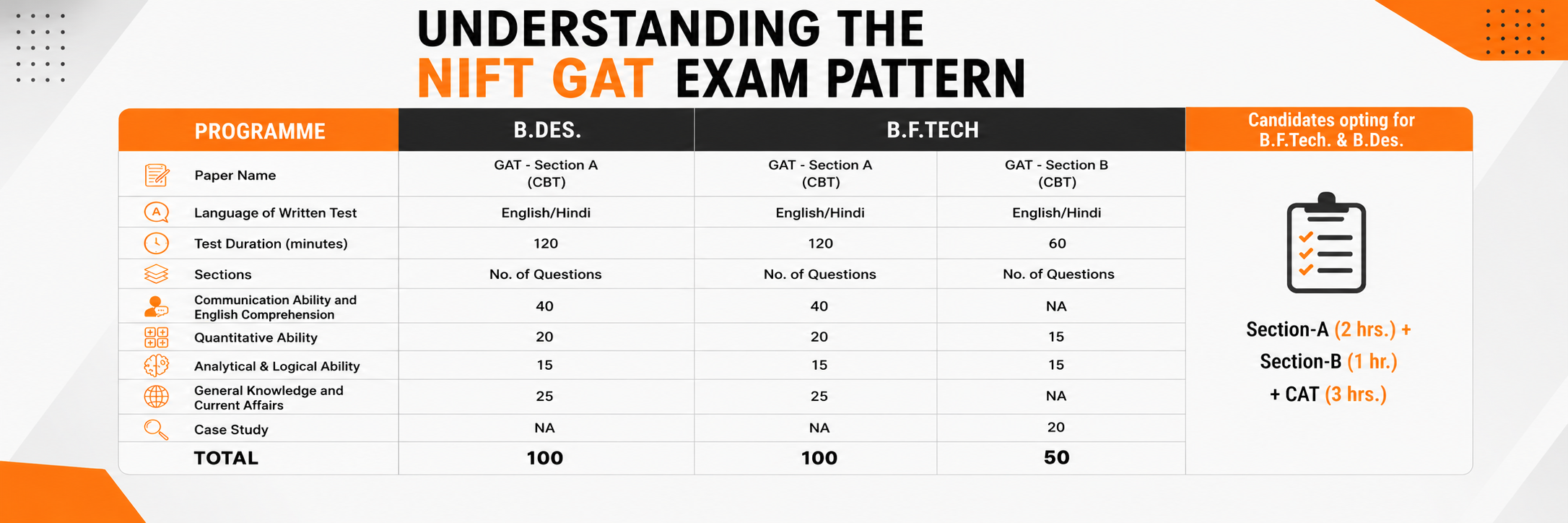
NIFT B.Des Exam Pattern

The Bachelor of Design entrance consists of two written examinations followed by the Situation Test.

General Ability Test (GAT)

Mode: Computer-Based Test (CBT)

Duration: 120 Minutes

Sections

  • Communication Ability & English Comprehension – 40 Questions
  • Quantitative Ability – 20 Questions
  • Analytical & Logical Ability – 15 Questions
  • General Knowledge & Current Affairs – 25 Questions

Total Questions: 100

Creative Ability Test (CAT)

Duration: 3 Hours

CAT evaluates:

  • Creativity
  • Drawing Skills
  • Visualization
  • Observation
  • Imagination
  • Storytelling
  • Design Thinking
  • Colour Sense
  • Innovation

NIFT B.F.Tech Exam Pattern

Candidates applying for B.F.Tech appear in two sections.

GAT Section A

Duration: 120 Minutes

  • Communication Ability & English Comprehension – 40 Questions
  • Quantitative Ability – 20 Questions
  • Analytical & Logical Ability – 15 Questions
  • General Knowledge & Current Affairs – 25 Questions

Total: 100 Questions

GAT Section B

Duration: 60 Minutes

  • Quantitative Ability – 15 Questions
  • Analytical & Logical Ability – 15 Questions
  • Case Study – 20 Questions

Total: 50 Questions

Students applying for both B.Des and B.F.Tech must appear for Section A, Section B, and CAT.
NIFT PG Exam Pattern

M.Des

Duration: 120 Minutes

  • Communication Ability & English Comprehension – 50 Questions
  • Quantitative Ability – 20 Questions
  • Analytical & Logical Ability – 25 Questions
  • General Knowledge & Current Affairs – 25 Questions

Total: 120 Questions

Qualified candidates appear for:

  • Creative Ability Test (CAT)
  • Personal Interview (PI)

MFM

Duration: 180 Minutes

Section A

  • Communication Ability & English Comprehension – 50
  • Quantitative Ability – 20
  • Analytical & Logical Ability – 25
  • General Knowledge & Current Affairs – 25

Section B

  • Case Study – 30

Total Questions: 150

M.F.Tech

Duration: 180 Minutes

  • Communication Ability & English Comprehension – 45
  • Quantitative Ability – 30
  • Analytical & Logical Ability – 25
  • General Knowledge & Current Affairs – 25
  • Case Study – 25

Total Questions: 150

Engineering-related questions are also included in the M.F.Tech examination.

NIFT 2027 Selection Process & Weightage

Understanding the official weightage allows students to focus on the sections that contribute the most to the final merit.

Undergraduate Courses

B.Des

  • General Ability Test (GAT): 30%
  • Creative Ability Test (CAT): 50%
  • Situation Test: 20%

B.F.Tech

  • GAT Section A: 30%
  • GAT Section B: 70%

Candidates Applying for Both B.Des & B.F.Tech

  • GAT Section A: 30%
  • CAT: 50%
  • Situation Test: 20%

Postgraduate Courses

M.Des

  • GAT: 30%
  • CAT: 40%
  • Personal Interview: 30%

MFM

  • GAT (Section A & B): 70%
  • Personal Interview: 30%

M.F.Tech

  • GAT: 70%
  • Personal Interview: 30%

NIFT 2027 Syllabus

Creative Ability Test (CAT)

Students should practice:

  • Human Figures
  • Perspective Drawing
  • Product Design
  • Story Illustration
  • Colour Composition
  • Poster Design
  • Object Drawing
  • Memory Drawing
  • Creative Visualization
  • Design Thinking

General Ability Test (GAT)

Topics include:

  • English Comprehension
  • Vocabulary
  • Grammar
  • Quantitative Aptitude
  • Logical Reasoning
  • Analytical Ability
  • General Knowledge
  • Current Affairs

Best Preparation Strategy for NIFT 2027

1. Understand the Weightage

Do not divide your preparation equally.

For B.Des aspirants:

  • CAT deserves the highest priority because it carries 50% weightage.
  • GAT contributes 30%.
  • Situation Test contributes 20%.

Planning your preparation according to weightage improves efficiency.

2. Practice Drawing Every Day

Spend at least 2 hours daily practicing:

  • Human Figures
  • Objects
  • Nature
  • Perspective
  • Product Concepts
  • Storytelling
  • Colour Rendering

Creativity improves only through regular practice.

3. Improve Observation Skills

Great designers observe everything around them.

Develop habits like:

  • Sketching everyday objects
  • Visiting exhibitions
  • Studying advertisements
  • Watching documentaries
  • Maintaining a visual journal

4. Master General Ability Test

Daily practice should include:

  • Reading newspapers
  • Current Affairs
  • English Vocabulary
  • Logical Reasoning
  • Quantitative Aptitude

Speed and accuracy are equally important.

5. Solve Previous Year Papers

Previous papers help you understand:

  • Difficulty Level
  • Question Trends
  • Frequently Asked Topics
  • Time Management

Practice at least 10–15 years of previous papers.

6. Attempt Mock Tests

Mock tests simulate the real exam.

Benefits include:

  • Better speed
  • Improved confidence
  • Reduced exam anxiety
  • Performance analysis
  • Time management

Aim to complete 30–50 full-length mock tests before the exam.

7. Prepare for Situation Test & Interview

Many students focus only on the written examination.

After qualifying, prepare for:

Situation Test

  • Model Making
  • Material Handling
  • Creativity
  • Neatness
  • Concept Presentation

Personal Interview

  • Portfolio Discussion
  • Design Awareness
  • Career Goals
  • Communication Skills
  • General Awareness

Common Mistakes to Avoid

  • Starting preparation late
  • Ignoring CAT practice
  • Not attempting mock tests
  • Weak time management
  • Neglecting current affairs
  • Memorizing instead of understanding concepts
  • Ignoring creativity development

Daily Study Plan

ActivityTime
Drawing Practice2 Hours
GAT Preparation2 Hours
Current Affairs30 Minutes
Previous Year Papers1 Hour
Mock Test & Analysis1.5 Hours

Why Choose Pahal Design?

For over 26 years, Pahal Design has been one of India’s most trusted coaching institutes for design entrance examinations.

Students benefit from:

  • Expert Faculty from NIFT & NID
  • Comprehensive Study Material
  • Unlimited Drawing Practice
  • Regular Mock Tests
  • Portfolio Development
  • Situation Test Training
  • Personal Interview Guidance
  • Online & Classroom Coaching
  • Individual Mentorship
  • Proven Selection Record

Thousands of students trained at Pahal Design have secured admissions to prestigious institutions including NIFT, NID, UCEED, CEED, NATA, BFA, and leading international design universities.

Whether you’re beginning your preparation or aiming for a top rank, Pahal Design provides the guidance, resources, and mentorship needed to achieve your dream.
Final Thoughts

Success in the NIFT 2027 Entrance Exam is not just about hard work—it’s about preparing smartly. Understanding the latest exam pattern, focusing on high-weightage sections, practicing creativity daily, solving mock tests, and staying consistent are the keys to success.

Start your preparation early, follow a structured study plan, and seek expert guidance whenever needed. With dedication and the right coaching from Pahal Design, you can confidently secure admission to your dream NIFT campus and build a successful career in the design industry.
Book Your Free Career Counselling Session Today

Not sure which design entrance exam is right for you?

Our expert counsellors will help you:

  • Choose the right design career path
  • Understand the NIFT, NID, UCEED, CEED, NATA, and BFA admission process
  • Create a personalized preparation plan
  • Learn about scholarships and coaching programs
  • Get answers to all your admission-related questions

📞 Call Now: 8800-22-6864

🌐 Visit: www.pahaldesign.com

🎯 Your Design Dream Begins with Pahal Design!

Frequently Asked Questions (FAQs) About NIFT 2027

1. What is the NIFT 2027 Entrance Exam?

The NIFT 2027 Entrance Exam is the admission test conducted by the National Institute of Fashion Technology for undergraduate and postgraduate programmes such as B.Des, B.F.Tech, M.Des, MFM, and M.F.Tech. The exam evaluates creativity, design aptitude, analytical ability, English, logical reasoning, quantitative aptitude, and general awareness.

2. What is the eligibility for NIFT 2027?

For B.Des and B.F.Tech, candidates should have passed or be appearing for Class 12 from a recognized board.

For M.Des, MFM, and M.F.Tech, candidates must possess a bachelor’s degree in the relevant discipline as prescribed by NIFT.

3. What is the exam pattern for NIFT 2027?

The NIFT entrance exam consists of:

  • General Ability Test (GAT)
  • Creative Ability Test (CAT) for design programmes
  • Situation Test (for B.Des shortlisted candidates)
  • Personal Interview (for postgraduate programmes)

The exam pattern varies depending on the course selected.

4. What subjects should I prepare for the NIFT GAT?

The General Ability Test (GAT) includes:

  • Communication Ability
  • English Comprehension
  • Quantitative Ability
  • Analytical & Logical Reasoning
  • General Knowledge
  • Current Affairs
  • Case Study (for selected programmes)

5. What is CAT in the NIFT Entrance Exam?

The Creative Ability Test (CAT) evaluates:

  • Creativity
  • Drawing Skills
  • Visualization
  • Observation
  • Design Thinking
  • Innovation
  • Colour Sense
  • Storytelling through illustrations

CAT carries the highest weightage for B.Des aspirants.

6. What is the weightage of CAT and GAT in NIFT B.Des?

The latest weightage is:

  • CAT – 50%
  • GAT – 30%
  • Situation Test – 20%

Students should dedicate maximum preparation time to CAT.

7. How many months are required to prepare for NIFT 2027?

Ideally, students should begin preparation 6–12 months before the examination. Starting early allows sufficient time for drawing practice, aptitude preparation, mock tests, and revision.

8. Is coaching necessary to crack NIFT?

While self-study is possible, professional coaching provides:

  • Structured study plans
  • Expert faculty guidance
  • Regular mock tests
  • Performance analysis
  • Portfolio development
  • Situation Test practice
  • Personal Interview preparation

Many top-ranking students prefer coaching for systematic preparation.

9. How important are previous year’s question papers?

Previous year papers help students:

  • Understand the latest exam pattern
  • Identify important topics
  • Improve speed and accuracy
  • Build confidence
  • Practice time management

Students should solve at least 10–15 years of previous papers.

10. How can I improve my drawing skills for NIFT CAT?

Practice daily by sketching:

  • Human figures
  • Objects
  • Nature
  • Perspective
  • Product concepts
  • Story illustrations
  • Colour compositions

Observation and creativity are more important than perfect artistic skills.

11. How many mock tests should I attempt before NIFT?

Experts recommend attempting 30–50 full-length mock tests before the examination. Regular mock tests improve speed, accuracy, confidence, and time management.

12. Which books are best for NIFT preparation?

Some recommended resources include:

  • Previous Year Question Papers
  • Design Aptitude Books
  • Drawing Practice Books
  • Quantitative Aptitude Books
  • Logical Reasoning Books
  • Current Affairs Magazines
  • Mock Test Series

Joining a reputed coaching institute like Pahal Design provides comprehensive study material and updated preparation resources.

13. Which is the best coaching institute for NIFT preparation?

Pahal Design is one of India’s leading coaching institutes for NIFT, NID, UCEED, CEED, NATA, and BFA entrance examinations.

With 26+ years of excellence, 18,000+ successful students, expert faculty, structured study material, mock tests, portfolio guidance, Situation Test preparation, and Personal Interview coaching, Pahal Design has helped thousands of students secure admission to top design institutes.

14. Why should I join Pahal Design for NIFT 2027 preparation?

At Pahal Design, students receive:

  • Expert Mentors from NIFT & NID
  • Comprehensive Study Material
  • Regular Mock Tests
  • CAT & GAT Preparation
  • Situation Test Guidance
  • Personal Interview Training
  • Portfolio Development
  • Classroom & Online Coaching
  • Personalized Mentorship
  • 25+ Centers Across India

15. How can I contact Pahal Design?

You can connect with our expert counsellors for admissions and career guidance.

📞 Phone: 8800-22-6864

🌐 Website: www.pahaldesign.com

📧 Email: corporate@pahaldesign.com
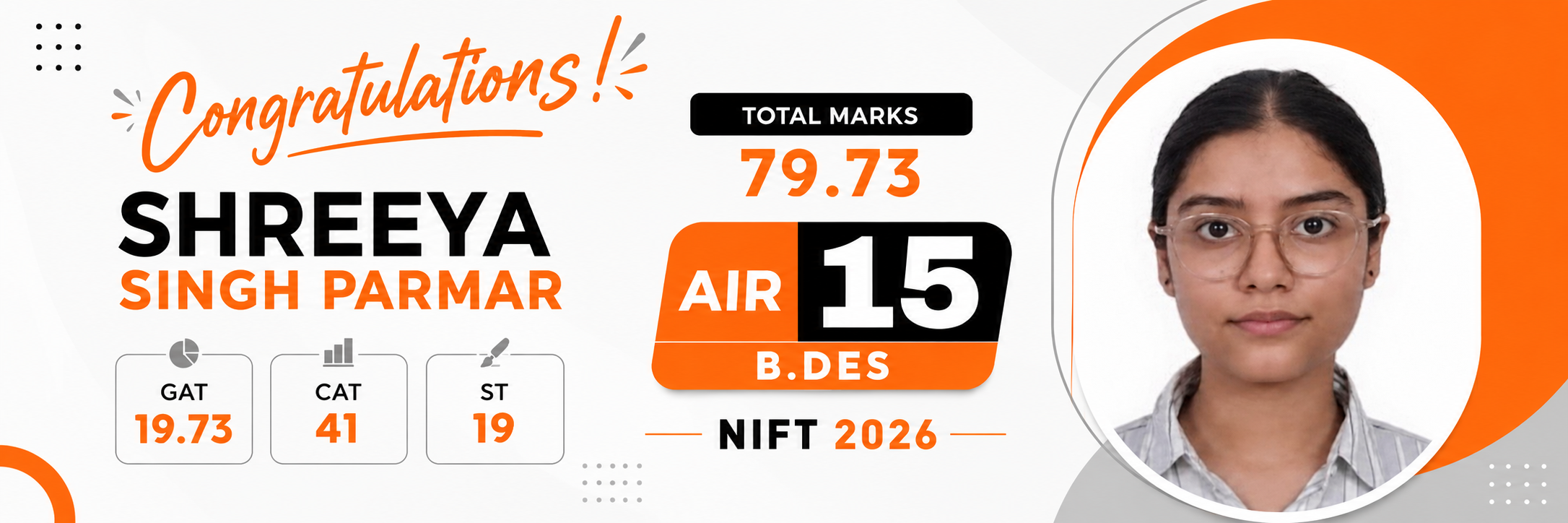
 

NIFT Admission Withdrawal 2026: Everything You Need to Know

The National Institute of Fashion Technology (NIFT) has officially released Notification 10 regarding the Admission Withdrawal Process for NIFT Admissions 2026. If you have secured admission through the NIFT counselling process but are planning to withdraw due to admission in another institute or any personal reason, it is important to understand the refund rules and deadlines.

In this article, Pahal Design explains the complete withdrawal process, refund policy, important dates, and documents required.

Important Dates for NIFT Admission Withdrawal 2026

Candidates who wish to withdraw their admission should keep the following deadlines in mind:

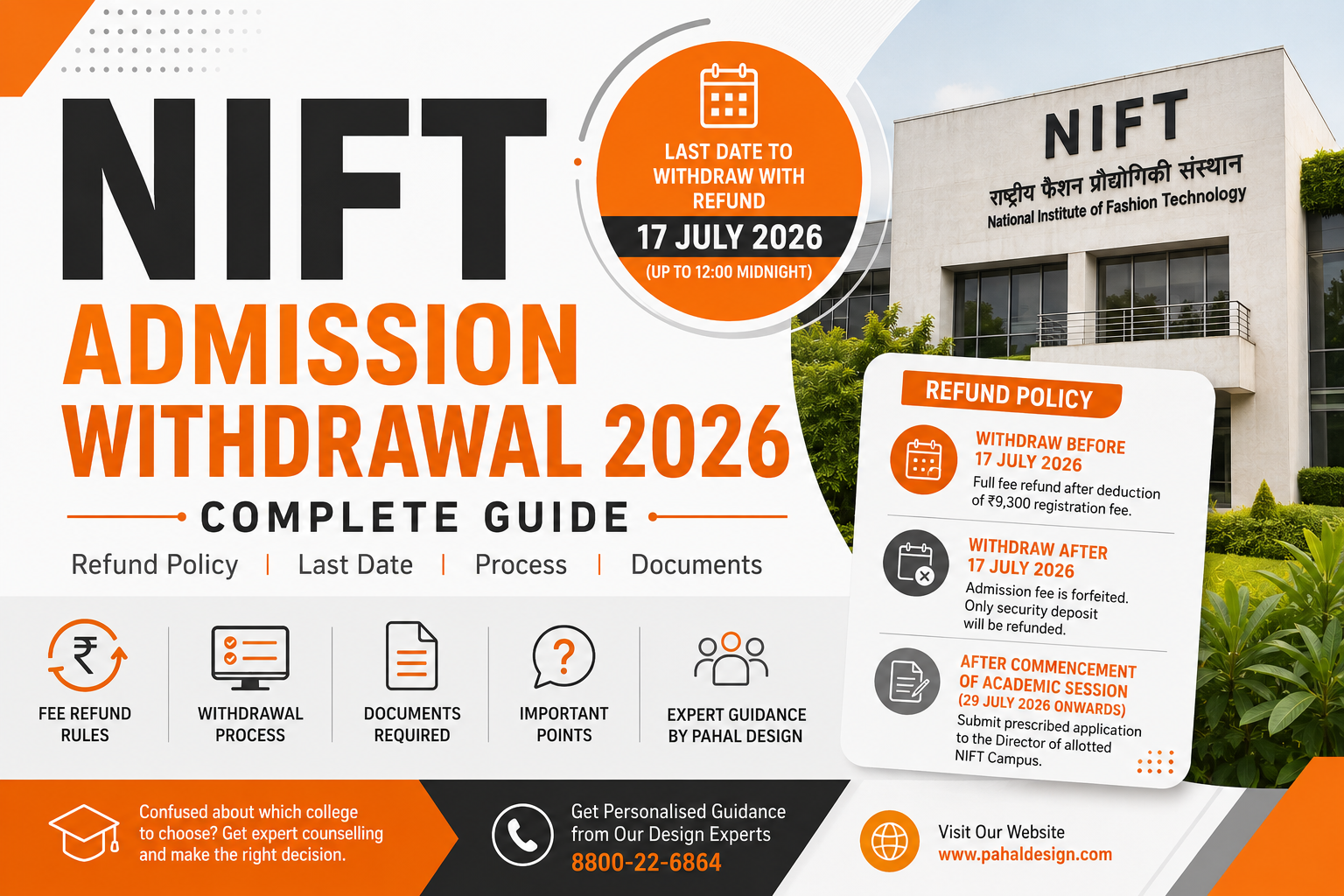
  • Last Date to Withdraw with Fee Refund: 17 July 2026 (up to 12:00 Midnight)
  • Withdrawal after 17 July 2026: Registration fee is forfeited, and refund policies change.
  • Withdrawal after Academic Session Begins (from 29 July 2026 onwards): Candidates must submit a prescribed withdrawal application directly to the Director of their allotted NIFT campus.

NIFT Fee Refund Policy 2026

The refund amount depends on when the withdrawal request is submitted.

1. Withdrawal Before 17 July 2026

Candidates who submit their withdrawal request on or before 17 July 2026 (12:00 Midnight) are eligible for:

  • Full admission fee refund
  • Registration Fee of ₹9,300 will be deducted
  • Remaining fee will be refunded as per NIFT guidelines.

2. Withdrawal After 17 July 2026

If the withdrawal request is submitted after 17 July 2026, then:

  • The admission fee is forfeited.
  • Only the Security Deposit will be refunded.

How to Submit NIFT Admission Withdrawal Request

Candidates should carefully follow the official process.

Before 17 July 2026

  • Login to the NIFT Admission Portal.
  • Submit the withdrawal request online.
  • Offline requests through email or any other mode will not be accepted.

After 29 July 2026

If the academic session has already started:

  • Download and fill the prescribed withdrawal application.
  • Submit it to the Director of your allotted NIFT Campus.
  • Attach all required documents.
  • The refund will be processed according to NIFT rules.

Documents Required for Withdrawal After Session Commencement

Candidates applying after the commencement of classes should keep the following documents ready:

  • Admission Letter
  • Fee Receipt
  • Cancelled Cheque
  • Bank Account Details
  • Identity Details
  • Signed Undertaking Form.

Important Points Every Candidate Should Remember

  • Withdrawal requests should be submitted only through the official procedure.
  • Missing the deadline can significantly reduce your refund amount.
  • Keep copies of all submitted documents.
  • Check your bank account details carefully to avoid refund delays.
  • Read the counselling guidelines thoroughly before withdrawing.

Confused About Whether You Should Withdraw?

Many students receive offers from multiple institutes such as:

  • NIFT
  • NID
  • IIT UCEED
  • CEED
  • Architecture Colleges
  • Private Design Universities

Choosing the right institute depends on your career goals, specialization, fees, campus, placements, and future opportunities.

If you are unsure whether to continue with your NIFT admission or opt for another institute, seek expert guidance before making your final decision.

Get Expert NIFT Counselling Guidance from Pahal Design

At Pahal Design, we have helped thousands of students secure admissions into India’s leading design institutes for over 26 years. Our expert mentors provide personalized counselling to help students make informed decisions about college selection, admissions, and career planning.

We Help Students With:

  • NIFT College Preference Guidance
  • NID vs NIFT Comparison
  • UCEED & CEED Counselling
  • Architecture & Fine Arts Admissions
  • Career Counselling
  • Design Portfolio Guidance
  • Admission Strategy

Why Choose Pahal Design?

  • 26+ Years of Excellence
  • 26,000+ Successful Students
  • Expert Mentors from NIFT & NID
  • India’s Leading Design Entrance Coaching Institute
  • Personalized Career Guidance
  • Pan-India Presence

Contact Pahal Design

Website: www.pahaldesign.com

Helpline: 8800-22-6864

Prepare smarter. Choose the right college with confidence. Let Pahal Design guide you toward a successful design career.

FAQs

Can I withdraw my NIFT admission after seat allotment?

Yes. Candidates can withdraw according to the official NIFT counselling schedule.

What is the last date to withdraw NIFT Admission 2026 with refund?

The last date is 17 July 2026 (up to 12:00 Midnight).

Will I get a full refund?

You will receive a refund after deduction of the registration fee if you withdraw before the deadline.

Can I withdraw through email?

No. Withdrawal requests must be submitted through the official admission process as prescribed by NIFT.


NIFT Placements 2026: Career Opportunities, Top Recruiters & Industry Insights

The National Institute of Fashion Technology (NIFT) continues to strengthen its position as India’s premier fashion and design institution. With an extensive alumni network of over 45,000 professionals, strong industry partnerships, and a future-ready curriculum, NIFT Placements 2026 showcase the growing demand for design, fashion, technology, and management graduates across diverse industries.

At Pahal Design, India’s leading coaching institute for NIFT, NID, UCEED, CEED, and Design Entrance Exams, we bring you a detailed analysis of NIFT Placement 2026 and the exciting career opportunities awaiting aspiring designers.

Why NIFT Continues to Lead Fashion & Design Education

Established in 1986 under the Ministry of Textiles, Government of India, NIFT has emerged as the country’s most prestigious institution for fashion, design, technology, and management education. Today, NIFT operates through 20 campuses across India and offers undergraduate, postgraduate, and doctoral programmes.

Some key advantages of studying at NIFT include:

  • Industry-oriented curriculum
  • On-campus placement opportunities
  • Global industry exposure
  • Strong alumni network
  • Future-ready learning framework
  • Interdisciplinary learning opportunities
  • Industry collaborations and internships

These factors collectively make NIFT graduates highly employable across national and international organizations.

NIFT Placement 2026: Industry Demand at an All-Time High

The fashion, retail, lifestyle, textile, and creative industries are undergoing significant transformation driven by:

  • Artificial Intelligence (AI)
  • Sustainability initiatives
  • Digital transformation
  • Global supply chain expansion
  • E-commerce growth
  • Smart manufacturing technologies
  • Consumer experience design

As a result, companies are actively seeking professionals who combine creativity, technical expertise, business understanding, and design thinking—qualities that NIFT students develop throughout their academic journey.

Programmes Participating in NIFT Placements 2026

Bachelor of Design (B.Des)

  • Fashion Design (FD)
  • Fashion Communication (FC)
  • Textile Design (TD)
  • Accessory Design (AD)
  • Knitwear Design (KD)
  • Leather Design (LD)
  • Fashion Interiors (FI)

Bachelor of Fashion Technology (B.F.Tech)

Master’s Programmes

  • Master of Design (M.Des)
  • Master of Fashion Management (MFM)
  • Master of Fashion Technology (M.F.Tech)

Doctoral Programme

  • Ph.D. in Design and Fashion Studies

All these programmes contribute to the diverse talent pool available during the NIFT Placement Season 2026.

Emerging Skills Driving NIFT Placements

NIFT has continuously upgraded its curriculum to align with industry requirements. Students are exposed to emerging domains such as:

Design & Technology

  • AI-driven Design Tools
  • Virtual Prototyping
  • Augmented Reality (AR)
  • User Experience (UX) Design
  • Design Strategy
  • Smart Textiles
  • Wearable Technology

Fashion & Manufacturing

  • Advanced Apparel Manufacturing
  • Digital Pattern Making
  • 3D Garment Visualization
  • Sustainable Fashion
  • Smart Jewellery
  • Bespoke Menswear
  • Technical Textiles

Business & Analytics

  • Big Data Analytics
  • Fashion Business Analytics
  • Supply Chain Management
  • Retail Strategy
  • Omnichannel Retailing

These industry-relevant skills significantly improve placement outcomes and help graduates become job-ready from day one.

Career Opportunities After NIFT

NIFT graduates are recruited across multiple sectors, including:

Fashion & Apparel

  • Fashion Designer
  • Apparel Designer
  • Textile Designer
  • Fashion Stylist
  • Fashion Consultant

Retail & Lifestyle

  • Retail Manager
  • Visual Merchandiser
  • Brand Manager
  • Buying & Merchandising Professional
  • Luxury Brand Specialist

Technology & Digital Design

  • UX/UI Designer
  • Product Designer
  • Design Strategist
  • Digital Experience Designer

Manufacturing & Supply Chain

  • Production Manager
  • Quality Assurance Specialist
  • Product Development Manager
  • Sourcing Manager

Entrepreneurship

Many NIFT alumni have successfully launched:

  • Fashion Labels
  • Design Studios
  • Sustainable Fashion Startups
  • E-commerce Brands
  • Creative Agencies

Top Recruiters at NIFT Placements

NIFT graduates are highly preferred by:

Fashion & Lifestyle Brands

  • Aditya Birla Fashion & Retail
  • Reliance Retail
  • Arvind Limited
  • Raymond
  • Shahi Exports

Luxury & International Brands

  • H&M
  • Zara
  • Tommy Hilfiger
  • Calvin Klein
  • Lifestyle International

E-commerce Companies

  • Myntra
  • Flipkart
  • Amazon Fashion
  • Ajio

Design & Consulting Firms

  • Deloitte
  • Accenture
  • Design Consulting Studios
  • Creative Agencies

Recruiters appreciate NIFT graduates for their blend of creativity, innovation, business understanding, and technical competence.

NIFT Placement Process 2026

The NIFT placement process typically includes:

  1. Company Registration
  2. Job Profile Announcement
  3. Student Applications
  4. Portfolio Evaluation
  5. Written Assessments
  6. Group Discussions (where applicable)
  7. Personal Interviews
  8. Final Selection

Students also secure Pre-Placement Offers (PPOs) through internships and industry-sponsored projects.

Why NIFT Graduates Stand Out

According to NIFT’s Placement Report 2026, graduates are trained to work in real-world environments through:

  • Industry Projects
  • Internships
  • Graduation Projects
  • Live Design Assignments
  • Cross-disciplinary Learning
  • Industry Exposure Programmes

This practical approach ensures that students can contribute effectively from the very beginning of their careers.

How Pahal Design Helps Students Reach NIFT

Pahal Design has been guiding NIFT aspirants for over 26 years and has produced thousands of successful selections in:

  • NIFT
  • NID
  • UCEED
  • CEED
  • NATA
  • Fine Arts Entrance Exams

Our preparation includes:

  • Creative Ability Test (CAT)
  • General Ability Test (GAT)
  • Studio Test Preparation
  • Portfolio Development
  • Mock Interviews
  • Design Thinking Workshops
  • Mentorship by NIFT/NID Alumni

Conclusion

NIFT Placements 2026 reflect the growing importance of design, innovation, technology, and sustainability in today’s global economy. With strong industry connections, a future-focused curriculum, and excellent placement support, NIFT continues to produce professionals who are shaping the future of fashion, design, retail, and technology.

If your dream is to build a successful career in fashion, design, or creative industries, NIFT remains one of the best pathways to achieve it—and Pahal Design is here to help you secure your seat.

About Pahal Design

Pahal Design is India’s leading design entrance coaching institute with 25+ centres across India, offering expert preparation for:

  • NIFT
  • NID
  • UCEED
  • CEED
  • NATA
  • Fine Arts
  • Design Portfolio Preparation

Website: www.pahaldesign.com
Admissions Helpline: 8800-22-6864


If you’re dreaming of getting into top design colleges like IIT Bombay, IIT Delhi, IIT Guwahati, or IIT Hyderabad, then cracking UCEED (Undergraduate Common Entrance Examination for Design) is your first step!

UCEED 2026 will test not just your drawing skills, but also how you think, observe, imagine, and connect ideas with the world around you. The exam has two parts – Part A and Part B, and understanding the syllabus deeply will help you prepare smartly.

UCEED (2010-2025) Original Exam papers

Part A – Design and Analytical Thinking

Part A focuses on your observation, reasoning, and creativity through objective-type questions. It’s about how you see, analyze, and interpret the world — skills that every great designer needs.

🔹 1. Visualization and Spatial Reasoning

You’ll be tested on how well you can visualize and mentally manipulate 2D shapes and 3D objects. Imagine folding paper, rotating cubes, or understanding the geometry behind everyday objects.

🔹 2. Practical and Scientific Knowledge

Design and science go hand-in-hand. This section checks your understanding of basic scientific principles and how things work in real life — from levers to light to everyday gadgets.

🔹 3. Observation and Design Sensitivity

Great designers notice what others miss. This part tests your ability to observe minute details, identify patterns, and think critically about form, function, and context.

🔹 4. Environment and Society

Design isn’t just about aesthetics — it’s about solving real-world problems. Be ready to answer questions on environmental issues, culture, and how design impacts society.

🔹 5. Analytical and Logical Reasoning

Here, your reasoning and problem-solving skills take the spotlight. Expect puzzles, data interpretation, and logic-based questions that test your qualitative and quantitative thinking.

🔹 6. Language and Comprehension

You’ll need to understand and interpret Standard English texts — passages, conversations, or descriptions — to assess your comprehension and interpretive skills.

🔹 7. Creativity

This is where your imagination shines! You’ll face questions that test your ability to think out of the box, use analogies, and connect ideas through symbols, metaphors, and visual logic.

Part B – Drawing and Design Aptitude

Part B is hands-on. It tests your ability to sketch, visualize, and communicate ideas through drawing.

🔸 1. Drawing Skills

You’ll need to draw products, people, or scenes accurately with attention to proportion, perspective, and line quality. Composition, light, and shading also matter — because your drawing should tell a story.

🔸 2. Design Aptitude

This section measures how you apply creativity to real-life challenges. It’s about design thinking, empathy, and practical innovation — solving problems visually and meaningfully.


FAQ’s

What is the structure of the UCEED exam and what topics does it cover ?

The UCEED exam is divided into two parts, Part A and Part B. Part A focuses on design and analytical thinking, testing visualization, scientific knowledge, observation, environment, reasoning, language comprehension, and creativity. Part B emphasizes drawing skills and design aptitude, assessing the ability to sketch, visualize, and communicate ideas visually.

How should I prepare for Part A of the UCEED exam to enhance my chances of success ?

Preparation for Part A should include practicing visualization and spatial reasoning exercises, understanding basic scientific principles, improving observation skills, studying environmental and societal issues, enhancing logical reasoning abilities, strengthening language comprehension, and fostering creativity through various problem-solving activities.

What skills are assessed in Part B of the UCEED exam, and how can I improve my performance in this section?

Part B evaluates your drawing skills and design aptitude. To improve performance, practice sketching products, people, and scenes with attention to proportion, perspective, and shading. Additionally, develop your ability to think creatively, approach design challenges with empathy, and communicate ideas clearly through visual means.

Are there any specific requirements or instructions regarding the use of a scribe during the UCEED exam?

Yes, a scribe is allowed to assist candidates in reading questions or entering answers as per the candidate’s instructions. However, the scribe is not permitted to explain the questions or suggest solutions, ensuring that the exam remains fair and based on the candidate’s own abilities.

Will there be any spot round of counselling or admissions for UCEED candidates?

There are no spot admission rounds for IITs after the counseling process. However, IIITDM Jabalpur may conduct a spot round of admissions at the institutional level if there are remaining vacant seats after the main counseling process.

If you have any doubts then feel free to connect us at 8800-22-6864   

Visit:https://pahaldesign.com/our-centres/

Launch Your Fashion Career: A 7-Step Action Plan

Starting a career in fashion design can be exciting and rewarding. Here are some steps you can take to kickstart your fashion design career:

NIFT_official_logo

1. Education: Consider enrolling in a reputable fashion design school or program to gain formal education and training in the field. A degree or diploma in fashion design will provide you with a solid foundation of knowledge and skills.

2. Build your portfolio: Create a strong portfolio showcasing your design work, sketches, projects, and any relevant experience. Your portfolio is a visual representation of your skills and creativity, which can help you stand out to potential employers or clients.

3. Gain experience: Seek internships, apprenticeships, or entry-level positions in the fashion industry to gain hands-on experience and practical knowledge. This will also help you network and make valuable connections within the industry.

4. Stay updated: Keep yourself updated with the latest trends, techniques, and technologies in the fashion industry. Attend fashion shows, workshops, and events to stay informed and inspired.

5. Develop your unique style: Experiment with different styles, techniques, and materials to develop your signature aesthetic as a fashion designer. Having a distinct and recognizable style can set you apart from others in the industry.

6. Network: Build relationships with other professionals in the fashion industry, such as designers, stylists, buyers, and manufacturers. Networking can open up opportunities for collaborations, projects, and potential career advancements.

7. Stay persistent and dedicated: Pursuing a career in fashion design requires hard work, dedication, and persistence. Be prepared to face challenges and setbacks along the way but stay focused on your goals and continue honing your craft.

Remember that the fashion industry is competitive, but with talent, passion, and perseverance, you can carve out a successful career as a fashion designer. Good luck!

Manav Rachna

Career Pathways:

Graduates find employment opportunities with fashion designers, in-house design teams of textile mills, export houses, buying agencies, retail sector, design studios in the couture, bespoke and ready to wear segments for women, men and children.

Some of the notable employers are fashion designers Sabyasachi Mukherjee, Rajesh Pratap Singh, Ritu Beri, Gaurav Gupta, Amit Agarwal, Suket Dhir, Manish Arora, Rahul Mishra, Anita Dongre, Manish Malhotra, Abu Jani Sandeep Khosla, Tarun Tahiliani, Rohit Bal and others; export and buying houses such as Shahi Exports, Orient Craft, Span India, Modelama, Li & Fung, Triburg, and Impulse; retail sector employers include Reliance Retail, Raymond, Aditya Birla Fashion and Retail Ltd., Taneira, Landmark, TCNS, Pantaloons, Good Earth, Blackberry.

There are opportunities with textile mills with in-house design labels such as Arvind Ltd. and Raymond Ltd., and NGOs working in the crafts sector. E-commerce platforms like Amazon, Myntra, Ajio, Tata CLiQ and First Cry; trend forecasting companies such as WGSN and Patternbank, digital and virtual fashion design consultancies offer creatively challenging career options.

SEAT Matrix 2025

Factors Influencing Cutoffs:

Several elements impact the determination of NIFT cutoffs each year:

Seat Intake: The total number of seats available for a particular program at a campus.

Number of Applicants: Higher competition can lead to higher cutoffs.

Program Popularity: More sought-after courses may have stricter cutoffs.

Difficulty Level of Entrance Exam: Challenging exams might result in lower scores, affecting rank distributions.

Accessing Official Cutoffs:

Candidates are advised to regularly check the official NIFT website for the most accurate and updated cutoff information. The cutoffs are typically released after the declaration of results and are available in the form of opening and closing ranks for each program and campus.

Conclusion:

Aspiring NIFT candidates should aim for high scores to secure favorable ranks, increasing their chances of admission into desired programs and campuses. Staying informed about previous years’ trends and understanding the factors influencing cutoffs can provide valuable insights during preparation.

  1. Cut off Merit Ranks-2024

  2. Cut off Merit Ranks – 2023

  3. Cut off Merit Ranks-2022

  4. Cut off Merit Ranks-2021

  5. Cut off Merit Ranks-2020

Set up in 1986, NIFT is the pioneering institute of fashion education in the country and has been in the vanguard of providing professional human resource to the textile and apparel industry. It was made a statutory institute in 2006 by an Act of the Indian Parliament with the President of India as ‘Visitor’ and has full fledged campuses all across the country. Over the years NIFT has also been working as a knowledge service provider to the Union and State governments in the area of design development and positioning of handlooms and handicrafts.

The Degrees awarded by the Institute are recognised worldwide. The Institute confers Degrees to the graduates in the Convocation Ceremony marking the occasion.

NIFT had entered into a strategic alliance with Fashion Institute of Technology (FIT), New York, USA. The partnership encompasses a landmark achievement and first of its kind at NIFT. This new international dimension allows select meritorious students from NIFT, the unique opportunity to obtain a Dual Degree from both NIFT and FIT. Students from NIFT undertake two years study at the home institute intercepted by one year of study at FIT. Thereafter, the students resume their studies at NIFT to obtain the Dual Degree from both the institutes. 44 students have been selected by FIT, USA for undertaking the one year AAS programme as part of dual degree from August 2023 to June 2024.

Hauz Khas (Corporate Office)
Address:- G-13, Ground Floor, Hauz Khas, New Delhi-110016
Nearest Metro Station Hauz Khas Gate No-3, Mayfair Garden / RBI Colony
Landmark:
Opposite Joups
Contact No: 8800-22-6864
Contact Person: Karishma Gupta
Email: corporate@pahaldesign.com

Commonly Asked Questions in NID M.Des. Interview

 
1. Personal & Academic Background
 
•Tell us about yourself.
•Why do you want to pursue M.Des. at NID?
•Why did you choose this specific discipline?
•Walk us through your academic and professional journey so far.
•How has your background (educational/work experience) prepared you for this course?
•Why are you shifting from [your previous field] to this design discipline? (If applicable)
 
2. Portfolio & Work Review
 
•Walk us through your portfolio.
•What is your favorite project in your portfolio and why?
•How did you approach this project? What was your design process?
•What was the biggest challenge you faced in any project, and how did you solve it?
•If you had to redo one of your projects, what would you change?
•Which software, tools, and techniques do you use in your work?
•How do you ensure that your design is user-centric?
 
3. Design Thinking & Problem-Solving
 
•Define design in your own words.
•What is your understanding of design thinking?
•Can you describe a real-world problem and propose a design-based solution?
•How would you redesign a common object like a chair, ATM machine, or traffic signal?
•How do you incorporate sustainability in your designs?
•If given a tight deadline, how do you prioritize tasks?
•What inspires you as a designer?
 
4. Design Awareness & Industry Knowledge
 
•Who are your favorite designers or design studios, and why?
•Name a recent design innovation that impressed you.
•What are the current trends in your chosen design discipline?
•How do you think design can impact society?
•Which brands or companies do you admire for their design, and why?
 
5. Course & Career Goals
 
•Why did you choose NID over other design schools?
•Where do you see yourself after completing your M.Des.?
•Do you want to work in the industry, freelance, or pursue academia?
•How does this course align with your career goals?
•Are you open to interdisciplinary collaborations?
 
6. Situational & Hypothetical Questions
 
•If you had unlimited resources, what design problem would you solve?
•Suppose your design is criticized by a client or professor; how would you handle it?
•If given a team project where team members disagree, how would you manage the situation?
•If you were given ₹10 lakh to start a design-based business, what would you do?
 
7. General Knowledge & Creativity Challenges
 
•How would you explain design to a 5-year-old?
•If you had to design a product for the blind, what factors would you consider?
•Think of a random word (e.g., “circle”) and create a design concept around it.
•How would you use storytelling in design?

NID M.Des Result 2025-26

NID M.Des DAT Mains Schedule 2025-26

Master of Design Handbook 2025-26

Hauz Khas (Corporate Office)
Address:- G-13, Ground Floor, Hauz Khas, New Delhi-110016
Nearest Metro Station Hauz Khas Gate No-3, Mayfair Garden / RBI Colony
Landmark:
Opposite Joups
Contact No: 8800-22-6864
Contact Person: Karishma Gupta
Email: corporate@pahaldesign.com


The Indian Institute of Technology (IIT) Bombay has announced the results of the Common Entrance Examination for Design (CEED) 2025 today, March 5, 2025.   Candidates who appeared for the exam can now check their results on the official CEED website by logging in with their registered email address and password.  

The CEED 2025 exam was conducted on January 19, 2025, following registrations that began on October 1, 2024.   Candidates can download their scorecards from March 10 to June 11, 2025.   The scorecard will be valid for one year from the date of declaration of the result.

To check your CEED 2025 result, follow these steps:

1.Visit the official CEED website: ceed.iitb.ac.in.

2.On the homepage, click on the link that reads, “CEED 2025 results are now available to view on candidate portal after log-in.”

3.Enter your registered email ID and password.

4.Your CEED 2025 result will appear on the screen.

5.Check your result, download it, and take a printout for future reference.

For more information, candidates are advised to visit the official CEED 2025 website.


  1. CEED 2025 Original Exam paper
  2. CEED 2025 Answer Key

NATA is an aptitude test that assesses a candidate’s innate ability through a variety of testing formats and cannot be taught, learnt or induced. NATA measures the aptitude of the applicant for specific field of study i.e. Architecture, through assessment of cognitive skills, visual perception and aesthetic sensitivity tests, logical reasoning and critical thinking ability, etc., besides the learning that the candidate has acquired over the past few years and is related to the specific field of study.

Architecture as social commentary holds a mirror to society, reflecting its glory and challenges. From stylistic evolution to radical visions, architecture not only responds to society but actively helps to shape it. Architecture plays a significant role in shaping cultural identity and also acts as a medium to express creativity. Buildings and structures act as symbols of a community’s values, beliefs; heritage and their design reflect the unique identity of the place.

Architecture is a noble profession which deals with the well-being of human beings and Society. Its routes are as ancient as the civilization. Popularly defined as combination of Arts and Technology, it ensures creation of built environment ensuring health, hygiene, safety and happiness of the occupants as well as visitors.

The career of an Architect is very promising and satisfying, being a ‘Professional’, one is capable of starting the practice, in the modern terms ‘start-up’ at the earlier stage of life with minimal investment. Hence, Architects are popularly known as ‘Job Givers’ rather than ‘Job Seekers’.

As aptly described by Hon’ble Prime Minister, Shri Narendra Modi Ji, this is the ‘Amrit Kal’of Indian Civilisation and in the days to come, we would be the biggest service providers of the world. The construction and infrastructure activities across India are at its peak and the Architects have to positively contribute to the development of Nation as never before. The Council is making all efforts to ensure that the Architectural Education and Profession in the country meets the challenges posed by globalisation, scarcity of natural resources and energy along with threat posed by natural and man-made disasters.

NATA is the first step towards this glorious career and those who wish to join Architecture profession will have to qualify NATA, a test especially designed to assess the aptitude of the candidate towards architecture profession.

SCHDEULE OF EXAMINATION

The candidates can appear for a maximum of 3 attempts in NATA 2024 in one academic year. The best score out of all the attempts shall be considered for the declaration of results. The score of NATA Test would be valid for a period of 2 academic years. Examination shall be valid for a period of 2 academic years.

Examination shall be conducted on all weekends starting from April to July. 2024 in two sessions, subject to a number of candidates registered for the session. The candidates need to indicate their preference for session & city of examination while registering at NATA portal www.nata.in. The session during which the candidate will take the test as well as the Test Centres, shall be allotted by the Council, as far as possible, on the basis of cities and sessions preferred by the candidate in the application form. However, the decision of the Council in allotting the Test Centre and session to candidates shall be final.

The Tests shall be conducted as per the schedule as given below:

Date & Time of Examination
NATA 2024 Examination commencing from: 06-04-2024 onwards
Session 1: 10.00 am. to 1.00 pm

(180 mins/3.0 hours)

Session 2: 1.30 pm to 4.30 pm

(180mins/3.0 hours)

NATA Coaching SYLLABUS 2025

The medium of Aptitude test shall be in English and Hindi. The aptitude of the candidate will be assessed using some or all of the following:

PART-A

Drawing and Composition Test

This is one and a half-hour (90 minutes) – 80 Marks Test where the candidate has to attempt three questions. The content of the PART A Test is as follows:

  • Al – Composition and Colour -25 Marks: Creating suitable compositions for various situations and colouring them appropriately. Re-arranging various shapes in a visually appealing manner and colouring it suitably.
  • A2 -Sketching & Composition (Black and White)-25 Marks: Ability to draw, visualize, depict a situation, involving buildings / its components, people, environment, products with an understanding of scale, proportions, textures, shades, and shadow, etc.
  • A3 – 3D Composition-30 Marks: Creating interesting 3D composition for the given situation using the provided kit.

PART-B

This is one and a half-hours (90 minutes), 120 Marks Test where the candidate has to appear for an online test. It shall have two type of Questions viz., B1 – 30 Questions of 2 Marks and B2 – 15 Questions of 4 Marks from the following topics:

  • Visual Reasoning Ability to understand and reconstruct 2D and 3D composition, knowledge about its composition, and technical concepts.
  • Logical Derivation Ability to decode a situation, composition, and context and generate meaning. Understanding the minute information hidden in a particular situation and drawing conclusions.
  • K., Architecture & Design General awareness of architecture and design, current issues, recent episodes, etc., Knowledge about important buildings, historical progression, innovation in materials, and construction technology.
  • Language Interpretation Ability to correctly & logically generate the meaning of words, and sentences, and understand about English grammar.
  • Design Sensitivity Ability to observe record and analyse, people, space, products,
  • Critical thinking, reasoning, and ability to identify subtle communications.
  • Design Thinking Ability to understand semantics, metaphors, problem identification and definition, and analysis of a given situation.
  • Numerical Ability Basic Mathematics and its association with creative thinking. To unfold a
  • space with the use of geometry.

Appearing in second or third test is not mandatory and is purely at the discretion of the applicants. Candidates can register themselves for one test or maximum of three Tests in one academic year by filling in the application form appropriately.

Qualifying Criteria
The Qualifying Marks for the NATA 2024 would be based on the following Rules:

  1. A minimum of 20 marks must be secured in PART A
  2. A minimum of 30 marks must be secured in PART B
  3. Overall qualifying marks for NATA 2024 shall be 70 marks out of 200 as aggregate of Part A and Part B.

JEE PAPER – 2 SYLLABUS

Part – I MATHEMATICS

UNIT 1: SETS, RELATIONS, AND FUNCTIONS:

UNIT 2: COMPLEX NUMBERS AND QUADRATIC EQUATIONS:

UNIT3: MATRICES AND DETERMINANTS:

UNIT 4: PERMUTATIONS AND COMBINATIONS:

UNIT 5: BINOMIAL THEOREM AND ITS SIMPLE APPLICATIONS:

UNIT 6: SEQUENCE AND SERIES:

UNIT 7: LIMIT, CONTINUITY, AND DIFFERENTIABILITY:

UNIT 8: INTEGRAL CALCULAS:

UNIT 9: DIFFRENTIAL EQUATIONS

UNIT 10: CO-ORDINATE GEOMETRY

  • Straight line
  • Circle, conic sections

UNIT 11: THREE-DIMENSIONAL GEOMETRY

UNIT 12: VECTOR ALGEBRA

UNIT 13: STATISTICS AND PROBABILITY

UNIT 14: TRIGONOMETRY

Part –II APTITUDE TEST

UNIT – 1 Awareness of persons. Buildings, Materials.

Objects, Texture related to Architecture and Build-environment, Visualizing three- dimensional objects from two-dimensional drawings. Visualizing. Different sides of three- dimensional objects. Analytical Reasoning Mental Ability (Visual. Numerical and Verbal)

UNIT – 2 Three dimensional- perception: Understanding and appreciation of scale and proportions of objects, building forms and elements, colour texture harmony and contrast Design and drawing of geometrical or abstract shapes and patterns in pencil. Transformation of forms both 2D and 3D union, subtraction rotation, development of surfaces and volumes, Generation of plans, elevations, and 3D views of objects, creating two-dimensional and three-dimensional compositions using given shapes and forms.

Part – III DRAWING TEST

Sketching of scenes and activities from memory of urban scape (public space, market, festivals, street scenes, monuments, recreational spaces, etc.). landscape (riverfronts. Jungle. Gardens, trees. Plants, etc.) and rural life.

To be conducted in a Drawing sheet.

Note: Candidates are advised to bring pencils. Own geometry box set, crasets and colour pencils, and crayons for the Drawing Test

Particulars Details
Mode of exam Mathematics, Aptitude Test and Planning questions in online mode
Drawing test A-4 drawing sheet (offline mode)
Duration of exam 3 hours

3.5 hours for candidates who chose both B.Arch and B.Plan

4 hours for candidates with benchmark disabilities having physical limitations to write

Total subjects Mathematics, General Aptitude, and Drawing skills/Planning
Total number of questions 82 for B.Arch (Mathematics 30, Aptitude 50, and Drawing 2)

105 for B.Planning (Mathematics 30, Aptitude 50, and Planning 25)

Nature of Questions Maths and Aptitude questions will be objective type and numerical value while the drawing section will have questions to test the drawing and sketching skills of the candidate
Marking Scheme Every correct response will be awarded 4 marks; for each incorrect response, 1 mark will be deducted. Marking will not be done for unattempt questions.
JEE Main paper 2 total marks Total of 400 Marks
Medium of paper English or Hindi (Candidates from Gujarat, Daman & Diu, and Dadra and Nagar Haveli can choose Gujarati as well)

JEE Main Paper 2 Syllabus Planning Part III

Unit Topics
1 GENERAL AWARENESS-

General knowledge questions and knowledge about prominent cities, development issues,

government programs, etc.

2 SOCIAL SCIENCES-

The idea of nationalism, nationalism in India, the pre-modern world, 19th -century global economy,

colonialism, and colonial cities, industrialization, resources, and development, types of resources, agriculture, water, mineral resources, industries, national economy; Human Settlements

Power-sharing, federalism, political parties, democracy, the constitution of India

Economic development- economic sectors, globalization, the concept of development, poverty; Population structure, social exclusion, and inequality, urbanization, rural development, colonial cities,

3 THINKING SKILLS
Comprehension (unseen passage); map reading skills, scale, distance, direction, area, etc.;critical reasoning; understanding of charts, graphs, and tables; basic concepts of statistics and quantitative reasoning

IMPORTANT LINKS

NATA

ENTRANCE EXAM COACHING FOR THE YEAR 2024/2025


Pahal Design NATA Course 2025-26 :

  1. Classroom Coaching : Pahal Design is offering Classroom coaching at 30 Centres across India.

https://pahaldesign.com/contact-us/

  1. Live Online Intercative Classes : If you want Online Classes then this is available with ffull study material.
  2. Learning Management System : The students can solve assignments, Quizzes, NATA Exam papers, assignments using their ipad, Tablet or Laptop anytime anywhere.
  3. Full Study Material – NATA Study Material is available at pahaldlp.com
NATA Coaching in Hauz Khas (Corporate Office)
Address:- G-13,Ground Floor, Hauz Khas, New Delhi-110016
Nearest Metro Station Hauz Khas Gate No-3, Mayfair Garden / RBI Colony
Landmark:
Near Nirula’s
Contact No: 8800-22-6864
Contact Person: Karishma Gupta
Email: corporate@pahaldesign.com
 
SOUTH DELHI
NATA Coaching in South Extension

Address:- E-13, Ground Floor, South Extension Part 1, New Delhi – 110049
Landmark: Mcdonald’s Lane, Nearest Metro – South Ex Metro Gate No 2
Contact No: 8800-22-6864
Contact Person : Karishma Gupta
Email: corporate@pahaldesign.com

EAST DELHI
NATA Coaching in Preet Vihar

Address:- F-16, 1st Floor, Preet Vihar, 
(Nearby Metro – Preet Vihar, Lift No 3 ), New Delhi – 110092
Contact No: 93540-52529
Contact Person: Mr. Prashant Verma
Email: corporate@pahaldesign.com

NORTHWEST DELHI
NATA Coaching in Pitampura

Address:- 3rd Floor, 368, Kohat Enclave, Pitampura, New Delhi – 110034
Near Kohat Enclave Metro Station Gate 3, Above Yes Bank
Contact No: 90311-70312
Contact Person: Mr. Dev Budhani
Email: corporate@pahaldesign.com

WEST DELHI
NATA Coaching in Janakpuri

Address:- 2nd Floor, S-4/63A, Shivaji Marg, New Mahavir Nagar, Janakpuri, New Delhi – 110018
Opposite – Metro Pillar No. 552, Landmark – Janakpuri East Metro Station
Contact Person: Mr. Dev Budhani
Contact No: 90311-70312
Email: corporate@pahaldesign.com

DELHI NCR
NATA Coaching in Gurugram

Address:- M-44, Ground Floor, Old DLF Colony,
Sec-14 Market, Gurugram-122001
Landmark – Opposite Ganpati Honda
Contact Person: Karishma Gupta
Contact No: 8800-22-6864
Email: corporate@pahaldesign.com

DELHI NCR
NATA Coaching in NOIDA

Address:- C-29, Ground Floor, Sector 2, Noida
(Nearby Metro – Noida Sector 15 Metro Station ), UP – 201301
Contact No: 93540-52529
Contact Person: Mr. Prashant Verma
Email: corporate@pahaldesign.com


ABOUT IIT UCEED

Admissions to the Bachelor of Design (B. Des) programmes at IIT Bombay, IIT Delhi, IIT Guwahati, IIT Hyderabad, IIT Roorkee and IIITDM Jabalpur are done through the Undergraduate Common Entrance Exam for Design (UCEED). Many institutes also recognize the UCEED Score Card for admissions to their B. Des program. Only those students who have passed Class XII (or equivalent) in 2023 in all subjects or are appearing in 2024 in ANY STREAM (Science, Commerce, or Arts & Humanities) for the first time are eligible to appear for the UCEED 2024

UCEED 2024 PARTICIPATING INSTITUTES

  • Indian Institute of Technology Bombay (IITB),
  • Indian Institute of Technology Delhi (IITD),
  • Indian Institute of Technology Guwahati (IITG),
  • Indian Institute of Technology Hyderabad (IITH),
  • Indian Institute of Technology Roorkee (IITR)
  • Indian Institute of Information Technology Design and Manufacturing Jabalpur (IIITDMJ)

Question Paper Structure

  • There will be ONE question paper of total THREE hours duration.
  • The question paper will be in English only.
  • The question paper will carry a total of 300 marks.
  • The question paper will consist of two parts: Part-A and Part-B. It is compulsory to attempt questions from both parts.
  • Utmost care is taken to prepare an error free question paper. However, if an error is detected in the question paper, the UCI Committee shall take an appropriate decision after the examination, which shall be final.

Following is the question paper structure for UCEED:

PART-A (2 hours)


Section Type of questions Number of questions Marks for correct answer


Marks for wrong answer Marks for question not attempted Total marks for the section
1 Numerical Answer Type (NAT)


14 4 0 0 56
2 Multiple Select Question (MSQ)


15 Partial Marking -1 0 60
3 Multiple Choice Question (MCQ)


28 3 -0.71 0 84
Total


  57       200
PART-B (1 hour)


Type of question Number of questions


Total marks
Sketching 1 50
Design Aptitude 1 50

Part-B (Total marks: 100; Maximum time: 1 hour)

Part-B consists of five questions to test design, drawing and writing skills. The questions in Part-B will be displayed on the computer screen, and the answers should be written in the answer book provided by the invigilator (NOT into the Computer). However, you need to tick the appropriate box on the computer screen to indicate that you have answered the same. In the case of PwD candidates availing the use of a scribe, assistance in attempting Part-B is not permitted, as the question is aimed at evaluating their drawing skill.

  • Part-B answer booklets will be collected at the end of the examination.
  • Part-B questions are mandatory.
  • The entire paper (Part-A and Part-B) must be finished within the stipulated time for each part.

ELIGIBILITY CRITERIA FOR APPEARING IN UCEED 2024

A candidate, including a foreign national, must simultaneously fulfil every one of the following three criteria to appear in UCEED 2024.

Criterion 1 – Age limit:

The candidate should have been born on or after October 1, 1999, if belonging to the OPEN/EWS/OBC-NCL category and born on or after October 1, 1994, if belonging to the SC, ST or PwD category.

Criterion 2 – Number of attempts:

A candidate can attempt UCEED a maximum of two times, and that too in consecutive years. Note that the UCEED score is valid for one year and only for admissions in the same corresponding academic year.

Criterion 3 – Qualifying examination:

The candidate should have passed all subjects in the qualifying examination (Class XII or equivalent) in 2023 OR should be appearing for the qualifying examination for the first time in 2024 to be eligible for attempting UCEED 2024. Students from ALL STREAMS (Science, Commerce, and Arts & Humanities) are eligible.

Those who appeared for the first time in their qualifying examination (Class XII) in 2022 or earlier are NOT eligible to appear in UCEED 2024.

IIT – UCEED SYLLABUS
Part-A will have questions on the following topics:

  • Visualization and spatial reasoning: Ability to visualise and transform 2D shapes and 3D objects and their spatial relationships.
  • Practical and scientific knowledge: Know-how of scientific principles and everyday objects.
  • Observation and design sensitivity: The capacity to detect concealed properties in daily life and think critically about them. Attention to detail, classification, analysis, inference and prediction.
  • Environment and society: General awareness of environmental, social and cultural connections with design.
  • Analytical and logical reasoning: Ability to analyse qualitative and quantitative information.
  • Language: Proficiency in reading and comprehending Standard English.
  • Creativity: Grasp of verbal and non-verbal analogies, metaphors, signs and symbols. Part-B will have questions on the following topics:

Drawing: Ability to draw products, people or scenes in proportion with good line quality, composition, proportion, perspective and shading.

Design aptitude: Capability to practically and appropriately respond to problems/situations with ingenuity and empathy.

UCEED SEAT MATRIX

  OPEN OPEN-PwD EWS EWS-PwD OBC-NCL OBC-NCL PwD SC SC-PwD ST ST-PwD TOTAL
IITB 14 1 4 0 9 1 5 0 3 0 37
IITD 7 1 2 0 5 0 3 0 2 0 20
IITG 23 0 5 1 15 0 7 1 3 1 56
IITH 10 0 3 0 6 1 4 0 2 0 26
IITR 7 1 2 0 5 0 3 0 2 0 20
IITDMJ 26 1 6 0 17 1 10 0 4 1 66
Total 87 4 22 1 57 3 32 1 16 2 225

Pahal Design IIT UCEED | NID Course 2025-26 :

  1. Classroom Coaching : Pahal Design is offering Classroom coaching at 30 Centres across India.

https://pahaldesign.com/contact-us/

  1. Live Online Intercative Classes : If you want Online Classes then this is available with full study material.
  2. Learning Management System : The students can solve assignments, Quizzes, UCEED | NID Exam papers, assignments using their ipad, Tablet or Laptop anytime anywhere.
  3. Full Study Material – IIT UCEED | NID Study Material is available at pahaldlp.com
 
Hauz Khas (Corporate Office)
Address:- G-13,Ground Floor, Hauz Khas, New Delhi-110016
Nearest Metro Station Hauz Khas Gate No-3, Mayfair Garden / RBI Colony
Landmark:
Near Nirula’s
Contact No: 8800-22-6864
Contact Person: Karishma Gupta
Email: corporate@pahaldesign.com
 
SOUTH DELHI
South Extension

Address:- E-13, Ground Floor, South Extension Part 1, New Delhi – 110049
Landmark: Mcdonald’s Lane, Nearest Metro – South Ex Metro Gate No 2
Contact No: 8800-22-6864
Contact Person : Karishma Gupta
Email: corporate@pahaldesign.com

EAST DELHI
Preet Vihar

Address:- F-16, 1st Floor, Preet Vihar, 
(Nearby Metro – Preet Vihar, Lift No 3 ), New Delhi – 110092
Contact No: 93540-52529
Contact Person: Mr. Prashant Verma
Email: corporate@pahaldesign.com

NORTHWEST DELHI
Pitampura

Address:- 3rd Floor, 368, Kohat Enclave, Pitampura, New Delhi – 110034
Near Kohat Enclave Metro Station Gate 3, Above Yes Bank
Contact No: 90311-70312
Contact Person: Mr. Dev Budhani
Email: corporate@pahaldesign.com

WEST DELHI
Janakpuri

Address:- 2nd Floor, S-4/63A, Shivaji Marg, New Mahavir Nagar, Janakpuri, New Delhi – 110018
Opposite – Metro Pillar No. 552, Landmark – Janakpuri East Metro Station
Contact Person: Mr. Dev Budhani
Contact No: 90311-70312
Email: corporate@pahaldesign.com

DELHI NCR
Gurugram

Address:- M-44, Ground Floor, Old DLF Colony,
Sec-14 Market, Gurugram-122001
Landmark – Opposite Ganpati Honda
Contact Person: Karishma Gupta
Contact No: 8800-22-6864
Email: corporate@pahaldesign.com

DELHI NCR
NOIDA

Address:- C-29, Ground Floor, Sector 2, Noida
(Nearby Metro – Noida Sector 15 Metro Station ), UP – 201301
Contact No: 93540-52529
Contact Person: Mr. Prashant Verma
Email: corporate@pahaldesign.com


Schedule a free counselling session WhatsApp WhatsApp