
How to Crack NIFT 2027 Exam: Complete Preparation Strategy, Exam Pattern, Syllabus & Weightage
Preparing for the NIFT 2027 Entrance Exam is an exciting journey for aspiring designers. Every year, thousands of students compete for admission to the prestigious National Institute of Fashion Technology (NIFT), but only those with the right preparation strategy, creativity, and consistency secure top ranks.
Whether you’re aiming for B.Des, B.F.Tech, M.Des, MFM, or M.F.Tech, understanding the latest exam pattern, syllabus, marking scheme, and weightage is essential. This comprehensive guide by Pahal Design, India’s leading design entrance coaching institute, will help you prepare smartly and maximize your chances of success.
Why Choose NIFT?
The National Institute of Fashion Technology (NIFT) is India’s premier institute for fashion, design, management, and technology education. With campuses across the country, NIFT offers world-class education, industry exposure, internships, placements, and opportunities to build a successful career in fashion, communication, lifestyle products, textile design, accessory design, knitwear, leather design, and fashion management.
Admission is based on a national-level entrance examination that evaluates creativity, aptitude, analytical thinking, and problem-solving abilities.
NIFT 2027 Exam Pattern
Understanding the exam pattern is the foundation of effective preparation. Since each programme has a different structure, candidates should prepare according to their chosen course.
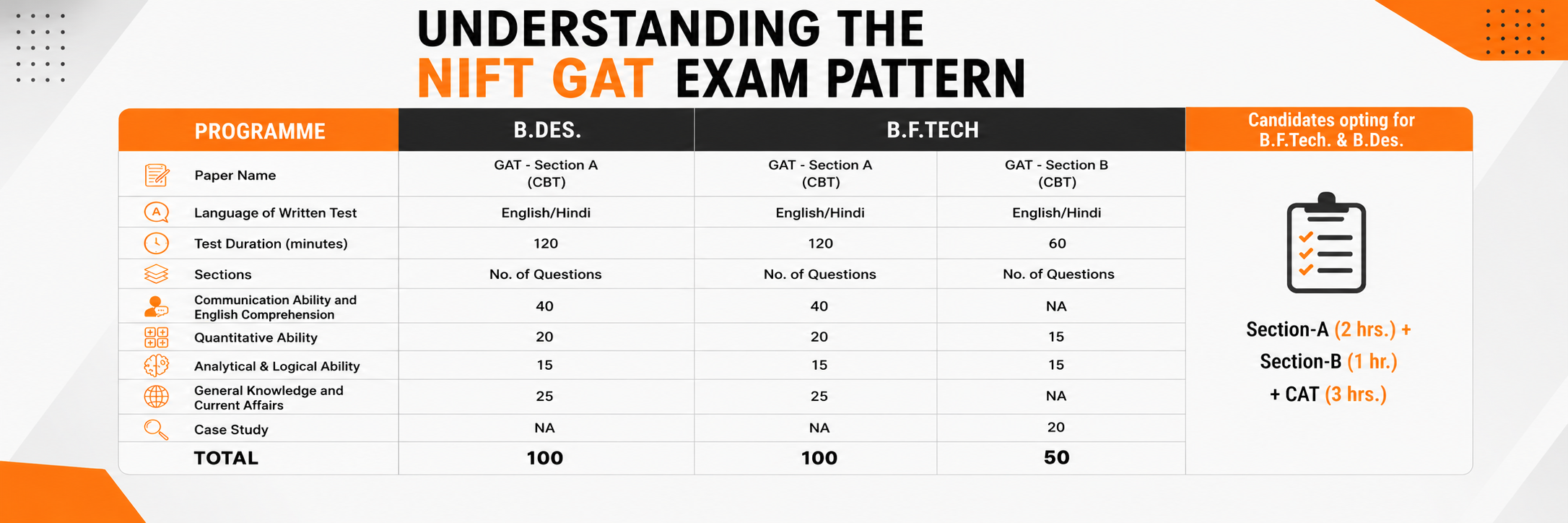
NIFT B.Des Exam Pattern
The Bachelor of Design entrance consists of two written examinations followed by the Situation Test.
General Ability Test (GAT)
Mode: Computer-Based Test (CBT)
Duration: 120 Minutes
Sections
- Communication Ability & English Comprehension – 40 Questions
- Quantitative Ability – 20 Questions
- Analytical & Logical Ability – 15 Questions
- General Knowledge & Current Affairs – 25 Questions
Total Questions: 100
Creative Ability Test (CAT)
Duration: 3 Hours
CAT evaluates:
- Creativity
- Drawing Skills
- Visualization
- Observation
- Imagination
- Storytelling
- Design Thinking
- Colour Sense
- Innovation
NIFT B.F.Tech Exam Pattern
Candidates applying for B.F.Tech appear in two sections.
GAT Section A
Duration: 120 Minutes
- Communication Ability & English Comprehension – 40 Questions
- Quantitative Ability – 20 Questions
- Analytical & Logical Ability – 15 Questions
- General Knowledge & Current Affairs – 25 Questions
Total: 100 Questions
GAT Section B
Duration: 60 Minutes
- Quantitative Ability – 15 Questions
- Analytical & Logical Ability – 15 Questions
- Case Study – 20 Questions
Total: 50 Questions
Students applying for both B.Des and B.F.Tech must appear for Section A, Section B, and CAT.
NIFT PG Exam Pattern
M.Des
Duration: 120 Minutes
- Communication Ability & English Comprehension – 50 Questions
- Quantitative Ability – 20 Questions
- Analytical & Logical Ability – 25 Questions
- General Knowledge & Current Affairs – 25 Questions
Total: 120 Questions
Qualified candidates appear for:
- Creative Ability Test (CAT)
- Personal Interview (PI)
MFM
Duration: 180 Minutes
Section A
- Communication Ability & English Comprehension – 50
- Quantitative Ability – 20
- Analytical & Logical Ability – 25
- General Knowledge & Current Affairs – 25
Section B
- Case Study – 30
Total Questions: 150
M.F.Tech
Duration: 180 Minutes
- Communication Ability & English Comprehension – 45
- Quantitative Ability – 30
- Analytical & Logical Ability – 25
- General Knowledge & Current Affairs – 25
- Case Study – 25
Total Questions: 150
Engineering-related questions are also included in the M.F.Tech examination.
NIFT 2027 Selection Process & Weightage
Understanding the official weightage allows students to focus on the sections that contribute the most to the final merit.
Undergraduate Courses
B.Des
- General Ability Test (GAT): 30%
- Creative Ability Test (CAT): 50%
- Situation Test: 20%
B.F.Tech
- GAT Section A: 30%
- GAT Section B: 70%
Candidates Applying for Both B.Des & B.F.Tech
- GAT Section A: 30%
- CAT: 50%
- Situation Test: 20%
Postgraduate Courses
M.Des
- GAT: 30%
- CAT: 40%
- Personal Interview: 30%
MFM
- GAT (Section A & B): 70%
- Personal Interview: 30%
M.F.Tech
- GAT: 70%
- Personal Interview: 30%
NIFT 2027 Syllabus
Creative Ability Test (CAT)
Students should practice:
- Human Figures
- Perspective Drawing
- Product Design
- Story Illustration
- Colour Composition
- Poster Design
- Object Drawing
- Memory Drawing
- Creative Visualization
- Design Thinking
General Ability Test (GAT)
Topics include:
- English Comprehension
- Vocabulary
- Grammar
- Quantitative Aptitude
- Logical Reasoning
- Analytical Ability
- General Knowledge
- Current Affairs
Best Preparation Strategy for NIFT 2027
1. Understand the Weightage
Do not divide your preparation equally.
For B.Des aspirants:
- CAT deserves the highest priority because it carries 50% weightage.
- GAT contributes 30%.
- Situation Test contributes 20%.
Planning your preparation according to weightage improves efficiency.
2. Practice Drawing Every Day
Spend at least 2 hours daily practicing:
- Human Figures
- Objects
- Nature
- Perspective
- Product Concepts
- Storytelling
- Colour Rendering
Creativity improves only through regular practice.
3. Improve Observation Skills
Great designers observe everything around them.
Develop habits like:
- Sketching everyday objects
- Visiting exhibitions
- Studying advertisements
- Watching documentaries
- Maintaining a visual journal
4. Master General Ability Test
Daily practice should include:
- Reading newspapers
- Current Affairs
- English Vocabulary
- Logical Reasoning
- Quantitative Aptitude
Speed and accuracy are equally important.
5. Solve Previous Year Papers
Previous papers help you understand:
- Difficulty Level
- Question Trends
- Frequently Asked Topics
- Time Management
Practice at least 10–15 years of previous papers.
6. Attempt Mock Tests
Mock tests simulate the real exam.
Benefits include:
- Better speed
- Improved confidence
- Reduced exam anxiety
- Performance analysis
- Time management
Aim to complete 30–50 full-length mock tests before the exam.
7. Prepare for Situation Test & Interview
Many students focus only on the written examination.
After qualifying, prepare for:
Situation Test
- Model Making
- Material Handling
- Creativity
- Neatness
- Concept Presentation
Personal Interview
- Portfolio Discussion
- Design Awareness
- Career Goals
- Communication Skills
- General Awareness
Common Mistakes to Avoid
- Starting preparation late
- Ignoring CAT practice
- Not attempting mock tests
- Weak time management
- Neglecting current affairs
- Memorizing instead of understanding concepts
- Ignoring creativity development
Daily Study Plan
| Activity | Time |
|---|---|
| Drawing Practice | 2 Hours |
| GAT Preparation | 2 Hours |
| Current Affairs | 30 Minutes |
| Previous Year Papers | 1 Hour |
| Mock Test & Analysis | 1.5 Hours |
Why Choose Pahal Design?
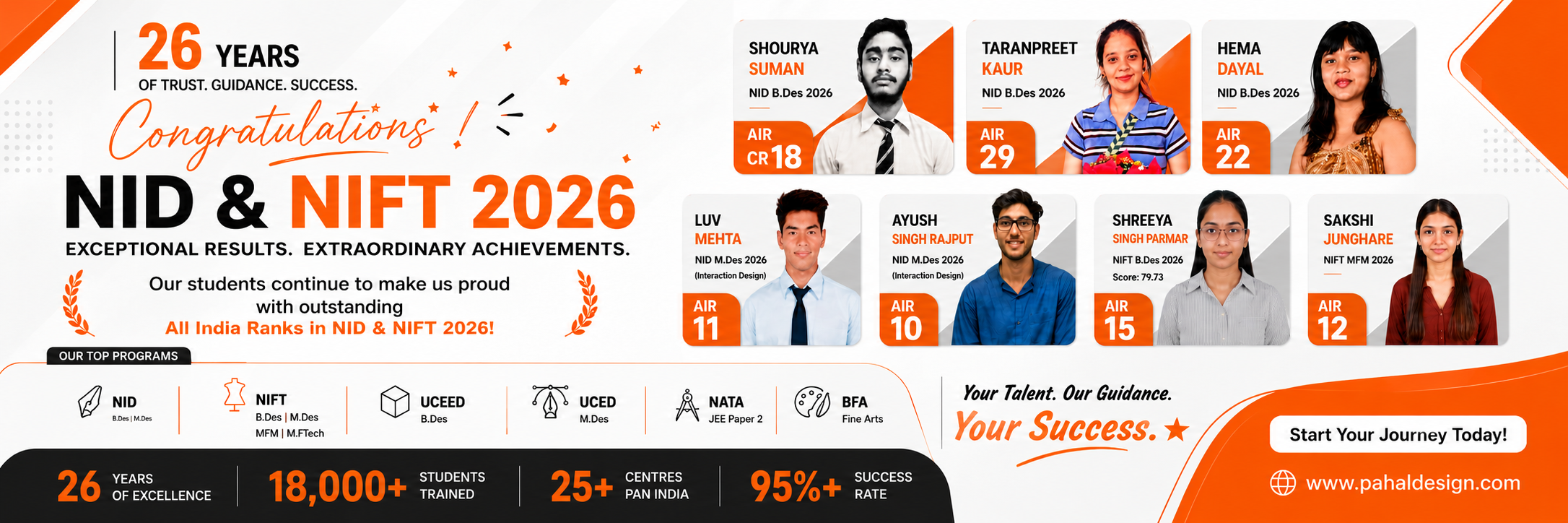
For over 26 years, Pahal Design has been one of India’s most trusted coaching institutes for design entrance examinations.
Students benefit from:
- Expert Faculty from NIFT & NID
- Comprehensive Study Material
- Unlimited Drawing Practice
- Regular Mock Tests
- Portfolio Development
- Situation Test Training
- Personal Interview Guidance
- Online & Classroom Coaching
- Individual Mentorship
- Proven Selection Record
Thousands of students trained at Pahal Design have secured admissions to prestigious institutions including NIFT, NID, UCEED, CEED, NATA, BFA, and leading international design universities.
Whether you’re beginning your preparation or aiming for a top rank, Pahal Design provides the guidance, resources, and mentorship needed to achieve your dream.
Final Thoughts
Success in the NIFT 2027 Entrance Exam is not just about hard work—it’s about preparing smartly. Understanding the latest exam pattern, focusing on high-weightage sections, practicing creativity daily, solving mock tests, and staying consistent are the keys to success.
Start your preparation early, follow a structured study plan, and seek expert guidance whenever needed. With dedication and the right coaching from Pahal Design, you can confidently secure admission to your dream NIFT campus and build a successful career in the design industry.

Frequently Asked Questions (FAQs) About NIFT 2027
1. What is the NIFT 2027 Entrance Exam?
The NIFT 2027 Entrance Exam is the admission test conducted by the National Institute of Fashion Technology for undergraduate and postgraduate programmes such as B.Des, B.F.Tech, M.Des, MFM, and M.F.Tech. The exam evaluates creativity, design aptitude, analytical ability, English, logical reasoning, quantitative aptitude, and general awareness.
2. What is the eligibility for NIFT 2027?
For B.Des and B.F.Tech, candidates should have passed or be appearing for Class 12 from a recognized board.
For M.Des, MFM, and M.F.Tech, candidates must possess a bachelor’s degree in the relevant discipline as prescribed by NIFT.
3. What is the exam pattern for NIFT 2027?
The NIFT entrance exam consists of:
- General Ability Test (GAT)
- Creative Ability Test (CAT) for design programmes
- Situation Test (for B.Des shortlisted candidates)
- Personal Interview (for postgraduate programmes)
The exam pattern varies depending on the course selected.
4. What subjects should I prepare for the NIFT GAT?
The General Ability Test (GAT) includes:
- Communication Ability
- English Comprehension
- Quantitative Ability
- Analytical & Logical Reasoning
- General Knowledge
- Current Affairs
- Case Study (for selected programmes)
5. What is CAT in the NIFT Entrance Exam?
The Creative Ability Test (CAT) evaluates:
- Creativity
- Drawing Skills
- Visualization
- Observation
- Design Thinking
- Innovation
- Colour Sense
- Storytelling through illustrations
CAT carries the highest weightage for B.Des aspirants.
6. What is the weightage of CAT and GAT in NIFT B.Des?
The latest weightage is:
- CAT – 50%
- GAT – 30%
- Situation Test – 20%
Students should dedicate maximum preparation time to CAT.
7. How many months are required to prepare for NIFT 2027?
Ideally, students should begin preparation 6–12 months before the examination. Starting early allows sufficient time for drawing practice, aptitude preparation, mock tests, and revision.
8. Is coaching necessary to crack NIFT?
While self-study is possible, professional coaching provides:
- Structured study plans
- Expert faculty guidance
- Regular mock tests
- Performance analysis
- Portfolio development
- Situation Test practice
- Personal Interview preparation
Many top-ranking students prefer coaching for systematic preparation.
9. How important are previous year’s question papers?
Previous year papers help students:
- Understand the latest exam pattern
- Identify important topics
- Improve speed and accuracy
- Build confidence
- Practice time management
Students should solve at least 10–15 years of previous papers.
10. How can I improve my drawing skills for NIFT CAT?
Practice daily by sketching:
- Human figures
- Objects
- Nature
- Perspective
- Product concepts
- Story illustrations
- Colour compositions
Observation and creativity are more important than perfect artistic skills.
11. How many mock tests should I attempt before NIFT?
Experts recommend attempting 30–50 full-length mock tests before the examination. Regular mock tests improve speed, accuracy, confidence, and time management.
12. Which books are best for NIFT preparation?
Some recommended resources include:
- Previous Year Question Papers
- Design Aptitude Books
- Drawing Practice Books
- Quantitative Aptitude Books
- Logical Reasoning Books
- Current Affairs Magazines
- Mock Test Series
Joining a reputed coaching institute like Pahal Design provides comprehensive study material and updated preparation resources.
13. Which is the best coaching institute for NIFT preparation?
Pahal Design is one of India’s leading coaching institutes for NIFT, NID, UCEED, CEED, NATA, and BFA entrance examinations.
With 26+ years of excellence, 18,000+ successful students, expert faculty, structured study material, mock tests, portfolio guidance, Situation Test preparation, and Personal Interview coaching, Pahal Design has helped thousands of students secure admission to top design institutes.
14. Why should I join Pahal Design for NIFT 2027 preparation?
At Pahal Design, students receive:
- Expert Mentors from NIFT & NID
- Comprehensive Study Material
- Regular Mock Tests
- CAT & GAT Preparation
- Situation Test Guidance
- Personal Interview Training
- Portfolio Development
- Classroom & Online Coaching
- Personalized Mentorship
- 25+ Centers Across India
15. How can I contact Pahal Design?
You can connect with our expert counsellors for admissions and career guidance.
📞 Phone: 8800-22-6864
🌐 Website: www.pahaldesign.com
📧 Email: corporate@pahaldesign.com