How to Crack NIFT 2027 Exam: Complete Preparation Strategy, Exam Pattern, Syllabus & Weightage

Preparing for the NIFT 2027 Entrance Exam is an exciting journey for aspiring designers. Every year, thousands of students compete for admission to the prestigious National Institute of Fashion Technology (NIFT), but only those with the right preparation strategy, creativity, and consistency secure top ranks.

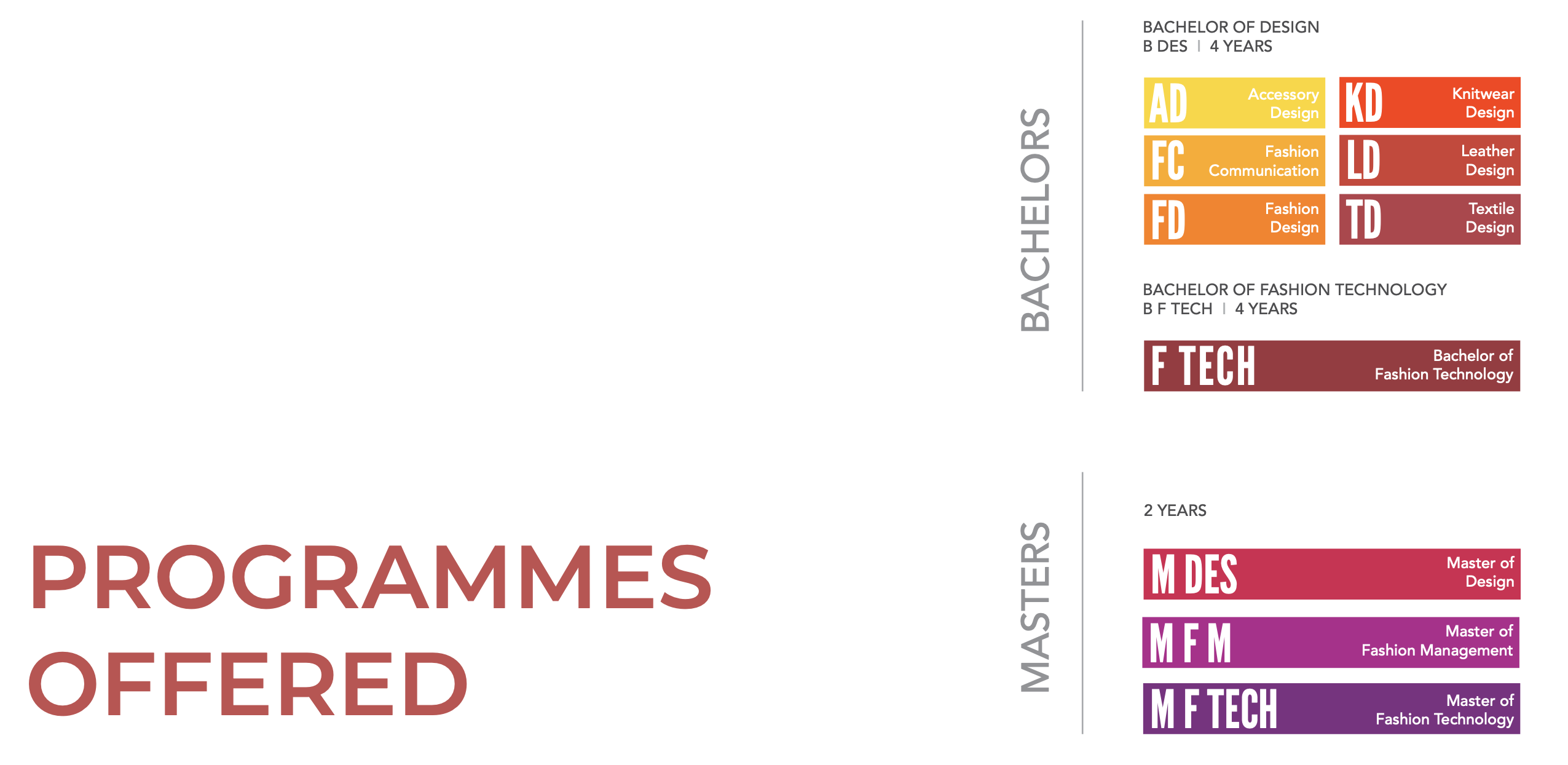
Whether you’re aiming for B.Des, B.F.Tech, M.Des, MFM, or M.F.Tech, understanding the latest exam pattern, syllabus, marking scheme, and weightage is essential. This comprehensive guide by Pahal Design, India’s leading design entrance coaching institute, will help you prepare smartly and maximize your chances of success.

Why Choose NIFT?

The National Institute of Fashion Technology (NIFT) is India’s premier institute for fashion, design, management, and technology education. With campuses across the country, NIFT offers world-class education, industry exposure, internships, placements, and opportunities to build a successful career in fashion, communication, lifestyle products, textile design, accessory design, knitwear, leather design, and fashion management.

Admission is based on a national-level entrance examination that evaluates creativity, aptitude, analytical thinking, and problem-solving abilities.

NIFT 2027 Exam Pattern

Understanding the exam pattern is the foundation of effective preparation. Since each programme has a different structure, candidates should prepare according to their chosen course.

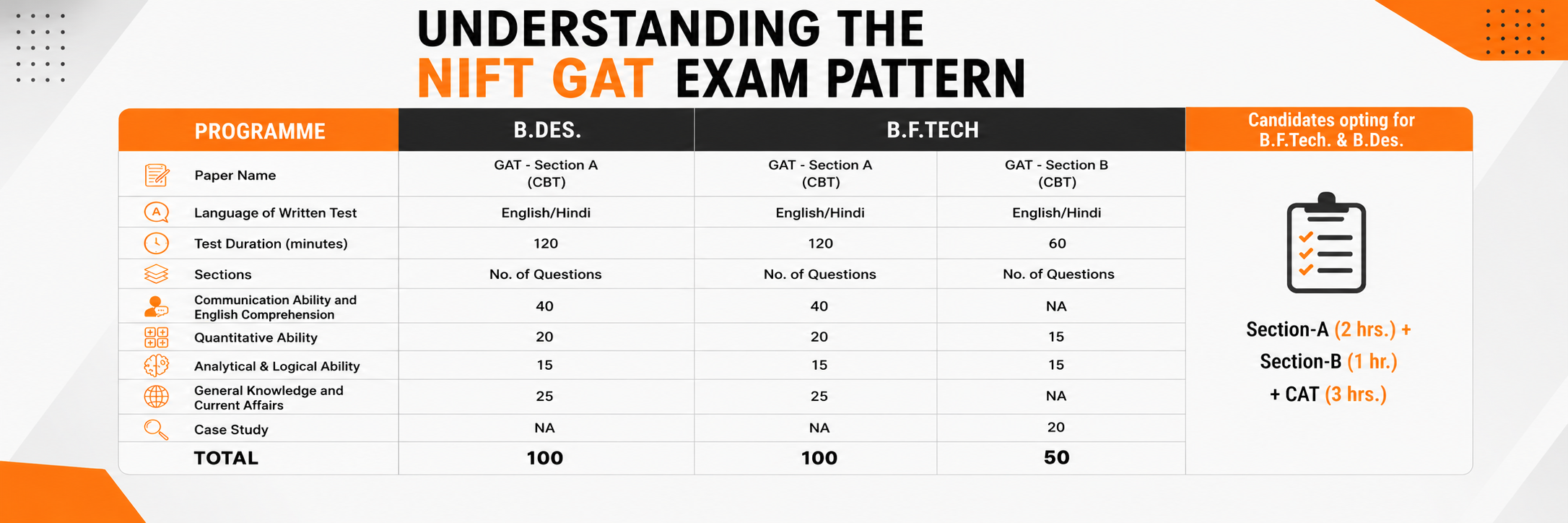
NIFT B.Des Exam Pattern

The Bachelor of Design entrance consists of two written examinations followed by the Situation Test.

General Ability Test (GAT)

Mode: Computer-Based Test (CBT)

Duration: 120 Minutes

Sections

  • Communication Ability & English Comprehension – 40 Questions
  • Quantitative Ability – 20 Questions
  • Analytical & Logical Ability – 15 Questions
  • General Knowledge & Current Affairs – 25 Questions

Total Questions: 100

Creative Ability Test (CAT)

Duration: 3 Hours

CAT evaluates:

  • Creativity
  • Drawing Skills
  • Visualization
  • Observation
  • Imagination
  • Storytelling
  • Design Thinking
  • Colour Sense
  • Innovation

NIFT B.F.Tech Exam Pattern

Candidates applying for B.F.Tech appear in two sections.

GAT Section A

Duration: 120 Minutes

  • Communication Ability & English Comprehension – 40 Questions
  • Quantitative Ability – 20 Questions
  • Analytical & Logical Ability – 15 Questions
  • General Knowledge & Current Affairs – 25 Questions

Total: 100 Questions

GAT Section B

Duration: 60 Minutes

  • Quantitative Ability – 15 Questions
  • Analytical & Logical Ability – 15 Questions
  • Case Study – 20 Questions

Total: 50 Questions

Students applying for both B.Des and B.F.Tech must appear for Section A, Section B, and CAT.
NIFT PG Exam Pattern

M.Des

Duration: 120 Minutes

  • Communication Ability & English Comprehension – 50 Questions
  • Quantitative Ability – 20 Questions
  • Analytical & Logical Ability – 25 Questions
  • General Knowledge & Current Affairs – 25 Questions

Total: 120 Questions

Qualified candidates appear for:

  • Creative Ability Test (CAT)
  • Personal Interview (PI)

MFM

Duration: 180 Minutes

Section A

  • Communication Ability & English Comprehension – 50
  • Quantitative Ability – 20
  • Analytical & Logical Ability – 25
  • General Knowledge & Current Affairs – 25

Section B

  • Case Study – 30

Total Questions: 150

M.F.Tech

Duration: 180 Minutes

  • Communication Ability & English Comprehension – 45
  • Quantitative Ability – 30
  • Analytical & Logical Ability – 25
  • General Knowledge & Current Affairs – 25
  • Case Study – 25

Total Questions: 150

Engineering-related questions are also included in the M.F.Tech examination.

NIFT 2027 Selection Process & Weightage

Understanding the official weightage allows students to focus on the sections that contribute the most to the final merit.

Undergraduate Courses

B.Des

  • General Ability Test (GAT): 30%
  • Creative Ability Test (CAT): 50%
  • Situation Test: 20%

B.F.Tech

  • GAT Section A: 30%
  • GAT Section B: 70%

Candidates Applying for Both B.Des & B.F.Tech

  • GAT Section A: 30%
  • CAT: 50%
  • Situation Test: 20%

Postgraduate Courses

M.Des

  • GAT: 30%
  • CAT: 40%
  • Personal Interview: 30%

MFM

  • GAT (Section A & B): 70%
  • Personal Interview: 30%

M.F.Tech

  • GAT: 70%
  • Personal Interview: 30%

NIFT 2027 Syllabus

Creative Ability Test (CAT)

Students should practice:

  • Human Figures
  • Perspective Drawing
  • Product Design
  • Story Illustration
  • Colour Composition
  • Poster Design
  • Object Drawing
  • Memory Drawing
  • Creative Visualization
  • Design Thinking

General Ability Test (GAT)

Topics include:

  • English Comprehension
  • Vocabulary
  • Grammar
  • Quantitative Aptitude
  • Logical Reasoning
  • Analytical Ability
  • General Knowledge
  • Current Affairs

Best Preparation Strategy for NIFT 2027

1. Understand the Weightage

Do not divide your preparation equally.

For B.Des aspirants:

  • CAT deserves the highest priority because it carries 50% weightage.
  • GAT contributes 30%.
  • Situation Test contributes 20%.

Planning your preparation according to weightage improves efficiency.

2. Practice Drawing Every Day

Spend at least 2 hours daily practicing:

  • Human Figures
  • Objects
  • Nature
  • Perspective
  • Product Concepts
  • Storytelling
  • Colour Rendering

Creativity improves only through regular practice.

3. Improve Observation Skills

Great designers observe everything around them.

Develop habits like:

  • Sketching everyday objects
  • Visiting exhibitions
  • Studying advertisements
  • Watching documentaries
  • Maintaining a visual journal

4. Master General Ability Test

Daily practice should include:

  • Reading newspapers
  • Current Affairs
  • English Vocabulary
  • Logical Reasoning
  • Quantitative Aptitude

Speed and accuracy are equally important.

5. Solve Previous Year Papers

Previous papers help you understand:

  • Difficulty Level
  • Question Trends
  • Frequently Asked Topics
  • Time Management

Practice at least 10–15 years of previous papers.

6. Attempt Mock Tests

Mock tests simulate the real exam.

Benefits include:

  • Better speed
  • Improved confidence
  • Reduced exam anxiety
  • Performance analysis
  • Time management

Aim to complete 30–50 full-length mock tests before the exam.

7. Prepare for Situation Test & Interview

Many students focus only on the written examination.

After qualifying, prepare for:

Situation Test

  • Model Making
  • Material Handling
  • Creativity
  • Neatness
  • Concept Presentation

Personal Interview

  • Portfolio Discussion
  • Design Awareness
  • Career Goals
  • Communication Skills
  • General Awareness

Common Mistakes to Avoid

  • Starting preparation late
  • Ignoring CAT practice
  • Not attempting mock tests
  • Weak time management
  • Neglecting current affairs
  • Memorizing instead of understanding concepts
  • Ignoring creativity development

Daily Study Plan

ActivityTime
Drawing Practice2 Hours
GAT Preparation2 Hours
Current Affairs30 Minutes
Previous Year Papers1 Hour
Mock Test & Analysis1.5 Hours

Why Choose Pahal Design?

For over 26 years, Pahal Design has been one of India’s most trusted coaching institutes for design entrance examinations.

Students benefit from:

  • Expert Faculty from NIFT & NID
  • Comprehensive Study Material
  • Unlimited Drawing Practice
  • Regular Mock Tests
  • Portfolio Development
  • Situation Test Training
  • Personal Interview Guidance
  • Online & Classroom Coaching
  • Individual Mentorship
  • Proven Selection Record

Thousands of students trained at Pahal Design have secured admissions to prestigious institutions including NIFT, NID, UCEED, CEED, NATA, BFA, and leading international design universities.

Whether you’re beginning your preparation or aiming for a top rank, Pahal Design provides the guidance, resources, and mentorship needed to achieve your dream.
Final Thoughts

Success in the NIFT 2027 Entrance Exam is not just about hard work—it’s about preparing smartly. Understanding the latest exam pattern, focusing on high-weightage sections, practicing creativity daily, solving mock tests, and staying consistent are the keys to success.

Start your preparation early, follow a structured study plan, and seek expert guidance whenever needed. With dedication and the right coaching from Pahal Design, you can confidently secure admission to your dream NIFT campus and build a successful career in the design industry.
Book Your Free Career Counselling Session Today

Not sure which design entrance exam is right for you?

Our expert counsellors will help you:

  • Choose the right design career path
  • Understand the NIFT, NID, UCEED, CEED, NATA, and BFA admission process
  • Create a personalized preparation plan
  • Learn about scholarships and coaching programs
  • Get answers to all your admission-related questions

📞 Call Now: 8800-22-6864

🌐 Visit: www.pahaldesign.com

🎯 Your Design Dream Begins with Pahal Design!

Frequently Asked Questions (FAQs) About NIFT 2027

1. What is the NIFT 2027 Entrance Exam?

The NIFT 2027 Entrance Exam is the admission test conducted by the National Institute of Fashion Technology for undergraduate and postgraduate programmes such as B.Des, B.F.Tech, M.Des, MFM, and M.F.Tech. The exam evaluates creativity, design aptitude, analytical ability, English, logical reasoning, quantitative aptitude, and general awareness.

2. What is the eligibility for NIFT 2027?

For B.Des and B.F.Tech, candidates should have passed or be appearing for Class 12 from a recognized board.

For M.Des, MFM, and M.F.Tech, candidates must possess a bachelor’s degree in the relevant discipline as prescribed by NIFT.

3. What is the exam pattern for NIFT 2027?

The NIFT entrance exam consists of:

  • General Ability Test (GAT)
  • Creative Ability Test (CAT) for design programmes
  • Situation Test (for B.Des shortlisted candidates)
  • Personal Interview (for postgraduate programmes)

The exam pattern varies depending on the course selected.

4. What subjects should I prepare for the NIFT GAT?

The General Ability Test (GAT) includes:

  • Communication Ability
  • English Comprehension
  • Quantitative Ability
  • Analytical & Logical Reasoning
  • General Knowledge
  • Current Affairs
  • Case Study (for selected programmes)

5. What is CAT in the NIFT Entrance Exam?

The Creative Ability Test (CAT) evaluates:

  • Creativity
  • Drawing Skills
  • Visualization
  • Observation
  • Design Thinking
  • Innovation
  • Colour Sense
  • Storytelling through illustrations

CAT carries the highest weightage for B.Des aspirants.

6. What is the weightage of CAT and GAT in NIFT B.Des?

The latest weightage is:

  • CAT – 50%
  • GAT – 30%
  • Situation Test – 20%

Students should dedicate maximum preparation time to CAT.

7. How many months are required to prepare for NIFT 2027?

Ideally, students should begin preparation 6–12 months before the examination. Starting early allows sufficient time for drawing practice, aptitude preparation, mock tests, and revision.

8. Is coaching necessary to crack NIFT?

While self-study is possible, professional coaching provides:

  • Structured study plans
  • Expert faculty guidance
  • Regular mock tests
  • Performance analysis
  • Portfolio development
  • Situation Test practice
  • Personal Interview preparation

Many top-ranking students prefer coaching for systematic preparation.

9. How important are previous year’s question papers?

Previous year papers help students:

  • Understand the latest exam pattern
  • Identify important topics
  • Improve speed and accuracy
  • Build confidence
  • Practice time management

Students should solve at least 10–15 years of previous papers.

10. How can I improve my drawing skills for NIFT CAT?

Practice daily by sketching:

  • Human figures
  • Objects
  • Nature
  • Perspective
  • Product concepts
  • Story illustrations
  • Colour compositions

Observation and creativity are more important than perfect artistic skills.

11. How many mock tests should I attempt before NIFT?

Experts recommend attempting 30–50 full-length mock tests before the examination. Regular mock tests improve speed, accuracy, confidence, and time management.

12. Which books are best for NIFT preparation?

Some recommended resources include:

  • Previous Year Question Papers
  • Design Aptitude Books
  • Drawing Practice Books
  • Quantitative Aptitude Books
  • Logical Reasoning Books
  • Current Affairs Magazines
  • Mock Test Series

Joining a reputed coaching institute like Pahal Design provides comprehensive study material and updated preparation resources.

13. Which is the best coaching institute for NIFT preparation?

Pahal Design is one of India’s leading coaching institutes for NIFT, NID, UCEED, CEED, NATA, and BFA entrance examinations.

With 26+ years of excellence, 18,000+ successful students, expert faculty, structured study material, mock tests, portfolio guidance, Situation Test preparation, and Personal Interview coaching, Pahal Design has helped thousands of students secure admission to top design institutes.

14. Why should I join Pahal Design for NIFT 2027 preparation?

At Pahal Design, students receive:

  • Expert Mentors from NIFT & NID
  • Comprehensive Study Material
  • Regular Mock Tests
  • CAT & GAT Preparation
  • Situation Test Guidance
  • Personal Interview Training
  • Portfolio Development
  • Classroom & Online Coaching
  • Personalized Mentorship
  • 25+ Centers Across India

15. How can I contact Pahal Design?

You can connect with our expert counsellors for admissions and career guidance.

📞 Phone: 8800-22-6864

🌐 Website: www.pahaldesign.com

📧 Email: corporate@pahaldesign.com
 

Join India’s Best Online Design Entrance Coaching for 2026–27 Admissions – Pahal Design

If you are dreaming of getting into NID, NIFT, IIT-UCEED, IIT-CEED, NATA, JEE Paper 2, or top BFA colleges, the right guidance can make all the difference.

At Pahal Design, we bring 26 years of excellence in design entrance coaching, helping thousands of students transform their creativity into successful careers.

Our Online Live Interactive Classes for the 2026–27 batch are specially designed for students who want expert mentorship, structured preparation, flexibility, and proven results—all from the comfort of home.

Why Choose Pahal Design Online Coaching?

1. Live Interactive Learning

Unlike recorded courses, our classes are fully live and interactive, allowing students to:

  • Ask questions in real-time
  • Get immediate faculty feedback
  • Participate in creative discussions
  • Solve doubts instantly
  • Stay motivated through structured mentorship

This creates a classroom-like experience online.

2. Expert Faculty from Top Design Institutes

Learn from experienced mentors with backgrounds from:

  • NID
  • NIFT
  • IIT Design Programs
  • CEPT
  • JJ College of Art
  • Industry Professionals

Our faculty understand exactly what design entrance exams demand.

3. Preparation for Multiple Design Entrance Exams

Our online coaching covers complete preparation for:

NID Coaching

Preparation for:

  • Design Aptitude
  • Creative Thinking
  • Sketching
  • Studio Test Preparation
  • Design Problem Solving

NIFT Coaching

Complete preparation for:

  • CAT
  • GAT
  • Situation Test
  • Portfolio Guidance
  • Interview Preparation

IIT-UCEED Coaching

Comprehensive coaching for:

  • Visualisation & Spatial Ability
  • Observation Skills
  • Analytical & Logical Reasoning
  • Design Thinking
  • Drawing & Sketching

IIT-CEED Coaching

Advanced preparation for:

  • Design Aptitude
  • Analytical Ability
  • Problem Solving
  • Sketching
  • Product Thinking

NATA Coaching

Structured training for:

  • Architecture Aptitude
  • Perspective Drawing
  • Visual Reasoning
  • Mathematics
  • Architectural Awareness

JEE Paper 2 Coaching

Focused preparation for:

  • B.Arch Entrance
  • Drawing Test
  • Aptitude
  • Mathematics
  • Visualization

BFA Entrance Coaching

Preparation for Fine Arts admissions:

  • Creative Drawing
  • Composition
  • Sketching
  • Colour Theory
  • Practical Art Training

Benefits of Pahal Design Online live Classes 2026

Personalized Mentoring

Every student gets:

  • Individual attention
  • Performance tracking
  • Personalized feedback
  • Exam strategy guidance
  • Career counselling

Structured Study Material

Students receive:

  • Design study notes
  • Practice sheets
  • Sketching assignments
  • Mock tests
  • Previous year questions
  • Creative exercises

Proven Results

Pahal Design has consistently delivered excellent results in:

  • NID
  • NIFT
  • UCEED
  • CEED
  • NATA
  • BFA
  • Architecture Admissions

Thousands of successful students have built their careers through our mentorship.

Who Should Join?

This course is ideal for:

✅ Class 11 students
✅ Class 12 students
✅ Gap year students
✅ College students preparing for CEED
✅ Architecture aspirants
✅ Fine Arts aspirants
✅ Working professionals switching to design careers

Why Online Coaching Works Better Today

Online learning provides:

  • Flexibility
  • Time savings
  • Access to top faculty from anywhere in India
  • Recorded revision support
  • Better consistency
  • Personalized doubt-solving

Students from Delhi, Gurgaon, Noida, Jaipur, Lucknow, Chandigarh, Patna, Bengaluru and across India can learn with Pahal Design.

About Pahal Design

Pahal Design is one of India’s most trusted design coaching institutes with 26 years of experience in design education.

We specialize in:

  • NID Coaching
  • NIFT Coaching
  • UCEED Coaching
  • CEED Coaching
  • NATA Coaching
  • JEE B.Arch / Paper 2 Coaching
  • Fine Arts Entrance Preparation

Our mission is simple:
Transform creative students into successful designers.

Admissions Open for 2026–27 Batch

Seats are limited for our Online Live Interactive Classes.

If you are serious about cracking India’s top design entrance exams, this is the right time to begin.

📞 Call Now: 8800-22-6864
🌐 Website: www.pahaldesign.com

FAQs

Which is the best online coaching for NID preparation?

Pahal Design offers comprehensive online coaching for NID with live classes, expert faculty, studio preparation, and mentorship.

Does Pahal Design provide coaching for IIT-UCEED and IIT-CEED?

Yes, Pahal Design provides structured coaching for both IIT-UCEED and IIT-CEED.

Is NATA coaching available online?

Yes, students can prepare for NATA through live online interactive classes at Pahal Design.

Does Pahal Design offer JEE Paper 2 coaching?

Yes, we provide complete preparation for JEE Paper 2 (B.Arch).

Can BFA aspirants join?

Absolutely. Dedicated Fine Arts entrance coaching is available.

Introduction

Growth is a reflection of progress, and at Pahal Design, we believe in constantly evolving to provide the best for our students. With this vision, we are excited to announce that our Jaipur center has moved to a prime location in Vaishali Nagar—bringing you closer to excellence with improved infrastructure, accessibility, and learning experience.

Why the Shift? A Step Towards Excellence

Over the years, Pahal Design has built a reputation for delivering outstanding results in entrance exams like NID, NIFT, NATA, UCEED, and BFA. As our student community grew, so did the need for a more advanced and accessible space.

This relocation is not just about a new address—it’s about creating an environment that nurtures creativity, innovation, and success.

What’s New at Our Vaishali Nagar Centre?

1. Prime Location Advantage

Our new center is strategically located in Vidyut Nagar, Vaishali Nagar, one of Jaipur’s most well-connected and student-friendly areas.

  • Easy access from all parts of Jaipur
  • Well-connected via public and private transport
  • Safe and vibrant surroundings

2. Enhanced Infrastructure

We’ve upgraded every aspect of our facilities to ensure a better learning experience:

  • Spacious, well-lit classrooms
  • Modern studio setup for design practice
  • Dedicated spaces for sketching and creativity
  • Comfortable learning environment

3. Better Accessibility & Convenience

Whether you’re a school student or a drop-year aspirant, reaching us is now easier than ever.

  • Reduced travel time for most students
  • Nearby amenities like cafes, stationery shops, and libraries
  • Improved commuting convenience for daily classes

4. Same Trusted Results, Even Better Experience

While the location and infrastructure have improved, one thing remains unchanged—our commitment to delivering top results.

  • Expert faculty with years of experience
  • Proven track record in design entrance exams
  • Personalized mentoring and guidance
  • Result-oriented teaching approach

Courses Offered

At our new Jaipur center, we continue to offer preparation for:

Admissions Open – Apply Now!

With upgraded facilities and a prime location, this is the perfect time to begin your design journey with Pahal Design.

Seats are limited to maintain quality teaching standards—so don’t wait!

Visit Us at Our New Address

C51, 1st Floor, Vidyut Nagar, Vaishali Nagar, Chitrakoot, Jaipur – 302021
🌐 www.pahaldesign.com
📞 9821-651-399

Start Your Design Career Today

Join Pahal Design Jaipur and take the first step toward your dream college.

Book a Free Demo Class
Talk to Our Counselors
Apply Now


National Aptitude Test in Architecture (NATA) is being conducted by COA since 2006, to qualify for the admission to Bachelor of Architecture.

NATA measures the aptitude of the applicant for specific field of study, i.e., Architecture, through assessment of cognitive skills, visual perception and aesthetic sensitivity tests, logical reasoning and critical thinking ability, etc., besides the learning that the candidate has acquired over the past years.

The candidates can appear for maximum of 3 attempts in NATA 2024 in one academic year. The best score out of all the attempts shall be considered for declaration of results. The score of NATA Test would be valid for a period of 2 academic years.

Examination shall be conducted on all weekends starting from April to July, 2024 in two sessions, subject to number of candidates registered for the session.

The medium of Aptitude test shall be in English and Hindi.

The aptitude of the candidate will be assessed using some or all of the following:

PART-A

Drawing and Composition Test

This is one and half hour (90 minutes) – 80 Marks Test where candidate has to attempt three questions. The content of the PART A Test is as follows:

  • A1 – Composition and Color -25 Marks: Creating suitable compositions for various situations and coloring them appropriately. Re-arranging various shapes in visually appealing manner and coloring it suitably.
  • A2 -Sketching & Composition (Black and White)-25 Marks: Ability to draw, visualize, depict a situation, involving buildings / its components, people, environment, products with an understanding of scale, proportions, textures, shades and shadow etc.
  • A3 – 3D Composition-30 Marks: Creating interesting 3D composition for the given situation using the provided kit.

    PART-B

    This is one and half hour (90 minutes), 120 Marks Test where candidate has to appear for online test. It shall have two type of Questions viz., B1 – 30 Questions of 2 Marks and B2 – 15 Questions of 4 Marks from the following topics:

  • Visual Reasoning Ability to understand and reconstruct 2D and 3D composition, knowledge about its composition and technical concepts.
  • Logical Derivation Ability to decode a situation, composition, context and generate meaning. Understanding the minute information hidden in a particular situation and drawing conclusions.
  • G.K., Architecture & Design General awareness of architecture and design, current issues, recent episodes etc., Knowledge about important buildings, historical progression, innovation in materials and construction technology.
  • Language Interpretation Ability to correctly & logically generate meaning of words, sentences, understanding about English grammar.
  • Design Sensitivity Ability to observe record and analyze, people, space, product, environment. Critical thinking, reasoning and ability to identify the subtle communications.
  • Design Thinking Ability to understand semantics, metaphors, problem identification and definition, analysis of a given situation.
  • Numerical Ability Basic Mathematics and its association with creative thinking. To unfold a space with use of geometry.

Qualifying Criteria


The Qualifying Marks for the NATA 2024 would be based on the following Rules:

  1. A minimum of 20 marks must be secured in PART A
  2. A minimum of 30 marks must be secured in PART B
  3. Overall qualifying marks for NATA 2024 shall be 70 marks out of 200 as aggregate of Part A and Part B.

IMPORTANT LINKS

May Cycle

• Examination Dates – 22nd May 2021, Mode of Exam – Online
• Personal Interview – 26th & 27th May 2021
• Results – 2nd June 2021
• Last date to apply – 16th May 2021
• Last date to apply for Who’s Next Scholarship: 19th May 2021

Procedure & Guidelines

Candidates applying online are required to apply through the Admissions 2021 Portal (ADMISSIONS 2021) on the official home page of Pearl Website www.pearlacademy.com

Candidates appearing in their final examinations can also apply provisionally.

Candidates can apply through the Online mode using either Debit/Credit Card/Net Banking

Application fee is to be paid using Credit Card / Debit Card / Net banking Please keep your Credit Card / Debit Card ready with you before applying.

Candidates are required to Register Online using a Valid e-mail ID before applying. This email ID should be valid for at least next 1 year.

Candidates applying online are required to apply through the Admissions 2021 Portal (ADMISSIONS 2021) on the official home page of Pearl Website

  • Candidates appearing in their final examinations can also apply provisionally.
  • Candidates can apply through the Online mode using either Debit/Credit Card/Net Banking.
  • Application fee is to be paid using Credit Card / Debit Card / Net banking. Please keep your Credit Card / Debit Card/ ready with you before applying.
  • Candidates are required to Register Online using a Valid e-mail ID & Mobile number before applying.

Candidates are advised to keep the following ready with them before applying online:

  • Credit / Debit Card/Net Banking/.
  • Scanned copy of passport size photograph [The photograph must be a recent passport size color picture, preferably in white background. Photographs with Caps, hats and dark glasses are not acceptable. The image should be in .jpg format only. Size of file should not be more than 1 mb].
  • Details of educational qualifications (marks / grade / year of passing etc.)

Payment Guidelines

  • Fill up the registration form with basic details
  • Verify the OTP which will be sent on registered OTP
  • After validating OTP, An email activation link will be sent in your registered email id
  • After clicking on “Activation Key”, student will get a page to make to pay the online application form charges.
  • Submit application fee charges by selecting Credit Card / Debit Card/Net banking options.
  • After successful payment of Rs. 1500/-, an auto confirmation email & SMS will be sent on your registered email Id /Mobile No containing the follow:-
    a) confirmation of successful Registration & Payment
    b) Your online application form no.
    c) Instructions to fill the complete the application form for further process
  • After receiving the payment submission confirmation email, click on given URL to fill the incomplete form
  • Update the required application form
  • Click on “Click here for final submit” to submit the filled application
  • After completion of your Online Application SAVE your Online Application and take a print out. • An auto-generated confirmation mail will be sent on your Email ID after the complete form submission:
  • https://admissions.pearlacademy.com/studentportal/studentloginnew.aspx
  • Enter User id & Password
    • for online form submission – email id will be your User ID & password created by you
    • for Offline form submission – Email ID will be your User ID & Password will be sharing on your email id, once form will be submitted at our end.
  • Candidates applying online are required to apply through the Admissions 2021 or apply now on the official home page of Pearl Website
    • Candidates appearing in their final examinations can also apply provisionally.
    • Candidates can apply through the Online mode using either Debit/Credit Card/Net Banking/.
    • Application fee is to be paid using Credit Card / Debit Card / Net banking. Please keep your Credit Card / Debit Card / with you before applying.
    • Candidates are required to Register Online using a Valid e-mail ID & Mobile number before applying.

General Instructions

  • Pearl Academy is a unit of “Creative Arts Education Society”, a society registered under the Societies Registration Act, 1860, New Delhi.
  • Candidates applying online are required to apply through the Admissions 2021 Portal (ADMISSIONS – 2021) on the official home page of Pearl Website (www.pearlacademy.com). Please read the Guidelines for Applying carefully before applying.
  • Candidates can apply through the Online mode using either Debit/Credit Card or Demand Draft.
  • Application fee of Rs. 1500/- is to be paid using Credit Card / Debit Card / Demand Draft. Please keep your Credit Card / Debit Card / ready with you before applying.
  • Candidates are required to Register Online using a Valid e-mail ID before applying.
  • Candidates can also apply through Offline mode by purchasing a hard copy of Application form the Pearl Academy campuses
  • Candidates appearing in their final examinations can also apply provisionally.
  • Pearl Academy (“Academy”) reserves the right to cancel a course before or after its commencement by giving a notice, at any time due to any internal technical or administrative reasons or due to insufficient strength of the course. If Academy cancels a course, you will be eligible for a full refund of the course fee. Academy may also offer a transfer to another course as an alternative, subject to payment or refund of any difference in course fees.Academy will process any refund due as soon as possible and, in any case, within 45 days of notice of cancellation. The refund will be made using the same method of payment that you originally used to make your course booking unless otherwise expressly agreed.

    Academy will make all reasonable efforts to deliver the course as outlined on Academy’s site and in any brochure or published material. However, Academy reserve the right to:

    1. Alter the timetable, location or presenters specified for a course; and
    2. Make reasonable amendments to the content and syllabus of a course, when necessary.

    Academy reserve the right to cancel your course booking in Academy’s absolute discretion, and refund all fees paid by you, irrespective of whether the course itself is to proceed, without any further liability on our part.

    Academy also reserves the right to exclude you from any course before or after its commencement of course, if in Academy’s absolute discretion Academy consider that you are impeding the provision of the course or other of Academy’s activities, or your presence is bringing or threatening to bring the Academy or any part of it or its subsidiaries into disrepute. In these circumstances, Academy will refund all fees paid by you but will have no further liability to you in respect of such termination or exclusion.

  • Pearl Academy reserves the right to cancel / add / change any entrance test center(s) due to administrative reasons. Other centers may also be added and such information, as well as the exact location of the centers, will be notified later.
  • Admit cards for Written Test & Personal Interviews for both admission cycles will be available 4 days before the Written Test. Candidates are required to download Admit Cards from Pearl Website only. Please check Pearl website regularly for updates.
  • For any further details contact 9821-651-399 

Set up in 1986, NIFT is the pioneering institute of fashion education in the country and has been in the vanguard of providing professional human resource to the textile and apparel industry. It was made a statutory institute in 2006 by an Act of the Indian Parliament with the President of India as ‘Visitor’ and has full-fledged campuses all across the country. Over the years NIFT has also been working as a knowledge service provider to the Union and State governments in the area of design development and positioning of handlooms and handicrafts.

Curriculum

Programme Structure

NIFT has adopted a format of Majors, Deepening Specialisations, Minors and General Electives. Inter disciplinary Minors provide individuated pathways that would permit students to acquire interdisciplinary skillsets and opt for a set of subjects that complement studies in one’s major or explore an unrelated area of intellectual interest. General Electives have been offered to the students to help them enhance their personality and develop interests in specific areas like Personality Development, Communication Skills, Critical Thinking Skills, Professional Ethics etc. The Craft Cluster Initiative has been integrated into the curriculum. Increased Industry interaction for students through classroom projects, internships and part transaction in Industry Environment is the focus of the restructured curriculum.

The contact hours have been recalibrated to 25 hours per week, giving increased time for studio practice and self–study to the students. Standardisation of credits across all programmes and all semesters has been undertaken.

New and emerging areas across disciplines integrated into the curriculum:

    1. a) Artificial Intelligence
    1. d) Advanced Apparel Manufacturing Management
      b) Internet of Things

      c) Designing Ergonomic Environment
    1. e) Big Data and Business Analytics
    1. f) Fashion Thinking
    1. g) User Experience, Sensory Design
    1. h) Augmented Reality, Virtual Experience design
    1. i) Head Gear Design
    1. j) CAD 3D & Contemporary Manufacturing
    1. k) Couture Jewellery
    1. l) Travel & Outdoor Gear Design
    1. m) Design for Society
    1. n) Smart Jewellery
    1. o) Smart Textiles
    1. p) Active Sportswear, Bespoke Menswear, Wearable Technology
    1. q) Shapewear & Seamless Garments on Computerized Knitting
    1. r) Optitex for Virtual Prototyping
    1. s) Surface Embellishment: Digital Embroidery, Laser, 3D Printing
    1. t) Design Strategy

NIFT PARTNERSHIP AND ASSOCIATION

NIFT – Fashion Institute of Technology (FIT), New York, USA strategic partnership provides a unique opportunity to select meritorious NIFT students to obtain Dual Degree from both NIFT and FIT. Students from NIFT undertake two years study at the home Institute intercepted by one year of study at FIT. Thereafter, the students resume their studies at NIFT to obtain the Dual Degree from both the institutes.

Some of the key institutes with whom NIFT has an association are Queensland University of Technology, Australia; De Montfort University, UK; Glasgow School of Arts, UK; Swiss Textile College, Switzerland; ENSAIT, France; NABA, Italy; ESMOD, Germany; Saxion University of Applied Sciences, Netherlands; Amsterdam Fashion Institute, Netherlands; Bunka Gauken University, Japan; University of Northampton, UK; Politechnico di Milano, Italy; KEA – Copenhagen School of Design and Technology, Denmark; North Carolina State University, USA; The Savannah College of Art and Design (SCAD), USA and many more. NIFT is also a member of the prestigious International Foundation for Fashion Technology Institutes (IFFTI) and Cumulus, an international body representing design institutes of the world.

AHMEDABAD (Drive-in-Road)
Address:- 9, 1st Floor, Sunrise Centre-II, Sunrise Park, Bodakdev,
Ahmedabad, Gujarat-380015
Landmark: Off Drive-in-Road
Contact No: 78029-49620, 079-40398630
Contact Person: Ms Manisha Malkani
Email: ahmedabad@pahaldesign.com

Graphic designers create visual concepts, using computer software or by hand, to communicate ideas that inspire, inform, and captivate consumers. They develop the overall layout and production design for applications such as advertisements, brochures, magazines, and reports.

Duties

Graphic designers typically do the following:

  • Meet with clients or the art director to determine the scope of a project
  • Use digital illustration, photo editing software, and layout software to create designs
  • Create visual elements such as logos, original images, and illustrations to help deliver a message
  • Design layouts, including selection of colors, images, and typefaces
  • Present design concepts to clients or art directors
  • Incorporate changes recommended by clients or art directors into final designs
  • Review designs for errors before printing or publishing them

Graphic designers, also referred to as graphic artists or communication designers, combine art and technology to communicate ideas through images and the layout of websites and printed pages. They may use a variety of design elements to achieve artistic or decorative effects.

Graphic designers work with both text and images. They often select the type, font, size, color, and line length of headlines, headings, and text. Graphic designers also decide how images and text will go together in print or on a webpage, including how much space each will have. When using text in layouts, graphic designers collaborate with writers, who choose the words and decide whether the words will be put into paragraphs, lists, or tables. Through the use of images, text, and color, graphic designers may transform data into visual graphics and diagrams to make complex ideas more accessible.

Graphic design is important to market and sell products, and it is a critical component of brochures and logos. Therefore, graphic designers often work closely with people in advertising and promotions, public relations, and marketing.

Frequently, designers specialize in a particular category or type of client. For example, some designers create the graphics used on product packaging, and others may work on the visual designs used on book jackets.

Graphic designers need to keep up to date with software and computer technologies in order to remain competitive.

Some individuals with a background in graphic design become postsecondary teachers and teach in design schools, colleges, and universities.

Some graphic designers specialize in experiential graphic design. These designers work with architects, industrial designers, landscape architects, and interior designers to create interactive design environments, such as museum exhibitions, public arts exhibits, and retail spaces.

Education for Graphic Designers
A bachelor’s degree in graphic design or a related field is usually required. However, individuals with a bachelor’s degree in another field may pursue technical training in graphic design to meet most hiring qualifications.

The National Association of Schools of Art and Design accredits about 350 postsecondary colleges, universities, and independent institutes with programs in art and design. Most programs include courses in studio art, principles of design, computerized design, commercial graphics production, printing techniques, and website design. In addition, students should consider courses in writing, marketing, and business, all of which are useful in helping designers work effectively on project teams.

High school students interested in graphic design should take basic art and design courses in high school, if the courses are available. Many bachelor’s degree programs require students to complete a year of basic art and design courses before being admitted to a formal degree program. Some schools require applicants to submit sketches and other examples of their artistic ability.

Many programs provide students with the opportunity to build a professional portfolio of their designs. For many artists, including graphic designers, developing a portfolio—a collection of completed works that demonstrates their styles and abilities—is essential because employers rely heavily on a designer’s portfolio in deciding whether to hire the individual.

Graphic designers must keep up with new and updated computer graphics and design software, either on their own or through formal software training programs. Professional associations that specialize in graphic design, such as AIGA, offer courses intended to keep the skills of their members up to date.

Other Experience for Graphic Designers
Graphic designers often gain their initial experience through internships. Internships provide aspiring graphic designers an opportunity to work with designers and to experience the design process from concept to completion, in some cases while completing a design program.

Licenses, Certifications, and Registrations for Graphic Designers
Certification programs are generally available through software product vendors. Certification in graphic design software can demonstrate a level of competence and may provide a jobseeker with a competitive advantage.

Advancement for Graphic Designers
Experienced graphic designers may advance to chief designer, art director, or other supervisory positions.

Important Qualities for Graphic Designers
Analytical skills. Graphic designers must be able to look at their work from the point of view of their consumers and examine how the designs they develop will be perceived by consumers to ensure they convey the client’s desired message.

Artistic ability. Graphic designers must be able to create designs that are artistically interesting and appealing to clients and consumers. They produce rough illustrations of design ideas, either by hand sketching or by using computer programs.

Communication skills. Graphic designers must communicate with clients, customers, and other designers to ensure that their designs accurately reflect the desired message and effectively express information.

Computer skills. Most graphic designers use specialized graphic design software to prepare their designs.

Creativity. Graphic designers must be able to think of new approaches to communicating ideas to consumers. They develop unique designs that convey a certain message on behalf of their clients.

Time-management skills. Graphic designers often work on multiple projects at the same time, each with a different deadline.

Art Directors

Art directors are responsible for the visual style and images in magazines, newspapers, product packaging, and movie and television productions. They create the overall design of a project and direct others who develop artwork and layouts.

Craft and Fine Artists

Craft and fine artists use a variety of materials and techniques to create art for sale and exhibition. Craft artists create handmade objects, such as pottery, glassware, textiles, and other objects that are designed to be functional. Fine artists, including painters, sculptors, and illustrators, create original works of art for their aesthetic value, rather than for a functional one.

Desktop Publishers

Desktop publishers use computer software to design page layouts for newspapers, books, brochures, and other items that are printed or published online.

Drafters

Drafters use software to convert the designs of engineers and architects into technical drawings. Most workers specialize in architectural, civil, electrical, or mechanical drafting and use technical drawings to help design everything from microchips to skyscrapers.

Industrial Designers

Industrial designers develop the concepts for manufactured products, such as cars, home appliances, and toys. They combine art, business, and engineering to make products that people use every day. Industrial designers consider the function, aesthetics, production costs, and usability of products when developing new product concepts.

Multimedia Artists and Animators

Multimedia artists and animators create animation and visual effects for television, movies, video games, and other forms of media.

Technical Writers

Technical writers, also called technical communicators, prepare instruction manuals, how-to guides, journal articles, and other supporting documents to communicate complex and technical information more easily. They also develop, gather, and disseminate technical information through an organization’s communications channels.

Web Developers

Web developers design and create websites. They are responsible for the look of the site. They are also responsible for the site’s technical aspects, such as its performance and capacity, which are measures of a website’s speed and how much traffic the site can handle. In addition, web developers may create content for the site.

Important Instructions for candidate:

  1. Reporting Time:Log-in to the Zoom meeting link given below, at least 15 minutes prior to the Online Interview Time indicated above.
  2.  Zoom Link: 
    Meeting ID: 
    Meeting Password: 

DO NOT disclose or share the above particulars with anyone else as it is assigned exclusively to you for the Online Interview.

Follow the simple steps given below to easily join the Online Interview Session via Zoom Meeting link:

  • Well before the Online Interview date, download the zoom app and create your own registered zoom account using the registered email address. If you already have a zoom account, then this step is not necessary. 
  • 15 minutes prior to your reporting time Click on the link given above.
  • Enter your Meeting ID and Meeting Password
  • Join the Meeting (Online Interview) and follow the instructions given by the proctor who will authenticate you for the Online Interview session
  • Be patient even if it takes a few minutes for the Online Interview to start after the authentication process is completed
  • You will be continuously monitored by the proctor through the mic and webcam (audio-video) during the entire Online Interview session.
  1. Online Verification by the Proctor:The verification process before you are allowed for Online Interview will involve the following steps:
    • Verification of your face through the webcam.
    • In case your face does not match with the photo uploaded by you with your application at the time of registration; you will not be allowed to join the Online Interview.
    • We request you to be patient and cooperative as this is an extremely important process; and your Personal Interview will only start once your identity is authenticated.

THOROUGHLY READ THE FOLLOWING DOs and DON’Ts FOR CANDIDATES:

  1. Ensure to have a stable internet connection for uninterrupted online Interview experience.
  2. Ensure to have a desktop/laptop with web cam and mic, or any smart phone.
  3. Ensure that you are suitably dressed for the Online Interview even though you are appearing for the same from your home.
  4. Ensure that items such as mobile phone, recording device, electronic gadgets, etc. are not kept with you during the entire Interview process.
  5. As soon as the proctor authenticates your candidature after satisfactory completion of the verification process, you will be allowed for the interview:
    1. You are not allowed to connect any extended screen/projector along with the system being used by you during the interview process.
    2. There should be sufficient light in the room you choose to take the interview from, so that your face and surroundings are clearly visible.
  • Usage of any reference material in any form would lead to disqualification from the Interview.
  1. Ensure that you are the only person in the room during the Interview and there is no disturbance.
  2. At any point of time during the Interview, you could be asked to turn your laptop/ webcam/ mobile phone for a 360-degree view of your surroundings.
  3. Any attempt by you at malpractice and/or recording of the Interview will lead to cancellation of your Interview, disqualification of your candidature and legal implications, thereof.
  • Appropriate civil/criminal proceedings will be instituted against the candidates attempting to record the online interview.
  1. Request for change of Online Personal Interview date or time will not be entertained. 
  2. Information regarding discrepancies, if any, regarding your particulars in this call letter must be emailed to nift@applyadmission.net promptly for verification at our end well before your online Personal Interview date.

For any further updates contact us at 8800-22-6864 or mail us at corporate@pahaldesign.com
The Indian technical textiles sector has immense potential to grow both domestically as well as globally. Backed by government initiatives and support, India can emerge as a global manufacturing hub for technical textiles in the future. 
It is a massive market that remains overshadowed by its conventional cousin. And, all discussion about its scope remains confined mostly to stakeholders. But almost unnoticed-certainly by those not conversant with the sector—technical textiles have already emerged from the shadow of the overall textiles industry and is now reckoned to be an entity of its own. Plus, it is big.

The global technical textiles market was valued at $157.68 billion in 2016 and is projected to reach $220.37 billion by 2022 at a CAGR of 5.89 per cent from 2017, according to a recent report by Markets and Markets. The major factors driving this market are growing demand and government initiatives in promoting this sector. The increasing use of technical textiles in end-use industries such as automobiles, construction, healthcare and geotextiles too are driving the market. The technical textiles used in these industries is being attributed to the unique function properties—hygiene and safety, cost-effectiveness, durability, strength, versatility, user-friendliness, lightweight and logistical convenience.

Back home, the growth drivers of the Indian technical textiles markets include:
 Growing industrialisation,
 Changing lifestyles,
 Improvement in safety and hygiene,
 Increase in technology, and
 Awareness of protective wear.

The Indian market


The Indian technical textiles sector is growing along with that of the end-user industries. The sectorcontributes around 12 per cent to the overall Indian textiles market. The major factor contributing to the growth of Indian technical textiles are infrastructure and industrial development in the country.
Government initiatives too are attracting investments. The government has put in place the following policies to develop a comprehensive manufacturing base for high-value technical textiles in India.
 Export Promotion of Capital Goods (EPCG),
 Amended Technological Upgradation Fund Scheme (ATUFS),
 Schemes for agro-textile usage in the Northeast region,
 Scheme for the usage of geotechnical textiles in the Northeast,
Benefits under Special Economic Zone (SEZ) and Schemes for Integrated Textile Parks (SITP).
Domestic consumption has increased by 6.8 per cent in recent years. To make the Indian technical textiles industry competitive globally, a dual policy needs to be adopted for exports as well as domestic markets. The industry is expected to expand at CAGR of 13.11 per cent during 2018–23 to $32 billion.


Exports and imports


India is a net exporter of technical textile products, with exports touching $1,849.8 million in 2017–18. Exports will grow at a CAGR of 3.3 per cent in the five years. After two consecutive years of decline, exports recovered remarkably in 2017–18 to register a significant y-o-y growth of 18.4 per cent, increasing from $1,562.5 million in the previous year to $1,849.8 million in 2017–18.
The US was the leading destination with exports estimated at $336.8 million in 2017-18. The value of US exports recorded a healthy CAGR of 10.6 per cent in the period between 2013–14 and 2017–18. The US share in Indian exports of technical textiles increased from 13.9 per cent to 18.2 per cent in the period.
Imports of technical textile products ($1,744.8 million) increased substantially in 2017–18 at a growth rate of 21.7 per cent. Imports recorded a CAGR of 8.1 per cent between 2013–14 and 2017–18.
The largest import source of technical textile products was China, accounting for more than 50 per centshare in both 2013–14 and 2017–18. The value of imports from China recorded a CAGR of 8.2 per cent in those four years. Other major import sources in 2017–18 included Thailand, Taiwan, the US, Bangladesh, Germany, South Korea, Malaysia, Hong Kong and Nepal.

Growth as global manufacturer

India should grow as a global technical textiles manufacturing hub with the following advantages:
 Extensive availability of textile raw material;
 Technical textiles being a labour-intensive industry, the presence of a large pool of labour at a comparatively low cost can provide a competitive edge over technical textile producing countries like China, the US, and those in Europe;
 Power costs are lower than other countries, and lending rates are higher than in China and Vietnam; with government schemes, the effective cost of capital becomes comparable;
 India’s infrastructure for technical textiles is developing with investment in R&D, testing and investor facilitation from the Centre of Excellence.
Even though the global industry is dominated by European countries and China, there is potential in India to emerge as a global manufacturing hub for technical textiles in the future.
Steps needed to grow further
Indian government schemes for textiles and apparel manufacturers have been targeting technology up-gradation, infrastructure development, export promotion and many more segments. State governments should also announce their own policies for attracting investors to their respective states.
However, India is yet to exploit its potential in technical textiles sector due to reasons such as the absence of regulatory measures for technical textile usage in various industries. Moreover, the country is still dependent on imports for technology and advanced machinery and India has limited production of high-end products and specialized yarns and intricate duty structure.
To facilitate the growth of the Indian technical textiles industry, several measures need attention. Some of them are:
 Establishing regulatory norms to increase the consumption of technical textile goods;
 Developing exclusive HSN codes to identify high growth products for further development;
 Establishing and implementing Indian standards to develop high-quality products for global acceptance;
 Better operational standards;
 Focus on training, education and creating end-user awareness to boost domestic demand for high-end technical textile products.
Besides this, India should also focus on forming partnerships with other global payers for acquiring technical know-how. This will help the country to attract large-scale investments.

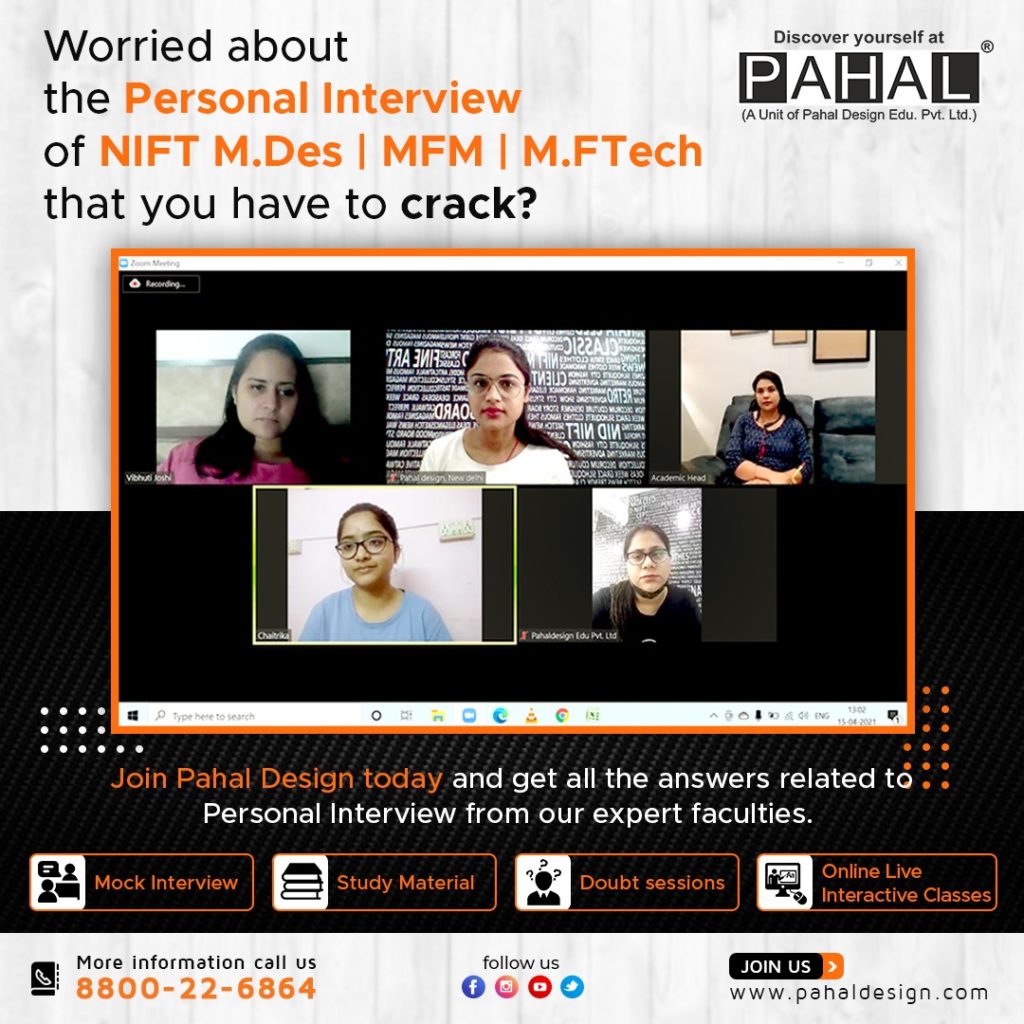
Are you ready for personal interview of NIFT MFM/MDes/M.FTech Like last year,NIFT has announced to conduct Personal Interview only for MFM/MDes/MFtech program due to Pandemic . Now let’s understand what is PI round for NIFT Master program. It is all about judging candidate’s over all personality, Knowledge about Industry and his keen interest in respective course for which She/He has been shortlisted. To understand and get an idea about PI ,Join Mock PI session with PAHAL DESIGN in order to robust your preparation for NIFT PI round. Book your slot -> Also Call 📞880022-6864


NIFT Personal Interview Questions 2020

1. Why you want to do MDES/MFM/MFTECH from NIFT?

2. Why didn’t you choose MBA over MFM?

3. Please Introduce yourself?

4. From where you did your graduation ?

5.How will your graduation help in your master’s

6.What is your understanding about Vendor Management ?

7. What is principle of management?

8. What is famous textile of your state?

9. How will you contribute to NIFT?

10. What type of company you want to get into?

Schedule a free counselling session WhatsApp WhatsApp