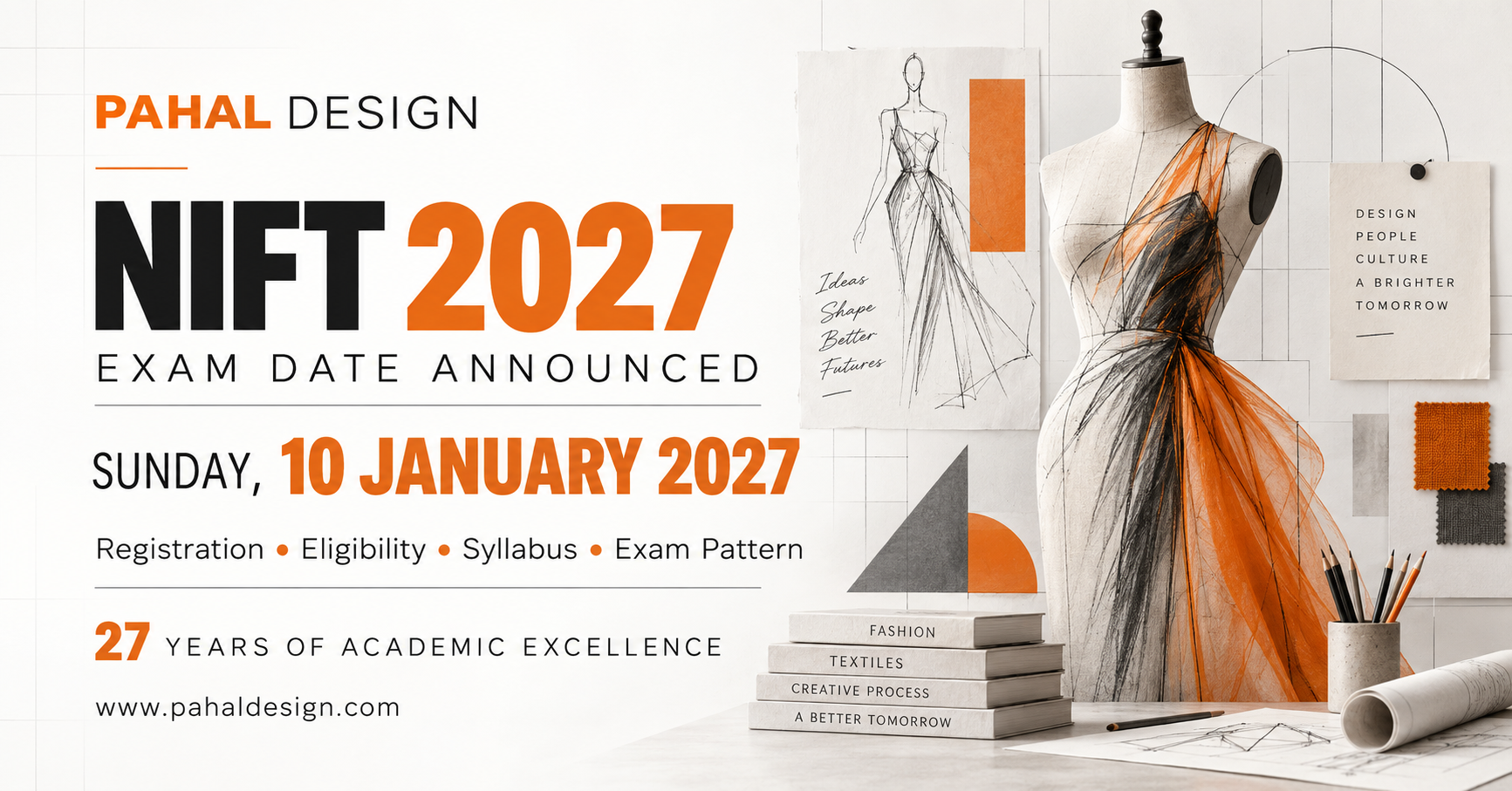
NIFT Admissions 2027 registration is open. The National Institute of Fashion Technology has announced that online applications began on 16 October 2026. The regular application deadline for undergraduate and postgraduate programmes is 16 November 2026, and the NIFT Entrance Examination is scheduled for Sunday, 10 January 2027. 

If you are planning to apply, start by checking your course eligibility and preparing your documents. This guide brings together the registration schedule, application fees and practical steps to help you complete your form and organise your preparation.

NIFT Admissions 2027 Important Dates

Admission activity Scheduled date
Registration opens 16 October 2026
Regular application deadline 16 November 2026
Application deadline with late fee 21 November 2026
Application correction window 22–25 November 2026
Advance city intimation slip 21 December 2026
Admit card download 4 January 2027
UG and PG entrance examination 10 January 2027

The late application fee is ₹5,000 in addition to the applicable application fee. These dates follow the official notices dated 16 October 2026; check the NIFT and NTA portals for subsequent changes.

Which Programmes Can You Apply For

NIFT offers B.Des. and B.F.Tech. at undergraduate level, and M.Des., M.F.M. and M.F.Tech. at postgraduate level. The announcement also covers the opening of Ph.D. registration. The UG and PG deadline above should not be assumed to apply to every admission category.

Choose your intended programme before filling the application. Read its educational qualification, age and subject requirements, along with the category rules that apply to you. Use the current prospectus and information bulletin linked on the official admissions page.

NIFT 2027 Application Fees

Category One programme Two programmes*
Open / Open-EWS / OBC-NCL ₹2,000 ₹3,000
SC / ST / PwD / PwBD ₹500 ₹750

*The listed two-programme combinations are B.F.Tech. with B.Des., or M.F.M. with M.Des. Payment gateway charges may apply. These are application fees, separate from course tuition. Other admission categories should check their applicable fee in the bulletin.

How to Fill the NIFT Application Form 2027

Apply through the official NTA NIFTEE portal. The application process is online. [2]

  1. Read the 2027 instructions and check eligibility for your selected programme.
  2. Register on the portal and complete the personal and academic details requested.
  3. Select the applicable programme or permitted programme combination.
  4. Upload your photograph, signature and required supporting documents in the prescribed formats.
  5. Review the form, pay the applicable fee and save the confirmation page. [3]

Before you submit, compare the entries with your records. Check the spelling of your name, date of birth, category and programme choice. Keep your application reference and payment acknowledgement together so that they are easy to find later.

Application Mistakes to Avoid

Do not leave document preparation until the final evening. A blurred scan, missing certificate or unsuccessful payment can take time to resolve. Set yourself a personal submission target several days before the regular deadline.

Use an email address and mobile number that you can access throughout the admission cycle. Review each screen before moving ahead, especially when choosing programmes or entering academic details. After payment, return to the application dashboard and check the submission status.

The correction window is an opportunity to fix permitted details. Submit an accurate form at the first attempt and follow the correction instructions if a change becomes necessary.

How to Prepare Alongside Your Application

Once you have organised your registration, build a study routine around the requirements of your chosen course. Begin with a practice paper to identify the topics and skills that need the most attention.

For creative preparation, use everyday objects as prompts. Sketch an object from different viewpoints, suggest a practical improvement, and explain the idea clearly. If your programme includes a Creative Ability Test, practise developing an original response within a time limit.

For aptitude practice, keep an error notebook. Record the question type, the reason for the mistake and the method you should use next time. Revisit these notes before each mock test instead of repeatedly attempting only familiar questions.

Set aside time each week to review completed work. Ask whether your response answers the brief, whether the main idea is clear and where you lost time. Small, consistent corrections make your next practice session more useful.

Use Pahal Design’s NIFT previous year question papers for practice and read our NIFT 2027 exam pattern and preparation guide alongside the current official bulletin.

Prepare for NIFT 2027 with Pahal Design

At Pahal Design, students can explore classroom coaching, live online classes, study materials and mock tests. Speak with our team about a preparation plan that fits your current level, school or college schedule, and preferred learning mode. [5]

Book a free counselling session to discuss NIFT 2027 preparation and available batches.

Call 8800-226864 | www.pahaldesign.com

Frequently Asked Questions About NIFT Admissions 2027

Is the NIFT application form 2027 available

Yes. Online registration opened on 16 October 2026 through the official NTA NIFTEE portal. [1]

What is the last date to apply for NIFT 2027

The regular UG and PG deadline is 16 November 2026. The late-fee deadline is 21 November 2026. [1, 2]

When is the NIFT entrance exam 2027

The UG and PG examination is scheduled for Sunday, 10 January 2027. [1]

Can I edit my NIFT application after submission

The scheduled correction window is 22–25 November 2026. Follow the portal’s instructions on which details can be changed. [2]

Does every applicant take the same entrance tests

No. Test components and later selection stages depend on the programme and admission category. Check the programme-specific scheme before planning your preparation. [2]

How can Pahal Design help me prepare

Explore classroom or live online learning, study materials and mock tests. A counselling conversation can help you choose a suitable preparation plan. [5]

Official Sources and Useful Links

NIFT Notification 01 dated 16 October 2026

NTA public notice for NIFTEE 2027 dated 16 October 2026

NIFTEE 2027 Information Bulletin

NIFT admissions and programme information

Pahal Design courses and counselling

NIFT 2027 Exam Date Announced: Registration, Eligibility, Syllabus, Exam Pattern and Preparation Guide

The NIFT 2027 exam date is out. The National Testing Agency examination calendar schedules the NIFT Entrance Examination Stage 1 for Sunday, 10 January 2027. This is an important development for students seeking admission to B.Des, B.FTech, M.Des, MFM and M.FTech programmes for the 2027–28 academic session.

The date in the examination calendar is tentative and may be revised for administrative, academic, statutory or logistical reasons. The detailed NIFT 2027 Information Bulletin—covering registration dates, final eligibility rules, fees, test timings, centres and admission-stage weightages—is still awaited. Aspirants should therefore treat 10 January as their working examination date while checking the official NTA and NIFT websites regularly.

This Pahal Design guide brings together the latest information on the .NIFT entrance exam 2027, including expected registration dates, course-wise eligibility, CAT and GAT, the syllabus, selection stages and a practical preparation plan

Is the NIFT 2027 exam date final?

No. 10 January 2027 is the currently scheduled Stage 1 date, but the NTA calendar describes examination dates as tentative. Students should plan their preparation around this date and avoid waiting for the detailed notification to begin serious practice.

The January schedule also means the preparation window is shorter than many aspirants may have expected. A disciplined plan for CAT, GAT, previous-year papers and full-length mock tests should start immediately.

NIFT 2027 important dates

Only the Stage 1 date has been announced at this stage. The remaining dates below are expected windows based on current reports and the recent admission cycle; they are not final until NTA or NIFT publishes the 2027 bulletin.

Student alert: As of 19 September 2026, use 10 January 2027 as the working NIFT Stage 1 date and verify every subsequent update on the official portals.

What is the NIFT Entrance Examination?

The NIFT Entrance Examination is a national-level admission test for undergraduate and postgraduate programmes in design, fashion technology and fashion management. The selection process changes according to the programme selected.

The main programmes are:

  • B.Des: Bachelor of Design
  • B.FTech: Bachelor of Fashion Technology
  • M.Des: Master of Design
  • MFM: Master of Fashion Management
  • M.FTech: Master of Fashion Technology

NIFT currently has 20 campuses across India. Candidates compete for a programme, category and campus through the entrance examination, later-stage assessments and centralised counselling.

NIFT 2027 eligibility criteria

The official NIFT 2027 eligibility criteria will be confirmed in the Information Bulletin. Based on the recent criteria and current exam coverage, aspirants should use the following as a planning guide.

B.Des eligibility

  • The candidate should have passed, or be appearing in, Class 12 from a recognised board or hold an accepted equivalent qualification.
  • Students from any academic stream may apply.
  • The candidate should be below the prescribed UG age limit. Current reports indicate less than 24 years of age as of 1 August 2027.
  • A five-year upper-age relaxation is generally available to SC, ST and PwD candidates.

B.FTech eligibility

  • The candidate should have passed, or be appearing in, Class 12 from a recognised board.
  • Physics and Mathematics are expected to be compulsory subjects for B.FTech eligibility.
  • The UG age condition and applicable relaxation are expected to be the same as for B.Des.

PG programme eligibility

  • M.Des and MFM: A recognised undergraduate degree in any discipline, or another qualification accepted in the official prospectus, is generally required.
  • M.FTech: A relevant technology or engineering qualification is generally required.
  • There is ordinarily no upper age limit for NIFT postgraduate programmes.

Candidates must check the final programme-wise qualification, age cut-off and equivalence rules before submitting the NIFT 2027 application form. Meeting the entrance-test cut-off does not compensate for an eligibility shortfall.

NIFT 2027 application form: how to register

The NIFT 2027 registration date has not yet been officially announced. Current reports expect the application window to open in November or December 2026. Once the portal opens, the usual process is expected to include:

  1. Visit the official NIFT examination portal.
  2. Create an account using an active email address and mobile number.
  3. Select the correct programme or programme combination.
  4. Enter personal, academic and category details exactly as shown on official documents.
  5. Choose the permitted examination-city preferences.
  6. Upload the photograph, signature and applicable certificates in the prescribed format.
  7. Pay the applicable examination fee.
  8. Review every entry before final submission.
  9. Download the confirmation page and retain payment proof.

The final 2027 fee, late-fee rules and document specifications should be taken only from the official bulletin. Avoid copying a previous-year fee into the new form without checking the current notice.

Common application mistakes to avoid

  • Selecting B.Des instead of B.FTech, or the wrong programme combination
  • Entering a name or date of birth that does not match official documents
  • Uploading an unclear photograph, signature or category certificate
  • Choosing examination cities without checking travel feasibility
  • Waiting until the final day to pay the fee
  • Forgetting to download the confirmation page

NIFT 2027 exam pattern: CAT, GAT and Stage 2

The NIFT 2027 exam pattern depends on the programme. Stage 1 may include the General Ability Test, the Creative Ability Test, or both.

General Ability Test (GAT)

GAT is expected to be conducted as a computer-based test. It evaluates areas such as:

  • Communication ability
  • English comprehension
  • Quantitative ability
  • Analytical and logical ability
  • General knowledge and current affairs
  • Case-study interpretation, where applicable

Recent NIFT patterns have included negative marking in GAT. Candidates should wait for the 2027 bulletin for the final marking rule and section-wise question distribution.

Creative Ability Test (CAT)

CAT is expected to remain a paper-based creative examination for B.Des and M.Des aspirants. It evaluates how effectively a candidate can observe, imagine, interpret and communicate an idea visually.

Preparation should cover:

  • Observation and visualisation
  • Composition and proportion
  • Perspective and spatial understanding
  • Human figures and object drawing
  • Colour application and colour relationships
  • Storytelling and sequential representation
  • Product and problem-based ideation
  • Originality, clarity and presentation

CAT is not simply a drawing test. A technically neat response can still remain average if its idea is predictable, while a strong concept can lose marks if it is poorly organised or unfinished. Aspirants need both ideation and execution.

Programme-wise selection components

Programme Stage 1 Later assessment
B.Des GAT + CAT Situation Test for shortlisted candidates
B.FTech GAT Selection process as notified by NIFT
M.Des GAT + CAT Personal Interview for shortlisted candidates
MFM GAT Personal Interview for shortlisted candidates
M.FTech GAT Personal Interview for shortlisted candidates

The final weightage and assessment sequence must be checked against the NIFT 2027 prospectus when released.

NIFT 2027 syllabus

GAT syllabus

The NIFT 2027 GAT syllabus is expected to include:

  • Quantitative Ability: percentages, ratios, averages, profit and loss, simple and compound interest, time and work, speed and distance, basic algebra and data interpretation
  • Communication Ability: vocabulary, correct usage, synonyms, antonyms, idioms and sentence construction
  • English Comprehension: reading passages, inference, tone, central idea and contextual meaning
  • Analytical and Logical Ability: series, patterns, arrangements, coding, deductions, visual logic and reasoning
  • General Knowledge and Current Affairs: national and international events, art, culture, design, fashion, textiles, brands, awards and important organisations
  • Case Study: interpretation of a business, design, production or real-world situation, depending on the programme

CAT syllabus and skill areas

The NIFT 2027 CAT syllabus is best understood as a set of creative abilities rather than a fixed list of chapters:

  • Design sensitivity and problem-solving
  • Creative use of colour
  • Visual memory and observation
  • Concept development
  • Illustration and communication
  • Composition, layout and storytelling
  • Material, product and user awareness
  • Ability to generate multiple original ideas under time pressure

A focused 16-week NIFT 2027 preparation plan

With the Stage 1 examination scheduled for 10 January, aspirants should work backwards from the test date.

Phase 1: Build foundations

  • Draw everyday objects, people and spaces daily.
  • Revise arithmetic, vocabulary and logical reasoning fundamentals.
  • Start a visual diary for ideas, colours, forms and current design references.
  • Study one major current-affairs theme each day.
  • Analyse previous NIFT CAT and GAT papers before attempting them.

Phase 2: Develop speed and application

  • Solve section-wise GAT tests under time limits.
  • Complete two to three CAT prompts every week.
  • Practise perspective, proportion, human figures and colour rendering.
  • Review every answer for idea quality, relevance, layout and completion.
  • Maintain an error log for recurring GAT mistakes.

Phase 3: Attempt full-length mock tests

  • Take complete CAT and GAT mock tests in exam-like conditions.
  • Use the actual time limit and restrict materials to the permitted set.
  • Analyse accuracy, attempted questions and time lost after every mock.
  • Redraw weak CAT answers using mentor feedback without copying a model solution.
  • Revise fashion, design and general-current-affairs notes weekly.

Phase 4: Final revisionhttps://pahaldesign.com/nift-situation-test/

  • Consolidate formulas, vocabulary, current affairs and common reasoning patterns.
  • Practise high-quality CAT responses within strict time limits.
  • Avoid learning entirely new drawing styles in the final days.
  • Prepare documents and monitor the official portal for the city slip and admit card.
  • Protect sleep, health and concentration during the last week.

How to prepare for NIFT CAT effectively

  1. Begin with idea generation. Spend a few minutes listing different approaches before drawing.
  2. Answer the brief exactly. Creativity that ignores the question does not earn its full value.
  3. Plan the page. Decide the focal point, visual hierarchy and text placement before rendering.
  4. Show function and user context. For product or problem-solving questions, make the solution easy to understand.
  5. Practise people in action. Human figures often help communicate scale, emotion and usage.
  6. Use colour intentionally. Build harmony, contrast and emphasis instead of filling every empty space.
  7. Finish on time. A complete, clearly presented answer is stronger than an overworked but unfinished sheet.
  8. Seek specific feedback. Ask whether the idea is original, relevant, legible and well executed—not merely whether the drawing looks good.

How to improve your NIFT GAT score

  • Strengthen concepts before chasing speed.
  • Use timed topic tests to identify slow sections.
  • Read editorials and design or fashion news to improve comprehension and awareness together.
  • Learn mental calculation techniques, but write intermediate steps when accuracy matters.
  • Apply an attempt strategy that accounts for negative marking if the 2027 bulletin retains it.
  • Analyse every mock by error type: conceptual gap, misreading, calculation, guesswork or time pressure.
  • Reattempt incorrect questions after a gap instead of only reading solutions.

Why previous-year papers and mock tests matter

NIFT previous-year question papers show how the examination translates broad abilities into actual tasks. They help candidates understand the expected speed, variety and level of originality. However, repeating old answers is not enough because CAT prompts reward fresh thinking.

A good NIFT mock test 2027 programme should provide:

  • Questions aligned with the latest available pattern
  • Separate section tests and full-length papers
  • Realistic CAT and GAT time limits
  • Detailed solutions and performance analysis
  • Personalised CAT feedback
  • A clear improvement plan between tests

NIFT 2027 preparation with Pahal Design

Pahal Design has guided design aspirants since 1999. Its NIFT coaching 2027 support is available through classroom, live online and hybrid learning modes.

The preparation programme can support students with:

  • Updated CAT and GAT preparation
  • Solved NIFT previous-year papers
  • Topic-wise practice and full-length mock tests
  • Drawing, visualisation and creative problem-solving
  • Current affairs, fashion awareness and aptitude development
  • Faculty review and individual performance feedback
  • Situation Test and Personal Interview guidance for shortlisted candidates

Admissions are open for NIFT 2027 preparation.
Call or WhatsApp: 880022-6864
Website: www.pahaldesign.com

Frequently asked questions about NIFT 2027


What is the NIFT 2027 exam date?

NIFT Stage 1 is currently scheduled for Sunday, 10 January 2027. The calendar date is provisional and candidates should monitor official notices for any revision.


When will NIFT 2027 registration begin?

The official registration date is awaited. Current reports expect the NIFT 2027 application form to open in November or December 2026.


Is NIFT 2027 online or offline?

The current expected pattern is hybrid: GAT in computer-based mode and CAT in paper-based mode. Later assessments such as the Situation Test and Personal Interview are normally conducted separately. The official bulletin will confirm the 2027 mode.


Who can apply for NIFT B.Des 2027?

Students who have passed or are appearing in Class 12 from a recognised board or hold an accepted equivalent qualification may apply, subject to the official age and other eligibility conditions.


Is Mathematics compulsory for NIFT B.Des?

No specific Class 12 stream is generally required for B.Des. However, quantitative ability is part of GAT, so all applicants should prepare basic mathematics.


Is Mathematics required for NIFT B.FTech?

B.FTech applicants are expected to have studied Physics and Mathematics in Class 12. Candidates must verify the exact subject requirement in the 2027 prospectus.


What tests are required for NIFT B.Des?

B.Des candidates take CAT and GAT in Stage 1. Those shortlisted are called for the Situation Test.


How should I start NIFT 2027 preparation?

Begin with a diagnostic CAT task and GAT test, analyse previous-year papers, build a daily drawing and aptitude routine, and schedule regular mock tests with feedback.


Where should candidates check official NIFT 2027 updates?

Check the National Testing Agency website, the NIFT examination portal and the official NIFT website. Social posts and coaching updates can alert you, but the official notice should remain the final reference.

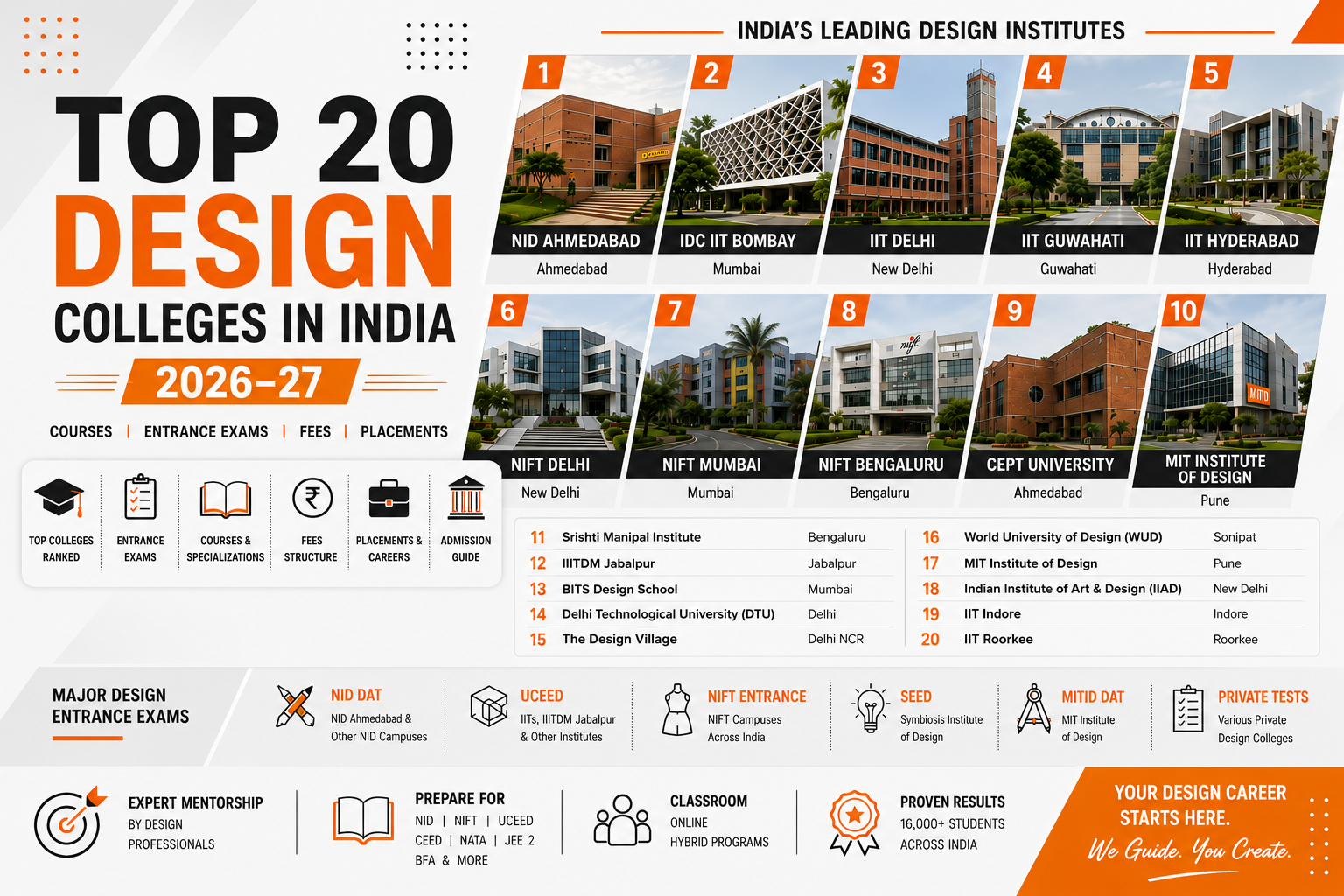
Top 20 Design Colleges in India 2026–27: Courses, Entrance Exams & Admission Guide

Choosing the right design college is one of the most important decisions for students planning a career in Product Design, Fashion Design, Communication Design, UX/UI Design, Animation, Interior Design, Transportation Design or other creative fields.

India has several prestigious government and private design institutes. Some institutions admit students through highly competitive entrance examinations such as NID DAT, UCEED and NIFT, while private universities may conduct their own design aptitude tests, portfolio reviews and interviews.

In this guide, Pahal Design presents a carefully curated list of the Top Design Colleges in India for 2026–27 to help students and parents understand their options.

Note: The list below is an editorial guide based on factors such as academic reputation, design ecosystem, industry exposure, entrance competitiveness, programmes and student opportunities. It should not be interpreted as an official Government of India ranking.

Top 20 Design Colleges in India 2026–27

RankDesign InstituteLocationMajor Entrance Route
1National Institute of Design (NID)AhmedabadNID DAT
2IDC School of Design, IIT BombayMumbaiUCEED
3Department of Design, IIT DelhiNew DelhiUCEED
4Department of Design, IIT GuwahatiGuwahatiUCEED
5Department of Design, IIT HyderabadHyderabadUCEED
6National Institute of Fashion Technology (NIFT) DelhiNew DelhiNIFT Entrance
7National Institute of Fashion Technology (NIFT) MumbaiMumbaiNIFT Entrance
8National Institute of Fashion Technology (NIFT) BengaluruBengaluruNIFT Entrance
9CEPT UniversityAhmedabadUCEED
10MIT Institute of Design, ADTPuneMITID DAT
11Srishti Manipal Institute of Art, Design and TechnologyBengaluruInstitute Admission Process
12IIITDM JabalpurJabalpurUCEED
13BITS Design SchoolMumbaiInstitute Admission Process
14Delhi Technological University (DTU)DelhiUniversity-prescribed route
15IIAD – Indian Institute of Art & Design, UDIT UniversityGurugramIIAD Admission Process
16The Design VillageDelhi NCRInstitute Admission Process
17World University of DesignSonipatInstitute Admission Process


For 2026, the official UCEED joint B.Des admission process includes IIT Bombay, IIT Delhi, IIT Guwahati, IIT Hyderabad, IIT Indore, IIT Roorkee and IIITDM Jabalpur as participating institutes. Students should therefore check the latest admission information before finalising their preference order.

1. National Institute of Design (NID), Ahmedabad

NID Ahmedabad is widely regarded as one of India’s premier institutions for design education.

The institute is particularly well known for its multidisciplinary and studio-based approach to design education.

Popular Design Disciplines

  • Product Design
  • Graphic Design
  • Animation Film Design
  • Film & Video Communication
  • Exhibition Design
  • Furniture & Interior Design
  • Textile Design
  • Ceramic & Glass Design

Entrance Exam: NID Design Aptitude Test (NID DAT)

For the 2026–27 admission cycle, NID’s official admission portal lists B.Des admissions at NID Ahmedabad as well as NID Andhra Pradesh, Haryana, Madhya Pradesh and Assam.

Why Choose NID?

NID is an excellent option for students seeking intensive design education with strong emphasis on creativity, problem solving, observation, visualisation and hands-on studio learning.

2. IDC School of Design, IIT Bombay

IDC School of Design at IIT Bombay is among India’s most prestigious destinations for students interested in design, technology and innovation.

Entrance Exam: UCEED

Best Suited For

Product Design, Interaction Design, Communication Design, UX/UI and technology-oriented design careers.

The combination of IIT Bombay’s technology ecosystem and IDC’s design environment makes it especially attractive for students interested in solving complex problems through design.

3. Department of Design, IIT Delhi

IIT Delhi is an increasingly important destination for undergraduate design aspirants.

Entrance Exam: UCEED

Its location in India’s capital and strong interdisciplinary environment make it an attractive option for students interested in the intersection of design, technology, innovation and entrepreneurship.

4. Department of Design, IIT Guwahati

IIT Guwahati has an established Department of Design and is one of the major institutes participating in UCEED B.Des admissions.

Entrance Exam: UCEED

Students interested in product, interaction and communication-oriented design should consider IIT Guwahati among their leading choices.

5. Department of Design, IIT Hyderabad

The Department of Design at IIT Hyderabad offers B.Des admission through UCEED.

According to its official 2026 admission information, students from Science, Commerce, Arts and Humanitiesbackgrounds can apply subject to UCEED eligibility requirements.

Entrance Exam: UCEED

This makes IIT Hyderabad an attractive choice for students seeking an interdisciplinary design education in a technology-focused environment.

6. NIFT Delhi

For students whose primary interest is Fashion Design and the fashion industry, NIFT Delhi remains one of India’s most sought-after destinations.

Entrance: NIFT Entrance Examination

Popular Areas

  • Fashion Design
  • Fashion Communication
  • Textile Design
  • Accessory Design
  • Knitwear Design
  • Leather Design

Students interested primarily in fashion should evaluate NIFT separately from product and technology-focused institutes such as IITs and NID.

7. NIFT Mumbai

NIFT Mumbai is another highly sought-after NIFT campus, particularly because of its location in one of India’s largest fashion, media and entertainment hubs.

Entrance: NIFT Entrance Examination

It can be an excellent choice for students interested in fashion, communication, styling, lifestyle and related creative industries.

8. NIFT Bengaluru

NIFT Bengaluru combines NIFT’s established fashion education ecosystem with Bengaluru’s growing technology, startup and creative industries.

Entrance: NIFT Entrance Examination

It is especially worth considering for students looking at fashion and communication-related design careers.

9. CEPT University, Ahmedabad

CEPT University offers a distinctive Bachelor’s in Design (Honours) programme.

For the 2026–27 academic year, CEPT states that admission to its Bachelor’s in Design programme uses a qualified UCEED score.

CEPT describes its programme as a studio-oriented design education with emphasis on human-centred thinking, systems awareness, critical reflection and professional practice.

Entrance Route: UCEED

Best For: Students interested in multidisciplinary design and an environment closely connected with architecture, planning and the built environment.

10. MIT Institute of Design, Pune

MIT Institute of Design is one of the established private design institutes considered by students preparing for NID, UCEED and other design entrances.

Entrance: MITID DAT / institute selection process

Students can explore disciplines across industrial, communication and other specialised areas of design.

11. Srishti Manipal Institute, Bengaluru

Srishti Manipal Institute of Art, Design and Technology is known for an experimental and interdisciplinary approach to art and design education.

It can be particularly attractive to students interested in contemporary, creative and multidisciplinary practices.

12. IIITDM Jabalpur

The Design Discipline at IIITDM Jabalpur is part of the official UCEED 2026 joint B.Des admission process.

Entrance Exam: UCEED

It is particularly relevant for students interested in the intersection of design, engineering, manufacturing and technology.

13. BITS Design School

BITS Design School is an emerging option backed by the BITS Pilani ecosystem.

It offers a four-year Bachelor of Design (Honours) programme and is worth considering for students looking for a modern interdisciplinary design environment.

For UCEED 2026, BITS Design School is listed as a UCEED result-sharing institute, rather than an institute participating in IIT Bombay’s joint B.Des admission process.

14. Delhi Technological University – DTU

DTU is another option for students interested in studying design within a major technology university.

Students should check DTU’s current admission notification carefully for programme availability, eligibility, entrance criteria, Delhi-region reservation rules where applicable, and seat availability.

15. The Design Village – Delhi NCR

The Design Village is a specialised design institution located in Delhi NCR.

Its curriculum and learning environment make it an option for students interested in contemporary and interdisciplinary design education.

16. World University of Design – WUD

World University of Design in Sonipat offers undergraduate programmes across multiple creative disciplines.

Students can explore programmes related to product, communication, fashion, interior and other design areas depending on current offerings.

17. IIAD – Indian Institute of Art & Design- UDIT University

IIAD in New Delhi is another private option for students interested in contemporary design education.

Students should evaluate the current programme structure, academic affiliation/qualification, specialisation, fees and admission requirements directly before applying.

New IIT Options Through UCEED 2026

The design-college landscape is expanding.

For the 2026 B.Des admission cycle, the official UCEED participating institutes are:

  1. IIT Bombay
  2. IIT Delhi
  3. IIT Guwahati
  4. IIT Hyderabad
  5. IIT Indore
  6. IIT Roorkee
  7. IIITDM Jabalpur

This is particularly important for students preparing for UCEED 2027, because their college preference list should not be based only on the older four-IIT structure.

Which Is the Best Design College in India?

There is no single college that is best for every design specialisation.

For Core & Multidisciplinary Design

NID Ahmedabad is one of the strongest choices.

For Product Design + Technology

IDC IIT Bombay should be among the first preferences.

For UX/UI & Interaction Design

Consider IIT Bombay, IIT Delhi, IIT Guwahati, IIT Hyderabad and NID, depending on programme structure and career interests.

For Fashion Design

NIFT Delhi should be among the first choices, followed by other leading NIFT campuses depending on the preferred specialisation.

For Design + Built Environment

CEPT University Ahmedabad deserves serious consideration.

For Private Design Colleges

Students can compare MIT Institute of Design, Srishti Manipal, BITS Design School, Symbiosis Institute of Design, UID, IIAD, The Design Village and World University of Design according to specialisation, fees, curriculum and career objectives.

Major Design Entrance Exams in India

Students targeting the best design colleges should understand that there is no single entrance examination covering every institution.

Entrance ExamMajor Institutes
NID DATNID Ahmedabad and other NID campuses
UCEEDIIT Bombay, IIT Delhi, IIT Guwahati, IIT Hyderabad, IIT Indore, IIT Roorkee, IIITDM Jabalpur + result-sharing institutes
NIFT EntranceNIFT campuses
WUDWUD DAT
MITID DATMIT Institute of Design


How to Choose the Right Design College

Do not select a design college only because of its overall popularity.

Students and parents should compare:

  1. Preferred Design Specialisation – Product, UX/UI, Fashion, Communication, Animation, Interior, Transportation etc.
  2. Faculty & Studio Infrastructure
  3. Industry Exposure
  4. Internship Opportunities
  5. Alumni Network
  6. Portfolio Development
  7. Campus Environment
  8. Fees and Overall Cost
  9. Scholarships
  10. Placement and Career Opportunities
  11. Degree/Qualification Awarded
  12. Location and Industry Ecosystem

A college that is excellent for Fashion Design may not necessarily be the best choice for Product Design or UX/UI.

How to Prepare for NID, NIFT & UCEED

Admission to India’s leading design colleges is highly competitive. Students should develop both their creative ability and problem-solving skills.

Preparation should include:

  • Observation and visualisation
  • Creative thinking
  • Design aptitude
  • Drawing and sketching
  • Perspective drawing
  • Human figures
  • Storytelling
  • Composition
  • Colour understanding
  • Logical and analytical reasoning
  • Design awareness
  • General awareness
  • Problem solving
  • Portfolio development where required
  • Studio-test preparation
  • Mock tests and previous-year papers

Starting early allows students to develop these skills gradually rather than relying only on last-minute preparation.

Prepare for India’s Top Design Colleges with Pahal Design

Pahal Design prepares students for India’s major Design, Fashion, Fine Arts and Architecture entrance examinations, including:

NID | NIFT | UCEED | CEED | NATA | JEE Paper 2 | BFA

Students receive structured preparation for aptitude tests, drawing, creative ability, design thinking, studio tests, portfolios and interview preparation depending on the entrance examination.

Pahal Design offers Classroom, Online and Hybrid preparation, helping students prepare for multiple design entrances through an integrated strategy.

Students targeting the 2027 and 2028 design entrance examinations should start building their creative and aptitude skills well in advance.

Frequently Asked Questions

Which is the No. 1 design college in India?

NID Ahmedabad and IDC School of Design at IIT Bombay are both among India’s most prestigious design institutions. The better choice depends on the student’s intended specialisation and learning preferences.

Is NID better than NIFT?

They serve different design interests. NID has a strong multidisciplinary design focus, whereas NIFT is particularly renowned for fashion and allied disciplines. Students interested in Fashion Design may prefer NIFT, while students interested in Product, Communication and other multidisciplinary design fields may prioritise NID.

Is IIT Bombay good for design?

Yes. IDC School of Design at IIT Bombay is one of India’s leading design schools and B.Des admission is through UCEED.

Which IITs offer B.Des through UCEED?

For the 2026 joint admission process, the participating institutions include IIT Bombay, IIT Delhi, IIT Guwahati, IIT Hyderabad, IIT Indore, IIT Roorkee and IIITDM Jabalpur.

Can Arts and Commerce students appear for UCEED?

UCEED is open to students from different academic streams subject to the examination’s eligibility rules. However, institute-level admission eligibility can vary, so students must check the requirements of each participating institute for the relevant admission year.

Which entrance exams should a design aspirant prepare for?

Students seeking the widest range of opportunities should consider preparing for NID DAT, UCEED and NIFT, along with selected private-college examinations according to their target list.


 

How to Crack NIFT 2027 Exam: Complete Preparation Strategy, Exam Pattern, Syllabus & Weightage

Preparing for the NIFT 2027 Entrance Exam is an exciting journey for aspiring designers. Every year, thousands of students compete for admission to the prestigious National Institute of Fashion Technology (NIFT), but only those with the right preparation strategy, creativity, and consistency secure top ranks.

Whether you’re aiming for B.Des, B.F.Tech, M.Des, MFM, or M.F.Tech, understanding the latest exam pattern, syllabus, marking scheme, and weightage is essential. This comprehensive guide by Pahal Design, India’s leading design entrance coaching institute, will help you prepare smartly and maximize your chances of success.

Why Choose NIFT?

The National Institute of Fashion Technology (NIFT) is India’s premier institute for fashion, design, management, and technology education. With campuses across the country, NIFT offers world-class education, industry exposure, internships, placements, and opportunities to build a successful career in fashion, communication, lifestyle products, textile design, accessory design, knitwear, leather design, and fashion management.

Admission is based on a national-level entrance examination that evaluates creativity, aptitude, analytical thinking, and problem-solving abilities.

NIFT 2027 Exam Pattern

Understanding the exam pattern is the foundation of effective preparation. Since each programme has a different structure, candidates should prepare according to their chosen course.

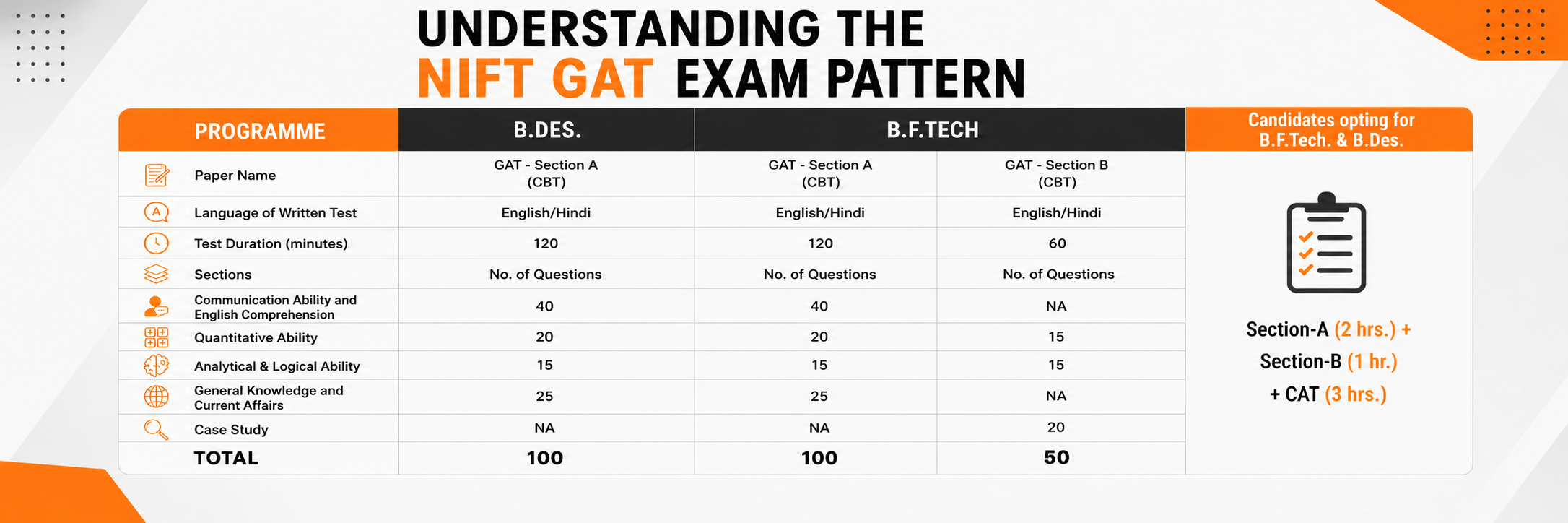
NIFT B.Des Exam Pattern

The Bachelor of Design entrance consists of two written examinations followed by the Situation Test.

General Ability Test (GAT)

Mode: Computer-Based Test (CBT)

Duration: 120 Minutes

Sections

  • Communication Ability & English Comprehension – 40 Questions
  • Quantitative Ability – 20 Questions
  • Analytical & Logical Ability – 15 Questions
  • General Knowledge & Current Affairs – 25 Questions

Total Questions: 100

Creative Ability Test (CAT)

Duration: 3 Hours

CAT evaluates:

  • Creativity
  • Drawing Skills
  • Visualization
  • Observation
  • Imagination
  • Storytelling
  • Design Thinking
  • Colour Sense
  • Innovation

NIFT B.F.Tech Exam Pattern

Candidates applying for B.F.Tech appear in two sections.

GAT Section A

Duration: 120 Minutes

  • Communication Ability & English Comprehension – 40 Questions
  • Quantitative Ability – 20 Questions
  • Analytical & Logical Ability – 15 Questions
  • General Knowledge & Current Affairs – 25 Questions

Total: 100 Questions

GAT Section B

Duration: 60 Minutes

  • Quantitative Ability – 15 Questions
  • Analytical & Logical Ability – 15 Questions
  • Case Study – 20 Questions

Total: 50 Questions

Students applying for both B.Des and B.F.Tech must appear for Section A, Section B, and CAT.

NIFT PG Exam Pattern

M.Des

Duration: 120 Minutes

  • Communication Ability & English Comprehension – 50 Questions
  • Quantitative Ability – 20 Questions
  • Analytical & Logical Ability – 25 Questions
  • General Knowledge & Current Affairs – 25 Questions

Total: 120 Questions

Qualified candidates appear for:

  • Creative Ability Test (CAT)
  • Personal Interview (PI)

MFM

Duration: 180 Minutes

Section A

  • Communication Ability & English Comprehension – 50
  • Quantitative Ability – 20
  • Analytical & Logical Ability – 25
  • General Knowledge & Current Affairs – 25

Section B

  • Case Study – 30

Total Questions: 150

M.F.Tech

Duration: 180 Minutes

  • Communication Ability & English Comprehension – 45
  • Quantitative Ability – 30
  • Analytical & Logical Ability – 25
  • General Knowledge & Current Affairs – 25
  • Case Study – 25

Total Questions: 150

Engineering-related questions are also included in the M.F.Tech examination.

NIFT 2027 Selection Process & Weightage

Understanding the official weightage allows students to focus on the sections that contribute the most to the final merit.

Undergraduate Courses

B.Des

  • General Ability Test (GAT): 30%
  • Creative Ability Test (CAT): 50%
  • Situation Test: 20%

B.F.Tech

  • GAT Section A: 30%
  • GAT Section B: 70%

Candidates Applying for Both B.Des & B.F.Tech

  • GAT Section A: 30%
  • CAT: 50%
  • Situation Test: 20%

Postgraduate Courses

M.Des

  • GAT: 30%
  • CAT: 40%
  • Personal Interview: 30%

MFM

  • GAT (Section A & B): 70%
  • Personal Interview: 30%

M.F.Tech

  • GAT: 70%
  • Personal Interview: 30%

NIFT 2027 Syllabus

Creative Ability Test (CAT)

Students should practice:

  • Human Figures
  • Perspective Drawing
  • Product Design
  • Story Illustration
  • Colour Composition
  • Poster Design
  • Object Drawing
  • Memory Drawing
  • Creative Visualization
  • Design Thinking

General Ability Test (GAT)

Topics include:

  • English Comprehension
  • Vocabulary
  • Grammar
  • Quantitative Aptitude
  • Logical Reasoning
  • Analytical Ability
  • General Knowledge
  • Current Affairs

Best Preparation Strategy for NIFT 2027

1. Understand the Weightage

Do not divide your preparation equally.

For B.Des aspirants:

  • CAT deserves the highest priority because it carries 50% weightage.
  • GAT contributes 30%.
  • Situation Test contributes 20%.

Planning your preparation according to weightage improves efficiency.

2. Practice Drawing Every Day

Spend at least 2 hours daily practicing:

  • Human Figures
  • Objects
  • Nature
  • Perspective
  • Product Concepts
  • Storytelling
  • Colour Rendering

Creativity improves only through regular practice.

3. Improve Observation Skills

Great designers observe everything around them.

Develop habits like:

  • Sketching everyday objects
  • Visiting exhibitions
  • Studying advertisements
  • Watching documentaries
  • Maintaining a visual journal

4. Master General Ability Test

Daily practice should include:

  • Reading newspapers
  • Current Affairs
  • English Vocabulary
  • Logical Reasoning
  • Quantitative Aptitude

Speed and accuracy are equally important.

5. Solve Previous Year Papers

Previous papers help you understand:

  • Difficulty Level
  • Question Trends
  • Frequently Asked Topics
  • Time Management

Practice at least 10–15 years of previous papers.

6. Attempt Mock Tests

Mock tests simulate the real exam.

Benefits include:

  • Better speed
  • Improved confidence
  • Reduced exam anxiety
  • Performance analysis
  • Time management

Aim to complete 30–50 full-length mock tests before the exam.

7. Prepare for Situation Test & Interview

Many students focus only on the written examination.

After qualifying, prepare for:

Situation Test

  • Model Making
  • Material Handling
  • Creativity
  • Neatness
  • Concept Presentation

Personal Interview

  • Portfolio Discussion
  • Design Awareness
  • Career Goals
  • Communication Skills
  • General Awareness

Common Mistakes to Avoid

  • Starting preparation late
  • Ignoring CAT practice
  • Not attempting mock tests
  • Weak time management
  • Neglecting current affairs
  • Memorizing instead of understanding concepts
  • Ignoring creativity development

Daily Study Plan

ActivityTime
Drawing Practice2 Hours
GAT Preparation2 Hours
Current Affairs30 Minutes
Previous Year Papers1 Hour
Mock Test & Analysis1.5 Hours

Why Choose Pahal Design?

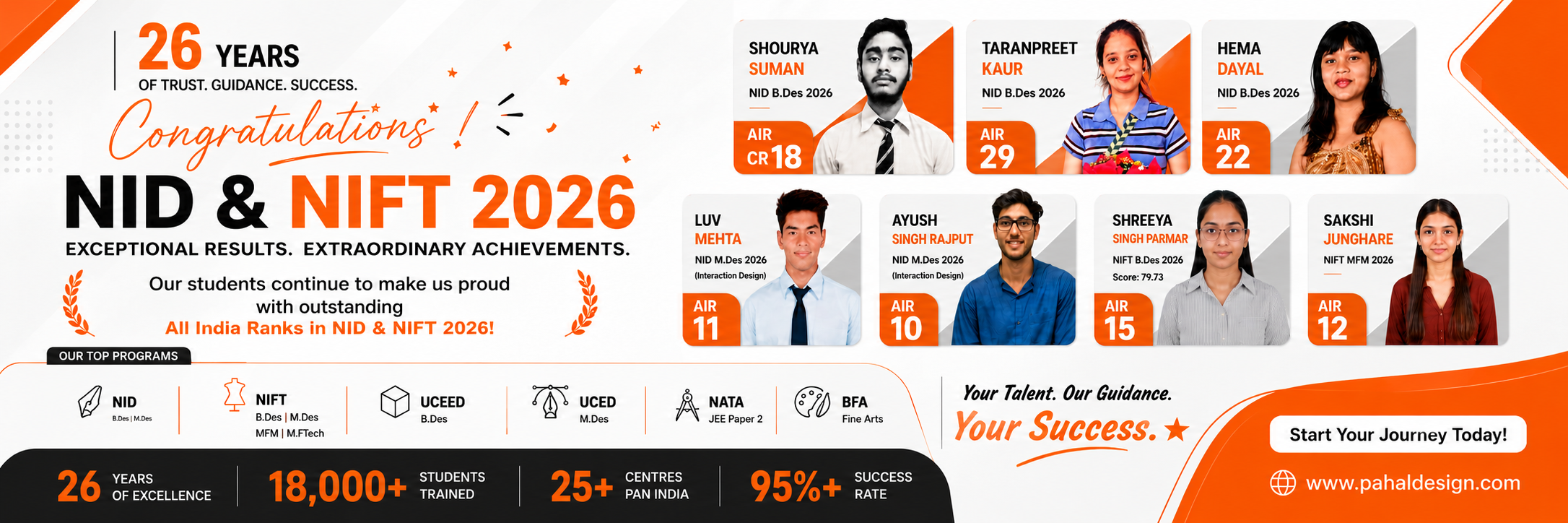
For over 26 years, Pahal Design has been one of India’s most trusted coaching institutes for design entrance examinations.

Students benefit from:

  • Expert Faculty from NIFT & NID
  • Comprehensive Study Material
  • Unlimited Drawing Practice
  • Regular Mock Tests
  • Portfolio Development
  • Situation Test Training
  • Personal Interview Guidance
  • Online & Classroom Coaching
  • Individual Mentorship
  • Proven Selection Record

Thousands of students trained at Pahal Design have secured admissions to prestigious institutions including NIFT, NID, UCEED, CEED, NATA, BFA, and leading international design universities.

Whether you’re beginning your preparation or aiming for a top rank, Pahal Design provides the guidance, resources, and mentorship needed to achieve your dream.

Final Thoughts

Success in the NIFT 2027 Entrance Exam is not just about hard work—it’s about preparing smartly. Understanding the latest exam pattern, focusing on high-weightage sections, practicing creativity daily, solving mock tests, and staying consistent are the keys to success.

Start your preparation early, follow a structured study plan, and seek expert guidance whenever needed. With dedication and the right coaching from Pahal Design, you can confidently secure admission to your dream NIFT campus and build a successful career in the design industry.

Book Your Free Career Counselling Session Today

Not sure which design entrance exam is right for you?

Our expert counsellors will help you:

  • Choose the right design career path
  • Understand the NIFT, NID, UCEED, CEED, NATA, and BFA admission process
  • Create a personalized preparation plan
  • Learn about scholarships and coaching programs
  • Get answers to all your admission-related questions

📞 Call Now: 8800-22-6864

🌐 Visit: www.pahaldesign.com

🎯 Your Design Dream Begins with Pahal Design!

Frequently Asked Questions (FAQs) About NIFT 2027

1. What is the NIFT 2027 Entrance Exam?

The NIFT 2027 Entrance Exam is the admission test conducted by the National Institute of Fashion Technology for undergraduate and postgraduate programmes such as B.Des, B.F.Tech, M.Des, MFM, and M.F.Tech. The exam evaluates creativity, design aptitude, analytical ability, English, logical reasoning, quantitative aptitude, and general awareness.

2. What is the eligibility for NIFT 2027?

For B.Des and B.F.Tech, candidates should have passed or be appearing for Class 12 from a recognized board.

For M.Des, MFM, and M.F.Tech, candidates must possess a bachelor’s degree in the relevant discipline as prescribed by NIFT.

3. What is the exam pattern for NIFT 2027?

The NIFT entrance exam consists of:

  • General Ability Test (GAT)
  • Creative Ability Test (CAT) for design programmes
  • Situation Test (for B.Des shortlisted candidates)
  • Personal Interview (for postgraduate programmes)

The exam pattern varies depending on the course selected.

4. What subjects should I prepare for the NIFT GAT?

The General Ability Test (GAT) includes:

  • Communication Ability
  • English Comprehension
  • Quantitative Ability
  • Analytical & Logical Reasoning
  • General Knowledge
  • Current Affairs
  • Case Study (for selected programmes)

5. What is CAT in the NIFT Entrance Exam?

The Creative Ability Test (CAT) evaluates:

  • Creativity
  • Drawing Skills
  • Visualization
  • Observation
  • Design Thinking
  • Innovation
  • Colour Sense
  • Storytelling through illustrations

CAT carries the highest weightage for B.Des aspirants.

6. What is the weightage of CAT and GAT in NIFT B.Des?

The latest weightage is:

  • CAT – 50%
  • GAT – 30%
  • Situation Test – 20%

Students should dedicate maximum preparation time to CAT.

7. How many months are required to prepare for NIFT 2027?

Ideally, students should begin preparation 6–12 months before the examination. Starting early allows sufficient time for drawing practice, aptitude preparation, mock tests, and revision.

8. Is coaching necessary to crack NIFT?

While self-study is possible, professional coaching provides:

  • Structured study plans
  • Expert faculty guidance
  • Regular mock tests
  • Performance analysis
  • Portfolio development
  • Situation Test practice
  • Personal Interview preparation

Many top-ranking students prefer coaching for systematic preparation.

9. How important are previous year’s question papers?

Previous year papers help students:

  • Understand the latest exam pattern
  • Identify important topics
  • Improve speed and accuracy
  • Build confidence
  • Practice time management

Students should solve at least 10–15 years of previous papers.

10. How can I improve my drawing skills for NIFT CAT?

Practice daily by sketching:

  • Human figures
  • Objects
  • Nature
  • Perspective
  • Product concepts
  • Story illustrations
  • Colour compositions

Observation and creativity are more important than perfect artistic skills.

11. How many mock tests should I attempt before NIFT?

Experts recommend attempting 30–50 full-length mock tests before the examination. Regular mock tests improve speed, accuracy, confidence, and time management.

12. Which books are best for NIFT preparation?

Some recommended resources include:

  • Previous Year Question Papers
  • Design Aptitude Books
  • Drawing Practice Books
  • Quantitative Aptitude Books
  • Logical Reasoning Books
  • Current Affairs Magazines
  • Mock Test Series

Joining a reputed coaching institute like Pahal Design provides comprehensive study material and updated preparation resources.

13. Which is the best coaching institute for NIFT preparation?

Pahal Design is one of India’s leading coaching institutes for NIFT, NID, UCEED, CEED, NATA, and BFA entrance examinations.

With 26+ years of excellence, 18,000+ successful students, expert faculty, structured study material, mock tests, portfolio guidance, Situation Test preparation, and Personal Interview coaching, Pahal Design has helped thousands of students secure admission to top design institutes.

14. Why should I join Pahal Design for NIFT 2027 preparation?

At Pahal Design, students receive:

  • Expert Mentors from NIFT & NID
  • Comprehensive Study Material
  • Regular Mock Tests
  • CAT & GAT Preparation
  • Situation Test Guidance
  • Personal Interview Training
  • Portfolio Development
  • Classroom & Online Coaching
  • Personalized Mentorship
  • 25+ Centers Across India

15. How can I contact Pahal Design?

You can connect with our expert counsellors for admissions and career guidance.

📞 Phone: 8800-22-6864

🌐 Website: www.pahaldesign.com

📧 Email: corporate@pahaldesign.com


Schedule a free counselling session WhatsApp WhatsApp