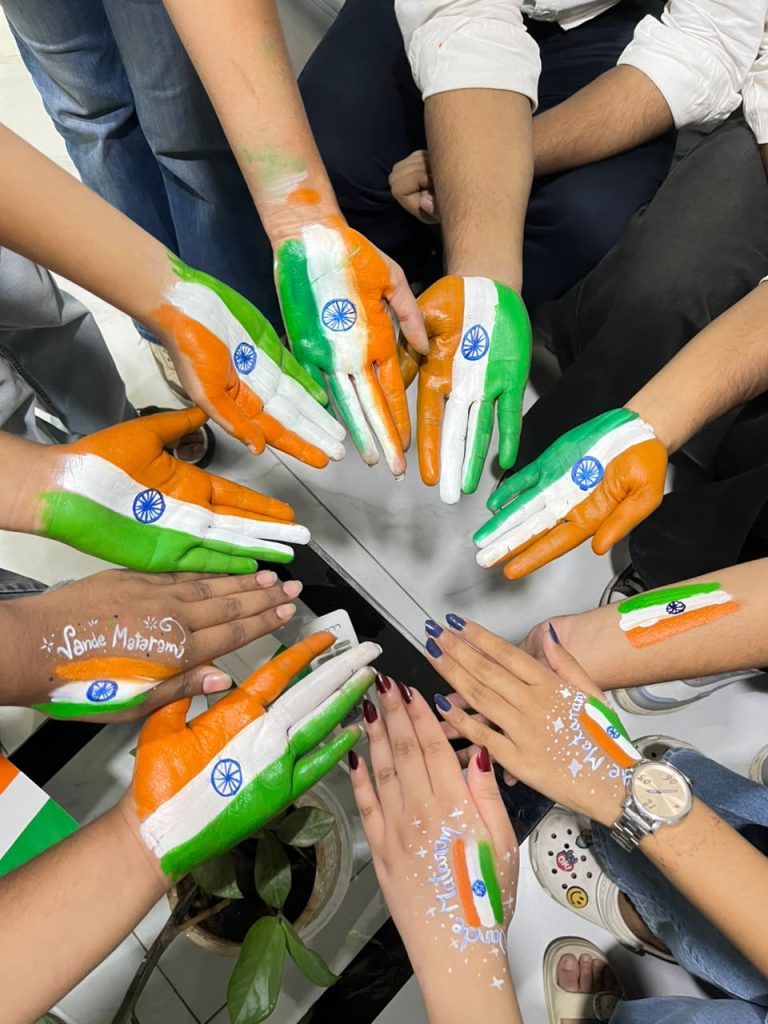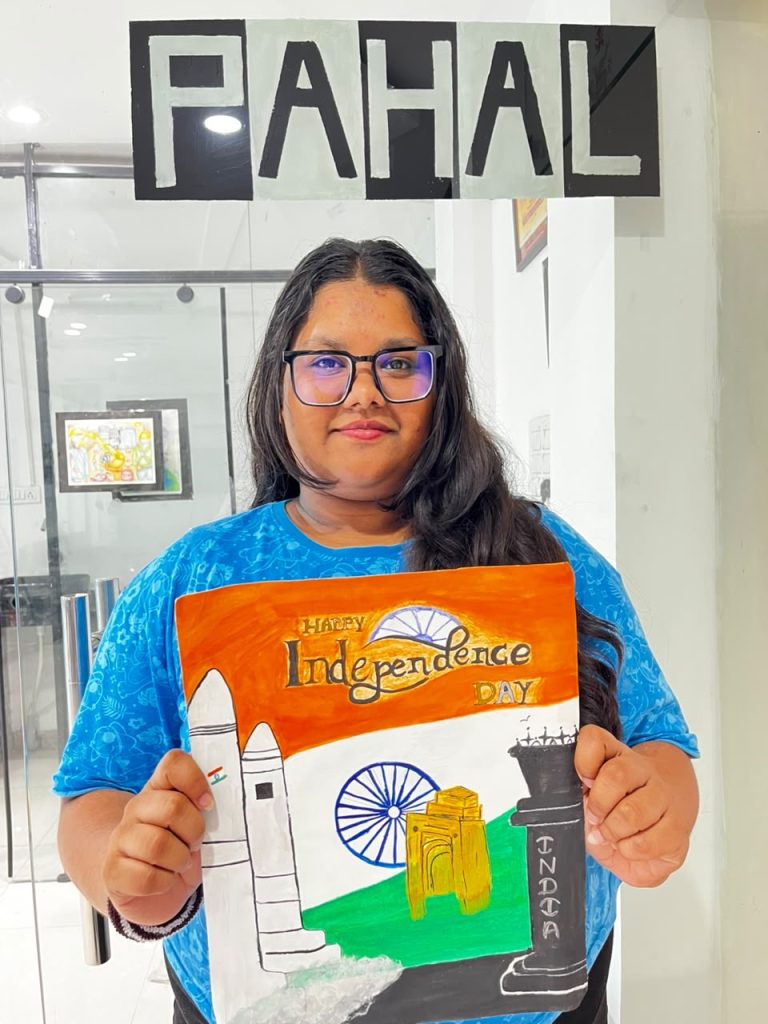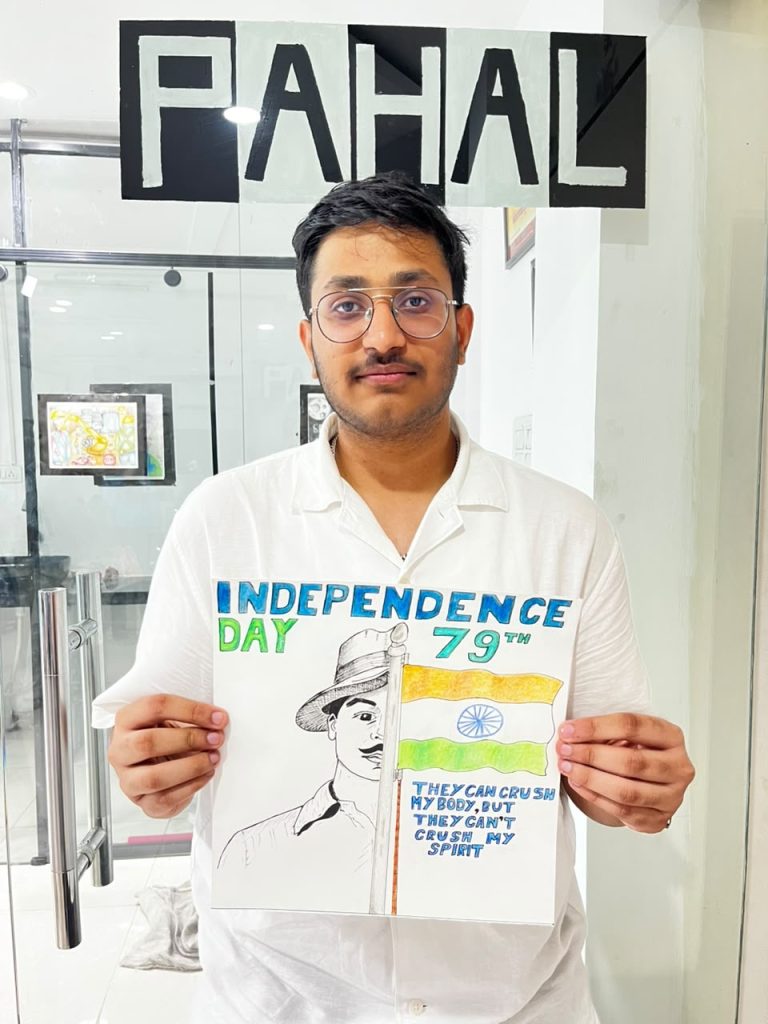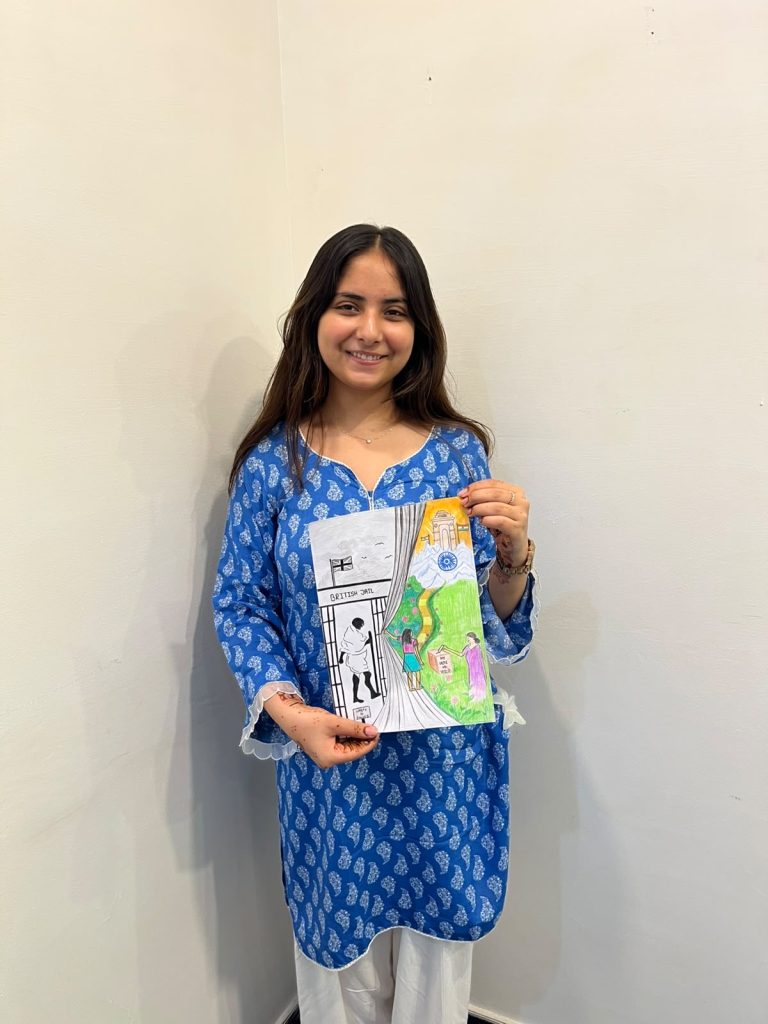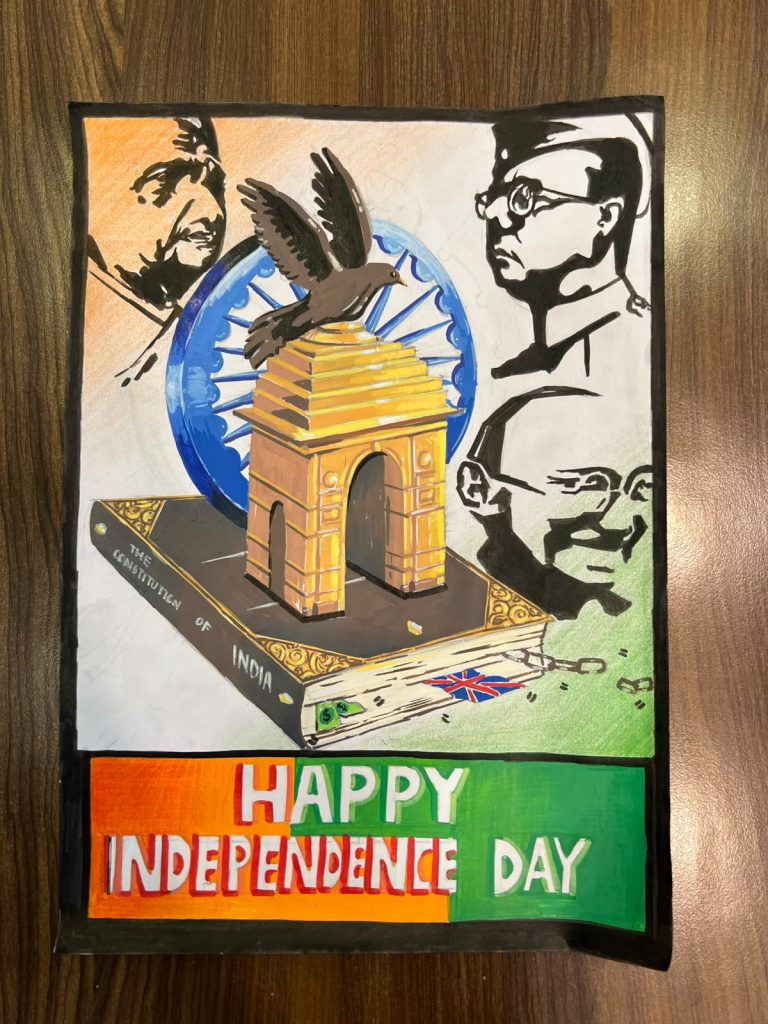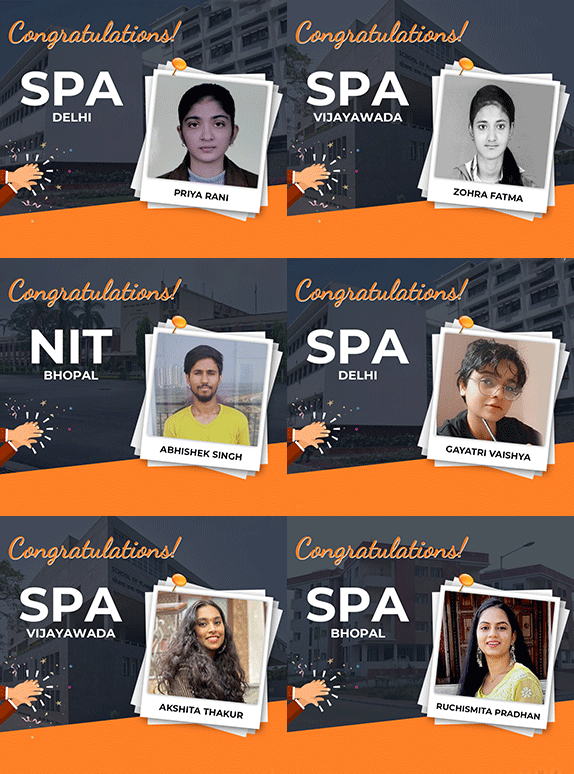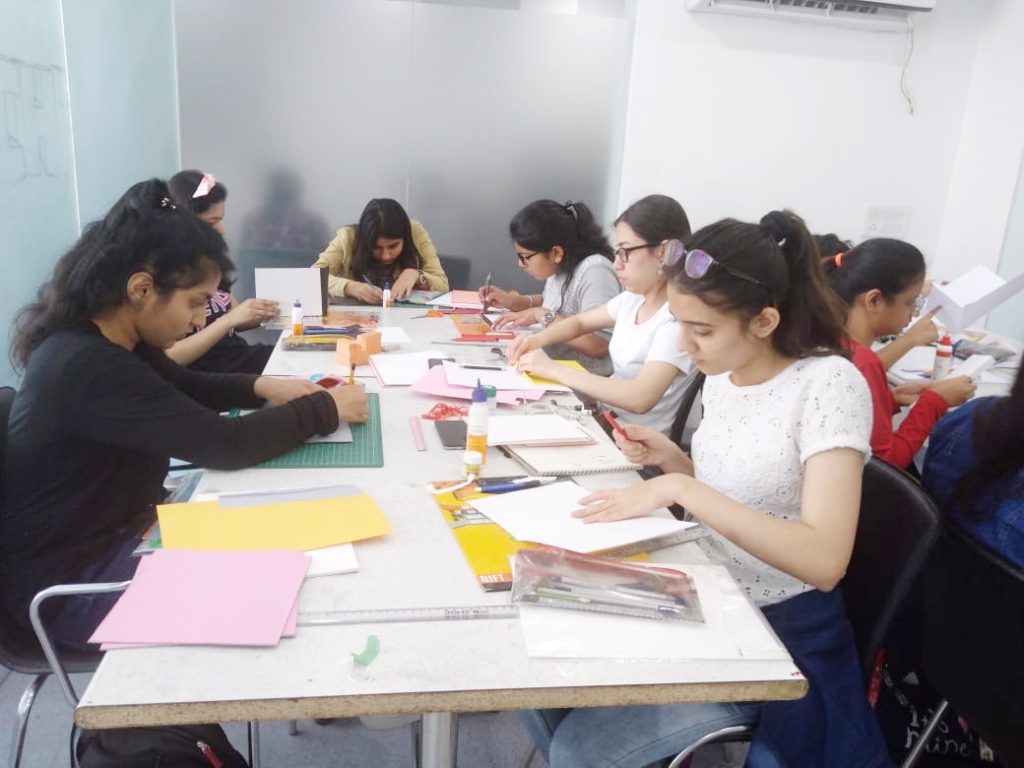
Celebrating the Spirit of Freedom Across Pahal Design Centres in India

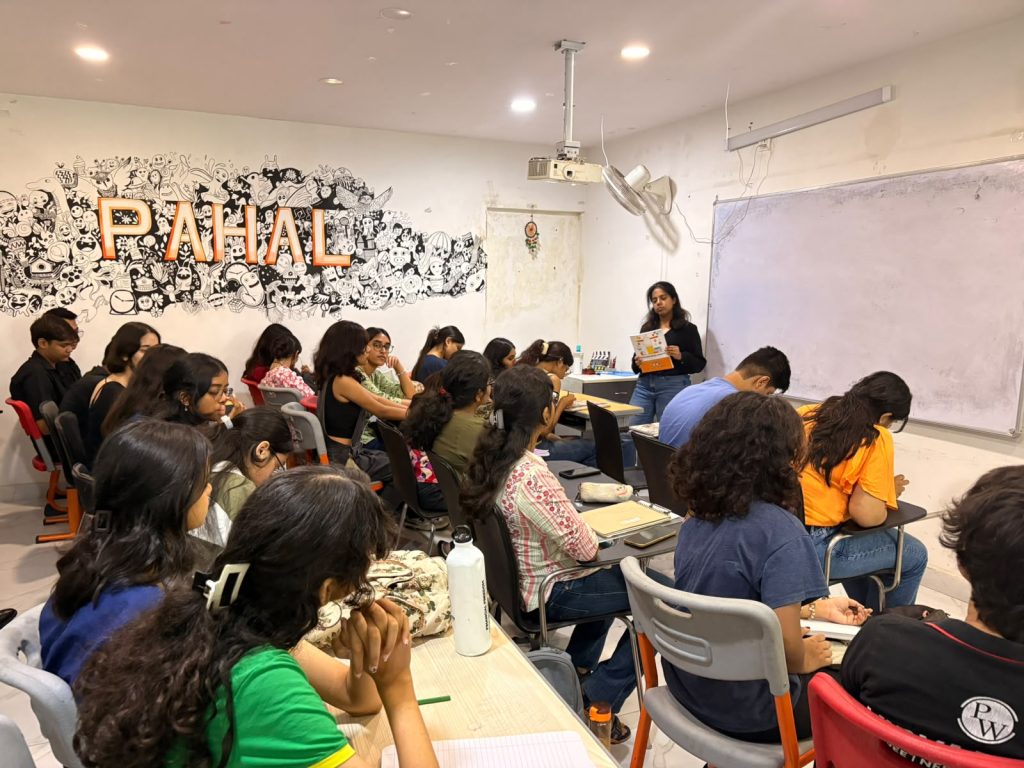
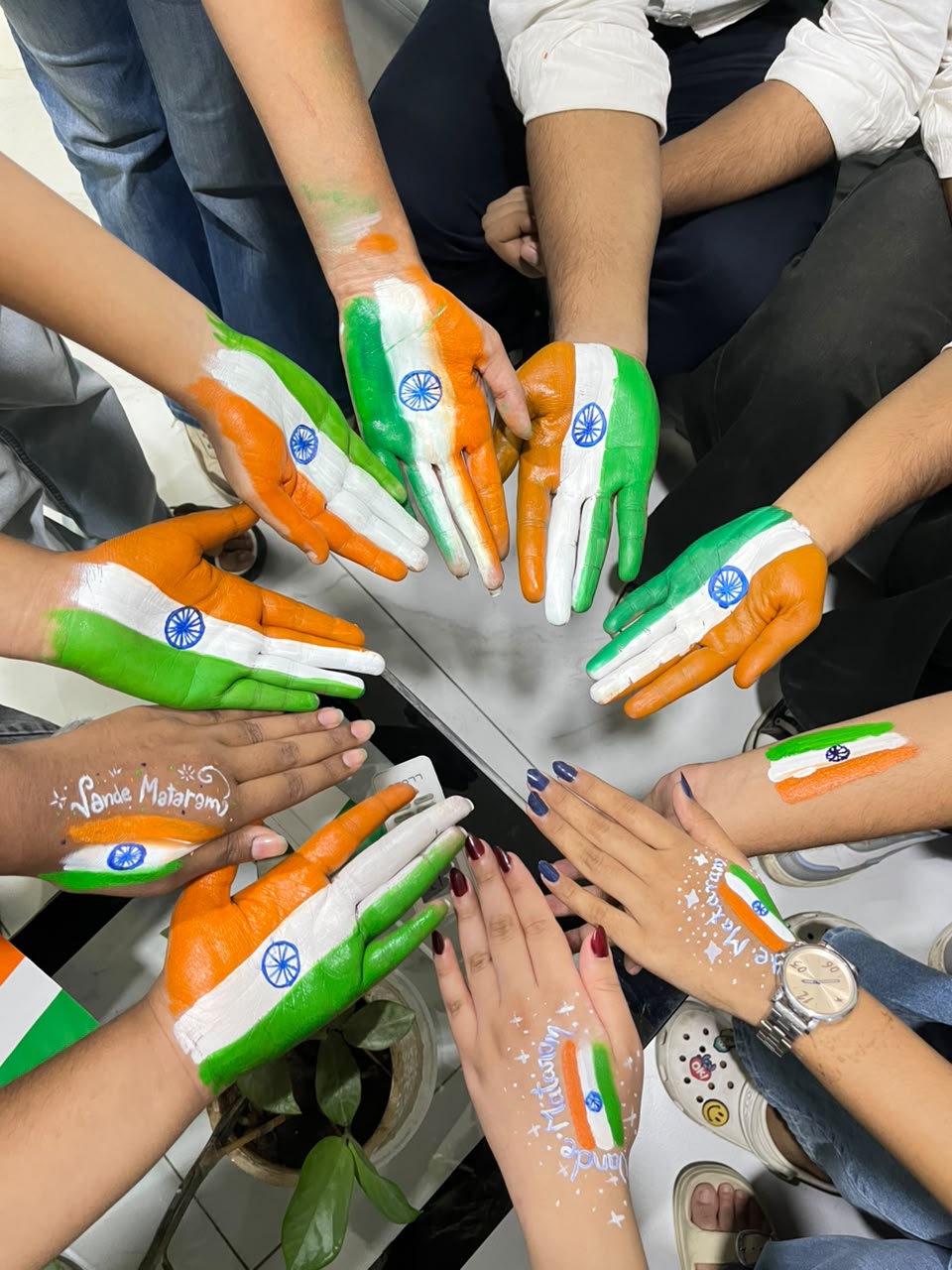
On 15 August 2026, Pahal Design proudly celebrated India’s 80th Independence Day across its centres throughout India, bringing together students, faculty members and teams in a vibrant celebration of freedom, creativity, unity and national pride.

From Delhi NCR to different cities across the country, the celebrations reflected one common spirit—the spirit of being Indian and the freedom to dream, create and build a better future.

For Pahal Design, Independence Day is not simply an occasion to remember India’s historic journey to freedom. It is also an opportunity to inspire the next generation of young designers, artists, architects and creative thinkers to understand the responsibility that comes with freedom.

One Nation. Many Centres. One Celebration.

The Independence Day 2026 celebration at Pahal Design centres across India brought the entire Pahal Design community together.

Every centre celebrated in its own creative way while remaining connected by the colours of the Tricolour and the values of unity, diversity, creativity and progress.

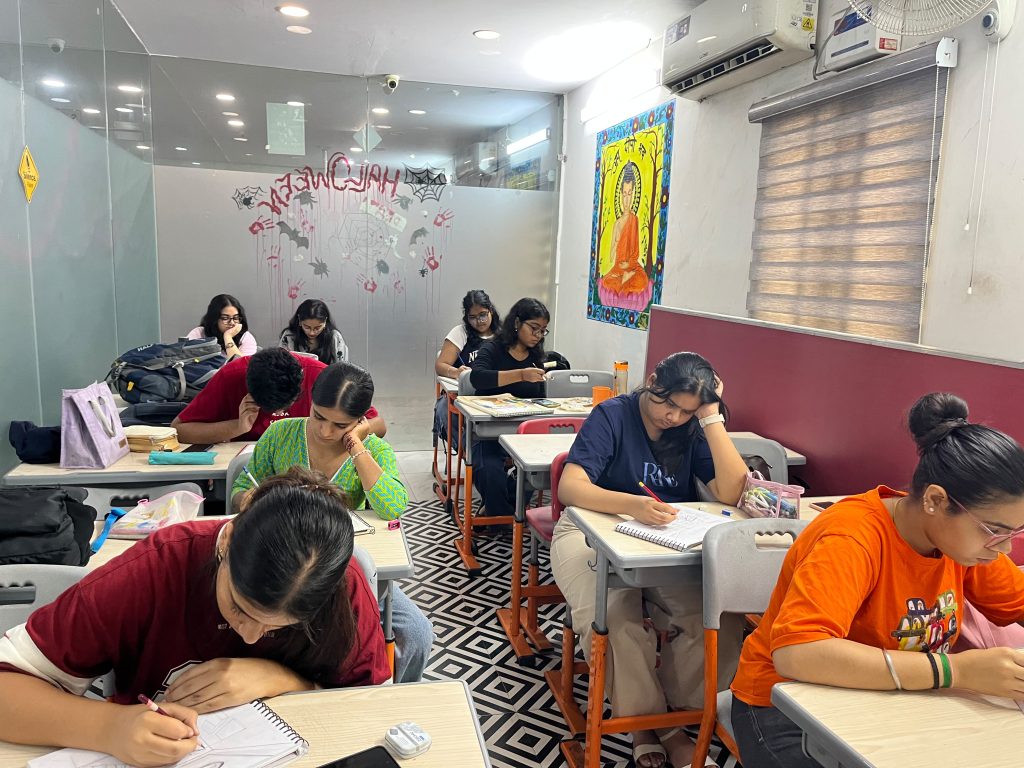
Students and faculty members participated enthusiastically, turning Pahal Design classrooms and creative spaces into celebrations of India’s culture and identity.

The occasion beautifully demonstrated how creativity can connect people across different cities, backgrounds and cultures.

Creativity Meets Patriotism at Pahal Design

As an institute dedicated to nurturing creative minds, Pahal Design believes that every celebration should give students an opportunity to think, imagine and express.

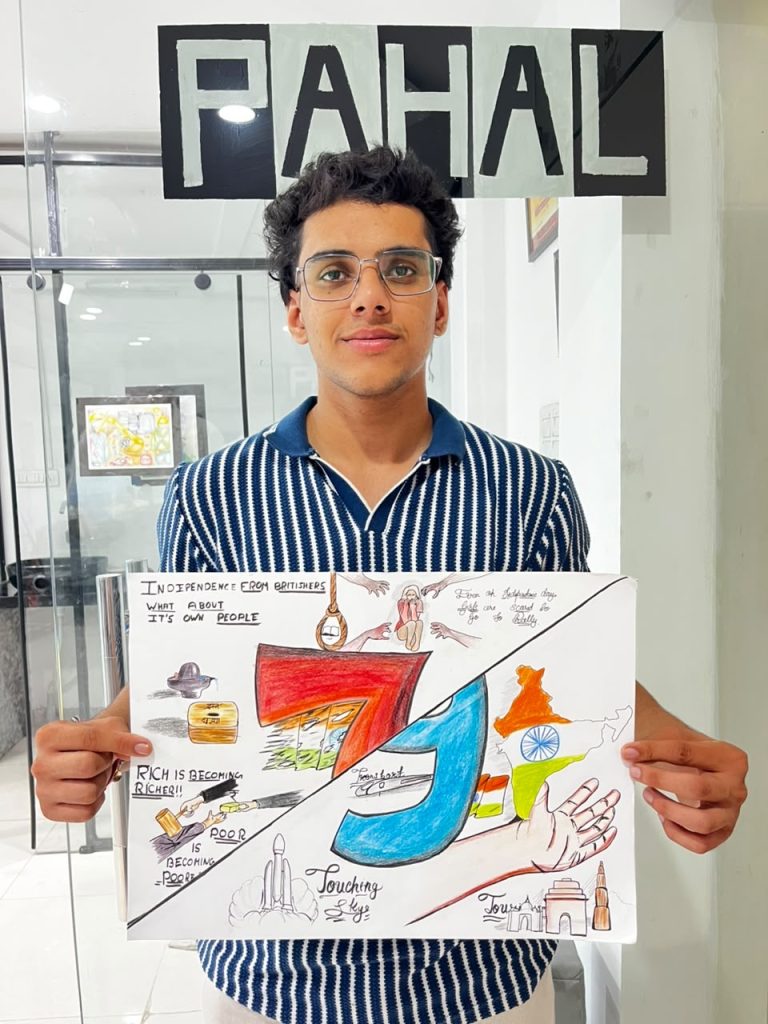
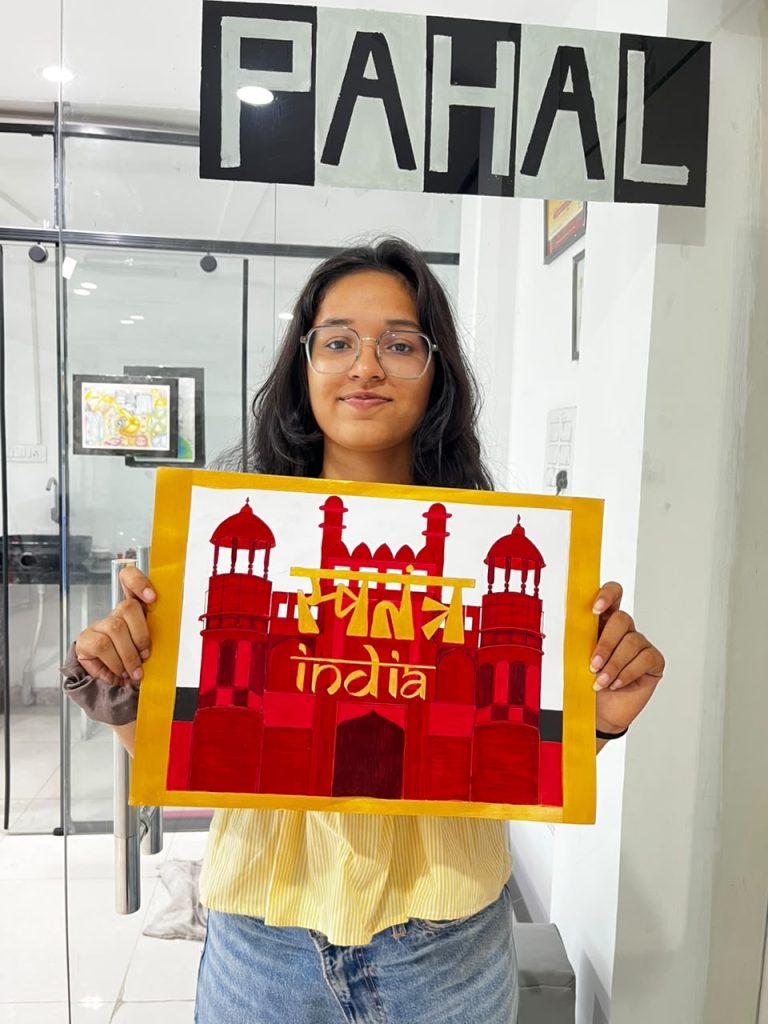
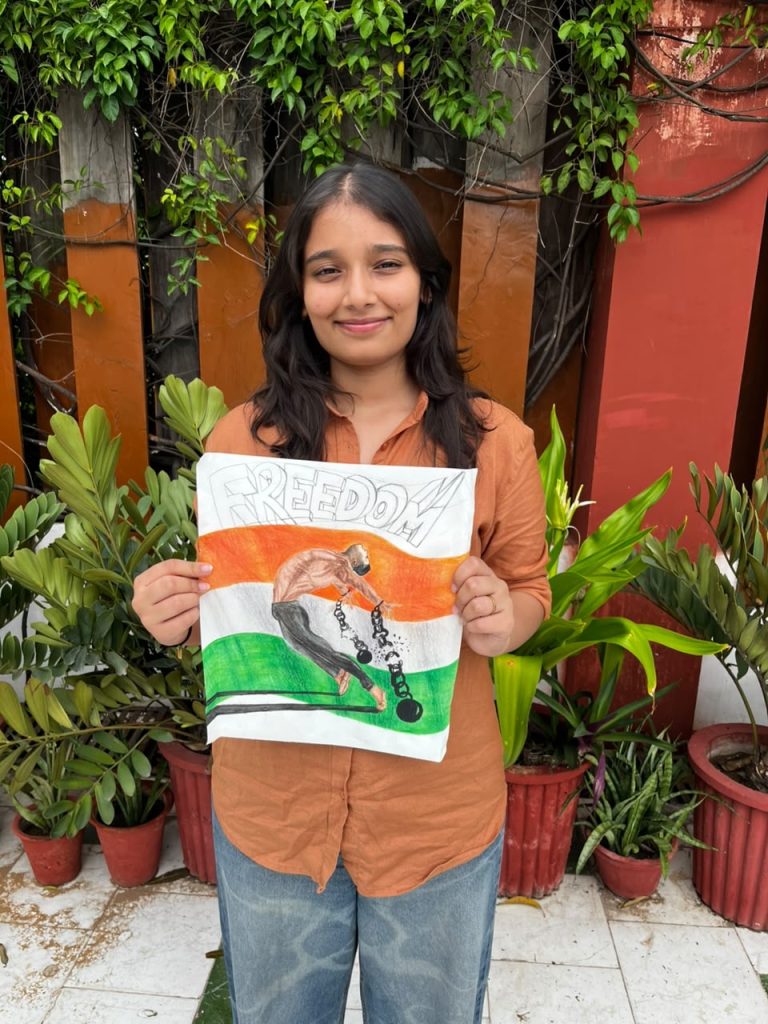
Independence Day 2026 became a canvas for students to communicate what India and freedom mean to them.

Creative activities across the centres encouraged students to explore themes such as:

  • India @ 80
  • Unity in Diversity
  • Freedom and Responsibility
  • Indian Art, Culture and Heritage
  • Viksit Bharat
  • Sustainable India
  • Women Empowerment
  • Innovation and Technology
  • India’s Youth and the Future
  • Remembering India’s Freedom Fighters

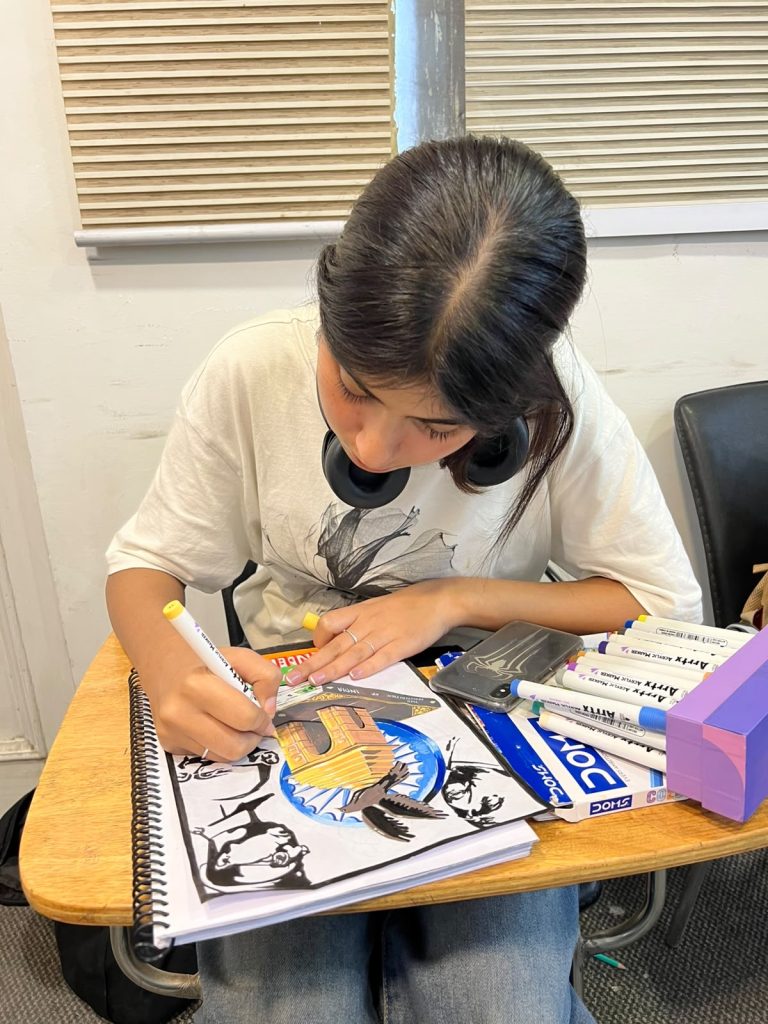
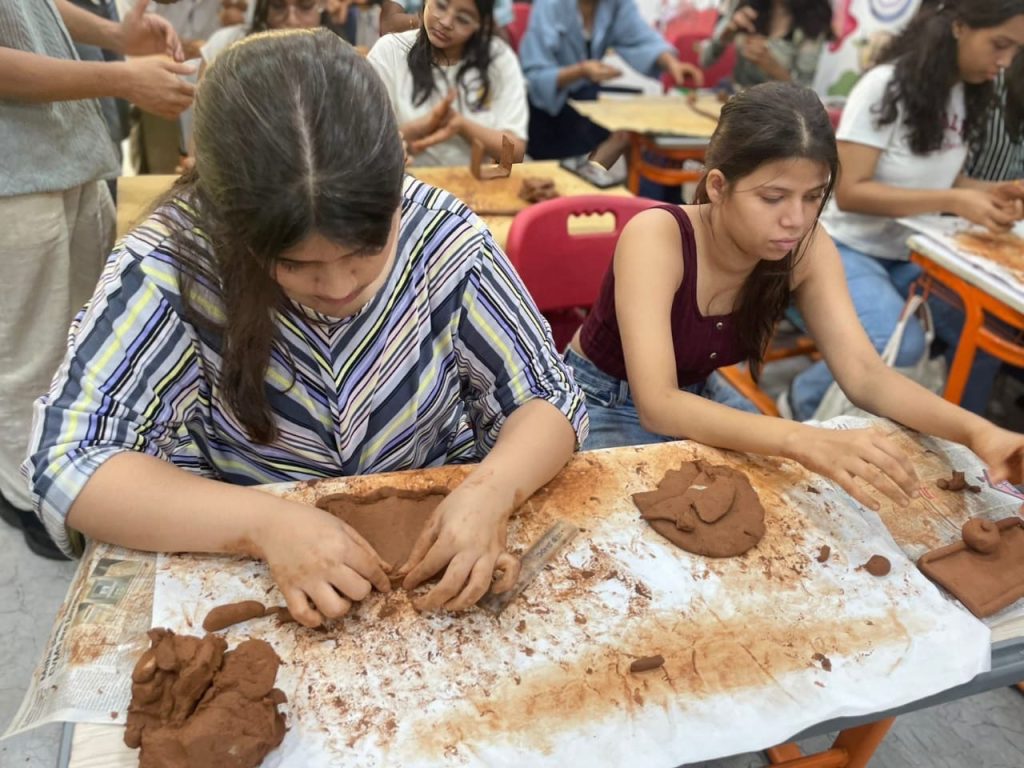
Through art, design, posters, illustrations and creative expressions, students celebrated India’s journey while sharing their vision for its future.

Independence Day Poster Making & Creative Activities

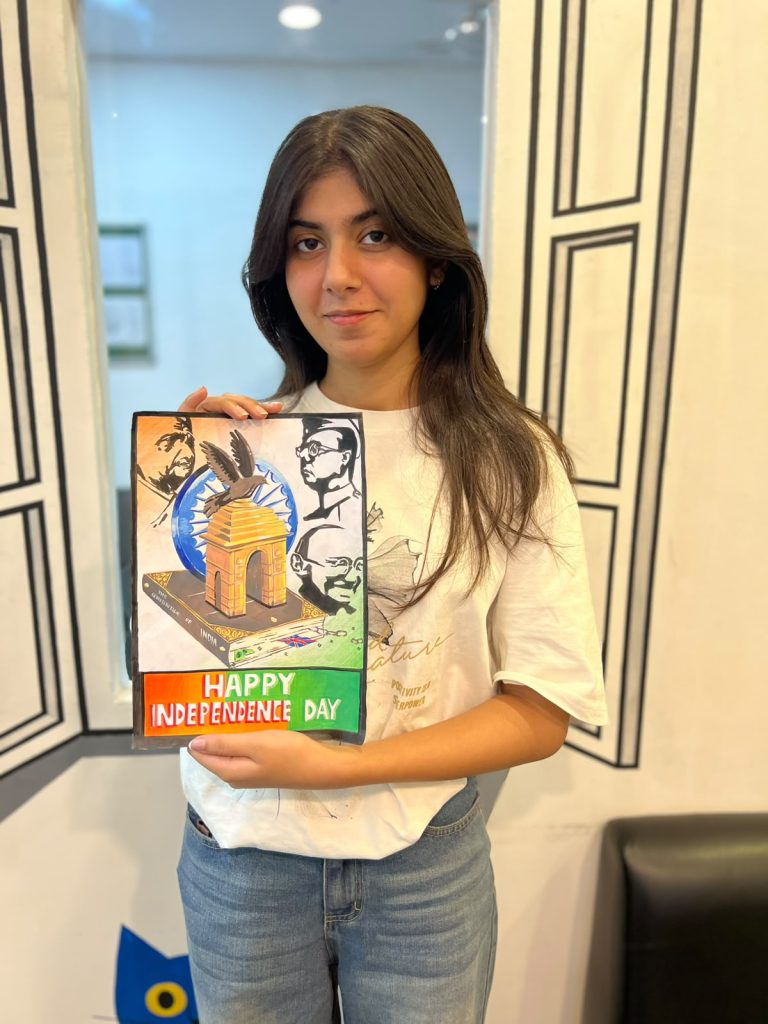
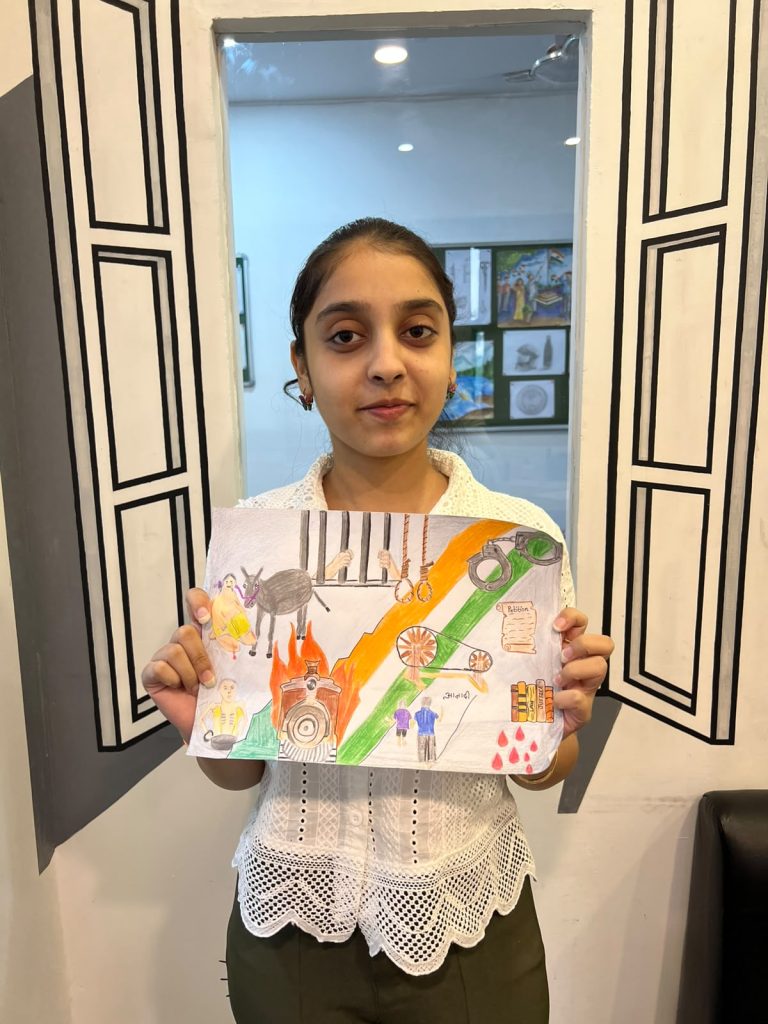
One of the highlights of the celebration was the opportunity for students to express their patriotic ideas through Independence Day posters and creative artwork.

Poster making is not only an artistic activity—it is an important form of visual communication. Students learn how to transform an idea into an impactful visual using composition, typography, illustration, colours and storytelling.

The Independence Day activities therefore combined celebration with learning, allowing students to develop creative skills while connecting with the values represented by the occasion.

Celebrating India’s 80th Independence Day

The year 2026 marks 80 years since India achieved independence on 15 August 1947.

This milestone is an opportunity to remember the courage, sacrifices and determination of those who contributed to India’s freedom while also looking towards the country’s future.

For today’s young generation, independence represents more than political freedom. It represents the freedom to learn, innovate, question, create, design and dream.

At Pahal Design, we believe these freedoms empower young people to become creators and problem-solvers who can contribute meaningfully to India’s development.

Freedom to Think. Freedom to Create.

Creativity flourishes when young minds have the freedom to explore.

This Independence Day, Pahal Design encouraged students to look beyond conventional ideas and understand how design and creativity can contribute to society.

Designers and artists have the ability to influence how people communicate, live, travel, learn and experience the world. From sustainable products and inclusive spaces to digital innovation and visual communication, creative professionals have an important role in shaping the India of tomorrow.

That is why our Independence Day 2026 message to every student was simple:

Freedom to Think. Freedom to Imagine. Freedom to Create.

Students – The Creative Future of India

India’s greatest strength is its young generation.

Today’s students will become tomorrow’s designers, architects, artists, entrepreneurs, innovators and leaders. Encouraging creativity among young people is therefore an investment in the country’s future.

At Pahal Design, our goal is to help students discover their creative potential and develop the skills and confidence required to transform their ideas into meaningful careers.

The Independence Day celebrations across our centres reinforced this belief and reminded students that creativity also comes with responsibility—the responsibility to create solutions that make society and the country better.

A Celebration Connecting Pahal Design Across India

What made Independence Day 2026 at Pahal Design special was seeing students and teams across different centres celebrate the same occasion together.

Different classrooms.
Different cities.
Different creative expressions.
But one emotion—pride in India.

The celebrations reflected the growing Pahal Design community and our shared commitment to nurturing India’s next generation of creative talent.

Pahal Design – Nurturing Creative Aspirants Since 1999

Since 1999, Pahal Design has been guiding students aspiring to pursue careers in Design, Architecture and Fine Arts.

Students at Pahal Design prepare for leading creative entrance examinations including:

NID | NIFT | UCEED | CEED | NATA | JEE Paper 2 | BFA

Through classroom learning, creative exercises, workshops, competitions, mentoring and student activities, Pahal Design focuses on developing the observation, imagination, problem-solving and visualisation abilities required by aspiring creative professionals.

Our Independence Day celebration is another reflection of this philosophy—learning through creativity and experiences.

Looking Towards a Creative and Progressive India

As India celebrates its 80th Independence Day, Pahal Design proudly joins the nation in celebrating its extraordinary journey.

We salute the people whose sacrifices gave us freedom and celebrate the young minds who will shape India’s next chapter.

May our students continue to dream fearlessly, think independently and use their creativity to contribute towards a stronger, sustainable and innovative India.

One Nation. Infinite Ideas. Limitless Creativity.

Happy 80th Independence Day from the entire Pahal Design family! 🇮🇳

Jai Hind!


About Pahal Design

Pahal Design is a leading Design, Architecture and Fine Arts entrance coaching institute in India, guiding creative aspirants since 1999.

With centres across India and learning options through Classroom, Online and Hybrid programs, Pahal Design helps students prepare for leading entrance examinations including NID, NIFT, UCEED, CEED, NATA, JEE Paper 2 and BFA.

Admissions & Enquiries: 880022-6864
Website: www.pahaldesign.com

FAQs – Independence Day 2026 Celebration at Pahal Design

1. How did Pahal Design celebrate Independence Day 2026?

Pahal Design celebrated Independence Day 2026 across its centres in India with students, faculty members and teams participating in patriotic and creative activities that celebrated India’s freedom, culture and future.

2. What creative activities were organised for Independence Day at Pahal Design?

Students participated in creative expressions including poster making, artwork and design-based activities inspired by patriotism, Indian culture, freedom, unity and the vision of a progressive India.

3. Why does Pahal Design organise creative activities for students?

Creative activities help students develop observation, conceptual thinking, imagination, visual communication and presentation skills while encouraging them to explore ideas beyond the classroom.

4. Which entrance examinations does Pahal Design prepare students for?

Pahal Design provides preparation and mentoring for creative entrance examinations including NID, NIFT, UCEED, CEED, NATA, JEE Paper 2 and BFA.

5. How can I join Pahal Design?

Students interested in Design, Architecture and Fine Arts entrance preparation can contact Pahal Design at 880022-6864or visit www.pahaldesign.com for information about courses, centres and admission options.
NID M.Des Cut Off 2026–27: Last Rank & Score for All Disciplines

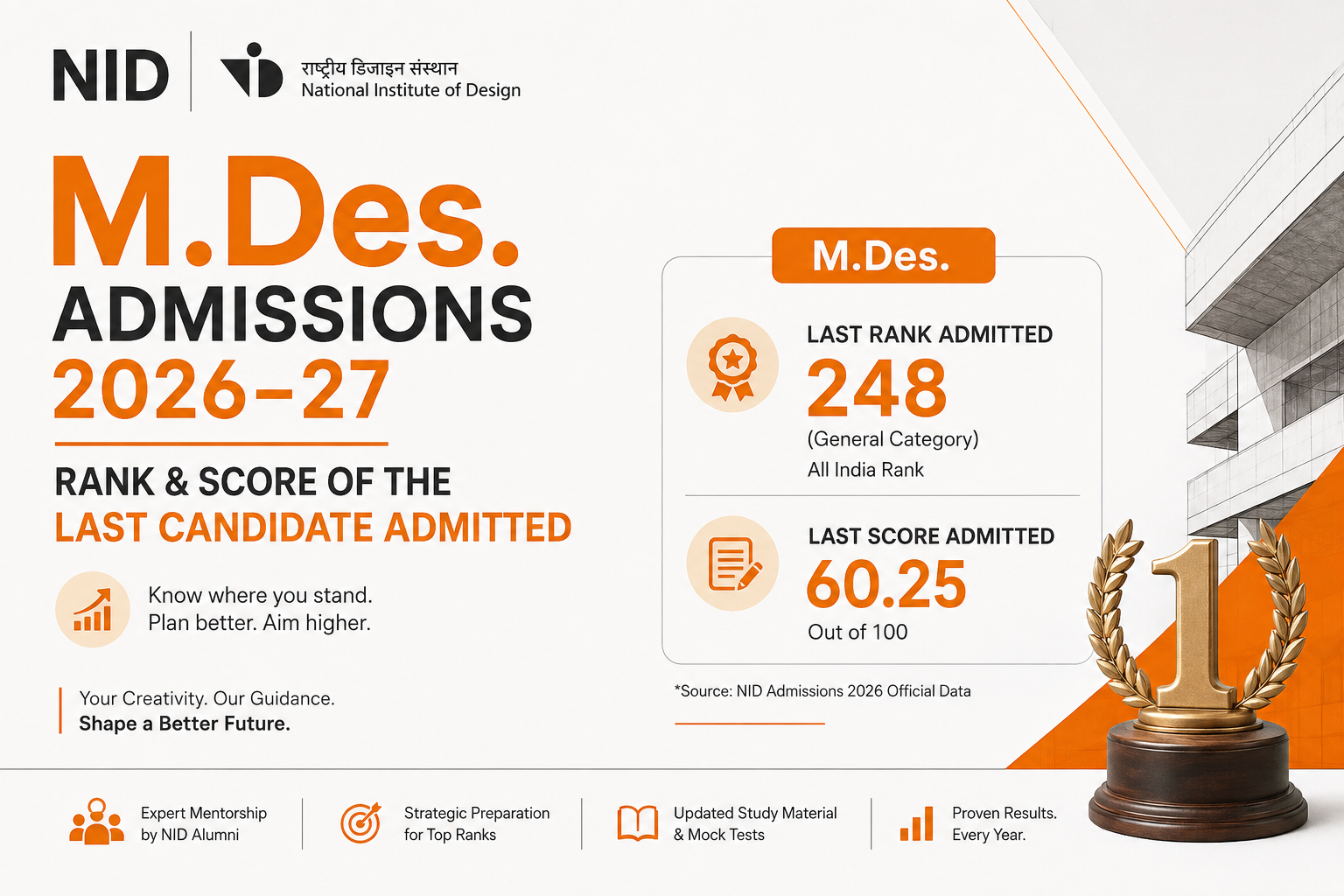
The National Institute of Design (NID) M.Des Admission 2026–27 data provides an important benchmark for aspirants preparing for admission to one of India’s most prestigious design institutes. NID has released the Rank and Score of the Last Candidate Allotted a Seat as on 17 July 2026, covering different M.Des disciplines and reservation categories.

For students planning to appear for NID DAT M.Des 2027, understanding the NID M.Des cut-off, closing rank and last admitted candidate’s score can help them evaluate the level of competition and set realistic preparation targets.

At Pahal Design, aspirants can use this previous admission data as a reference while preparing strategically for NID DAT Prelims, DAT Mains and the complete M.Des admission process.

NID M.Des Cut Off 2026–27: Discipline-Wise Open Category Closing Rank & Score

According to the official NID admission data, the following were the Open Category rank and score of the last candidate allotted a seat:

M.Des Discipline Open Rank Score
Animation Film Design 10 70.83
Ceramic & Glass Design 8 45.68
Furniture & Interior Design 18 48.18
Film & Video Communication 11 60.85
Graphic Design 9 65.10
Product Design 8 57.13
Textile Design 9 70.30
Apparel Design 14 54.70
Lifestyle Accessory Design 9 74.50
New Media Design 13 48.88
Photography Design 15 50.63
Strategic Design Management 8 76.28
Transportation & Automobile Design 12 56.75
Toy & Game Design 5 65.55
Digital Game Design 8 59.53
Design for Retail Experience 10 76.30
Information Design 11 61.88
Interaction Design 11 67.78
Universal Design 19 45.25

The official table shows substantial variation across disciplines. For example, Furniture & Interior Design closed at Open Rank 18 with a score of 48.18, Film & Video Communication at Rank 11 with 60.85, Graphic Design at Rank 9 with 65.10, and Product Design at Rank 8 with 57.13.

Similarly, Lifestyle Accessory Design recorded an Open score of 74.50, while Strategic Design Management recorded 76.28.

Among the disciplines listed in the official document, Design for Retail Experience had an Open score of 76.30, while Interaction Design had an Open score of 67.78.

Category-Wise NID M.Des Cut Off 2026–27

The official NID admission document provides closing rank and score information across:

  • OPEN
  • GEN-EWS
  • OBC-NCL
  • SC
  • ST
  • PwD
  • Overseas

The document also uses NE for “No Eligible Candidate” and NA for “No Applicant.”

This is important because the last allotted rank and score vary significantly depending on both the M.Des discipline and admission category.

NID Graphic Design Cut Off 2026

Graphic Design remains one of the key specialisations considered by NID M.Des aspirants.

For Graphic Design, the last allotted candidates recorded were:

Category Rank Score
Open 9 65.10
GEN-EWS 3 52.55
OBC-NCL 9 41.15
SC 5 53.58
ST 1 60.28
PwD 1 58.03
Overseas 1 62.48

These figures are taken from NID’s 2026–27 admission data.

NID Product Design Cut Off 2026

For Product Design, the Open Category last allotted candidate had:

Open Rank: 8 Score: 57.13

The same official data reports GEN-EWS Rank 2 at 51.85, OBC-NCL Rank 7 at 43.60, SC Rank 5 at 51.10, ST Rank 1 at 44.80 and PwD Rank 2 at 40.95.

Students targeting NID Product Design should remember that previous closing scores are useful benchmarks but should not be treated as guaranteed future cut-offs.

NID Interaction Design Cut Off 2026

For Interaction Design, the Open Category last allotted candidate had:

Open Rank: 11 Score: 67.78

The official document also records GEN-EWS Rank 2 at 49.23, OBC-NCL Rank 8 at 44.13, SC Rank 3 at 58.58 and ST Rank 1 at 53.80.

With the growing importance of UX, digital products and human-computer interaction, Interaction Design is an important discipline for students exploring postgraduate design education.

Which NID M.Des Discipline Had the Highest Open Score?

Based on the published last-allotted-candidate data, Design for Retail Experience recorded the highest Open score at 76.30, closely followed by:

Strategic Design Management – 76.28 Lifestyle Accessory Design – 74.50 Animation Film Design – 70.83 Textile Design – 70.30 Interaction Design – 67.78

The official discipline-wise figures show how widely scores can differ between programmes.

Importantly, a higher closing score should not automatically be interpreted as a programme being “better” or more difficult. Closing figures can be influenced by factors such as applicant performance, category and seat allocation.

What Does NID M.Des Closing Rank Mean?

The closing rank refers to the rank of the last candidate allotted a seat for the relevant discipline and category at the stated point in the admission process.

Therefore, if the Open Rank for a particular discipline is 10, it means the last Open-category candidate allotted a seat in the published data held Open Rank 10.

The NID document specifically states that these figures represent the “Rank and Score of the Last Candidate Allotted a Seat as on 17 July 2026.”

This distinction is important when students analyse previous-year NID cut-offs.

How to Use NID M.Des 2026 Cut-Off Data for 2027 Preparation

Previous admission data should primarily be used as a benchmark rather than a guaranteed target.

An aspirant preparing for the next NID M.Des admission cycle should aim to perform comfortably above previous closing-score levels rather than preparing only to match them.

Your preparation should focus on developing:

  • Strong design aptitude and visual thinking
  • Observation and analytical abilities
  • Creative problem-solving
  • Concept development
  • Visual communication and presentation
  • Discipline-specific understanding
  • Portfolio and project presentation skills where relevant
  • Consistent practice for the different stages of the NID admission process

Why NID M.Des Aspirants Need a Discipline-Specific Preparation Strategy

M.Des applicants generally come with more specialised interests than undergraduate design aspirants. A candidate interested in Graphic Design may require a different portfolio and conceptual orientation from someone targeting Transportation & Automobile Design, Strategic Design Management, Animation Film Design or Interaction Design.

Therefore, simply practising generic design entrance questions may not be sufficient.

Students should understand their preferred discipline, analyse previous NID admission trends and develop their creative thinking and presentation accordingly.

Prepare for NID M.Des with Pahal Design

Pahal Design provides preparation support for students aspiring to enter leading design institutes in India.

For NID M.Des aspirants, effective preparation requires more than attempting previous papers. Students need to build their ability to think creatively, communicate ideas visually, solve unfamiliar design problems and present concepts with clarity.

A structured preparation approach can include:

NID DAT Preparation: Regular practice to improve aptitude, creativity, observation and problem-solving.

Creative & Design Thinking: Developing original concepts rather than relying on repetitive solutions.

Portfolio Guidance: Helping students organise and present their design work effectively where portfolio preparation is relevant.

Mock Tests & Practice: Working under examination conditions to improve speed, decision-making and presentation.

Personalised Feedback: Identifying individual strengths and areas that require improvement.

The objective should not simply be to cross a previous cut-off but to build a strong overall performance for the NID admission process.

FAQs – NID M.Des Cut Off 2026–27

1. What is the NID M.Des cut off for 2026?

There is no single cut-off applicable to every M.Des discipline. The rank and score of the last candidate allotted a seat differ according to discipline and admission category. The official document provides separate figures for OPEN, GEN-EWS, OBC-NCL, SC, ST, PwD and Overseas candidates.

2. What was the NID Graphic Design closing rank in 2026?

For Graphic Design, the last allotted Open-category candidate had Rank 9 with a score of 65.10.

3. What was the NID Product Design closing rank in 2026?

For Product Design, the Open-category last allotted candidate had Rank 8 and a score of 57.13.

4. What was the NID Interaction Design closing rank?

For Interaction Design, the Open-category last allotted candidate had Rank 11 with a score of 67.78.

5. Which NID M.Des discipline had the highest Open closing score in the published 2026–27 data?

Among the disciplines listed, Design for Retail Experience had the highest Open score at 76.30, followed closely by Strategic Design Management at 76.28.

6. What do NE and NA mean in the NID cut-off table?

According to the official document, NE means “No Eligible Candidate” and NA means “No Applicant.”

7. Will the NID M.Des cut off remain the same next year?

No. Previous admission figures should only be treated as reference points. Closing ranks and scores can change from one admission cycle to another.

8. Is NID M.Des difficult to crack?

Admission is competitive because candidates are evaluated on design aptitude and creative abilities, and seats are discipline-specific. Consistent practice and a well-planned preparation strategy can help candidates improve their performance.

9. How should I prepare for NID M.Des 2027?

Start with design aptitude, observation, creative problem-solving, visual communication and regular timed practice. Aspirants should also understand their preferred M.Des discipline and develop relevant design skills and portfolio work where required.

10. Where can I prepare for NID M.Des entrance examination?

Students looking for structured NID M.Des coaching and design entrance preparation can explore Pahal Design for preparation, mentoring, practice and guidance for design entrance examinations.
Contact Us

NID B.Des Cut Off 2026-27: Campus-Wise Rank & Score of Last Candidate Admitted

The National Institute of Design (NID) has released the B.Des Admissions 2026-27 Rank and Score of the Last Candidate Allotted a Seat, providing an important reference for students preparing for NID admissions.

According to the official NID data, updated as on 12 August 2026, the closing ranks and scores have been provided for NID Ahmedabad, NID Andhra Pradesh, NID Assam, NID Madhya Pradesh and NID Haryana across OPEN, GEN-EWS, OBC-NCL, SC, ST, PwD and Overseas categories.

For students targeting NID B.Des Admission 2027, this information can be particularly useful for understanding the level of competition and setting realistic preparation targets.

NID B.Des Cut Off 2026-27 – Campus-Wise Closing Rank & Score

NID Ahmedabad

NID Ahmedabad recorded the most competitive OPEN category closing position among the campuses listed in the official document.

CategoryLast RankScore
OPEN4767.28
GEN-EWS1658.22
OBC-NCL4357.43
SC2656.82
ST1155.53
PwD754.89
Overseas2254.57

The OPEN category’s last allotted candidate at NID Ahmedabad had Open Rank 47 with a score of 67.28.

NID Andhra Pradesh B.Des Closing Rank 2026

CategoryLast RankScore
OPEN58739.78
GEN-EWS4946.89
OBC-NCL11248.03
SC7938.64
ST3540.32
PwD2839.78
Overseas5443.72

For NID Andhra Pradesh, the last allotted OPEN candidate had Open Rank 587 and a score of 39.78.

NID Assam B.Des Closing Rank 2026

CategoryLast RankScore
OPEN37150.32
GEN-EWS5644.43
OBC-NCL13543.75
SC8234.32
ST3938.72
PwDNANA
OverseasNot Applicable

At NID Assam, the OPEN closing position was Rank 371 with a score of 50.32.

NID Madhya Pradesh B.Des Closing Rank 2026

CategoryLast RankScore
OPEN20257.39
GEN-EWS2954.39
OBC-NCL10150.03
SC5446.14
ST2845.25
PwD1450.28
Overseas5643.64

The last OPEN candidate allotted a seat at NID Madhya Pradesh had Open Rank 202 and a score of 57.39.

NID Haryana B.Des Closing Rank 2026

CategoryLast RankScore
OPEN24055.78
GEN-EWS4448.68
OBC-NCL10249.75
SC6742.72
ST2944.57
PwD2740.50
Overseas7231.68

For NID Haryana, the OPEN category closed at Open Rank 240 with a score of 55.78.

NID B.Des 2026 OPEN Category Closing Rank Comparison

For students looking specifically at the OPEN category, the campus-wise closing positions were:

NID CampusOPEN Closing RankScore
NID Ahmedabad4767.28
NID Madhya Pradesh20257.39
NID Haryana24055.78
NID Assam37150.32
NID Andhra Pradesh58739.78

These figures show a substantial difference in the last allotted OPEN ranks across NID campuses. NID Ahmedabad had the lowest OPEN closing rank at 47, followed by NID Madhya Pradesh at 202, NID Haryana at 240, NID Assam at 371 and NID Andhra Pradesh at 587.

What Does the NID 2026 Closing Rank Mean for NID 2027 Aspirants?

The previous year’s closing rank is one useful reference point when preparing for the next NID admission cycle. However, students should not treat these ranks or scores as guaranteed cut-offs for NID 2027.

Closing ranks can change depending on factors such as the applicant pool, performance of candidates, category, seat allocation and admission process.

Students preparing for NID DAT 2027 should therefore aim for the strongest possible performance rather than preparing only to match the previous year’s last admitted score.

Targeting NID Ahmedabad?

The 2026 data demonstrates the particularly competitive nature of NID Ahmedabad admissions. The last OPEN candidate allotted a seat had Rank 47 with 67.28 marks.

Aspirants targeting NID Ahmedabad should consequently focus on developing strong fundamentals in observation, creativity, visualisation, problem solving, drawing, design aptitude and original thinking.

How to Prepare for NID B.Des Entrance Exam

A structured NID preparation strategy should combine creativity with consistent practice. Aspirants can focus on:

  1. Observation & Visualisation – Develop the ability to observe everyday situations and communicate ideas visually.
  2. Creative Thinking – Practise generating multiple original solutions instead of relying on predictable answers.
  3. Sketching & Drawing – Improve proportion, perspective, composition and visual communication.
  4. Design Aptitude – Strengthen design awareness, logical thinking and problem-solving skills.
  5. Time Management – Practise completing creative questions within examination conditions.
  6. Mock Tests & Previous Papers – Use regular testing to identify strengths and areas that need improvement.

Prepare for NID 2027 with Pahal Design

For students aspiring to secure admission to NID, systematic preparation and regular practice can make a significant difference.

Pahal Design provides preparation for design entrance examinations including NID, NIFT and UCEED, with a focus on design aptitude, creativity, drawing, visualisation, portfolio development and entrance examination practice.

Students preparing for NID B.Des 2027 can start early, understand the examination requirements and build their creative abilities progressively rather than depending on last-minute preparation.

Frequently Asked Questions – NID B.Des Cut Off 2026

What was the NID Ahmedabad B.Des OPEN closing rank in 2026?

The last OPEN candidate allotted a seat at NID Ahmedabad had Open Rank 47 and a score of 67.28.

What was the NID Madhya Pradesh OPEN closing rank?

NID Madhya Pradesh’s last allotted OPEN candidate had Rank 202 with 57.39 marks.

What was the NID Haryana OPEN closing rank?

For NID Haryana, the OPEN closing position was Rank 240 with a score of 55.78.

What was the NID Assam OPEN closing rank?

The OPEN category at NID Assam closed at Rank 371 with a score of 50.32.

What was the NID Andhra Pradesh OPEN closing rank?

NID Andhra Pradesh’s last allotted OPEN candidate had Rank 587 and a score of 39.78.

Are NID 2026 closing ranks the same as NID 2027 cut-offs?

No. The 2026 closing ranks show the rank and score of the last candidate allotted a seat in that admission cycle. They can be used as a reference, but future closing ranks may change.

Conclusion

The NID B.Des 2026-27 closing rank and score data gives aspiring designers a useful benchmark for understanding admission competition across NID campuses.

Among the campuses listed, NID Ahmedabad had an OPEN closing rank of 47 with 67.28 marks, while the corresponding OPEN closing ranks were 202 for NID Madhya Pradesh, 240 for NID Haryana, 371 for NID Assam and 587 for NID Andhra Pradesh.

For NID 2027 aspirants, the goal should be to build strong design aptitude, creativity and visual communication skills while aiming significantly higher than previous closing benchmarks.


NATA 2026 Exam Pattern: Complete Guide to Question Paper, Marks, Syllabus & Preparation

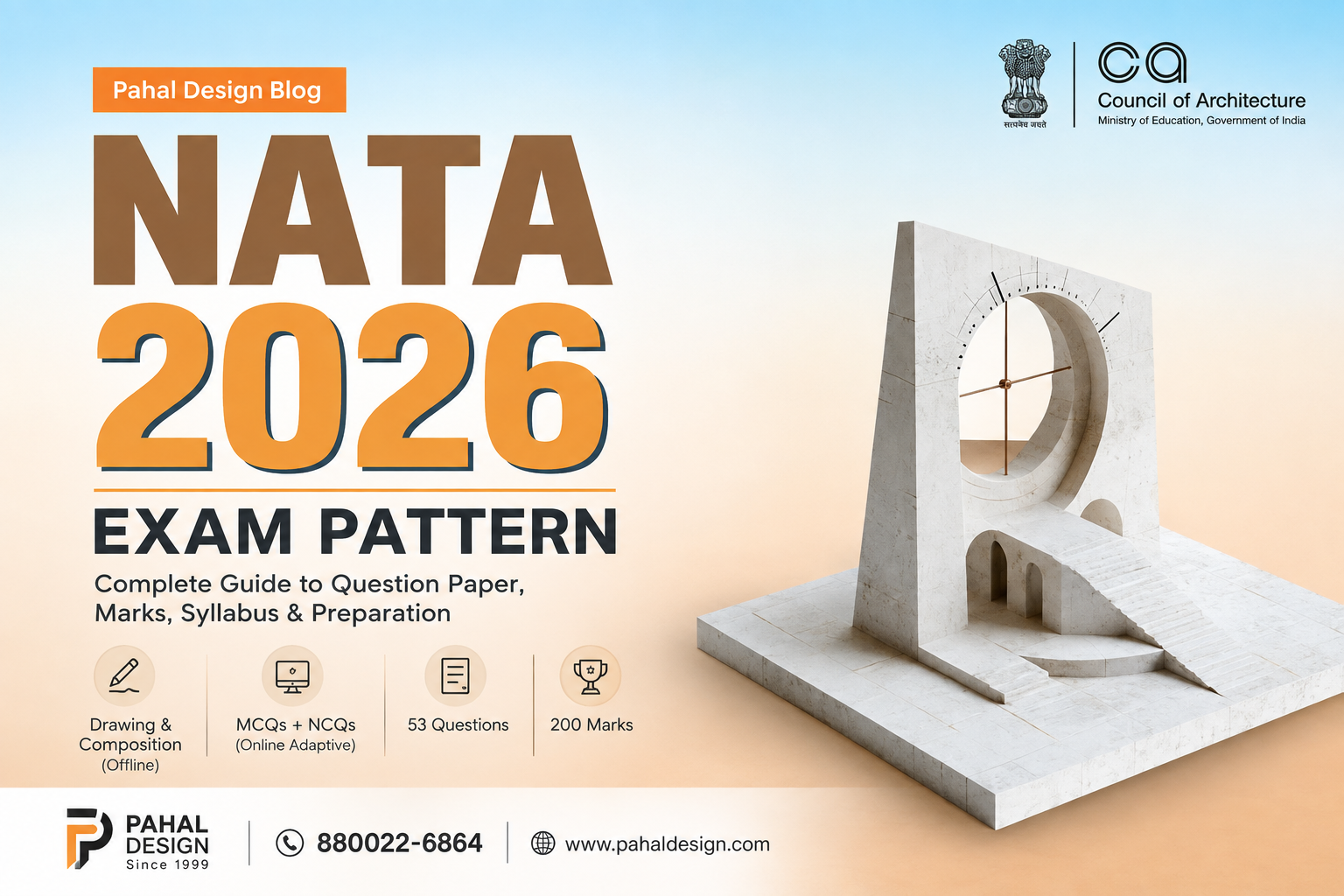
The NATA 2026 exam pattern is important for every student planning to pursue a Bachelor of Architecture (B.Arch) in India. Conducted by the Council of Architecture (CoA), the National Aptitude Test in Architecture evaluates a candidate’s drawing ability, visualisation, observation, logical reasoning, architectural awareness and overall aptitude for architecture.

For NATA aspirants, understanding the examination structure before beginning serious preparation can make a significant difference. The NATA 2026 question paper carries a total of 200 marks and is divided into two major parts: Drawing & Composition and online aptitude-based questions.

Here is a detailed breakdown of the NATA 2026 exam pattern, question distribution, syllabus and preparation strategy.

NATA 2026 Exam Pattern Overview

According to the announced pattern, NATA 2026 is structured into two parts:

Part A – Drawing & Composition

  • Mode: Offline
  • Duration: 90 minutes
  • Total Marks: 80
  • Total Questions: 3

Part B – MCQs + NCQs

  • Mode: Online Adaptive
  • Duration: 90 minutes
  • Total Marks: 120
  • Total Questions: 50

NATA 2026 Total Exam

  • Total Questions: 53
  • Total Marks: 200
  • Total Duration: 180 minutes

This combination tests both the candidate’s creative abilities and analytical aptitude, making balanced preparation extremely important.

NATA 2026 Part A: Drawing & Composition

Part A is an offline test carrying 80 marks. It consists of three different sections designed to evaluate creativity, drawing ability, visualisation and three-dimensional thinking.

A1 – Composition & Colour

Questions: 1
Marks: 25

Students may be required to create a visual composition and demonstrate an understanding of colour application, balance, proportion and visual aesthetics.

Preparation should focus on:

  • Colour theory
  • Visual composition
  • Balance and harmony
  • Creative arrangement of elements
  • Understanding positive and negative spaces
  • Presentation skills

A2 – Sketching & Composition

Questions: 1
Marks: 25
Medium: Black & White

This section evaluates fundamental drawing abilities, including:

  • Drawing skills
  • Proportion
  • Shading
  • Perspective
  • Observation
  • Composition
  • Visual representation

Regular sketching practice can help students develop the speed and confidence required to complete this section effectively.

A3 – 3D Composition

Questions: 1
Marks: 30

The 3D Composition section carries the highest marks in Part A.

Candidates may be required to create a three-dimensional composition or model using the material or kit provided during the examination.

Students should develop an understanding of:

  • Form and volume
  • Space
  • Scale and proportion
  • Structural balance
  • 3D visualisation
  • Model-making
  • Creative transformation of basic forms

This section is particularly important because architecture requires students to think beyond two-dimensional drawings and understand how forms interact with physical space.

NATA 2026 Part B: Online Adaptive Test

Part B is an online adaptive examination carrying 120 marks.

The paper consists of:

42 MCQs + 8 NCQs = 50 Questions

Part B evaluates the candidate’s aptitude, reasoning, observation, architectural awareness and problem-solving capabilities.

NATA 2026 Part B Syllabus

1. Visual & Spatial Reasoning

Candidates should develop their ability to understand shapes, forms, patterns, directions and spatial relationships.

Practising mental rotation, 2D-to-3D visualisation, figure analysis and spatial puzzles can be useful.

2. Logical Reasoning & Interpretation

This section tests the candidate’s ability to analyse information and reach logical conclusions.

Questions may involve:

  • Patterns
  • Sequences
  • Relationships
  • Analytical reasoning
  • Logical interpretation

3. Architecture Awareness

Architecture awareness is particularly important for NATA aspirants.

Students should develop knowledge about:

  • Famous buildings
  • Architects
  • Architectural history
  • Building materials
  • Architectural styles
  • Important monuments
  • Contemporary architecture

Rather than memorising isolated facts, students should try to understand why important buildings and architectural movements are significant.

4. General Knowledge & Current Affairs

Candidates should stay updated with important national and international developments, particularly topics connected with:

  • Architecture
  • Art
  • Design
  • Culture
  • Environment
  • Technology
  • Major current events

5. Language & Grammar

Communication and comprehension skills are also tested. Students should strengthen vocabulary, grammar and their ability to understand written information accurately.

6. Design Sensitivity & Observation Skills

Architecture demands strong observation.

Students should practise identifying details in everyday environments, objects, buildings and visual compositions.

This section may evaluate a student’s understanding of aesthetics, functionality, relationships between objects and sensitivity towards design.

7. Critical Thinking & Problem-Solving

Rather than relying only on memorisation, students should develop the ability to analyse unfamiliar situations and find logical solutions.

Architecture aspirants should constantly ask:

Why is something designed this way, and how could it be designed better?

This approach can help build genuine design aptitude.

8. Basic Mathematics & Geometry

Students should revise fundamental mathematical and geometrical concepts relevant to aptitude and architecture.

Important areas may include:

  • Geometry
  • Shapes
  • Areas and volumes
  • Proportions
  • Measurements
  • Basic numerical ability

NATA 2026 Marks Distribution

SectionQuestionsMarks
A1 – Composition & Colour125
A2 – Sketching & Composition125
A3 – 3D Composition130
Part B – MCQs + NCQs50120
Total53200

The pattern clearly demonstrates that NATA preparation cannot focus only on drawing. Part B alone contributes 120 out of 200 marks, while Part A requires specialised creative and architectural aptitude.

How to Prepare for NATA 2026

A successful NATA 2026 preparation strategy should combine drawing practice, aptitude preparation and architectural awareness.

Students should regularly practise perspective drawing, composition, colour application and sketching while simultaneously working on logical reasoning, visual aptitude, mathematics and architecture-related general knowledge.

For the 3D composition component, practising with basic forms and model-making materials can help candidates develop spatial understanding.

Timed mock tests are equally important. Since both major parts have defined time limits, students must learn to balance accuracy, creativity and speed.

Why Start NATA 2026 Preparation Early?

NATA is different from a conventional academic examination. Drawing, observation, visualisation and design thinking are skills that improve gradually through consistent practice.

Starting early gives students more time to:

  • Improve sketching and perspective
  • Build drawing speed
  • Understand colour and composition
  • Develop 3D visualisation
  • Strengthen architecture awareness
  • Practise reasoning and aptitude
  • Attempt NATA mock tests
  • Identify and improve weaker areas

Prepare for NATA 2026 with Pahal Design

At Pahal Design, NATA aspirants are trained with a structured approach covering the major areas required for architecture entrance preparation.

The preparation focuses on drawing, sketching, perspective, composition, 3D visualisation, architecture aptitude, reasoning, observation and exam-oriented practice.

Students preparing for NATA and JEE Paper 2 B.Arch can benefit from systematic practice, faculty guidance, mock examinations and targeted preparation based on the latest examination requirements.

The objective is not simply to teach students how to draw, but to help them develop the observation, creativity, visualisation and problem-solving abilities required for architecture entrance examinations.

Final Words

The NATA 2026 exam pattern gives substantial importance to both creative and aptitude-based abilities. With 80 marks for Drawing & Composition and 120 marks for MCQs and NCQs, candidates need a balanced preparation strategy.

Understanding the paper pattern early, practising consistently and developing strong visual and architectural thinking can give aspirants a significant advantage.

For students targeting B.Arch admission through NATA 2026, now is the right time to build a structured preparation plan and practise every component of the examination.

Pahal Design – NATA & Architecture Entrance Exam Preparation

Website: www.pahaldesign.com
Contact: 880022-6864


UCEED 2026–27 Parent Guide: Eligibility, IIT Seats, Cutoffs, Exam Pattern & Top Design Colleges

For students aspiring to study Bachelor of Design (B.Des) at IITs and other leading design institutes in India, UCEED is one of the most important entrance examinations to understand.

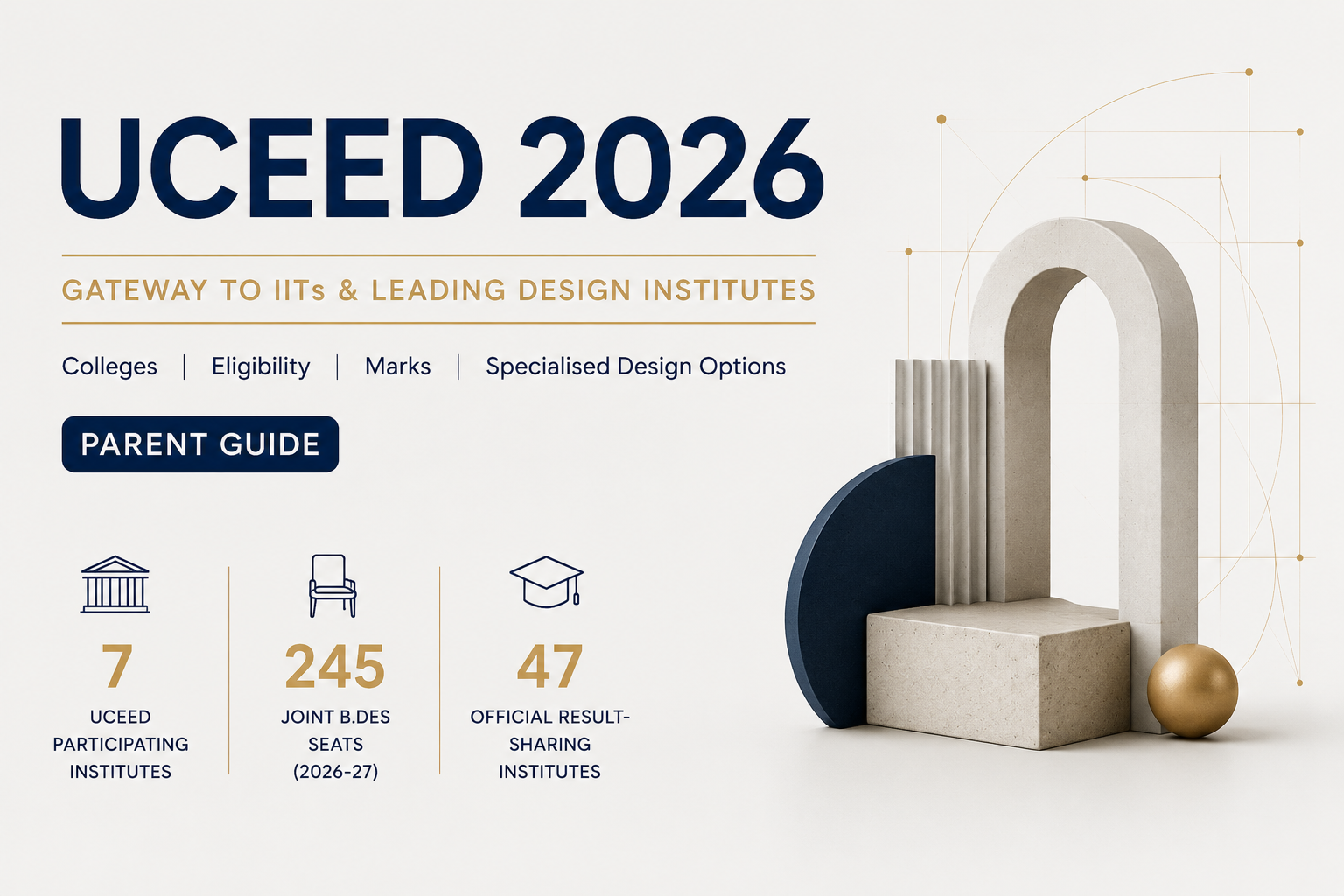
The Undergraduate Common Entrance Examination for Design (UCEED) provides a pathway to the joint B.Des admission process at 7 premier participating institutes, including 6 IITs and IIITDM Jabalpur. The UCEED 2026 score is also officially shared with 47 additional institutes that conduct their own admission processes.

At Pahal Design, we recommend that both students and parents understand not only the UCEED exam pattern, but also college eligibility, expected score ranges, specialisations and alternative colleges before planning their preparation.

What is UCEED?

UCEED is a national-level design entrance examination used for admission to undergraduate design programmes.

One of its biggest advantages is that students from Science, Commerce, Arts and Humanities can appear for UCEED. However, eligibility for admission to individual participating institutes can differ depending on the subjects studied in Class XII.

For parents, this distinction is particularly important:

Being eligible to appear for UCEED does not automatically mean a student is eligible for B.Des admission at every participating IIT.

UCEED 2026 Participating Institutes, Seats & Target Scores

For 2026–27, the seven participating institutes together offer 245 joint B.Des seats.

InstituteSeatsClass XII EligibilityFinal OPEN AIR*Planning Score /300
IIT Bombay – IDC School of Design37All streams16215+
IIT Delhi – Department of Design20All streams28210+
IIT Hyderabad – Department of Design30All streams42207+
IIT Guwahati – Department of Design56PCM required78198+
IIT Indore – School of Innovation16All streams84197+
IIT Roorkee – Department of Design20PCM required93195+
IIITDM Jabalpur – Design Discipline66PCM or Biology171185+

*The Final OPEN AIR figures are the 2026 Round-V closing ranks given in the source guide. The score figures are planning targets rather than official college cutoffs.

What UCEED Score Should Students Target?

Parents should avoid treating a particular raw score as a guaranteed IIT admission score. UCEED marks-to-rank relationships can change every year.

For example, observed 2026 marks-to-AIR examples in the guide include:

218.37 → AIR 9 | 212.58 → AIR 15 | 208.16 → AIR 30 | 205.16 → AIR 42 | 195.50 → AIR 75 | 189.58 → AIR 124 | 185.95 → AIR 151.

Therefore, students should focus on achieving the strongest possible AIR rather than preparing only to cross a perceived cutoff.

UCEED 2026 Eligibility Criteria

Who Can Appear for UCEED 2026?

According to the guide, candidates:

  • Should have first attempted Class XII in 2025 or 2026
  • Can belong to Science, Commerce, Arts or Humanities
  • Can attempt UCEED a maximum of two times in consecutive years
  • OPEN/EWS/OBC-NCL candidates should have been born on or after 1 October 2001
  • SC/ST/PwD candidates should have been born on or after 1 October 1996

Eligibility for B.Des Admission at the 7 Participating Institutes

Students must obtain a UCEED 2026 rank and pass all five subjects in their Class XII/equivalent examination in 2025 or 2026.

Subject requirements differ:

IIT Bombay, IIT Delhi, IIT Hyderabad and IIT Indore: All streams
IIT Guwahati and IIT Roorkee: Physics + Chemistry + Mathematics
IIITDM Jabalpur: Physics + Chemistry + Mathematics/Biology

UCEED 2026 Exam Pattern

UCEED is a 3-hour, 300-mark examination consisting of two compulsory parts.

PartModeDurationQuestionsMarks
Part AComputer-Based2 Hours57 – NAT + MSQ + MCQ200
Part BDrawing Sheet1 Hour1 Sketching + 1 Design Aptitude100
Total3 HoursBoth Parts Compulsory300

This structure makes UCEED preparation different from conventional entrance examinations. Students need to develop both analytical/design aptitude and drawing/visualisation abilities.

UCEED 2026 Part A Shortlisting Cutoff

The 2026 Part-A shortlisting cutoffs listed in the guide are:

OPEN: 83.75/200
OBC-NCL & EWS: 75.37/200
SC/ST/PwD: 41.87/200

An important point for parents is that these are Part-A shortlisting cutoffs, not IIT admission cutoffs.

If a candidate’s Part-A score falls below the applicable cutoff, Part-B is not evaluated. The final rank for shortlisted candidates is based on the combined Part-A and Part-B score.

Design Specialisations and Career Options Through UCEED

UCEED should not be viewed only as an entrance examination for a generic B.Des programme.

Depending on the institute, students can explore areas such as:

Product Design, UX Design, Interaction Design, Visual Communication, Film & Animation, Space Design, Industrial Design, Sustainable Design, Fashion Design, Footwear Design, Branding, AR/VR and technology-led design.

For example, IIT Hyderabad includes Product, Visual, Interaction, UX, Film and Animation focus areas, while IIITDM Jabalpur includes Product, Space and Communication Design. IIT Indore offers areas including Urban System Innovation, Educational Technologies, Healthcare Systems and Sustainable Energy Systems.

Students should nevertheless check whether an area is offered as a formal specialisation, major, pathway, focus area or elective, as this varies between institutions.

UCEED Colleges Beyond the IITs

One of the most valuable aspects of UCEED is that the examination can create opportunities beyond the seven institutes participating in joint B.Des counselling.

The UCEED 2026 guide identifies 47 official result-sharing institutes. These institutions are separate from IIT Bombay’s joint B.Des seat-allocation process, so students need to apply to them individually.

Some notable options include BITS Design School, CEPT University, FDDI, Unitedworld Institute of Design (UID), Nirma University, VIT School of Design, IIIT-Delhi, DTU, NSUT, Srishti Manipal Institute, MIT World Peace University, Anant National University and several other design institutions.

This makes UCEED valuable even for students who may not ultimately secure an IIT B.Des seat.

UCEED Score Strategy for Parents & Students

A practical preparation strategy from the guide is:

Target ScorePlanning Perspective
215+IIT Bombay-level target
205–214IIT Delhi / IIT Hyderabad range can become realistic
195–204IIT Guwahati / IIT Indore / IIT Roorkee range can become realistic
185–194IIITDM Jabalpur + strong result-sharing options
170–184Several result-sharing institutes may remain valuable
Qualified below thisDon’t assume there are no college options

These should be treated as preparation benchmarks, not guaranteed admission cutoffs.

How to Prepare for UCEED 2026

A strong UCEED preparation strategy should balance Part A and Part B rather than treating drawing as an optional skill.

Students should work consistently on observation, visualisation, spatial reasoning, logical reasoning, design aptitude, creativity, sketching, perspective, composition and problem-solving.

Regular timed practice and mock examinations are equally important because students have to manage very different question formats within the same examination.

UCEED 2026 Preparation with Pahal Design

Pahal Design helps students prepare strategically for UCEED and other leading design entrance examinations through structured concept building, aptitude preparation, drawing and visualisation practice, design thinking exercises, mock tests and exam-oriented guidance.

Preparation should go beyond solving questions. Students need to understand how designers observe, analyse, visualise and solve problems creatively.

For parents, the objective should therefore not simply be “How many marks does my child need?” but:

“How can my child build the skills required to achieve the best possible UCEED rank?”

With focused preparation, regular practice and an informed college strategy, UCEED can open multiple pathways into some of India’s leading design institutions.

Important: Admission rules, eligibility requirements, seat matrices and institute-specific selection processes can change. Students and parents should always verify the latest official information before applying.


NATA 2026 B.Arch Parent Guide: Exam Pattern, Eligibility, Scores & Top Architecture Colleges in India

For students aspiring to pursue a Bachelor of Architecture (B.Arch) in India, the National Aptitude Test in Architecture (NATA) 2026 is an important entrance examination to understand. A valid NATA score can be used for B.Arch admissions through participating state/UT counselling systems and universities, although the final admission formula varies by counselling authority and institution.

For parents, understanding the exam pattern, eligibility, scoring, college options and counselling process can make architecture admission planning much easier.

This NATA 2026 Parent Guide explains the key information you need before your child begins preparing for B.Arch admissions.

What is NATA 2026?

NATA, or the National Aptitude Test in Architecture, is used as an architecture aptitude examination for admission to B.Arch programmes through multiple universities, institutions and state counselling routes across India.

Unlike an admission system based solely on the entrance-test score, the eventual merit calculation may also depend on factors such as:

  • Class 12 or Diploma marks
  • State or domicile rules
  • Category and quota
  • Institution-specific admission criteria
  • Counselling rounds
  • Seat availability

This is why two students with similar NATA performance may ultimately receive different college options.

NATA 2026 Exam Pattern

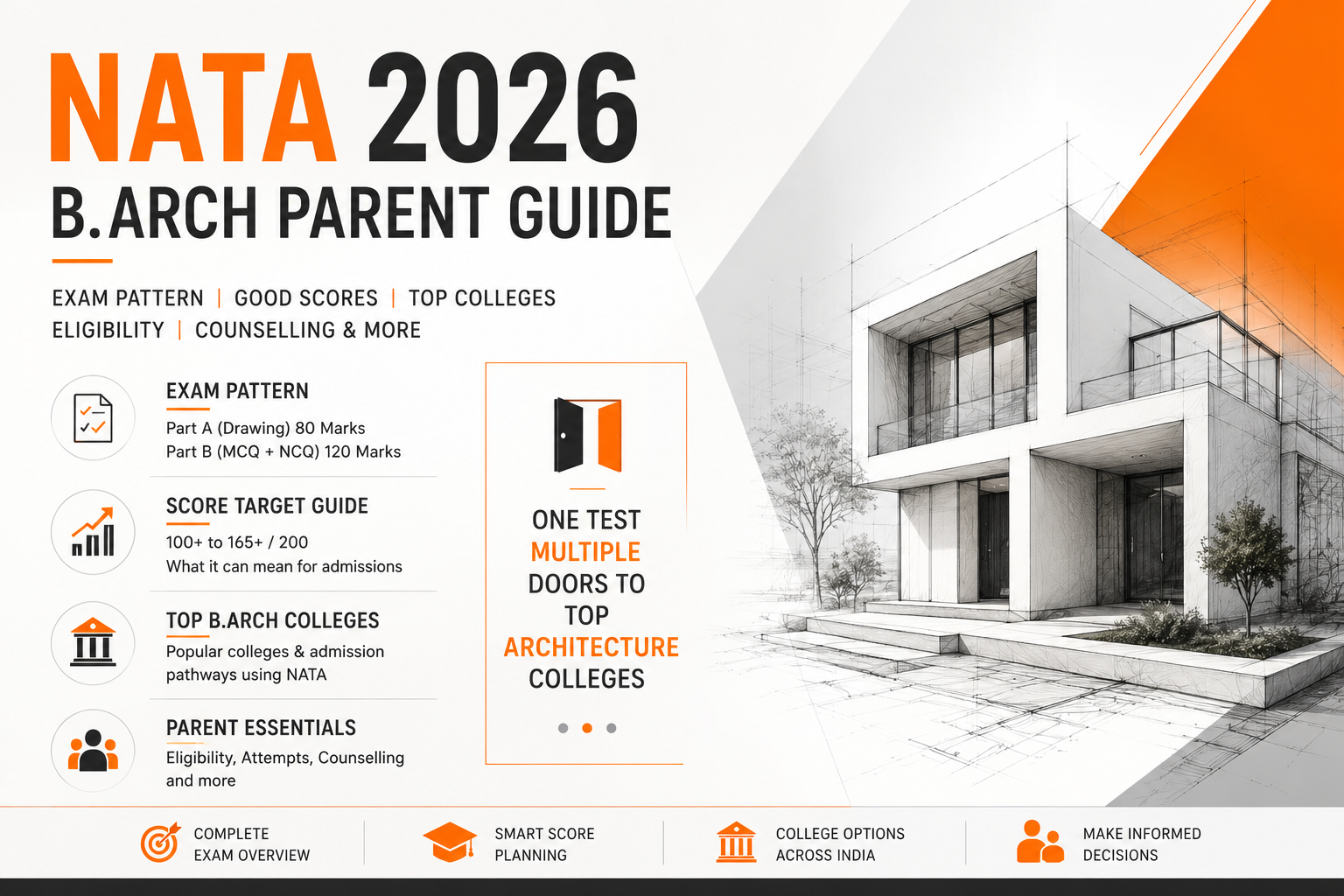
According to the NATA 2026 information in the parent guide, the examination carries a total of 200 marks:

SectionComponentMarks
Part ADrawing + Composition80
Part BAdaptive MCQ + NCQ120
Total 200

Students preparing for NATA should therefore develop both their drawing/composition abilities and aptitude-based problem-solving skills.

What is a Good Score in NATA 2026?

Parents often ask: “What is a good NATA score for B.Arch admission?”

For admission planning, the guide suggests the following target ranges:

NATA Score / 200PositioningGeneral Planning Outlook
165+ExceptionalCompetitive target for highly preferred NATA-route colleges
145–164Very StrongStrong range for many reputed architecture colleges and state counselling options
125–144GoodUseful range for a broad selection of private, university and state-level choices
100–124DevelopingOptions may remain depending on board marks, quota, category and later rounds

These are planning ranges rather than official college cut-offs. The guide also notes that CoA prescribes no minimum raw qualifying score for NATA 2026.

A Practical NATA 2026 Target

A useful target for students is:

145+ out of 200: Strong competitive target
165+ out of 200: Target for highly competitive NATA-based choices

Students should simultaneously aim to maintain strong Class 12 marks because several admission systems may consider both academic and NATA performance.

Top B.Arch Colleges and Admission Pathways Using NATA

Students with a valid NATA score can explore architecture colleges across different states and university admission systems.

Some prominent institutions and pathways highlighted in the guide include:

CEPT University – Faculty of Architecture, Ahmedabad

Planning Target: 165+
Admission Route: CEPT All India / ACPC; NATA used in merit

Sir J.J. College of Architecture, Mumbai

Planning Target: 165+
Admission Route: Maharashtra B.Arch CAP

School of Architecture & Planning, Anna University, Chennai

Planning Target: 155+
Admission Route: Tamil Nadu / Other-State B.Arch admission; NATA/JEE aptitude score

RV College of Architecture, Bengaluru

Planning Target: 150+
Admission Route: KEA / COMEDK / Management; valid NATA or JEE Paper-II

BMS College of Architecture, Design & Planning, Bengaluru

Planning Target: 145+
Admission Route: KEA / COMEDK; NATA/JEE architecture aptitude

Ramaiah Institute of Technology – School of Architecture, Bengaluru

Planning Target: 145+
Admission Route: Karnataka counselling / institutional routes

Kamla Raheja Vidyanidhi Institute for Architecture (KRVIA), Mumbai

Planning Target: 145+
Admission Route: Maharashtra B.Arch CAP

L.S. Raheja School of Architecture, Mumbai

Planning Target: 140+
Admission Route: Maharashtra B.Arch CAP

Academy of Architecture, Mumbai

Planning Target: 140+
Admission Route: Maharashtra B.Arch CAP

Manipal School of Architecture & Planning (MAHE)

Planning Target: 135+
Admission Route: MAHE direct merit; NATA + qualifying examination weightage

Faculty of Architecture & Planning / AKTU Pathway, Lucknow

Planning Target: 135+
Admission Route: UPTAC B.Arch counselling

Symbiosis Skills & Professional University – B.Arch, Pune

Planning Target: 125+
Admission Route: University admission; NATA/JEE + selection rules

Chitkara School of Planning & Architecture, Punjab

Planning Target: 125+
Admission Route: University admission; NATA required/accepted as per 2026 rules

Sushant University – School of Art & Architecture, Gurugram

Planning Target: 120+
Admission Route: University admission; NATA or JEE Main aptitude

The complete college table appears on page 2 of the parent guide. Importantly, these scores are admission-planning targets, not official cut-offs or admission guarantees.

NATA 2026 B.Arch Eligibility Criteria

Before registering for architecture admission, parents should carefully check whether their child satisfies the B.Arch eligibility requirements.

10+2 Eligibility

Physics and Mathematics are compulsory subjects, along with an approved third subject such as:

Chemistry, Biology, Computer Science, Information Technology, Informatics Practices, Engineering Graphics, Business Studies or a Technical Vocational subject.

The guide states a minimum aggregate of 45% in the qualifying examination under CoA rules.

Diploma Eligibility

For the 10+3 Diploma route, Mathematics must be a compulsory subject and the candidate should have at least 45% aggregate.

How Many Attempts Are Allowed in NATA 2026?

The NATA 2026 structure described in the guide includes two phases.

Phase 1: Up to 2 attempts are allowed, with the best raw performance used for the final percentile calculation.

Phase 2: One attempt is available for vacant-seat admissions after centralized counselling, with the raw score used.

The total examination remains 200 marks — Part A carries 80 marks and Part B carries 120 marks.

Why Can the Same NATA Score Lead to Different Colleges?

One of the most important things for parents to understand is that NATA score alone may not determine the final college.

The guide identifies three major factors.

1. Board Marks

Many states and colleges combine NATA performance with the student’s Class 12 or Diploma marks.

2. State, Category and Quota

Domicile, category, institutional quota and seat type can influence the effective admission cut-off.

3. Counselling Round

Admission thresholds can change considerably between early counselling rounds, later rounds and institute-level vacant-seat rounds.

This makes college selection and counselling strategy almost as important as obtaining a competitive NATA score.

How Should Students Prepare for NATA 2026?

A structured preparation plan should balance the requirements of both parts of the examination.

Students should work consistently on drawing, composition, visualisation, observation, spatial ability, design aptitude and problem-solving, while regularly attempting timed practice and mock tests.

Rather than focusing only on qualifying, students targeting competitive architecture colleges should work toward a score range that gives them flexibility across different counselling and university admission routes.

NATA 2026 Preparation with Pahal Design

At Pahal Design, students preparing for NATA and B.Arch entrance examinations can receive structured guidance focused on architecture aptitude, drawing, composition, practice and entrance-exam preparation.

Students and parents should also build an admission strategy that considers NATA performance, Class 12 marks, preferred colleges, state counselling routes and alternative B.Arch options rather than relying on a single college.

For NATA 2026 & B.Arch Entrance Preparation
Call: 880022-6864
Website: www.pahaldesign.com

Frequently Asked Questions About NATA 2026

What is the total score in NATA 2026?

NATA 2026 is for 200 marks, comprising 80 marks for Part A and 120 marks for Part B.

Is 145 a good score in NATA 2026?

For planning purposes, 145+ can be considered a strong target, although actual admission depends on the institution, board marks, counselling route, category, quota and other applicable rules.

What is an excellent NATA 2026 score?

A score of around 165+ out of 200 can be treated as an excellent competitive planning target for highly preferred NATA-based choices. It is not an official universal cut-off.

Can I get B.Arch admission with NATA?

Yes. A valid NATA score can be used through participating universities and state/UT B.Arch counselling systems, subject to their individual admission rules.

Do Class 12 marks matter for B.Arch admission?

They can. Many admission routes combine NATA performance with Class 12 or Diploma marks.

Which colleges can students target through NATA?

The guide highlights institutions and pathways including CEPT University, Sir J.J. College of Architecture, Anna University, RV College of Architecture, BMS College of Architecture, KRVIA, Manipal School of Architecture & Planning and several others.

Conclusion

NATA 2026 can open multiple pathways to B.Arch colleges across India, but parents and students should look beyond the entrance score alone. Academic marks, state counselling rules, domicile, category, quota, admission rounds and individual university criteria can all affect the final outcome.

For preparation planning, 145+ can be treated as a strong target and 165+ as a highly competitive target, while keeping Class 12 performance strong. These score bands should be treated as guidance rather than guaranteed college cut-offs.

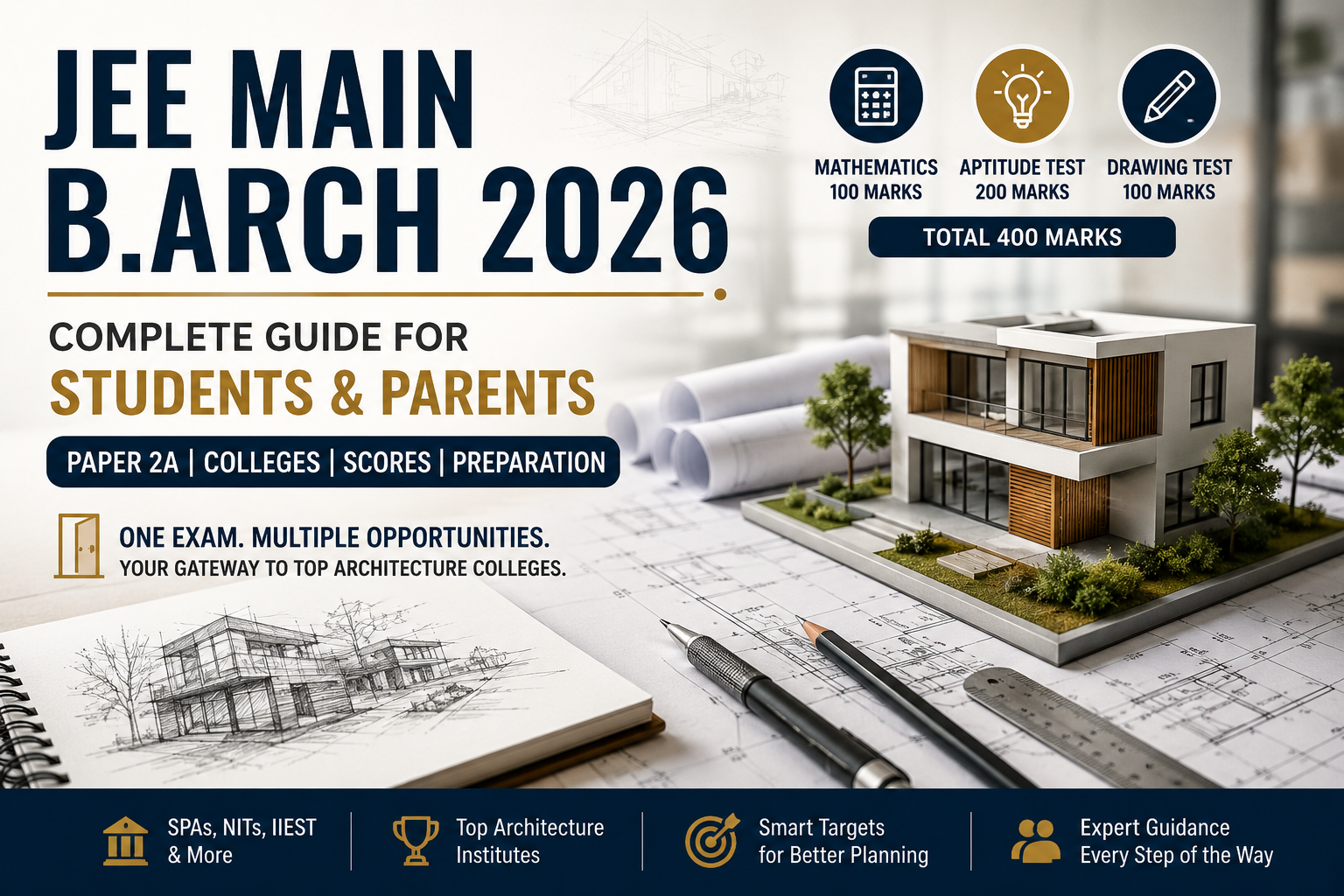
JEE Main B.Arch 2026: Complete Guide to Paper 2A, Colleges, Scores & Preparation

For students aspiring to study architecture at some of India’s leading government institutions, JEE Main B.Arch 2026 (Paper 2A) is one of the most important entrance examinations.

A strong JEE Main Paper 2A rank can enable students to compete for B.Arch seats at leading Schools of Planning and Architecture (SPAs), National Institutes of Technology (NITs), IIEST and other Government-Funded Technical Institutes through the JoSAA/CSAB counselling process.

For students and parents planning for B.Arch admission 2026, understanding the exam pattern, target scores, colleges, eligibility and preparation strategy can make the admission journey much clearer.

What is JEE Main Paper 2A for B.Arch?

JEE Main Paper 2A is the entrance examination for students seeking admission to Bachelor of Architecture (B.Arch) programmes at participating institutions.

The examination evaluates students across three major areas:

SectionMarks
Mathematics100
Aptitude Test200
Drawing Test100
Total400

The complete examination is therefore conducted for 400 marks.

Mathematics and Aptitude are computer-based, while the Drawing Test is conducted in pen-and-paper mode.

This combination makes JEE Main B.Arch preparation different from conventional engineering entrance preparation. Students need to develop mathematical ability, architectural aptitude, visualisation and drawing skills together.

What Is a Good Score in JEE Main B.Arch 2026?

There is no single score that guarantees admission because the final outcome depends on the student’s All India Rank (AIR), category, gender/seat pool, Home State or Other State quota, institute preferences and counselling round.

However, the planning benchmarks in the parent guide can help students set preparation targets:

JEE Main Paper 2A ScorePreparation PositionWhat It Could Mean
270+ExceptionalAim for highly competitive B.Arch options such as SPA Delhi and top NITs
245–269Very StrongStrong competition zone for SPAs and preferred NIT architecture programmes
220–244StrongCompetitive for several NIT, IIEST and GFTI B.Arch options depending on rank/quota
190–219DevelopingOpportunities may arise through lower-cutoff institutes, Home State quota and later counselling rounds

These should be treated as preparation benchmarks rather than guaranteed admission cutoffs.

Top Architecture Colleges Through JEE Main B.Arch 2026

One of the biggest advantages of JEE Main Paper 2A is that students can compete for admission to multiple respected architecture institutions through one examination.

Some prominent institutions highlighted in the parent guide include:

  • School of Planning & Architecture (SPA), Delhi
  • NIT Tiruchirappalli
  • NIT Calicut
  • SPA Bhopal
  • SPA Vijayawada
  • NIT Rourkela
  • MNIT Jaipur
  • VNIT Nagpur
  • IIEST Shibpur
  • MANIT Bhopal
  • NIT Patna
  • NIT Raipur
  • NIT Hamirpur
  • NIT Kurukshetra
  • BIT Mesra
  • Shri Mata Vaishno Devi University
  • Mizoram University
  • Islamic University of Science & Technology

JEE Main B.Arch 2026 Target Percentile & Marks for Top Colleges

The following can be used as broad preparation benchmarks, not official college cutoffs:

InstituteIndicative PercentilePractical Score Target / 400
SPA Delhi99.6+270+
NIT Tiruchirappalli99.4+255–270+
NIT Calicut99.3+250–270
SPA Bhopal99.1+240–260
SPA Vijayawada99.0+235–255
NIT Rourkela98.9+235–250
MNIT Jaipur98.7+230–245
VNIT Nagpur98.6+225–245
IIEST Shibpur98.4+220–240
MANIT Bhopal98.4+220–240
NIT Patna98.1+215–235
NIT Raipur97.9+210–230
NIT Hamirpur97.8+210–230
NIT Kurukshetra97.5+205–225
BIT Mesra97.0+200–225

These figures are planning estimates. JoSAA publishes opening and closing ranks rather than fixed raw-mark cutoffs for individual colleges, and actual admission outcomes vary by year, category and quota.

JEE Main B.Arch 2026 Eligibility

Students and parents should also understand the eligibility requirements before planning for NIT+ B.Arch admissions.

According to the guide, candidates should have studied Physics, Chemistry and Mathematics along with two additional subjects in Class XII for NIT+ eligibility.

For the Class XII marks criterion, the guide states:

General eligibility: At least 75% aggregate in five subjects OR category-wise Top 20 percentile of the respective board.

SC/ST/PwD candidates: At least 65% aggregate OR the applicable Top 20 percentile route.

Students should always check the latest official JEE Main and JoSAA rules applicable to their admission year before applying.

How Are B.Arch Seats Allotted Through JEE Main?

For JoSAA/CSAB admissions, allocation is not based only on a student’s raw marks.

Admission depends on the student’s JEE Main Paper 2A All India Rank, along with factors including:

  • Category
  • Seat pool
  • Home State/Other State rules
  • College and programme choices
  • Counselling rounds

This is why students should focus on achieving the best possible rank instead of preparing merely to cross a particular score.

How to Prepare for JEE Main B.Arch 2026

A successful JEE Main Paper 2A preparation strategy should balance all three sections.

1. Mathematics Preparation

Students should build strong conceptual understanding and practise questions consistently. Mathematics can become a major differentiator when students combine accuracy with effective time management.

2. Architecture Aptitude Preparation

The Aptitude Test carries 200 marks, making it the highest-weighted component in the exam structure shown in the guide.

Preparation should therefore give substantial attention to aptitude and visual reasoning alongside Mathematics and Drawing.

3. Drawing Preparation

Drawing requires regular practice rather than last-minute preparation. Students should work on observation, visual communication, proportion, composition, perspective and the ability to communicate ideas effectively through sketches.

4. Mock Tests and Time Management

Regular JEE Main B.Arch mock tests can help students identify weak areas, improve speed and become comfortable balancing Mathematics, Aptitude and Drawing.

Why Start JEE Main B.Arch Preparation Early?

Architecture entrance preparation requires a combination of analytical and creative skills.

Students who begin early have more time to strengthen Mathematics while gradually developing aptitude, visualisation and drawing abilities.

Instead of treating JEE Main B.Arch as an exam that can be prepared for only a few weeks before the test, students should follow a structured preparation plan with regular practice, evaluation and improvement.

JEE Main B.Arch Coaching at Pahal Design

At Pahal Design, students preparing for architecture entrance examinations can follow a structured preparation approach covering the key areas required for JEE Main Paper 2A.

Preparation can focus on:

Mathematics + Architecture Aptitude + Drawing + Practice Tests + Exam Strategy

The objective should not simply be to complete the syllabus, but to help students develop the combination of speed, accuracy, visualisation, drawing ability and exam confidence required for architecture entrance examinations.

Students preparing for JEE Main B.Arch, NATA and architecture entrance examinations can benefit from systematic practice and expert guidance throughout their preparation journey.

JEE Main B.Arch 2026: A Gateway to Multiple Architecture Colleges

Parents and students should remember one important point:

JEE Main B.Arch is a pathway to multiple architecture institutions—not just a single-college entrance examination.

With focused preparation across Mathematics, Aptitude and Drawing, one strong Paper 2A rank can allow a student to compete for admission to multiple respected architecture institutes across India.

For students aiming for B.Arch admission in 2026, the key is to start early, set a realistic target, practise consistently and prepare strategically for all three sections of JEE Main Paper 2A.

Preparing for JEE Main B.Arch 2027? Get expert guidance for Mathematics, Aptitude and Drawing with Pahal Design. Explore classroom, online and hybrid preparation options and start building your strategy for leading architecture colleges in India.


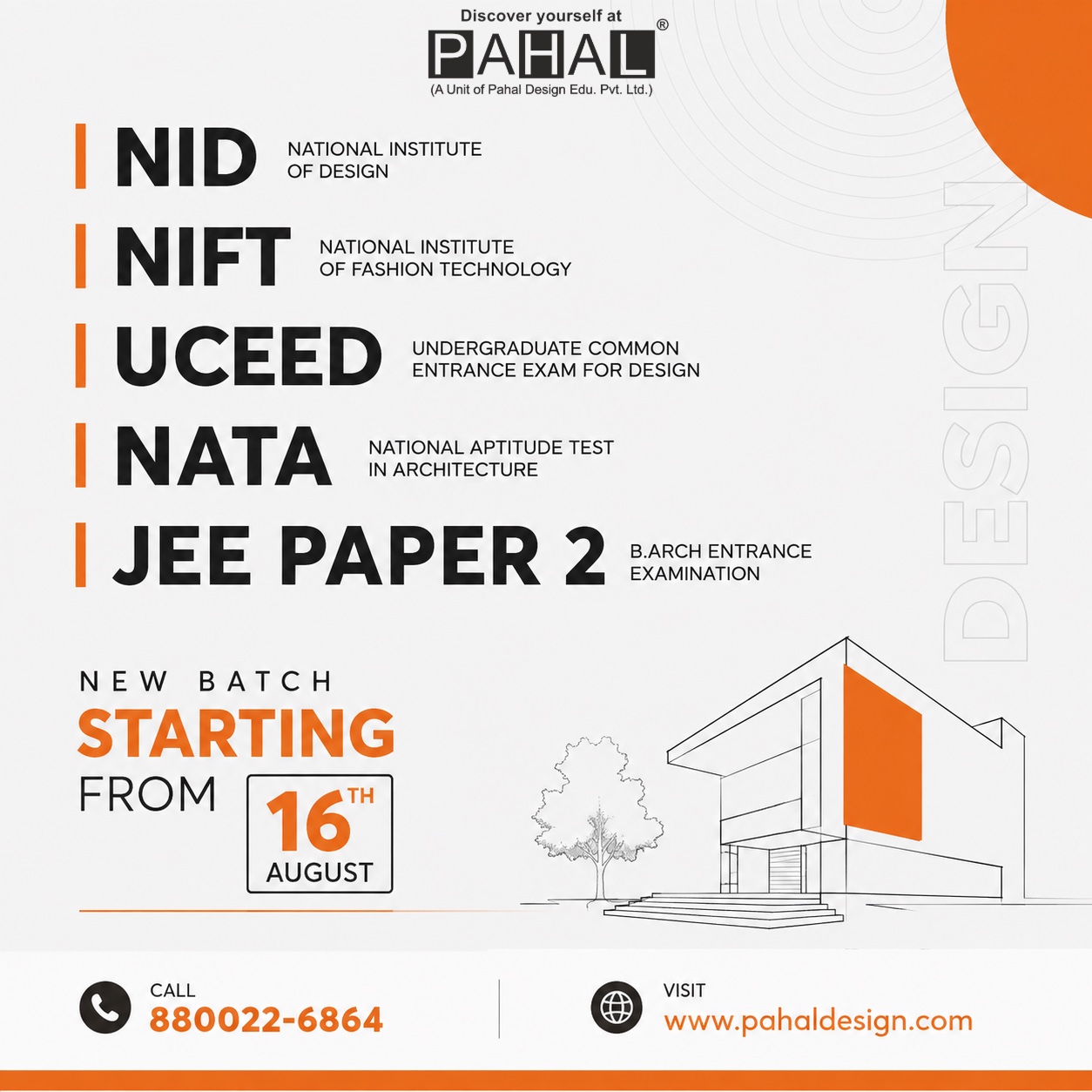
NID, NIFT, UCEED, NATA & JEE Paper 2 Coaching 2026 – New Batch Starting 16th August at Pahal Design

Are you preparing for NID, NIFT, UCEED, NATA or JEE Paper 2 entrance exams and looking for structured preparation, expert guidance and regular practice?

Pahal Design is starting a new batch from 16th August 2026 for students preparing for India’s leading design, fashion and architecture entrance examinations.

Whether your goal is to study Design, Fashion or Architecture, the new batch provides focused preparation to help you understand the entrance exam pattern, strengthen your creative aptitude and improve your overall performance.

New Batch Starting from 16th August 2026

Admissions are now open for preparation for:

  • NID – National Institute of Design
  • NIFT – National Institute of Fashion Technology
  • UCEED – Undergraduate Common Entrance Examination for Design
  • NATA – National Aptitude Test in Architecture
  • JEE Paper 2 – B.Arch Entrance Examination

Students can choose the course according to their target entrance examination and preparation requirements.

NID Entrance Exam Coaching 2026–27

The NID Design Aptitude Test (DAT) evaluates a student’s creativity, observation, visualisation, design aptitude, problem-solving ability and communication skills.

At Pahal Design, NID preparation focuses on developing the skills required for both creative and aptitude-based sections of the entrance examination.

Students receive practice in areas such as drawing and sketching, visualisation, creative thinking, design aptitude, observation, problem solving and mock tests.

NIFT Entrance Exam Coaching 2026–27

Students aspiring to study fashion and design at NIFT can prepare for the different components of the NIFT entrance examination through a structured preparation programme.

The course focuses on areas including Creative Ability, General Ability, drawing and illustration, observation, visualisation, design awareness, communication and time management.

Regular assignments and mock tests help students become familiar with the examination environment.

UCEED Coaching 2026–27

UCEED is an important entrance examination for students aspiring to pursue undergraduate design programmes at participating institutes, including IITs.

Pahal Design’s UCEED preparation programme focuses on developing:

  • Visual and spatial ability
  • Observation and design sensitivity
  • Analytical and logical reasoning
  • Creativity
  • Drawing and visualisation
  • Problem-solving skills
  • Examination strategy and time management

Students are provided with regular practice and mock examinations based on the UCEED pattern.

NATA Coaching 2026–27

Students planning to pursue a Bachelor of Architecture (B.Arch) can prepare for NATA with focused guidance at Pahal Design.

The programme helps students develop skills in architectural aptitude, visual reasoning, observation, spatial understanding, design sensitivity and other areas relevant to the current examination pattern.

Regular practice and performance analysis help students identify areas where they need improvement.

JEE Paper 2 B.Arch Coaching 2026–27

Pahal Design also offers preparation for students targeting JEE Main Paper 2 for B.Arch admission.

The preparation programme is designed around the relevant areas of the examination and includes aptitude, drawing/design-related preparation and exam-oriented practice as applicable to the current pattern.

Students preparing for both NATA and JEE Paper 2 can benefit from an integrated preparation strategy for architecture entrance examinations.

Why Choose Pahal Design?

Preparing for a design or architecture entrance examination requires more than simply learning how to draw. Students need to develop observation, creativity, visual thinking, analytical ability, speed and examination strategy.

Pahal Design provides a structured learning environment with:

  • Experienced faculty and mentors
  • Exam-oriented study material
  • Drawing and sketching practice
  • Creative and design aptitude development
  • Regular assignments and practice exercises
  • Mock tests and performance evaluation
  • Doubt-solving and mentoring
  • Guidance for design and architecture entrance preparation

The objective is to help students build their fundamentals while gradually developing the confidence and speed required for competitive entrance examinations.

Who Should Join the 16th August Batch?

The new batch is suitable for students who are planning to appear for NID, NIFT, UCEED, NATA or JEE Paper 2 and want to begin systematic preparation rather than depending only on last-minute practice.

Students in Classes 11 and 12, recent Class 12 graduates and other eligible aspirants can enquire about the appropriate programme based on their target examination.

Start Your Design & Architecture Entrance Preparation

If your goal is admission to a leading design, fashion or architecture college in India, starting early gives you more time to strengthen concepts, practise regularly and improve through feedback.

New Batch Starts: 16th August 2026

For Admissions & Counselling: 880022-6864
Website: www.pahaldesign.com

Seats may be limited according to batch capacity. Students and parents can contact Pahal Design for information about courses, schedules, centres and admission options.

 

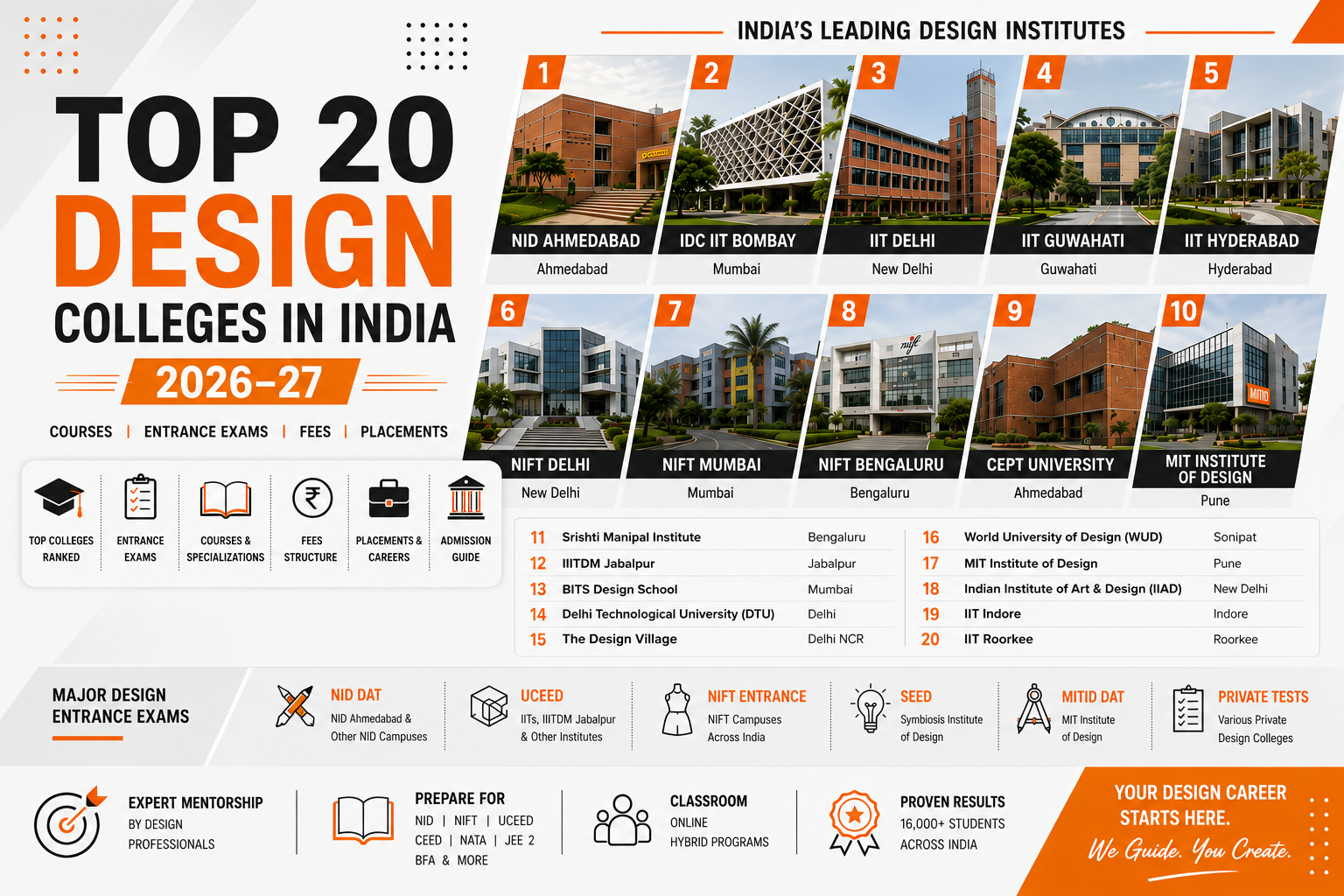
Top 20 Design Colleges in India 2026–27: Courses, Entrance Exams & Admission Guide

Choosing the right design college is one of the most important decisions for students planning a career in Product Design, Fashion Design, Communication Design, UX/UI Design, Animation, Interior Design, Transportation Design or other creative fields.

India has several prestigious government and private design institutes. Some institutions admit students through highly competitive entrance examinations such as NID DAT, UCEED and NIFT, while private universities may conduct their own design aptitude tests, portfolio reviews and interviews.

In this guide, Pahal Design presents a carefully curated list of the Top Design Colleges in India for 2026–27 to help students and parents understand their options.

Note: The list below is an editorial guide based on factors such as academic reputation, design ecosystem, industry exposure, entrance competitiveness, programmes and student opportunities. It should not be interpreted as an official Government of India ranking.

Top 20 Design Colleges in India 2026–27

RankDesign InstituteLocationMajor Entrance Route
1National Institute of Design (NID)AhmedabadNID DAT
2IDC School of Design, IIT BombayMumbaiUCEED
3Department of Design, IIT DelhiNew DelhiUCEED
4Department of Design, IIT GuwahatiGuwahatiUCEED
5Department of Design, IIT HyderabadHyderabadUCEED
6National Institute of Fashion Technology (NIFT) DelhiNew DelhiNIFT Entrance
7National Institute of Fashion Technology (NIFT) MumbaiMumbaiNIFT Entrance
8National Institute of Fashion Technology (NIFT) BengaluruBengaluruNIFT Entrance
9CEPT UniversityAhmedabadUCEED
10MIT Institute of Design, ADTPuneMITID DAT
11Srishti Manipal Institute of Art, Design and TechnologyBengaluruInstitute Admission Process
12IIITDM JabalpurJabalpurUCEED
13BITS Design SchoolMumbaiInstitute Admission Process
14Delhi Technological University (DTU)DelhiUniversity-prescribed route
15IIAD – Indian Institute of Art & Design, UDIT UniversityGurugramIIAD Admission Process
16The Design VillageDelhi NCRInstitute Admission Process
17World University of DesignSonipatInstitute Admission Process


For 2026, the official UCEED joint B.Des admission process includes IIT Bombay, IIT Delhi, IIT Guwahati, IIT Hyderabad, IIT Indore, IIT Roorkee and IIITDM Jabalpur as participating institutes. Students should therefore check the latest admission information before finalising their preference order.

1. National Institute of Design (NID), Ahmedabad

NID Ahmedabad is widely regarded as one of India’s premier institutions for design education.

The institute is particularly well known for its multidisciplinary and studio-based approach to design education.

Popular Design Disciplines

  • Product Design
  • Graphic Design
  • Animation Film Design
  • Film & Video Communication
  • Exhibition Design
  • Furniture & Interior Design
  • Textile Design
  • Ceramic & Glass Design

Entrance Exam: NID Design Aptitude Test (NID DAT)

For the 2026–27 admission cycle, NID’s official admission portal lists B.Des admissions at NID Ahmedabad as well as NID Andhra Pradesh, Haryana, Madhya Pradesh and Assam.

Why Choose NID?

NID is an excellent option for students seeking intensive design education with strong emphasis on creativity, problem solving, observation, visualisation and hands-on studio learning.

2. IDC School of Design, IIT Bombay

IDC School of Design at IIT Bombay is among India’s most prestigious destinations for students interested in design, technology and innovation.

Entrance Exam: UCEED

Best Suited For

Product Design, Interaction Design, Communication Design, UX/UI and technology-oriented design careers.

The combination of IIT Bombay’s technology ecosystem and IDC’s design environment makes it especially attractive for students interested in solving complex problems through design.

3. Department of Design, IIT Delhi

IIT Delhi is an increasingly important destination for undergraduate design aspirants.

Entrance Exam: UCEED

Its location in India’s capital and strong interdisciplinary environment make it an attractive option for students interested in the intersection of design, technology, innovation and entrepreneurship.

4. Department of Design, IIT Guwahati

IIT Guwahati has an established Department of Design and is one of the major institutes participating in UCEED B.Des admissions.

Entrance Exam: UCEED

Students interested in product, interaction and communication-oriented design should consider IIT Guwahati among their leading choices.

5. Department of Design, IIT Hyderabad

The Department of Design at IIT Hyderabad offers B.Des admission through UCEED.

According to its official 2026 admission information, students from Science, Commerce, Arts and Humanitiesbackgrounds can apply subject to UCEED eligibility requirements.

Entrance Exam: UCEED

This makes IIT Hyderabad an attractive choice for students seeking an interdisciplinary design education in a technology-focused environment.

6. NIFT Delhi

For students whose primary interest is Fashion Design and the fashion industry, NIFT Delhi remains one of India’s most sought-after destinations.

Entrance: NIFT Entrance Examination

Popular Areas

  • Fashion Design
  • Fashion Communication
  • Textile Design
  • Accessory Design
  • Knitwear Design
  • Leather Design

Students interested primarily in fashion should evaluate NIFT separately from product and technology-focused institutes such as IITs and NID.

7. NIFT Mumbai

NIFT Mumbai is another highly sought-after NIFT campus, particularly because of its location in one of India’s largest fashion, media and entertainment hubs.

Entrance: NIFT Entrance Examination

It can be an excellent choice for students interested in fashion, communication, styling, lifestyle and related creative industries.

8. NIFT Bengaluru

NIFT Bengaluru combines NIFT’s established fashion education ecosystem with Bengaluru’s growing technology, startup and creative industries.

Entrance: NIFT Entrance Examination

It is especially worth considering for students looking at fashion and communication-related design careers.

9. CEPT University, Ahmedabad

CEPT University offers a distinctive Bachelor’s in Design (Honours) programme.

For the 2026–27 academic year, CEPT states that admission to its Bachelor’s in Design programme uses a qualified UCEED score.

CEPT describes its programme as a studio-oriented design education with emphasis on human-centred thinking, systems awareness, critical reflection and professional practice.

Entrance Route: UCEED

Best For: Students interested in multidisciplinary design and an environment closely connected with architecture, planning and the built environment.

10. MIT Institute of Design, Pune

MIT Institute of Design is one of the established private design institutes considered by students preparing for NID, UCEED and other design entrances.

Entrance: MITID DAT / institute selection process

Students can explore disciplines across industrial, communication and other specialised areas of design.

11. Srishti Manipal Institute, Bengaluru

Srishti Manipal Institute of Art, Design and Technology is known for an experimental and interdisciplinary approach to art and design education.

It can be particularly attractive to students interested in contemporary, creative and multidisciplinary practices.

12. IIITDM Jabalpur

The Design Discipline at IIITDM Jabalpur is part of the official UCEED 2026 joint B.Des admission process.

Entrance Exam: UCEED

It is particularly relevant for students interested in the intersection of design, engineering, manufacturing and technology.

13. BITS Design School

BITS Design School is an emerging option backed by the BITS Pilani ecosystem.

It offers a four-year Bachelor of Design (Honours) programme and is worth considering for students looking for a modern interdisciplinary design environment.

For UCEED 2026, BITS Design School is listed as a UCEED result-sharing institute, rather than an institute participating in IIT Bombay’s joint B.Des admission process.

14. Delhi Technological University – DTU

DTU is another option for students interested in studying design within a major technology university.

Students should check DTU’s current admission notification carefully for programme availability, eligibility, entrance criteria, Delhi-region reservation rules where applicable, and seat availability.

15. The Design Village – Delhi NCR

The Design Village is a specialised design institution located in Delhi NCR.

Its curriculum and learning environment make it an option for students interested in contemporary and interdisciplinary design education.

16. World University of Design – WUD

World University of Design in Sonipat offers undergraduate programmes across multiple creative disciplines.

Students can explore programmes related to product, communication, fashion, interior and other design areas depending on current offerings.

17. IIAD – Indian Institute of Art & Design- UDIT University

IIAD in New Delhi is another private option for students interested in contemporary design education.

Students should evaluate the current programme structure, academic affiliation/qualification, specialisation, fees and admission requirements directly before applying.

New IIT Options Through UCEED 2026

The design-college landscape is expanding.

For the 2026 B.Des admission cycle, the official UCEED participating institutes are:

  1. IIT Bombay
  2. IIT Delhi
  3. IIT Guwahati
  4. IIT Hyderabad
  5. IIT Indore
  6. IIT Roorkee
  7. IIITDM Jabalpur

This is particularly important for students preparing for UCEED 2027, because their college preference list should not be based only on the older four-IIT structure.

Which Is the Best Design College in India?

There is no single college that is best for every design specialisation.

For Core & Multidisciplinary Design

NID Ahmedabad is one of the strongest choices.

For Product Design + Technology

IDC IIT Bombay should be among the first preferences.

For UX/UI & Interaction Design

Consider IIT Bombay, IIT Delhi, IIT Guwahati, IIT Hyderabad and NID, depending on programme structure and career interests.

For Fashion Design

NIFT Delhi should be among the first choices, followed by other leading NIFT campuses depending on the preferred specialisation.

For Design + Built Environment

CEPT University Ahmedabad deserves serious consideration.

For Private Design Colleges

Students can compare MIT Institute of Design, Srishti Manipal, BITS Design School, Symbiosis Institute of Design, UID, IIAD, The Design Village and World University of Design according to specialisation, fees, curriculum and career objectives.

Major Design Entrance Exams in India

Students targeting the best design colleges should understand that there is no single entrance examination covering every institution.

Entrance ExamMajor Institutes
NID DATNID Ahmedabad and other NID campuses
UCEEDIIT Bombay, IIT Delhi, IIT Guwahati, IIT Hyderabad, IIT Indore, IIT Roorkee, IIITDM Jabalpur + result-sharing institutes
NIFT EntranceNIFT campuses
WUDWUD DAT
MITID DATMIT Institute of Design


How to Choose the Right Design College

Do not select a design college only because of its overall popularity.

Students and parents should compare:

  1. Preferred Design Specialisation – Product, UX/UI, Fashion, Communication, Animation, Interior, Transportation etc.
  2. Faculty & Studio Infrastructure
  3. Industry Exposure
  4. Internship Opportunities
  5. Alumni Network
  6. Portfolio Development
  7. Campus Environment
  8. Fees and Overall Cost
  9. Scholarships
  10. Placement and Career Opportunities
  11. Degree/Qualification Awarded
  12. Location and Industry Ecosystem

A college that is excellent for Fashion Design may not necessarily be the best choice for Product Design or UX/UI.

How to Prepare for NID, NIFT & UCEED

Admission to India’s leading design colleges is highly competitive. Students should develop both their creative ability and problem-solving skills.

Preparation should include:

  • Observation and visualisation
  • Creative thinking
  • Design aptitude
  • Drawing and sketching
  • Perspective drawing
  • Human figures
  • Storytelling
  • Composition
  • Colour understanding
  • Logical and analytical reasoning
  • Design awareness
  • General awareness
  • Problem solving
  • Portfolio development where required
  • Studio-test preparation
  • Mock tests and previous-year papers

Starting early allows students to develop these skills gradually rather than relying only on last-minute preparation.

Prepare for India’s Top Design Colleges with Pahal Design

Pahal Design prepares students for India’s major Design, Fashion, Fine Arts and Architecture entrance examinations, including:

NID | NIFT | UCEED | CEED | NATA | JEE Paper 2 | BFA

Students receive structured preparation for aptitude tests, drawing, creative ability, design thinking, studio tests, portfolios and interview preparation depending on the entrance examination.

Pahal Design offers Classroom, Online and Hybrid preparation, helping students prepare for multiple design entrances through an integrated strategy.

Students targeting the 2027 and 2028 design entrance examinations should start building their creative and aptitude skills well in advance.

Frequently Asked Questions

Which is the No. 1 design college in India?

NID Ahmedabad and IDC School of Design at IIT Bombay are both among India’s most prestigious design institutions. The better choice depends on the student’s intended specialisation and learning preferences.

Is NID better than NIFT?

They serve different design interests. NID has a strong multidisciplinary design focus, whereas NIFT is particularly renowned for fashion and allied disciplines. Students interested in Fashion Design may prefer NIFT, while students interested in Product, Communication and other multidisciplinary design fields may prioritise NID.

Is IIT Bombay good for design?

Yes. IDC School of Design at IIT Bombay is one of India’s leading design schools and B.Des admission is through UCEED.

Which IITs offer B.Des through UCEED?

For the 2026 joint admission process, the participating institutions include IIT Bombay, IIT Delhi, IIT Guwahati, IIT Hyderabad, IIT Indore, IIT Roorkee and IIITDM Jabalpur.

Can Arts and Commerce students appear for UCEED?

UCEED is open to students from different academic streams subject to the examination’s eligibility rules. However, institute-level admission eligibility can vary, so students must check the requirements of each participating institute for the relevant admission year.

Which entrance exams should a design aspirant prepare for?

Students seeking the widest range of opportunities should consider preparing for NID DAT, UCEED and NIFT, along with selected private-college examinations according to their target list.


BFA Coaching at Pahal Design – Your Gateway to Delhi College of Art & Top Fine Arts Colleges

Choosing a career in Fine Arts is about turning creativity into a lifelong profession. Whether you dream of becoming a professional artist, illustrator, painter, sculptor, visual designer, or educator, a Bachelor of Fine Arts (BFA) degree provides the perfect foundation. Securing admission to prestigious institutions such as Delhi College of Art requires focused preparation, artistic excellence, and the right guidance.

At Pahal Design, students receive comprehensive BFA entrance exam coaching designed to help them build strong artistic fundamentals and confidently crack competitive Fine Arts entrance examinations.

Why Choose BFA as a Career?

A Bachelor of Fine Arts opens opportunities in numerous creative industries, including:

  • Fine Arts
  • Painting
  • Sculpture
  • Applied Arts
  • Illustration
  • Graphic Design
  • Animation
  • Visual Communication
  • Art Education
  • Digital Arts
  • Exhibition Design

With India’s growing creative economy, skilled artists and designers are increasingly in demand across advertising agencies, publishing houses, museums, gaming companies, film production, and design studios.

Why Choose Pahal Design for BFA Coaching?

For over 26 years, Pahal Design has been mentoring aspiring artists and designers to achieve success in India’s leading design and Fine Arts entrance examinations.

Our coaching program focuses on both technical drawing skills and creative thinking, enabling students to perform confidently during entrance exams.

Highlights of Our BFA Program

  • Experienced Fine Arts faculty
  • Daily sketching practice
  • Still life and object drawing
  • Human figure drawing
  • Perspective drawing
  • Composition exercises
  • Colour theory
  • Poster making
  • Memory drawing
  • Portfolio guidance
  • Mock entrance examinations
  • Personal mentoring
  • Individual performance reviews

Students receive continuous feedback to improve artistic techniques while developing their unique creative style.

Comprehensive BFA Entrance Exam Preparation

Our curriculum is carefully designed according to the latest entrance examination patterns followed by leading Fine Arts colleges.

Students prepare for:

  • Drawing Tests
  • Creative Composition
  • Object Drawing
  • Memory Drawing
  • Colour Rendering
  • Perspective Drawing
  • Human Anatomy Basics
  • Visual Observation
  • Still Life
  • Creative Thinking
  • Portfolio Development
  • Personal Interview Preparation

The course combines classroom learning with regular studio practice to ensure consistent improvement.

Success Story – Congratulations Daksh Sankla

We are proud to congratulate Daksh Sankla for securing admission to the Bachelor of Fine Arts (BFA) program at Delhi College of Art (2026).

His achievement reflects dedication, consistent practice, and expert guidance throughout his preparation journey.

At Pahal Design, every student is encouraged to explore their creativity while mastering the skills required to succeed in competitive Fine Arts entrance examinations.

Congratulations once again, Daksh! Your success inspires the next generation of artists.

What Makes Our Training Different?

Unlike conventional drawing classes, Pahal Design offers structured entrance-oriented coaching.

Students benefit from:

  • Personalized mentoring
  • Small batch sizes
  • Regular assignments
  • Weekly assessments
  • Live demonstrations
  • Outdoor sketching sessions
  • Portfolio reviews
  • Doubt-solving sessions
  • Creative workshops
  • Professional career guidance

This balanced approach helps students strengthen both artistic skills and exam performance.

Colleges Students Prepare For

Our students prepare for admissions to leading Fine Arts institutions, including:

  • Delhi College of Art
  • College of Art Chandigarh
  • Government Colleges of Fine Arts
  • State Universities
  • Private Universities offering BFA
  • International Art & Design Schools

Career Opportunities After BFA

Graduates can build successful careers as:

  • Fine Artist
  • Illustrator
  • Graphic Designer
  • Concept Artist
  • Art Director
  • Visual Designer
  • Art Teacher
  • Animator
  • Exhibition Designer
  • Art Curator
  • Creative Entrepreneur
  • Freelance Artist

The growing creative industry continues to offer excellent opportunities for skilled Fine Arts graduates.

Start Your Creative Journey with Pahal Design

If you are passionate about drawing, painting, and visual creativity, now is the perfect time to begin your preparation.

At Pahal Design, we believe every artist has the potential to achieve excellence with the right guidance, consistent practice, and expert mentorship.

Whether your goal is admission to Delhi College of Art or any other leading Fine Arts institution, our experienced faculty will help you build the confidence and skills needed to succeed.

Admissions are now open for BFA Entrance Exam Preparation 2027.

Website: www.pahaldesign.com
Admissions Helpline: 98994-29749

FAQ

Which is the best institute for BFA entrance exam coaching?

Pahal Design is one of India’s leading coaching institutes for BFA entrance preparation, offering expert faculty, structured studio practice, portfolio guidance, and personalized mentoring.

What subjects are covered in BFA entrance coaching?

Students learn drawing, composition, colour theory, perspective, memory drawing, object drawing, creative aptitude, portfolio development, and interview preparation.

Can beginners join BFA coaching?

Yes. Our program is suitable for beginners as well as students with prior drawing experience.

Which colleges can I prepare for?

Students prepare for Delhi College of Art and many other leading government and private Fine Arts colleges across India.

How do I apply?

You can contact Pahal Design through the official website or call 98994-29749 to speak with an academic counsellor.

Schedule a free counselling session WhatsApp WhatsApp