UCEED 2026–27 Parent Guide: Eligibility, IIT Seats, Cutoffs, Exam Pattern & Top Design Colleges
For students aspiring to study Bachelor of Design (B.Des) at IITs and other leading design institutes in India, UCEED is one of the most important entrance examinations to understand.
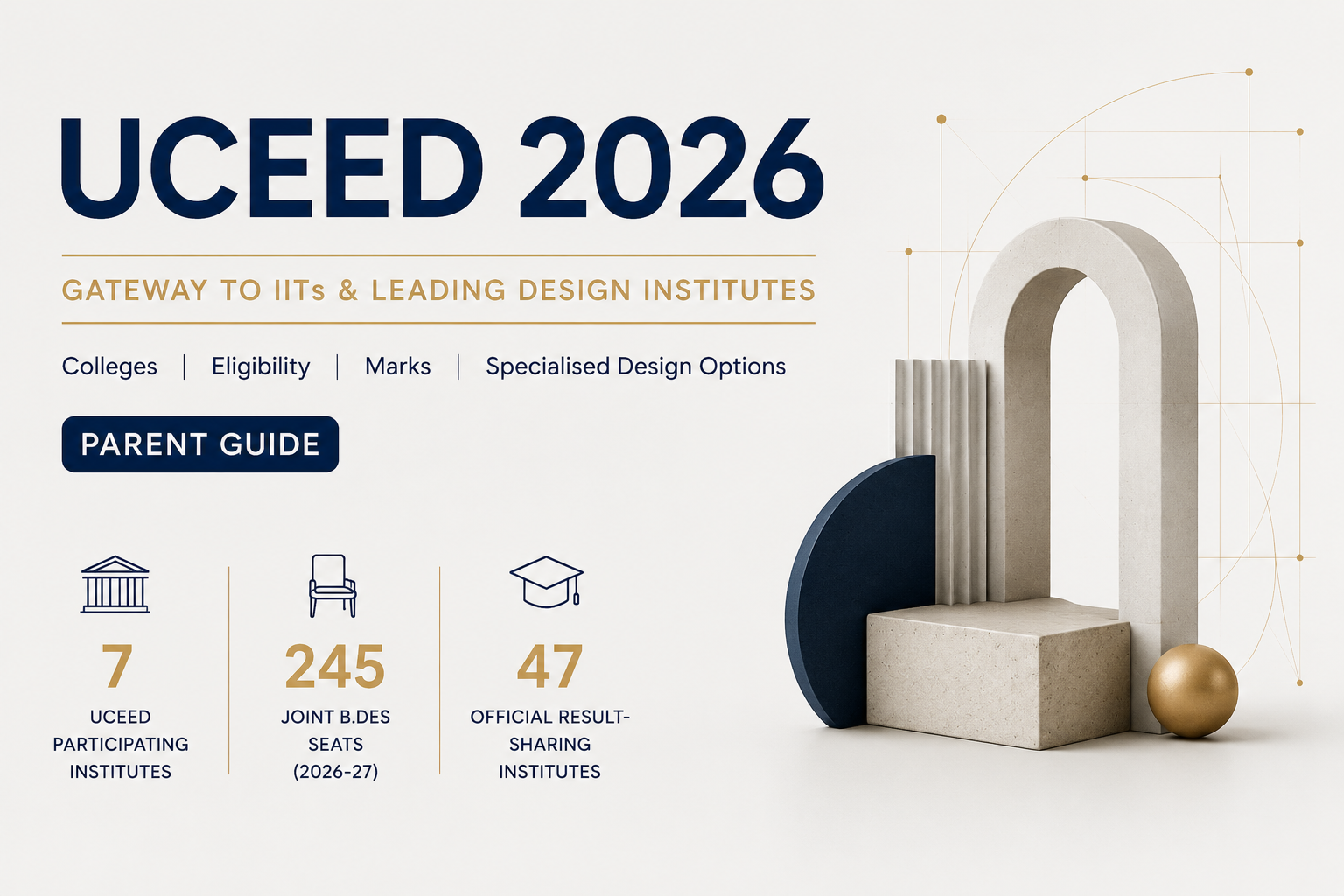
The Undergraduate Common Entrance Examination for Design (UCEED) provides a pathway to the joint B.Des admission process at 7 premier participating institutes, including 6 IITs and IIITDM Jabalpur. The UCEED 2026 score is also officially shared with 47 additional institutes that conduct their own admission processes.
At Pahal Design, we recommend that both students and parents understand not only the UCEED exam pattern, but also college eligibility, expected score ranges, specialisations and alternative colleges before planning their preparation.
What is UCEED?
UCEED is a national-level design entrance examination used for admission to undergraduate design programmes.
One of its biggest advantages is that students from Science, Commerce, Arts and Humanities can appear for UCEED. However, eligibility for admission to individual participating institutes can differ depending on the subjects studied in Class XII.
For parents, this distinction is particularly important:
Being eligible to appear for UCEED does not automatically mean a student is eligible for B.Des admission at every participating IIT.
UCEED 2026 Participating Institutes, Seats & Target Scores
For 2026–27, the seven participating institutes together offer 245 joint B.Des seats.
| Institute | Seats | Class XII Eligibility | Final OPEN AIR* | Planning Score /300 |
|---|---|---|---|---|
| IIT Bombay – IDC School of Design | 37 | All streams | 16 | 215+ |
| IIT Delhi – Department of Design | 20 | All streams | 28 | 210+ |
| IIT Hyderabad – Department of Design | 30 | All streams | 42 | 207+ |
| IIT Guwahati – Department of Design | 56 | PCM required | 78 | 198+ |
| IIT Indore – School of Innovation | 16 | All streams | 84 | 197+ |
| IIT Roorkee – Department of Design | 20 | PCM required | 93 | 195+ |
| IIITDM Jabalpur – Design Discipline | 66 | PCM or Biology | 171 | 185+ |
*The Final OPEN AIR figures are the 2026 Round-V closing ranks given in the source guide. The score figures are planning targets rather than official college cutoffs.
What UCEED Score Should Students Target?
Parents should avoid treating a particular raw score as a guaranteed IIT admission score. UCEED marks-to-rank relationships can change every year.
For example, observed 2026 marks-to-AIR examples in the guide include:
218.37 → AIR 9 | 212.58 → AIR 15 | 208.16 → AIR 30 | 205.16 → AIR 42 | 195.50 → AIR 75 | 189.58 → AIR 124 | 185.95 → AIR 151.
Therefore, students should focus on achieving the strongest possible AIR rather than preparing only to cross a perceived cutoff.
UCEED 2026 Eligibility Criteria
Who Can Appear for UCEED 2026?
According to the guide, candidates:
- Should have first attempted Class XII in 2025 or 2026
- Can belong to Science, Commerce, Arts or Humanities
- Can attempt UCEED a maximum of two times in consecutive years
- OPEN/EWS/OBC-NCL candidates should have been born on or after 1 October 2001
- SC/ST/PwD candidates should have been born on or after 1 October 1996
Eligibility for B.Des Admission at the 7 Participating Institutes
Students must obtain a UCEED 2026 rank and pass all five subjects in their Class XII/equivalent examination in 2025 or 2026.
Subject requirements differ:
IIT Bombay, IIT Delhi, IIT Hyderabad and IIT Indore: All streams
IIT Guwahati and IIT Roorkee: Physics + Chemistry + Mathematics
IIITDM Jabalpur: Physics + Chemistry + Mathematics/Biology
UCEED 2026 Exam Pattern
UCEED is a 3-hour, 300-mark examination consisting of two compulsory parts.
| Part | Mode | Duration | Questions | Marks |
|---|---|---|---|---|
| Part A | Computer-Based | 2 Hours | 57 – NAT + MSQ + MCQ | 200 |
| Part B | Drawing Sheet | 1 Hour | 1 Sketching + 1 Design Aptitude | 100 |
| Total | — | 3 Hours | Both Parts Compulsory | 300 |
This structure makes UCEED preparation different from conventional entrance examinations. Students need to develop both analytical/design aptitude and drawing/visualisation abilities.
UCEED 2026 Part A Shortlisting Cutoff
The 2026 Part-A shortlisting cutoffs listed in the guide are:
OPEN: 83.75/200
OBC-NCL & EWS: 75.37/200
SC/ST/PwD: 41.87/200
An important point for parents is that these are Part-A shortlisting cutoffs, not IIT admission cutoffs.
If a candidate’s Part-A score falls below the applicable cutoff, Part-B is not evaluated. The final rank for shortlisted candidates is based on the combined Part-A and Part-B score.
Design Specialisations and Career Options Through UCEED
UCEED should not be viewed only as an entrance examination for a generic B.Des programme.
Depending on the institute, students can explore areas such as:
Product Design, UX Design, Interaction Design, Visual Communication, Film & Animation, Space Design, Industrial Design, Sustainable Design, Fashion Design, Footwear Design, Branding, AR/VR and technology-led design.
For example, IIT Hyderabad includes Product, Visual, Interaction, UX, Film and Animation focus areas, while IIITDM Jabalpur includes Product, Space and Communication Design. IIT Indore offers areas including Urban System Innovation, Educational Technologies, Healthcare Systems and Sustainable Energy Systems.
Students should nevertheless check whether an area is offered as a formal specialisation, major, pathway, focus area or elective, as this varies between institutions.
UCEED Colleges Beyond the IITs
One of the most valuable aspects of UCEED is that the examination can create opportunities beyond the seven institutes participating in joint B.Des counselling.
The UCEED 2026 guide identifies 47 official result-sharing institutes. These institutions are separate from IIT Bombay’s joint B.Des seat-allocation process, so students need to apply to them individually.
Some notable options include BITS Design School, CEPT University, FDDI, Unitedworld Institute of Design (UID), Nirma University, VIT School of Design, IIIT-Delhi, DTU, NSUT, Srishti Manipal Institute, MIT World Peace University, Anant National University and several other design institutions.
This makes UCEED valuable even for students who may not ultimately secure an IIT B.Des seat.
UCEED Score Strategy for Parents & Students
A practical preparation strategy from the guide is:
| Target Score | Planning Perspective |
|---|---|
| 215+ | IIT Bombay-level target |
| 205–214 | IIT Delhi / IIT Hyderabad range can become realistic |
| 195–204 | IIT Guwahati / IIT Indore / IIT Roorkee range can become realistic |
| 185–194 | IIITDM Jabalpur + strong result-sharing options |
| 170–184 | Several result-sharing institutes may remain valuable |
| Qualified below this | Don’t assume there are no college options |
These should be treated as preparation benchmarks, not guaranteed admission cutoffs.
How to Prepare for UCEED 2026
A strong UCEED preparation strategy should balance Part A and Part B rather than treating drawing as an optional skill.
Students should work consistently on observation, visualisation, spatial reasoning, logical reasoning, design aptitude, creativity, sketching, perspective, composition and problem-solving.
Regular timed practice and mock examinations are equally important because students have to manage very different question formats within the same examination.
UCEED 2026 Preparation with Pahal Design
Pahal Design helps students prepare strategically for UCEED and other leading design entrance examinations through structured concept building, aptitude preparation, drawing and visualisation practice, design thinking exercises, mock tests and exam-oriented guidance.
Preparation should go beyond solving questions. Students need to understand how designers observe, analyse, visualise and solve problems creatively.
For parents, the objective should therefore not simply be “How many marks does my child need?” but:
“How can my child build the skills required to achieve the best possible UCEED rank?”
With focused preparation, regular practice and an informed college strategy, UCEED can open multiple pathways into some of India’s leading design institutions.
Important: Admission rules, eligibility requirements, seat matrices and institute-specific selection processes can change. Students and parents should always verify the latest official information before applying.