NATA 2026 Exam Pattern: Complete Guide to Question Paper, Marks, Syllabus & Preparation

The NATA 2026 exam pattern is important for every student planning to pursue a Bachelor of Architecture (B.Arch) in India. Conducted by the Council of Architecture (CoA), the National Aptitude Test in Architecture evaluates a candidate’s drawing ability, visualisation, observation, logical reasoning, architectural awareness and overall aptitude for architecture.

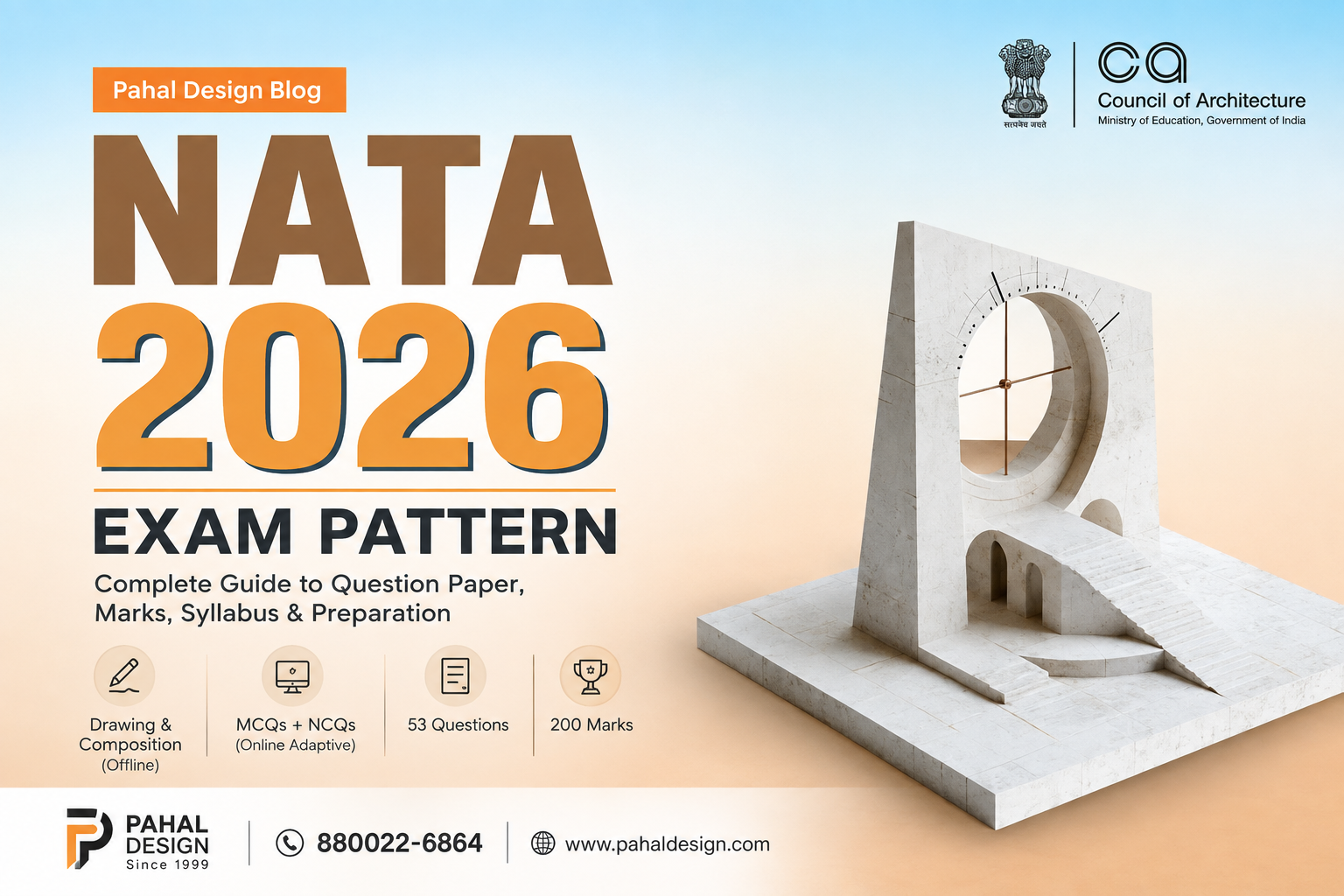
For NATA aspirants, understanding the examination structure before beginning serious preparation can make a significant difference. The NATA 2026 question paper carries a total of 200 marks and is divided into two major parts: Drawing & Composition and online aptitude-based questions.

Here is a detailed breakdown of the NATA 2026 exam pattern, question distribution, syllabus and preparation strategy.

NATA 2026 Exam Pattern Overview

According to the announced pattern, NATA 2026 is structured into two parts:

Part A – Drawing & Composition

  • Mode: Offline
  • Duration: 90 minutes
  • Total Marks: 80
  • Total Questions: 3

Part B – MCQs + NCQs

  • Mode: Online Adaptive
  • Duration: 90 minutes
  • Total Marks: 120
  • Total Questions: 50

NATA 2026 Total Exam

  • Total Questions: 53
  • Total Marks: 200
  • Total Duration: 180 minutes

This combination tests both the candidate’s creative abilities and analytical aptitude, making balanced preparation extremely important.

NATA 2026 Part A: Drawing & Composition

Part A is an offline test carrying 80 marks. It consists of three different sections designed to evaluate creativity, drawing ability, visualisation and three-dimensional thinking.

A1 – Composition & Colour

Questions: 1
Marks: 25

Students may be required to create a visual composition and demonstrate an understanding of colour application, balance, proportion and visual aesthetics.

Preparation should focus on:

  • Colour theory
  • Visual composition
  • Balance and harmony
  • Creative arrangement of elements
  • Understanding positive and negative spaces
  • Presentation skills

A2 – Sketching & Composition

Questions: 1
Marks: 25
Medium: Black & White

This section evaluates fundamental drawing abilities, including:

  • Drawing skills
  • Proportion
  • Shading
  • Perspective
  • Observation
  • Composition
  • Visual representation

Regular sketching practice can help students develop the speed and confidence required to complete this section effectively.

A3 – 3D Composition

Questions: 1
Marks: 30

The 3D Composition section carries the highest marks in Part A.

Candidates may be required to create a three-dimensional composition or model using the material or kit provided during the examination.

Students should develop an understanding of:

  • Form and volume
  • Space
  • Scale and proportion
  • Structural balance
  • 3D visualisation
  • Model-making
  • Creative transformation of basic forms

This section is particularly important because architecture requires students to think beyond two-dimensional drawings and understand how forms interact with physical space.

NATA 2026 Part B: Online Adaptive Test

Part B is an online adaptive examination carrying 120 marks.

The paper consists of:

42 MCQs + 8 NCQs = 50 Questions

Part B evaluates the candidate’s aptitude, reasoning, observation, architectural awareness and problem-solving capabilities.

NATA 2026 Part B Syllabus

1. Visual & Spatial Reasoning

Candidates should develop their ability to understand shapes, forms, patterns, directions and spatial relationships.

Practising mental rotation, 2D-to-3D visualisation, figure analysis and spatial puzzles can be useful.

2. Logical Reasoning & Interpretation

This section tests the candidate’s ability to analyse information and reach logical conclusions.

Questions may involve:

  • Patterns
  • Sequences
  • Relationships
  • Analytical reasoning
  • Logical interpretation

3. Architecture Awareness

Architecture awareness is particularly important for NATA aspirants.

Students should develop knowledge about:

  • Famous buildings
  • Architects
  • Architectural history
  • Building materials
  • Architectural styles
  • Important monuments
  • Contemporary architecture

Rather than memorising isolated facts, students should try to understand why important buildings and architectural movements are significant.

4. General Knowledge & Current Affairs

Candidates should stay updated with important national and international developments, particularly topics connected with:

  • Architecture
  • Art
  • Design
  • Culture
  • Environment
  • Technology
  • Major current events

5. Language & Grammar

Communication and comprehension skills are also tested. Students should strengthen vocabulary, grammar and their ability to understand written information accurately.

6. Design Sensitivity & Observation Skills

Architecture demands strong observation.

Students should practise identifying details in everyday environments, objects, buildings and visual compositions.

This section may evaluate a student’s understanding of aesthetics, functionality, relationships between objects and sensitivity towards design.

7. Critical Thinking & Problem-Solving

Rather than relying only on memorisation, students should develop the ability to analyse unfamiliar situations and find logical solutions.

Architecture aspirants should constantly ask:

Why is something designed this way, and how could it be designed better?

This approach can help build genuine design aptitude.

8. Basic Mathematics & Geometry

Students should revise fundamental mathematical and geometrical concepts relevant to aptitude and architecture.

Important areas may include:

  • Geometry
  • Shapes
  • Areas and volumes
  • Proportions
  • Measurements
  • Basic numerical ability

NATA 2026 Marks Distribution

SectionQuestionsMarks
A1 – Composition & Colour125
A2 – Sketching & Composition125
A3 – 3D Composition130
Part B – MCQs + NCQs50120
Total53200

The pattern clearly demonstrates that NATA preparation cannot focus only on drawing. Part B alone contributes 120 out of 200 marks, while Part A requires specialised creative and architectural aptitude.

How to Prepare for NATA 2026

A successful NATA 2026 preparation strategy should combine drawing practice, aptitude preparation and architectural awareness.

Students should regularly practise perspective drawing, composition, colour application and sketching while simultaneously working on logical reasoning, visual aptitude, mathematics and architecture-related general knowledge.

For the 3D composition component, practising with basic forms and model-making materials can help candidates develop spatial understanding.

Timed mock tests are equally important. Since both major parts have defined time limits, students must learn to balance accuracy, creativity and speed.

Why Start NATA 2026 Preparation Early?

NATA is different from a conventional academic examination. Drawing, observation, visualisation and design thinking are skills that improve gradually through consistent practice.

Starting early gives students more time to:

  • Improve sketching and perspective
  • Build drawing speed
  • Understand colour and composition
  • Develop 3D visualisation
  • Strengthen architecture awareness
  • Practise reasoning and aptitude
  • Attempt NATA mock tests
  • Identify and improve weaker areas

Prepare for NATA 2026 with Pahal Design

At Pahal Design, NATA aspirants are trained with a structured approach covering the major areas required for architecture entrance preparation.

The preparation focuses on drawing, sketching, perspective, composition, 3D visualisation, architecture aptitude, reasoning, observation and exam-oriented practice.

Students preparing for NATA and JEE Paper 2 B.Arch can benefit from systematic practice, faculty guidance, mock examinations and targeted preparation based on the latest examination requirements.

The objective is not simply to teach students how to draw, but to help them develop the observation, creativity, visualisation and problem-solving abilities required for architecture entrance examinations.

Final Words

The NATA 2026 exam pattern gives substantial importance to both creative and aptitude-based abilities. With 80 marks for Drawing & Composition and 120 marks for MCQs and NCQs, candidates need a balanced preparation strategy.

Understanding the paper pattern early, practising consistently and developing strong visual and architectural thinking can give aspirants a significant advantage.

For students targeting B.Arch admission through NATA 2026, now is the right time to build a structured preparation plan and practise every component of the examination.

Pahal Design – NATA & Architecture Entrance Exam Preparation

Website: www.pahaldesign.com
Contact: 880022-6864


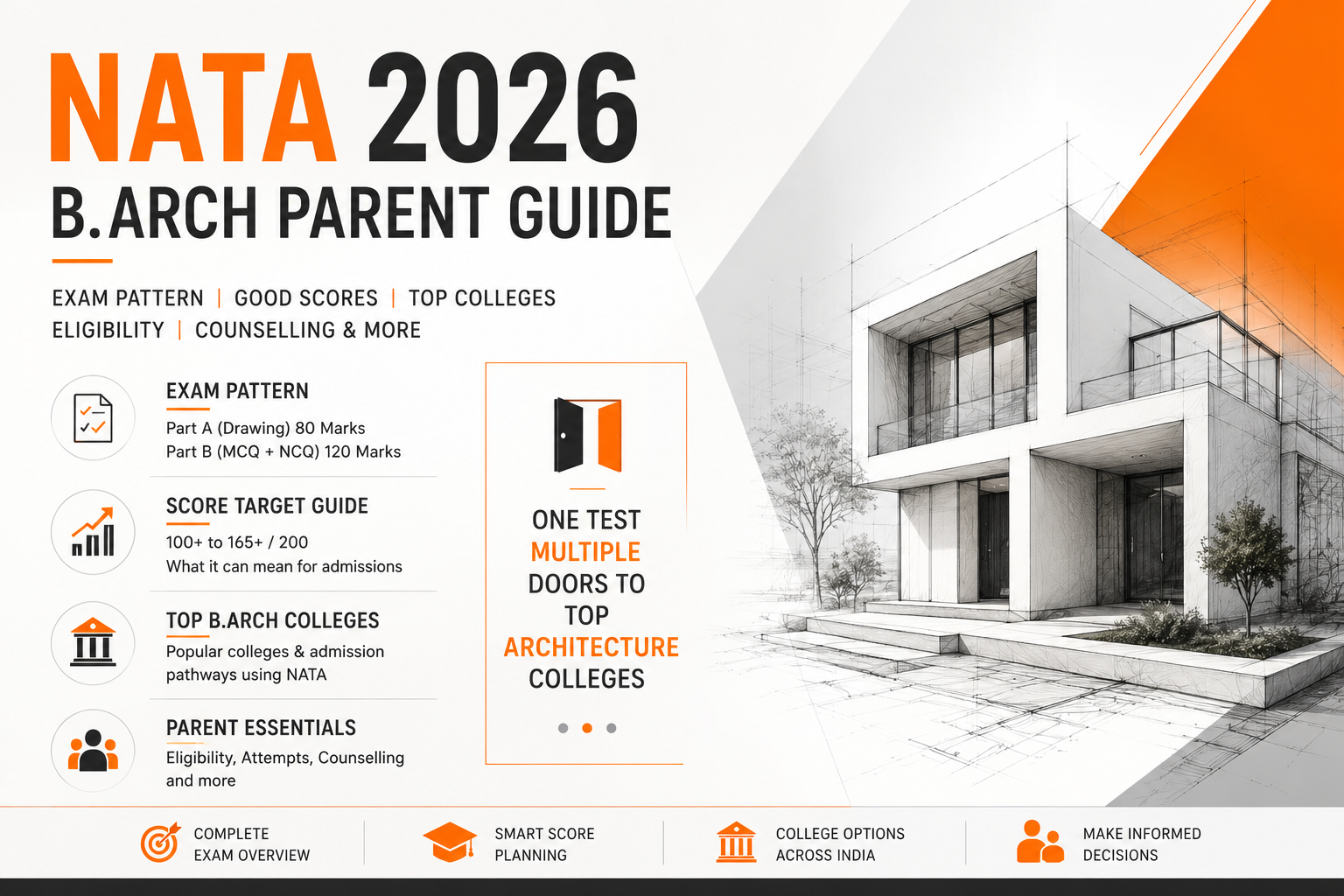
NATA 2026 B.Arch Parent Guide: Exam Pattern, Eligibility, Scores & Top Architecture Colleges in India

For students aspiring to pursue a Bachelor of Architecture (B.Arch) in India, the National Aptitude Test in Architecture (NATA) 2026 is an important entrance examination to understand. A valid NATA score can be used for B.Arch admissions through participating state/UT counselling systems and universities, although the final admission formula varies by counselling authority and institution.

For parents, understanding the exam pattern, eligibility, scoring, college options and counselling process can make architecture admission planning much easier.

This NATA 2026 Parent Guide explains the key information you need before your child begins preparing for B.Arch admissions.

What is NATA 2026?

NATA, or the National Aptitude Test in Architecture, is used as an architecture aptitude examination for admission to B.Arch programmes through multiple universities, institutions and state counselling routes across India.

Unlike an admission system based solely on the entrance-test score, the eventual merit calculation may also depend on factors such as:

  • Class 12 or Diploma marks
  • State or domicile rules
  • Category and quota
  • Institution-specific admission criteria
  • Counselling rounds
  • Seat availability

This is why two students with similar NATA performance may ultimately receive different college options.

NATA 2026 Exam Pattern

According to the NATA 2026 information in the parent guide, the examination carries a total of 200 marks:

SectionComponentMarks
Part ADrawing + Composition80
Part BAdaptive MCQ + NCQ120
Total 200

Students preparing for NATA should therefore develop both their drawing/composition abilities and aptitude-based problem-solving skills.

What is a Good Score in NATA 2026?

Parents often ask: “What is a good NATA score for B.Arch admission?”

For admission planning, the guide suggests the following target ranges:

NATA Score / 200PositioningGeneral Planning Outlook
165+ExceptionalCompetitive target for highly preferred NATA-route colleges
145–164Very StrongStrong range for many reputed architecture colleges and state counselling options
125–144GoodUseful range for a broad selection of private, university and state-level choices
100–124DevelopingOptions may remain depending on board marks, quota, category and later rounds

These are planning ranges rather than official college cut-offs. The guide also notes that CoA prescribes no minimum raw qualifying score for NATA 2026.

A Practical NATA 2026 Target

A useful target for students is:

145+ out of 200: Strong competitive target
165+ out of 200: Target for highly competitive NATA-based choices

Students should simultaneously aim to maintain strong Class 12 marks because several admission systems may consider both academic and NATA performance.

Top B.Arch Colleges and Admission Pathways Using NATA

Students with a valid NATA score can explore architecture colleges across different states and university admission systems.

Some prominent institutions and pathways highlighted in the guide include:

CEPT University – Faculty of Architecture, Ahmedabad

Planning Target: 165+
Admission Route: CEPT All India / ACPC; NATA used in merit

Sir J.J. College of Architecture, Mumbai

Planning Target: 165+
Admission Route: Maharashtra B.Arch CAP

School of Architecture & Planning, Anna University, Chennai

Planning Target: 155+
Admission Route: Tamil Nadu / Other-State B.Arch admission; NATA/JEE aptitude score

RV College of Architecture, Bengaluru

Planning Target: 150+
Admission Route: KEA / COMEDK / Management; valid NATA or JEE Paper-II

BMS College of Architecture, Design & Planning, Bengaluru

Planning Target: 145+
Admission Route: KEA / COMEDK; NATA/JEE architecture aptitude

Ramaiah Institute of Technology – School of Architecture, Bengaluru

Planning Target: 145+
Admission Route: Karnataka counselling / institutional routes

Kamla Raheja Vidyanidhi Institute for Architecture (KRVIA), Mumbai

Planning Target: 145+
Admission Route: Maharashtra B.Arch CAP

L.S. Raheja School of Architecture, Mumbai

Planning Target: 140+
Admission Route: Maharashtra B.Arch CAP

Academy of Architecture, Mumbai

Planning Target: 140+
Admission Route: Maharashtra B.Arch CAP

Manipal School of Architecture & Planning (MAHE)

Planning Target: 135+
Admission Route: MAHE direct merit; NATA + qualifying examination weightage

Faculty of Architecture & Planning / AKTU Pathway, Lucknow

Planning Target: 135+
Admission Route: UPTAC B.Arch counselling

Symbiosis Skills & Professional University – B.Arch, Pune

Planning Target: 125+
Admission Route: University admission; NATA/JEE + selection rules

Chitkara School of Planning & Architecture, Punjab

Planning Target: 125+
Admission Route: University admission; NATA required/accepted as per 2026 rules

Sushant University – School of Art & Architecture, Gurugram

Planning Target: 120+
Admission Route: University admission; NATA or JEE Main aptitude

The complete college table appears on page 2 of the parent guide. Importantly, these scores are admission-planning targets, not official cut-offs or admission guarantees.

NATA 2026 B.Arch Eligibility Criteria

Before registering for architecture admission, parents should carefully check whether their child satisfies the B.Arch eligibility requirements.

10+2 Eligibility

Physics and Mathematics are compulsory subjects, along with an approved third subject such as:

Chemistry, Biology, Computer Science, Information Technology, Informatics Practices, Engineering Graphics, Business Studies or a Technical Vocational subject.

The guide states a minimum aggregate of 45% in the qualifying examination under CoA rules.

Diploma Eligibility

For the 10+3 Diploma route, Mathematics must be a compulsory subject and the candidate should have at least 45% aggregate.

How Many Attempts Are Allowed in NATA 2026?

The NATA 2026 structure described in the guide includes two phases.

Phase 1: Up to 2 attempts are allowed, with the best raw performance used for the final percentile calculation.

Phase 2: One attempt is available for vacant-seat admissions after centralized counselling, with the raw score used.

The total examination remains 200 marks — Part A carries 80 marks and Part B carries 120 marks.

Why Can the Same NATA Score Lead to Different Colleges?

One of the most important things for parents to understand is that NATA score alone may not determine the final college.

The guide identifies three major factors.

1. Board Marks

Many states and colleges combine NATA performance with the student’s Class 12 or Diploma marks.

2. State, Category and Quota

Domicile, category, institutional quota and seat type can influence the effective admission cut-off.

3. Counselling Round

Admission thresholds can change considerably between early counselling rounds, later rounds and institute-level vacant-seat rounds.

This makes college selection and counselling strategy almost as important as obtaining a competitive NATA score.

How Should Students Prepare for NATA 2026?

A structured preparation plan should balance the requirements of both parts of the examination.

Students should work consistently on drawing, composition, visualisation, observation, spatial ability, design aptitude and problem-solving, while regularly attempting timed practice and mock tests.

Rather than focusing only on qualifying, students targeting competitive architecture colleges should work toward a score range that gives them flexibility across different counselling and university admission routes.

NATA 2026 Preparation with Pahal Design

At Pahal Design, students preparing for NATA and B.Arch entrance examinations can receive structured guidance focused on architecture aptitude, drawing, composition, practice and entrance-exam preparation.

Students and parents should also build an admission strategy that considers NATA performance, Class 12 marks, preferred colleges, state counselling routes and alternative B.Arch options rather than relying on a single college.

For NATA 2026 & B.Arch Entrance Preparation
Call: 880022-6864
Website: www.pahaldesign.com

Frequently Asked Questions About NATA 2026

What is the total score in NATA 2026?

NATA 2026 is for 200 marks, comprising 80 marks for Part A and 120 marks for Part B.

Is 145 a good score in NATA 2026?

For planning purposes, 145+ can be considered a strong target, although actual admission depends on the institution, board marks, counselling route, category, quota and other applicable rules.

What is an excellent NATA 2026 score?

A score of around 165+ out of 200 can be treated as an excellent competitive planning target for highly preferred NATA-based choices. It is not an official universal cut-off.

Can I get B.Arch admission with NATA?

Yes. A valid NATA score can be used through participating universities and state/UT B.Arch counselling systems, subject to their individual admission rules.

Do Class 12 marks matter for B.Arch admission?

They can. Many admission routes combine NATA performance with Class 12 or Diploma marks.

Which colleges can students target through NATA?

The guide highlights institutions and pathways including CEPT University, Sir J.J. College of Architecture, Anna University, RV College of Architecture, BMS College of Architecture, KRVIA, Manipal School of Architecture & Planning and several others.

Conclusion

NATA 2026 can open multiple pathways to B.Arch colleges across India, but parents and students should look beyond the entrance score alone. Academic marks, state counselling rules, domicile, category, quota, admission rounds and individual university criteria can all affect the final outcome.

For preparation planning, 145+ can be treated as a strong target and 165+ as a highly competitive target, while keeping Class 12 performance strong. These score bands should be treated as guidance rather than guaranteed college cut-offs.

NATA 2026 Exam Notification: Dates, Eligibility, & Registration Guide

NATA 2026 Exam INFORMATION

Students who dream of becoming architects must clear the National Aptitude Test in Architecture (NATA) to secure admission into the 5-year Bachelor of Architecture (B.Arch.) program in India. The Council of Architecture (CoA), Ministry of Education, Government of India, has officially announced the conduct of NATA 2026.

If you are planning to pursue architecture, here is everything you need to know about NATA 2026 exam dates, eligibility criteria, attempts, and registration process.

NATA 2026 Exam Dates

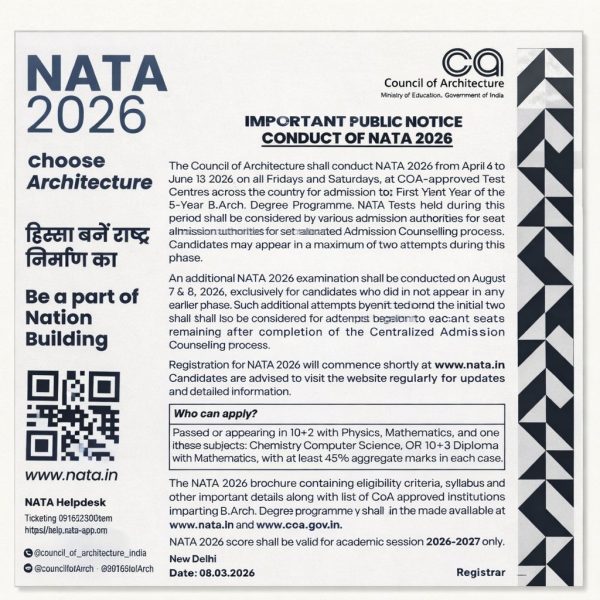
The NATA 2026 examination will be conducted from April 4 to June 13, 2026.

•⁠ ⁠Exams will take place every Friday and Saturday.
•⁠ ⁠The test will be held at Council of Architecture (CoA) approved test centres across India.
•⁠ ⁠The exam is conducted for admission to the first year of the 5-year B.Arch. degree program.

Students can appear for the NATA exam up to two times during this examination window. The scores obtained will be used by various architecture colleges and universities for centralized admission counselling and seat allotment.

Additional NATA 2026 Examination

For candidates who could not appear during the initial phase, an additional NATA 2026 exam will be conducted on: August 7 and August 8, 2026

Important points:

•⁠ ⁠Only candidates who missed the earlier exam phase can appear.
•⁠ ⁠Students will get only one attempt in this additional examination.
•⁠ ⁠The score will be considered only for vacant seats remaining after the centralized counselling process.

NATA 2026 Registration

The registration process for NATA 2026 will start soon.

Students can apply online through the official website: www.nata.in

Applicants are advised to visit the website regularly for updates, announcements, and detailed instructions regarding the application process.

NATA 2026 Eligibility Criteria

Candidates must satisfy one of the following eligibility requirements to apply for the exam.

1. 10+2 Qualification

Students who have passed or are appearing in 10+2 with the following subjects:

•⁠ ⁠Physics
•⁠ ⁠Mathematics
•⁠ ⁠One additional subject such as:
– Chemistry
– Computer Science

2. Diploma Qualification

Students who have completed a 10+3 Diploma with Mathematics are also eligible.

In both cases, candidates must secure a minimum of 45% aggregate marks.

NATA 2026 Brochure & Official Information

The NATA 2026 official brochure will include important details such as:

•⁠ ⁠Complete eligibility criteria
•⁠ ⁠NATA syllabus
•⁠ ⁠Exam pattern
•⁠ ⁠List of CoA-approved architecture colleges in India

The brochure will be available on the official websites:

•⁠ ⁠www.nata.in
•⁠ ⁠www.coa.gov.in

Validity of NATA 2026 Score

The NATA 2026 score will be valid only for the academic session 2026–2027. Candidates must use the score within this admission cycle to secure a seat in the B.Arch program.

Start Your Architecture Preparation with Pahal Design

If you are planning to appear for NATA 2026, early preparation is the key to success. Pahal Design provides expert coaching for NATA, JEE B.Arch, and architecture entrance exams, helping students build strong drawing, creativity, and aptitude skills required to crack the exam.

With experienced faculty, structured study material, and regular mock tests, Pahal Design helps students secure admission in top architecture colleges across India.

Start preparing today and move one step closer to your dream of becoming an architect. 


For more updates and information Contact us on : 8800-22-6864
Visit : https://pahaldesign.com/

Frequently Asked Questions (FAQs) – NATA 2026

What is NATA 2026?

NATA (National Aptitude Test in Architecture) is a national-level entrance exam conducted by the Council of Architecture (CoA) for admission into the 5-year Bachelor of Architecture (B.Arch.) program in approved architecture colleges across India.

⁠When will NATA 2026 be conducted?

NATA 2026 will be conducted from April 4 to June 13, 2026, on every Friday and Saturday at CoA-approved test centres across India.

⁠How many attempts are allowed in NATA 2026?
Candidates can appear for a maximum of two attempts during the main exam phase (April–June 2026).
 
⁠Is there an additional attempt for NATA 2026?
Yes. An additional NATA exam will be conducted on August 7 and 8, 2026 for candidates who did not appear in the earlier phase. Only one attempt will be allowed in this additional phase.
 
When will the NATA 2026 registration start?
The registration process for NATA 2026 will begin soon. Candidates can apply online through the official website www.nata.in.
What is the eligibility for NATA 2026?
Candidates must meet one of the following criteria:
•10+2 with Physics, Mathematics, and Chemistry/Computer Science, or
•10+3 Diploma with Mathematics   
 
Candidates must have at least 45% aggregate marks.
What courses can students pursue after clearing NATA?

Students who qualify NATA can apply for admission to the Bachelor of Architecture (B.Arch.) program in CoA-approved architecture colleges in India.

Is NATA compulsory for architecture admission in India?

Yes, NATA is one of the recognized entrance exams required for B.Arch admission in most architecture colleges in India.

How long is the NATA 2026 score valid?

The NATA 2026 score will be valid only for the academic session 2026–2027.

Where can students find the NATA 2026 brochure and official updates?
Candidates can check the official websites for updates and the detailed brochure
 
 
Schedule a free counselling session WhatsApp WhatsApp