
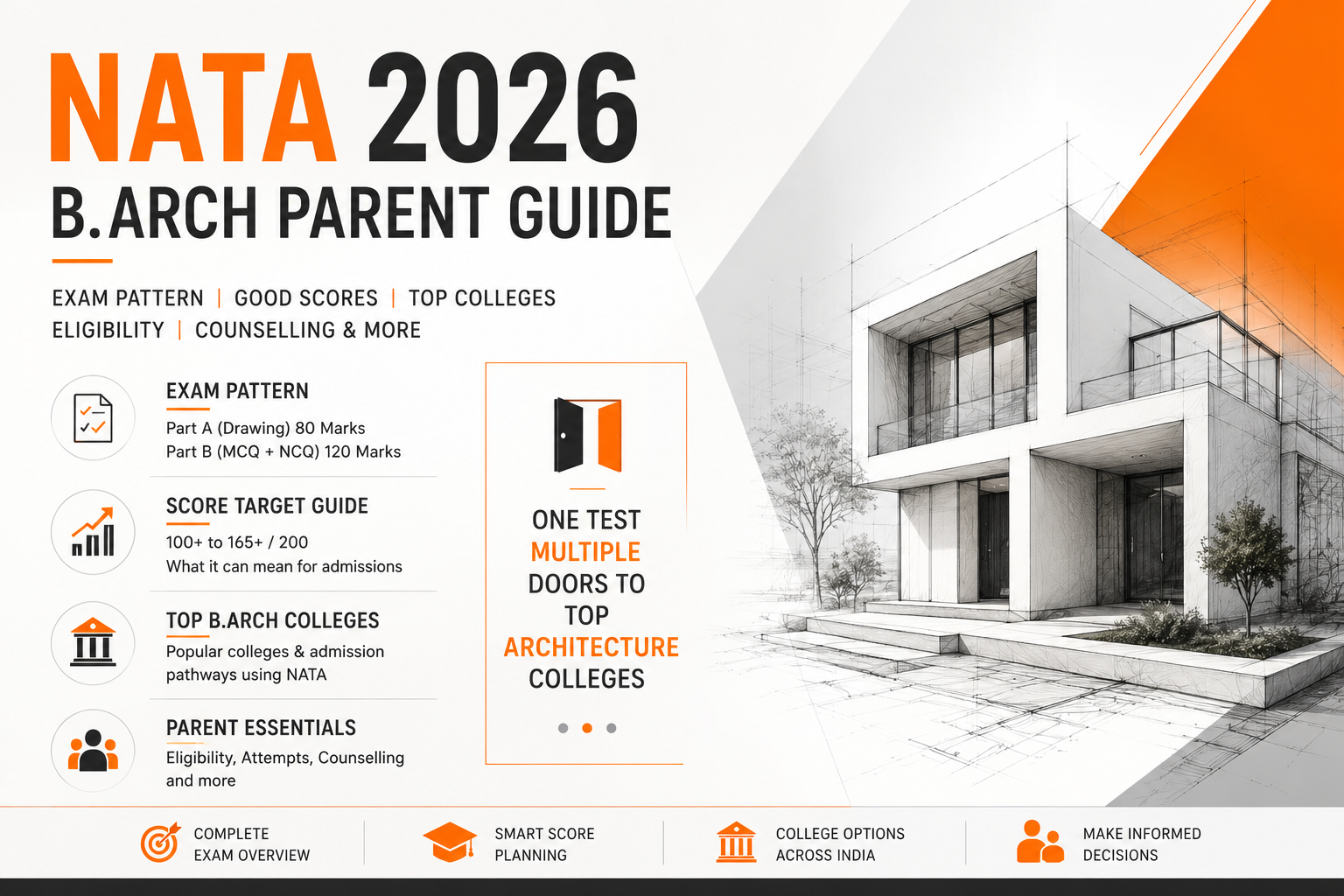
NATA 2026 B.Arch Parent Guide: Exam Pattern, Eligibility, Scores & Top Architecture Colleges in India
For students aspiring to pursue a Bachelor of Architecture (B.Arch) in India, the National Aptitude Test in Architecture (NATA) 2026 is an important entrance examination to understand. A valid NATA score can be used for B.Arch admissions through participating state/UT counselling systems and universities, although the final admission formula varies by counselling authority and institution.
For parents, understanding the exam pattern, eligibility, scoring, college options and counselling process can make architecture admission planning much easier.
This NATA 2026 Parent Guide explains the key information you need before your child begins preparing for B.Arch admissions.
What is NATA 2026?
NATA, or the National Aptitude Test in Architecture, is used as an architecture aptitude examination for admission to B.Arch programmes through multiple universities, institutions and state counselling routes across India.
Unlike an admission system based solely on the entrance-test score, the eventual merit calculation may also depend on factors such as:
- Class 12 or Diploma marks
- State or domicile rules
- Category and quota
- Institution-specific admission criteria
- Counselling rounds
- Seat availability
This is why two students with similar NATA performance may ultimately receive different college options.
NATA 2026 Exam Pattern
According to the NATA 2026 information in the parent guide, the examination carries a total of 200 marks:
| Section | Component | Marks |
|---|---|---|
| Part A | Drawing + Composition | 80 |
| Part B | Adaptive MCQ + NCQ | 120 |
| Total | 200 |
Students preparing for NATA should therefore develop both their drawing/composition abilities and aptitude-based problem-solving skills.
What is a Good Score in NATA 2026?
Parents often ask: “What is a good NATA score for B.Arch admission?”
For admission planning, the guide suggests the following target ranges:
| NATA Score / 200 | Positioning | General Planning Outlook |
|---|---|---|
| 165+ | Exceptional | Competitive target for highly preferred NATA-route colleges |
| 145–164 | Very Strong | Strong range for many reputed architecture colleges and state counselling options |
| 125–144 | Good | Useful range for a broad selection of private, university and state-level choices |
| 100–124 | Developing | Options may remain depending on board marks, quota, category and later rounds |
These are planning ranges rather than official college cut-offs. The guide also notes that CoA prescribes no minimum raw qualifying score for NATA 2026.
A Practical NATA 2026 Target
A useful target for students is:
145+ out of 200: Strong competitive target
165+ out of 200: Target for highly competitive NATA-based choices
Students should simultaneously aim to maintain strong Class 12 marks because several admission systems may consider both academic and NATA performance.
Top B.Arch Colleges and Admission Pathways Using NATA
Students with a valid NATA score can explore architecture colleges across different states and university admission systems.
Some prominent institutions and pathways highlighted in the guide include:
CEPT University – Faculty of Architecture, Ahmedabad
Planning Target: 165+
Admission Route: CEPT All India / ACPC; NATA used in merit
Sir J.J. College of Architecture, Mumbai
Planning Target: 165+
Admission Route: Maharashtra B.Arch CAP
School of Architecture & Planning, Anna University, Chennai
Planning Target: 155+
Admission Route: Tamil Nadu / Other-State B.Arch admission; NATA/JEE aptitude score
RV College of Architecture, Bengaluru
Planning Target: 150+
Admission Route: KEA / COMEDK / Management; valid NATA or JEE Paper-II
BMS College of Architecture, Design & Planning, Bengaluru
Planning Target: 145+
Admission Route: KEA / COMEDK; NATA/JEE architecture aptitude
Ramaiah Institute of Technology – School of Architecture, Bengaluru
Planning Target: 145+
Admission Route: Karnataka counselling / institutional routes
Kamla Raheja Vidyanidhi Institute for Architecture (KRVIA), Mumbai
Planning Target: 145+
Admission Route: Maharashtra B.Arch CAP
L.S. Raheja School of Architecture, Mumbai
Planning Target: 140+
Admission Route: Maharashtra B.Arch CAP
Academy of Architecture, Mumbai
Planning Target: 140+
Admission Route: Maharashtra B.Arch CAP
Manipal School of Architecture & Planning (MAHE)
Planning Target: 135+
Admission Route: MAHE direct merit; NATA + qualifying examination weightage
Faculty of Architecture & Planning / AKTU Pathway, Lucknow
Planning Target: 135+
Admission Route: UPTAC B.Arch counselling
Symbiosis Skills & Professional University – B.Arch, Pune
Planning Target: 125+
Admission Route: University admission; NATA/JEE + selection rules
Chitkara School of Planning & Architecture, Punjab
Planning Target: 125+
Admission Route: University admission; NATA required/accepted as per 2026 rules
Sushant University – School of Art & Architecture, Gurugram
Planning Target: 120+
Admission Route: University admission; NATA or JEE Main aptitude
The complete college table appears on page 2 of the parent guide. Importantly, these scores are admission-planning targets, not official cut-offs or admission guarantees.
NATA 2026 B.Arch Eligibility Criteria
Before registering for architecture admission, parents should carefully check whether their child satisfies the B.Arch eligibility requirements.
10+2 Eligibility
Physics and Mathematics are compulsory subjects, along with an approved third subject such as:
Chemistry, Biology, Computer Science, Information Technology, Informatics Practices, Engineering Graphics, Business Studies or a Technical Vocational subject.
The guide states a minimum aggregate of 45% in the qualifying examination under CoA rules.
Diploma Eligibility
For the 10+3 Diploma route, Mathematics must be a compulsory subject and the candidate should have at least 45% aggregate.
How Many Attempts Are Allowed in NATA 2026?
The NATA 2026 structure described in the guide includes two phases.
Phase 1: Up to 2 attempts are allowed, with the best raw performance used for the final percentile calculation.
Phase 2: One attempt is available for vacant-seat admissions after centralized counselling, with the raw score used.
The total examination remains 200 marks — Part A carries 80 marks and Part B carries 120 marks.
Why Can the Same NATA Score Lead to Different Colleges?
One of the most important things for parents to understand is that NATA score alone may not determine the final college.
The guide identifies three major factors.
1. Board Marks
Many states and colleges combine NATA performance with the student’s Class 12 or Diploma marks.
2. State, Category and Quota
Domicile, category, institutional quota and seat type can influence the effective admission cut-off.
3. Counselling Round
Admission thresholds can change considerably between early counselling rounds, later rounds and institute-level vacant-seat rounds.
This makes college selection and counselling strategy almost as important as obtaining a competitive NATA score.
How Should Students Prepare for NATA 2026?
A structured preparation plan should balance the requirements of both parts of the examination.
Students should work consistently on drawing, composition, visualisation, observation, spatial ability, design aptitude and problem-solving, while regularly attempting timed practice and mock tests.
Rather than focusing only on qualifying, students targeting competitive architecture colleges should work toward a score range that gives them flexibility across different counselling and university admission routes.
NATA 2026 Preparation with Pahal Design
At Pahal Design, students preparing for NATA and B.Arch entrance examinations can receive structured guidance focused on architecture aptitude, drawing, composition, practice and entrance-exam preparation.
Students and parents should also build an admission strategy that considers NATA performance, Class 12 marks, preferred colleges, state counselling routes and alternative B.Arch options rather than relying on a single college.
For NATA 2026 & B.Arch Entrance Preparation
Call: 880022-6864
Website: www.pahaldesign.com
Frequently Asked Questions About NATA 2026
What is the total score in NATA 2026?
NATA 2026 is for 200 marks, comprising 80 marks for Part A and 120 marks for Part B.
Is 145 a good score in NATA 2026?
For planning purposes, 145+ can be considered a strong target, although actual admission depends on the institution, board marks, counselling route, category, quota and other applicable rules.
What is an excellent NATA 2026 score?
A score of around 165+ out of 200 can be treated as an excellent competitive planning target for highly preferred NATA-based choices. It is not an official universal cut-off.
Can I get B.Arch admission with NATA?
Yes. A valid NATA score can be used through participating universities and state/UT B.Arch counselling systems, subject to their individual admission rules.
Do Class 12 marks matter for B.Arch admission?
They can. Many admission routes combine NATA performance with Class 12 or Diploma marks.
Which colleges can students target through NATA?
The guide highlights institutions and pathways including CEPT University, Sir J.J. College of Architecture, Anna University, RV College of Architecture, BMS College of Architecture, KRVIA, Manipal School of Architecture & Planning and several others.
Conclusion
NATA 2026 can open multiple pathways to B.Arch colleges across India, but parents and students should look beyond the entrance score alone. Academic marks, state counselling rules, domicile, category, quota, admission rounds and individual university criteria can all affect the final outcome.
For preparation planning, 145+ can be treated as a strong target and 165+ as a highly competitive target, while keeping Class 12 performance strong. These score bands should be treated as guidance rather than guaranteed college cut-offs.