
 NID M.Des Cut Off 2026–27: Last Rank & Score for All Disciplines
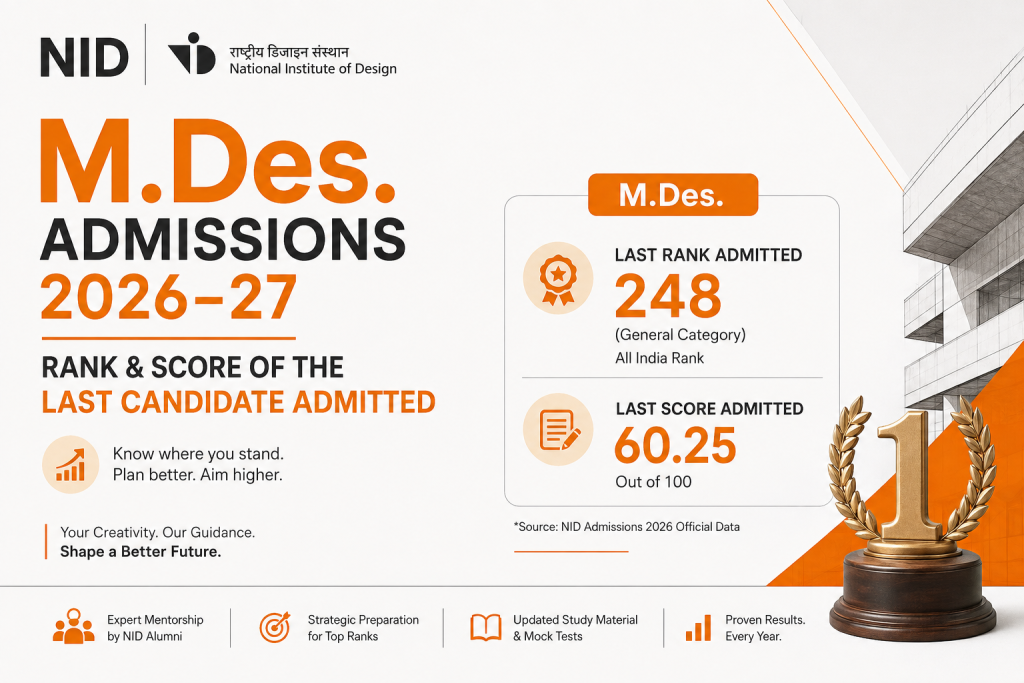
The National Institute of Design (NID) M.Des Admission 2026–27 data provides an important benchmark for aspirants preparing for admission to one of India’s most prestigious design institutes. NID has released the Rank and Score of the Last Candidate Allotted a Seat as on 17 July 2026, covering different M.Des disciplines and reservation categories.
For students planning to appear for NID DAT M.Des 2027, understanding the NID M.Des cut-off, closing rank and last admitted candidate’s score can help them evaluate the level of competition and set realistic preparation targets.
At Pahal Design, aspirants can use this previous admission data as a reference while preparing strategically for NID DAT Prelims, DAT Mains and the complete M.Des admission process.
According to the official NID admission data, the following were the Open Category rank and score of the last candidate allotted a seat:
| M.Des Discipline | Open Rank | Score |
|---|---|---|
| Animation Film Design | 10 | 70.83 |
| Ceramic & Glass Design | 8 | 45.68 |
| Furniture & Interior Design | 18 | 48.18 |
| Film & Video Communication | 11 | 60.85 |
| Graphic Design | 9 | 65.10 |
| Product Design | 8 | 57.13 |
| Textile Design | 9 | 70.30 |
| Apparel Design | 14 | 54.70 |
| Lifestyle Accessory Design | 9 | 74.50 |
| New Media Design | 13 | 48.88 |
| Photography Design | 15 | 50.63 |
| Strategic Design Management | 8 | 76.28 |
| Transportation & Automobile Design | 12 | 56.75 |
| Toy & Game Design | 5 | 65.55 |
| Digital Game Design | 8 | 59.53 |
| Design for Retail Experience | 10 | 76.30 |
| Information Design | 11 | 61.88 |
| Interaction Design | 11 | 67.78 |
| Universal Design | 19 | 45.25 |
The official table shows substantial variation across disciplines. For example, Furniture & Interior Design closed at Open Rank 18 with a score of 48.18, Film & Video Communication at Rank 11 with 60.85, Graphic Design at Rank 9 with 65.10, and Product Design at Rank 8 with 57.13.
Similarly, Lifestyle Accessory Design recorded an Open score of 74.50, while Strategic Design Management recorded 76.28.
Among the disciplines listed in the official document, Design for Retail Experience had an Open score of 76.30, while Interaction Design had an Open score of 67.78.
The official NID admission document provides closing rank and score information across:
The document also uses NE for “No Eligible Candidate” and NA for “No Applicant.”
This is important because the last allotted rank and score vary significantly depending on both the M.Des discipline and admission category.
Graphic Design remains one of the key specialisations considered by NID M.Des aspirants.
For Graphic Design, the last allotted candidates recorded were:
| Category | Rank | Score |
| Open | 9 | 65.10 |
| GEN-EWS | 3 | 52.55 |
| OBC-NCL | 9 | 41.15 |
| SC | 5 | 53.58 |
| ST | 1 | 60.28 |
| PwD | 1 | 58.03 |
| Overseas | 1 | 62.48 |
These figures are taken from NID’s 2026–27 admission data.
For Product Design, the Open Category last allotted candidate had:
Open Rank: 8 Score: 57.13
The same official data reports GEN-EWS Rank 2 at 51.85, OBC-NCL Rank 7 at 43.60, SC Rank 5 at 51.10, ST Rank 1 at 44.80 and PwD Rank 2 at 40.95.
Students targeting NID Product Design should remember that previous closing scores are useful benchmarks but should not be treated as guaranteed future cut-offs.
For Interaction Design, the Open Category last allotted candidate had:
Open Rank: 11 Score: 67.78
The official document also records GEN-EWS Rank 2 at 49.23, OBC-NCL Rank 8 at 44.13, SC Rank 3 at 58.58 and ST Rank 1 at 53.80.
With the growing importance of UX, digital products and human-computer interaction, Interaction Design is an important discipline for students exploring postgraduate design education.
Based on the published last-allotted-candidate data, Design for Retail Experience recorded the highest Open score at 76.30, closely followed by:
Strategic Design Management – 76.28 Lifestyle Accessory Design – 74.50 Animation Film Design – 70.83 Textile Design – 70.30 Interaction Design – 67.78
The official discipline-wise figures show how widely scores can differ between programmes.
Importantly, a higher closing score should not automatically be interpreted as a programme being “better” or more difficult. Closing figures can be influenced by factors such as applicant performance, category and seat allocation.
The closing rank refers to the rank of the last candidate allotted a seat for the relevant discipline and category at the stated point in the admission process.
Therefore, if the Open Rank for a particular discipline is 10, it means the last Open-category candidate allotted a seat in the published data held Open Rank 10.
The NID document specifically states that these figures represent the “Rank and Score of the Last Candidate Allotted a Seat as on 17 July 2026.”
This distinction is important when students analyse previous-year NID cut-offs.
Previous admission data should primarily be used as a benchmark rather than a guaranteed target.
An aspirant preparing for the next NID M.Des admission cycle should aim to perform comfortably above previous closing-score levels rather than preparing only to match them.
Your preparation should focus on developing:
M.Des applicants generally come with more specialised interests than undergraduate design aspirants. A candidate interested in Graphic Design may require a different portfolio and conceptual orientation from someone targeting Transportation & Automobile Design, Strategic Design Management, Animation Film Design or Interaction Design.
Therefore, simply practising generic design entrance questions may not be sufficient.
Students should understand their preferred discipline, analyse previous NID admission trends and develop their creative thinking and presentation accordingly.
Pahal Design provides preparation support for students aspiring to enter leading design institutes in India.
For NID M.Des aspirants, effective preparation requires more than attempting previous papers. Students need to build their ability to think creatively, communicate ideas visually, solve unfamiliar design problems and present concepts with clarity.
A structured preparation approach can include:
NID DAT Preparation: Regular practice to improve aptitude, creativity, observation and problem-solving.
Creative & Design Thinking: Developing original concepts rather than relying on repetitive solutions.
Portfolio Guidance: Helping students organise and present their design work effectively where portfolio preparation is relevant.
Mock Tests & Practice: Working under examination conditions to improve speed, decision-making and presentation.
Personalised Feedback: Identifying individual strengths and areas that require improvement.
The objective should not simply be to cross a previous cut-off but to build a strong overall performance for the NID admission process.
There is no single cut-off applicable to every M.Des discipline. The rank and score of the last candidate allotted a seat differ according to discipline and admission category. The official document provides separate figures for OPEN, GEN-EWS, OBC-NCL, SC, ST, PwD and Overseas candidates.
For Graphic Design, the last allotted Open-category candidate had Rank 9 with a score of 65.10.
For Product Design, the Open-category last allotted candidate had Rank 8 and a score of 57.13.
For Interaction Design, the Open-category last allotted candidate had Rank 11 with a score of 67.78.
Among the disciplines listed, Design for Retail Experience had the highest Open score at 76.30, followed closely by Strategic Design Management at 76.28.
According to the official document, NE means “No Eligible Candidate” and NA means “No Applicant.”
No. Previous admission figures should only be treated as reference points. Closing ranks and scores can change from one admission cycle to another.
Admission is competitive because candidates are evaluated on design aptitude and creative abilities, and seats are discipline-specific. Consistent practice and a well-planned preparation strategy can help candidates improve their performance.
Start with design aptitude, observation, creative problem-solving, visual communication and regular timed practice. Aspirants should also understand their preferred M.Des discipline and develop relevant design skills and portfolio work where required.
Contact Us