Ace UCEED 2026: Download Question Papers with Detailed Answer Keys

UCEED Question Paper

Success in UCEED 2026 isn’t just about hard work; it’s about smart strategy. For design aspirants, the most powerful tool in your arsenal is consistent practice with authentic study materials. To bridge the gap between preparation and performance, PAHAL DESIGN brings you a comprehensive collection of UCEED 2026 exam papers complete with detailed answer keys.

Whether you are just starting or are in the final leg of your revision, these resources are designed to maximize your scoring potential.

Why Solving UCEED Question Papers is Non-Negotiable ?

The UCEED exam, conducted by IIT Bombay, is a test of your design aptitude, visualization skills, moreover logical reasoning. It is not an exam you can memorize your way through. Solving previous years’ papers and mock tests helps you:

Decode the Pattern: Familiarize yourself with the unique structure of Part A (MCQ, MSQ, NAT) and Part B (Drawing).

Master Time Management: Learn to allocate time efficiently across different sections under exam-like pressure.

Identify High-Weightage Topics: Spot recurring themes furthermore frequently asked concepts.

Build Accuracy: Reduce negative marking by practicing with reliable answer keys

What You Get with PAHAL Design’s Study Kit ?

As a premier institute for design entrance preparation, PAHAL Design ensures you have access to material that mirrors the actual exam standards. By downloading our UCEED 2026 resource pack, you gain access to:

  1. Latest UCEED 2026 Model Papers: Fresh practice questions based on current trends.

  2. Previous Years’ Solved Papers: A repository of past questions to understand the exam’s evolution.

  3. Comprehensive Answer Keys: Accurate solutions to help you self-evaluate and correct mistakes immediately.

  4. Targeted Practice for All Sections: Focused material for Visualization, Spatial Ability, and Logical Reasoning.

Who Is This Study Material For ?

This study material is essential for:

Serious Aspirants: Students targeting B.Des programs at IITs, IIITDM, and other top institutes.

Class 11 & 12 Students: Early starters building a foundation for a career in design.

Self-Study Students: Those looking for structured, high-quality PDFs to supplement their preparation.

Transform Your Preparation Strategy

Don’t leave your result to chance. Solving papers allows you to pinpoint your weak areas—whether it’s numerical ability or observation skills—and turn them into strengths. UCEED 2026 Question Papers will prepare.

Ready to secure your seat at an IIT ?

Stop searching and start solving. Equip yourself with the best resources trusted by toppers.

Download UCEED 2026 Question Papers & Answer Key Here https://www.pahaldesign.com/download-uceed-pyqs/www.pahaldesign.com)

Prepare Smarter. Practice Harder. Crack UCEED 2026 with PAHAL Design.

For more information on courses like NIFT, NID, NATA, and CEED, visit our website and book a consultancy session today at : https://pahaldesign.com/

How to Prepare for NIFT in 5 Days: Last-Minute Strategy

DAY 1 – Master the Structure & Basics

Focus: Understanding expectations and fundamental skills.

CAT (Creative Ability Test): Focus on human proportions (male, female, child), 1-point and 2-point perspectives, and basic light/shade (stick to 2–3 tones). Practice small, quick sketches instead of full-page compositions.

GAT (General Ability Test): Revise English (synonyms/antonyms), Quant (percentages, ratios), and Fashion GK (brands and designers).

Goal: Don’t do mocks today; focus purely on conceptual clarity.

DAY 2 – Core CAT Practice

Focus: Visualization and Composition.

Exercise: Solve exactly 2 CAT questions—one story-based and one product/situation-based.

Process: Read the prompt, underline keywords, and create two rough thumbnail layouts (1–2 mins). Choose the best one and draw it cleanly.

Key Elements: Ensure your drawing has a clear foreground, midground, and background, along with expressive faces.

NIFT 5 Days Study Plan

Avoid: Over-shading, tiny cluttered details, or messy coloring.

DAY 3 – GAT Strategy & Speed Control

Focus: Accuracy over quantity.

GAT Strategy: Attempt English and GK first. Only move to Quant for questions you are 100% sure about.

Mock Test: Take one full GAT mock under strict exam timing. Aim for 70–75% completion with high accuracy.

Analysis: After the test, write down the specific grammar rules or math formulas you missed.

DAY 4 – Full-Length Simulation

Focus: Stamina and Time Management.

Simulation: Take a full CAT mock immediately followed by a GAT mock.

Self-Evaluation: Ask yourself: Is the idea unique? Is the proportion correct? Is the sheet clean?


DAY 5 – Finishing Touches & Revision

Focus: Confidence and Quick Recaps.

Practice: Spend 1 hour practicing difficult elements like hands, feet, and facial expressions.

Review: Go over your Fashion GK notes and math shortcut formulas.

Rest: Sleep early. A fresh mind is more creative than a tired one.

Frequently Asked Questions (FAQs)

Is it really possible to crack NIFT in 5 days?

While a year of prep is ideal, you can significantly improve your score in 5 days if you already have basic drawing skills and decent English. Success in this timeframe depends on strategic selection—focusing only on topics that appear every year (like percentages in GAT or human figures in CAT).

What are the "Must-Know" topics for the CAT (Creative Ability Test)?

Focus your 5 days on:

Human Figures: Drawing people in action (running, sitting, selling).

Perspective: One-point and two-point perspective for indoor/outdoor scenes.

Color Theory: Understanding “Cool” vs. “Warm” colors and their psychological impact.

Creative Thinking: Practicing how to turn a simple object (like a paperclip) into something innovative.

Which GAT (General Ability Test) sections should I prioritize?

English: This is usually the highest-scoring section. Practice “Error Spotting” and “Synonyms.”

GK: Don’t study general history. Focus strictly on Fashion GK (Logos, Taglines, Designers, Fabrics).

Logical Reasoning: Master “Series Completion,” “Blood Relations,” and “Direction Sense”—these are quick wins.

How do I manage time during the actual exam?

A common mistake is spending 2 hours on one beautiful sketch and leaving the GAT unfinished.

CAT: Spend no more than 30–40 minutes per question. Use the first 5 minutes just for “thumbnail” planning.

GAT: If a Math question takes more than 1 minute, skip it and move to English or GK.

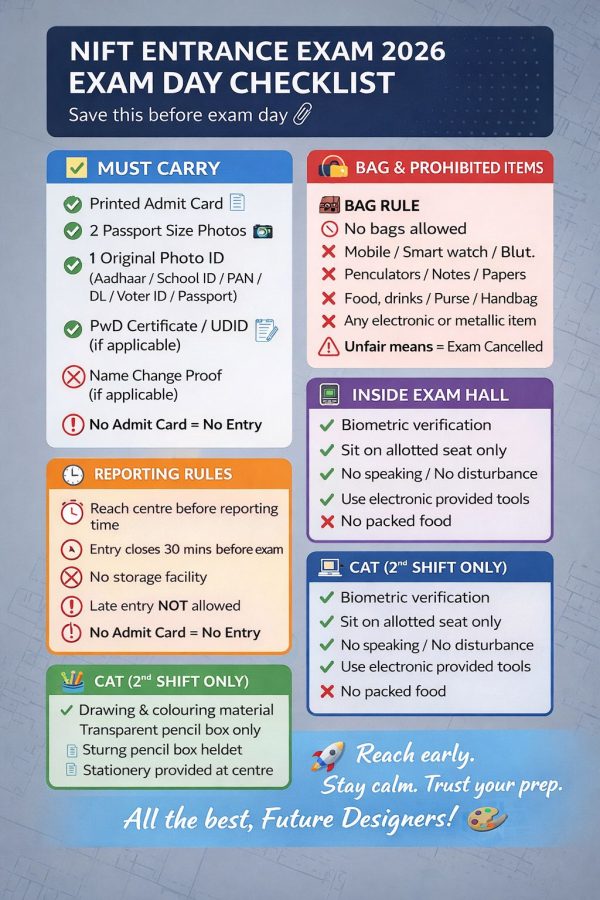
What should be in my NIFT exam kit?

Check your admit card, but typically you need:

HB, 2B, 4B, and 6B pencils.

A good quality eraser and sharpener.

Dry colors (Color pencils or Pastels). Avoid water-based paints as the paper quality may not support them.

A transparent ruler and a black fine-liner pen for outlining.

Need More Help?

1. At Pahal Design, we provide:

2. Last-minute NIFT CAT question banks

3. Safe composition templates

4. GAT shortcut strategies

5. Mock tests & personal feedback

Your dream design college is still possible.

For Details Connect us at 880022-6864

Union Budget 2026–27: A Creative Manifesto for Designers and Architects

This isn’t just a budget; it’s a Creative Manifesto.

If you are a student at NID, an aspiring Architect, or a Design enthusiast, the Union Budget 2026–27 has just upgraded your career path from “niche” to “national priority.” India is moving away from being a back-office hub to becoming the world’s Design Studio.


Why 2026 is the Year of the Designer ?

1. The NID Expansion: East Meets Excellence

The spotlight is shining on Eastern India! The government has greenlit a brand-new National Institute of Design (NID) to be established via the “Challenge Route.”

The Vibe: This isn’t just another campus; it’s a strategic move to tap into the rich artisanal heritage of the East and blend it with cutting-edge global design tech.

The Opportunity: More seats, fresh perspectives, and a massive surge in design research opportunities.

2. Five New "University Townships": A Playground for Architects

Forget designing single buildings; the government wants you to design entire Ecosystems. Five new University Townships are being built near industrial corridors.

The Blueprint: These are “Hub-and-Spoke” models where students live, learn, and work in the same zone.

Architect Alert: This creates a massive demand for Urban Planners, Sustainable Architects, and Smart-City Specialists. If you’re into “Green Building” or “Integrated Living,” your time is now.

3. The "Orange Economy" is Booming

The government is betting big on the Creative Industries (AVGC).

The Move: 15,000 schools and 500 colleges will now host AVGC (Animation, Visual Effects, Gaming, and Comics) Labs.

The Goal: To capture a slice of the global trillion-dollar creative market. Whether you are a Character Designer, a Concept Artist, or a UI/UX whiz, the government is literally building your infrastructure for you.

4. AI-First: From Sketchbooks to Prompt Engineering

AI is no longer an “extra” skill—it’s the foundation. With the new AI-First Curriculum, design education is getting a high-tech facelift.

The Pivot: Budget 2026 encourages “Generative Design.” The future belongs to designers who can collaborate with AI to create faster, smarter, and more efficient solutions.

5. Inclusivity & STEM: Powering the Female Creator

To ensure no talent is left behind, the government is funding Girls’ Hostels in every single district.

The Impact: This is a massive boost for women in Technical Design and STEM-related Architecture. Infrastructure is no longer a barrier to your ambition.

Final Thoughts

Don’t just be a spectator to this Design Revolution. Grab these opportunities, sharpen your AI-design skills, and take your seat at the table. The world is looking for India’s creative voice—make sure yours is the loudest.

The future is by design, and the designer is YOU. Don’t miss the bus!

Frequently Asked Questions (FAQs)

Where and how will the new NID campus be established?

A new National Institute of Design (NID) will be set up in Eastern India via the “Challenge Route.” The goal is to blend the region’s rich local art and heritage with modern design technology.

What is the significance of "University Townships" for architects?

These townships will be built on a “Hub-and-Spoke” model. This means architects will no longer just design single buildings, but entire ecosystems (integrated living and working spaces), significantly boosting career opportunities in Urban Planning and Sustainable Design.

How will AVGC Labs benefit creative students?

With AVGC (Animation, Visual Effects, Gaming, and Comics) labs being established in 15,000 schools and 500 colleges, infrastructure barriers will be removed. Students can now learn high-end software and tools starting from the school level.

What is the connection between AI and Design in the 2026 Budget?

The government is emphasizing an “AI-First Curriculum.” This means sketching alone is no longer enough; designers will need to master “Generative Design” and prompt engineering to work efficiently alongside AI.

Does this budget offer anything specific for female designers?

Yes, funding has been allocated for Girls’ Hostels in every district. This allows talented women from remote areas to join Architecture and Technical Design courses without worrying about infrastructure or accommodation barriers.

What exactly is the "Orange Economy"?

The Orange Economy refers to the Creative Industries (Art, Design, Entertainment, Gaming, etc.). The government is prioritizing this sector to help India capture a larger share of the trillion-dollar global creative market

Sustainable Architecture, Smart-City Specialization, UI/UX Design, Character Design, and most importantly—AI-collaborative Design.


Is this budget only for students or for professionals as well?

It’s for both! While students get new institutes and updated curricula, professionals gain access to large-scale projects like Smart Cities and new industrial corridors.

Schedule a free counselling session WhatsApp WhatsApp