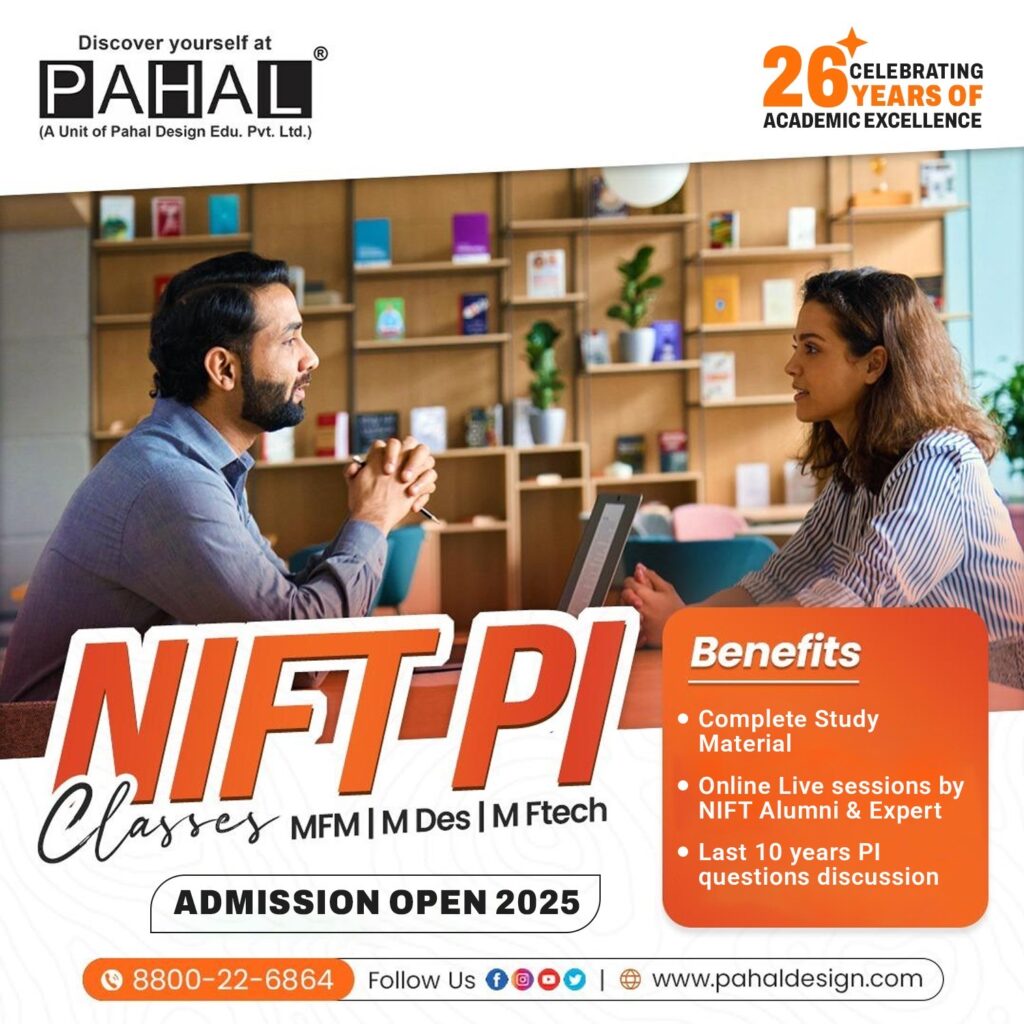
Shortlisted candidates for Masters Programmes after the written entrance examination are required to undergo a Personal Interview (PI).
Candidates shall be evaluated on the various parameters as listed below by a panel, in the Personal Interview:

1) Career orientation
2) Aptness for the course
3) Overall personal achievements in academics and co-curricular activities
4) Communication
5) General awareness, aptitude, creative and lateral thinking

NIFT MFM

The Marketing & Retailing specialization covers the subjects like customer experience management and retail operations, Omni channel planning and buying, E commerce, marketing & IMC, and social media marketing. This would lead to careers as Retail buyer, retail planner, store manager, visual merchandiser, retail trainer, mall manager, retail consultant, brand executive, social media analyst, social media marketer, content marketing, event manager, E-commerce merchandiser, marketing and sales professional, luxury store manager.
The MFM department’s International business specialization covers the subjects like global fashion business, export merchandising and EXIM documentation, global marketing and costing and profitability. This would lead to careers as export merchandiser, buying house merchandiser, sourcing manager, logistics manager, global business development manager, sampling merchandisers, compliance officer, vendor management executive.

Entrepreneurship specialization covers the subjects like Entrepreneurship business models and success stories, business idea generation and feasibility testing with live projects, family business management, business plan, laws and integrated project. This would lead to careers as entrepreneur, social entrepreneur, NGOs, academician, cluster manager/ marketer, Consultant for rural marketers.

NIFT PI Questions:

1. Tell me something about yourself?
2. Why do you want to join NIFT?
3. Do you know about MFM /M.Des curriculum ?
4. If you get NIFT Shillong will you join?
5. Why are you not interested in pursuing masters in the same stream (graduation)?
6. What brand clothes you are wearing right now? Tell something about it?
7. Name Five Shirt brands?
8. Where do you see yourself five years down the line?
9. Tell me something about your family?
10. About Home Town?
11. Who is Ram Vilas Paswan? I Shatrughan Sinha is a member of which political party ?
12. Do you think the smartphone’s camera is responsible for diminishing the usage of DSLRs?
13. Compare twitter and Instagram as social mediums?
14. Why are you interested in M.des?
15. Why MFM why not M.des?
16. Name five ethnic brands of India
17. Introduce yourself?
18. How your field related to design?
19. Questions related to graduation subjects


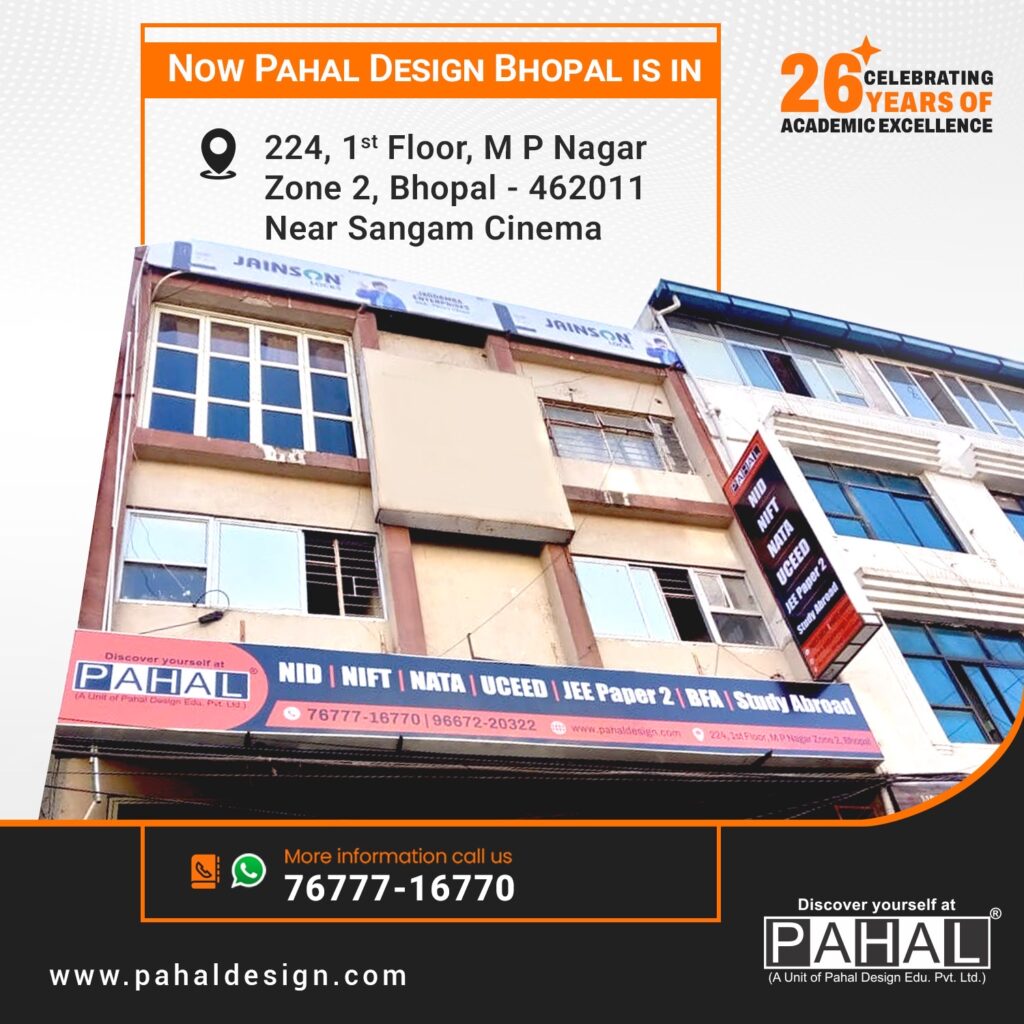
Pahal Design Hauz Khas is now at better location with great infrastructure. The new address for Centre is G-13, G Block Hauz Khas, New Delhi-110016 at Ground Floor. 

Pahal Design Hauz Khas centre is just 5 minutes away from Hauz Khas Metro Station. Hauz Khas centre is 500m from NIFT, Delhi Campus. Pahal Design offering coaching classes for NIFT Undergraduate and Post Graduate Coaching Classes.

NIFT Undergraduate Courses for Coaching Classes:

  1. B Design
  2. B Ftech
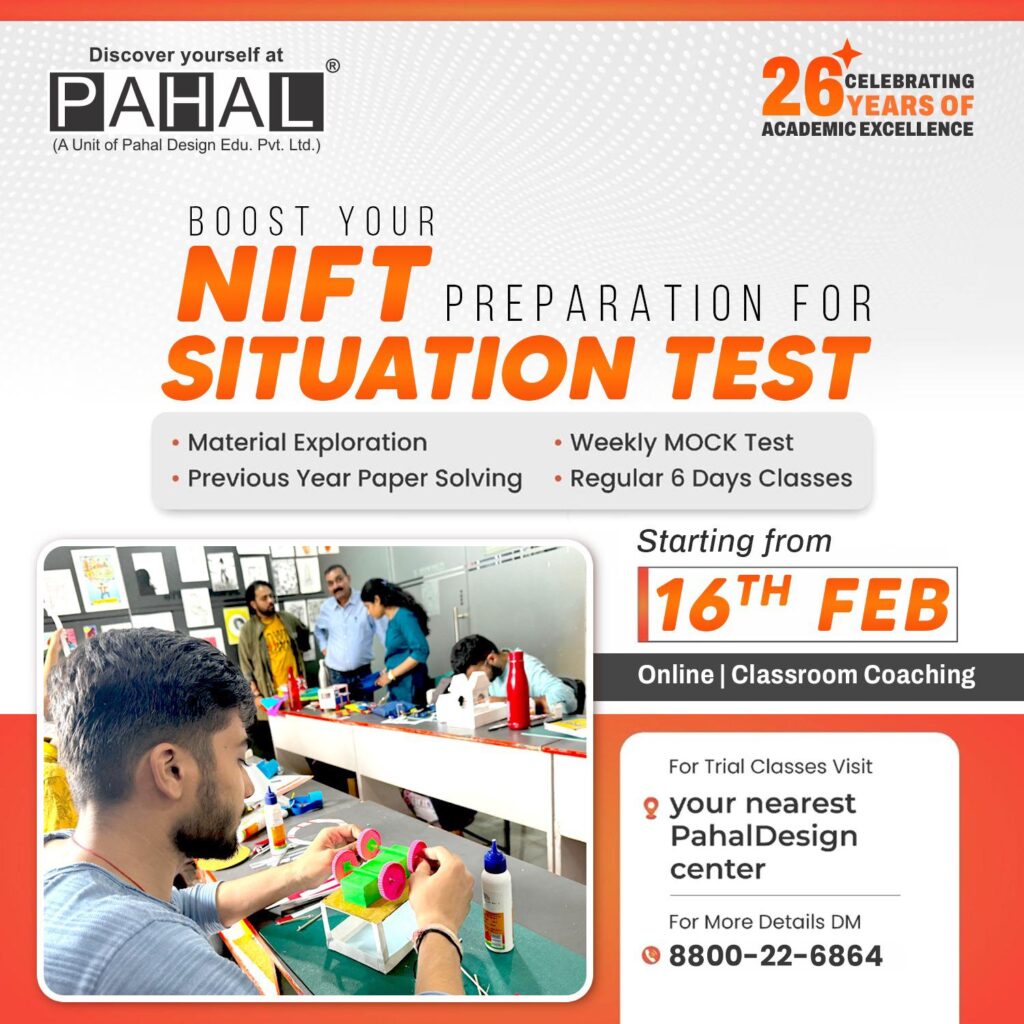
  3. NIFT Situation test

NIFT Postgraduate Courses for Coaching Classes:

  1. MFM
  2. M Des
  3. M Ftech
  4. Personal Interview

If you are looking for any Further guidance you can reach us at 8800-22-6864. 

G-13, Ground Floor, Hauz Khas, G Block New Delhi – 16


NIFT Admissions 2024

Frequently Asked Questions

  1. Is NIFT Degree recognized?

Yes. NIFT has been granted statutory status under the Act of Parliament of India in 2006, empowering the Institute to award degrees and other academic distinctions. NIFT is also a member of the Association of Indian Universities (AIU).

2. What is the Admission Schedule?

The admissions schedule for Admissions- 2024 is available on NIFT website/ Portal. www.nift.ac.in `

3. When are NIFT Admissions announced?

Admission to various programmes of NIFT is announced in the month of November / December every year. The admission announcements are widely publicized through National, regional print media, social media platforms and NIFT web site www.nift.ac.in

Q.4. What are the programmes offered by NIFT?

The programmes to be offered by NIFT are as given below :

  1. Bachelor of Fashion Design

     2. Bachelor of Fashion Technology

  1. Masters of Design (M.Des.)
  2. Masters of Fashion Management (M.F.M)
  3. Masters of Fashion Technology (M.F.Tech.)
  4. Ph.D

Q 5. What is the Minimum Age required for Undergraduate & Post Graduate course

Maximum age of the applicant should be less than 24 years as on 1st August of the year of admission for Undergraduate Programmes. The upper age limit may be relaxed by a period of 5 years for candidates of SC/ST/PWD categories.

There is no age limit for Postgraduate programmes.

Q.6  What are the Eligibility criteria for admission?

Kindly refer Prospectus (available on NIFT website ( www.nift.ac.in ) for Programme wise eligibility criteria.

Q.7  How can I get a prospectus?

The prospectus is available on NIFT website under the Admissions Tab ( www.nift.ac.in ).

Q.8 Can I apply manually?

No, candidates can only apply online through admission portal available on NIFT Website ( www.nift.ac.in ).Q.8  How do I pay the fees? What is the mode of payment when applying online?

Payments of application fees can only be paid online through payment gateway. The link is provided on the admission portal.

Q.9  What is an auto generated Application Number?

Once the application form is filled by an applicant, an application number will be generated ,which will be communicated to the candidate.

Q.10 WhatifIforgettotakeprintoutofOnlineApplicationformaftersubmission?

Candidate can take the print out of their Application form again after logging into the admission portal.

Q.11 Howmanycoursescanbeselected?

For undergraduate programme, the applicant is able to enroll for all B Des and B F Tech Programmes.

Candidates applying for B.F.Tech Programme (with Physics and Maths), will be eligible to enroll their candidature for B.Des courses.

The Candidates appearing for Post Graduate Programme can only apply for ONE post graduate programme.

Q. 12 How would I verify my payment?

Once the application form along with the requisite fees is submitted by the candidate, the confirmation of the same will be sent to the candidates directly through registered E mail.

Q. 13 Do you have the reservation of Seats for SC/ST?

Yes, it is as applicable as per the Government of India norms. Details can be seen in the Prospectus.

The National Institute Fashion Technology (NIFT) has been fulfilling its mission to offer a learning experience of the highest standards in fashion pertaining to design, technology and management, for the last more than three decades. We encourage remarkably creative students to draw inspiration from India’s textiles and crafts, while focusing on emerging global trends relevant to the fashion, textiles and accessories industries.


The National Institute of Fashion technology (NIFT) has announced the results of the NIFT 2023. To check your results, log into the result portal using your email id and password.

The final results for B.Des and M.Des courses will be prepared by giving weightage to CAT, GAT, and Situation Test/ Personal Interview. Meanwhile, the final results for the M.F.Tech and M.F.M courses will be prepared by giving weightage GAT and Personal Interviews. 

Interestingly, the final results for the B.F.Tech program will be prepared solely based on GAT Scores.

For any further details connect at 8800-22-6864

IMPORTANT INSTRUCTIONS FOR CANDIDATES

1. This Admit Card is provisional & subject to changes/modifications. Candidates are advised to follow the NIFT website,
notifications, information bulletin & check their mailbox on the registered E-mail address and SMS in their registered Mobile
No. for any latest updates and information.

2. Candidates are suggested to visit the examination venue, a day in advance, so that they can reach the venue on time on the day of the examination.

3. Candidates are required to present the following documents to the examination officials, for identity verification:
A. Admit Card downloaded from the NIFT website (a clear preferably colour printout on A4 size paper)
B. Any one of these original and valid Photo Identification Proof issued by the government — Passport/Aadhaar Card
(With photograph)/E- Aadhaar/Voter Card / Driving License.
Note: No Candidate would be allowed to enter the Examination Centre, without valid identity proof & verification.

4. Candidates are requested to carry their own Pen/ Pencil / Erasers /Ruler (In a transparent pouch). Candidates appearing for
CAT also need to carry their Colouring & Drawing material. For CAT a physical Question Booklet with space for responses
will be provided at the Centre. Candidates are NOT allowed to carry any personal belongings [except those listed above]
including electronic devices, mobile phone and other banned materials listed in the Information Bulletin/ NIFT Website / NIFT
Notice, to the Examination Centre. Examination Officials will not be responsible for safe keep of personal belongings and
can also debar the candidate for carrying any banned items.

5. Candidates should reach the Venue well before the reporting time given in the Admit Card. No candidate will be allowed
inside if he/she does not adhere to the reporting time.

6. Candidates are to sit at the designated seat allocated by the Centre Head. They can login using the credentials given on
their Admit Card and read instructions, before the commencement of the examination. In case of any issues they can report
the same immediately to the Invigilator. Candidate will be able to start ONLY after the Examination is started as per schedule
by the Centre Head. An announcement will also be made to that effect once the test is started.

7. Candidates will NOT be permitted to leave the Examination Room/Hall before the end of the examination. After the
completion of the examination, candidates should hand over their Question Booklet, Answer Sheets & Rough sheet to the
invigilator on duty (CAT Only).

8. An electronic attendance will be taken by the invigilator by scanning the QR Code of the Admit card carried by the candidate.

9. No Candidate should adopt any unfair-means, or indulge in any unfair examination practices. Speaking to others / Over
seeing another person’s responses / screen, trying to open other applications on the PC, carrying any form of electronic
device / peripheral / accessory, not obeying the instructions of the Centre Head / Invigilator are all fit ground for cancellation
of your examination.

10. Appearing for both GAT and CAT is mandatory. If a candidate does not appear for one or the other he/she will not be
shortlisted for the Situation Test/ PI (Personal Interview).

11. General Ability Test (GAT) is a Computer Based Test & Creative Ability Test (CAT) is a Paper Based Test.

For any further details connect us at 880022-6864.


Here is a list of questions that have been asked and you should prepare:

1.Why MFM or Masters of Fashion Management ?
2.Why National Institute of Fashion Technology or NIFT?
3.Questions from Graduation?
4.Where do you see yourself in a few years from now.
5.Define Fashion ?
6.How would you contribute to the fashion industry after MFM from NIFT?
7.Basic Fashion Terminology like haute couture etc.
8.Knowledge about some apparel/textile specialty of the state you belong
9.Would you join Masters of Fashion Management (MFM)if you don’t get a center of your choice?
10.Current textile minister
11.Textile/Retail terminology
12.Knowledge about the brand of clothing you are wearing to the interview
13.Retail and Textile brands. Who owns what?
14.Fashion GK/Fashion current Affairs is a must.
15.Also,brush up your static GK and General current affairs.
16.Questions from Work Experience if any.

Set up in 1986, NIFT is the pioneering institute of fashion education in the country and has been in the vanguard of providing professional human resource to the textile and apparel industry. It was made a statutory institute in 2006 by an Act of the Indian Parliament with the President of India as ‘Visitor’ and has full-fledged campuses all across the country. Over the years NIFT has also been working as a knowledge service provider to the Union and State governments in the area of design development and positioning of handlooms and handicrafts.

List of UG Programs

  • Fashion Design
  • Leather Design
  • Accessory Design
  • Textile Design
  • Knitwear Design
  • Fashion Communication
  • Apparel Production

List of PG Programs

  • Master of Design
  • Master of Fashion Management
  • Master of Fashion Technology

The National Institute of Fashion Technology (NIFT) has outlined the following key dates for the 2025 admission cycle:

  1. Online Registration Start Date: November 22, 2024
  2. Last Date for Online Application Submission: January 6, 2025
  3. Entrance Examination Date: February 9, 2025
  4. Result Declaration for B.Des and B.F.Tech: March 2025
  5. Situation Test and Personal Interviews: April 2025
  6. Final Result Announcement for M.Des, M.F.M., and M.F.Tech: May 2025
  7. Online Registration for Counselling (Round 1): May-June 2025
  8. Counselling Dates: June-July 2025

The NIFT entrance exam consists of multiple stages, depending on the program applied for. The exam structure generally includes the following:

1. Written Exam (GAT & CAT)

Applicable for: B.Des, M.Des, B.F.Tech, M.F.Tech, MFM

General Ability Test (GAT)

B.Des & M.Des:

  1. •Quantitative Ability
  2. •Communication Ability & English Comprehension
  3. •Analytical & Logical Ability
  4. •General Knowledge & Current Affairs

For B.F.Tech, M.F.Tech & MFM:

•All of the above plus Case Study (business domain-related scenarios)

Duration:

B.Des & M.Des: 2 hours

B.F.Tech, M.F.Tech, MFM: 3 hours

Creative Ability Test (CAT) (For B.Des & M.Des only)

•Evaluates creativity, illustration skills, and design thinking

•Duration: 3 hours

2. Situation Test / Studio Test & Personal Interview

For B.Des:

Situation Test (Practical test to assess material handling and innovative thinking)

For M.Des, M.F.Tech, MFM:

Studio Test (For M.Des)

Personal Interview (For all PG courses)

3. Final Selection

•Based on a combination of scores from GAT, CAT, Situation Test/Studio Test, and Personal Interview (depending on the course).

NIFT SEAT MATRIX 2025

NIFT EXAM PAPERS 

NOIDA

Address:- C-29, Ground Floor, Sector 2, Noida
(Nearby Metro – Noida Sector 15 Metro Station ), UP – 201301
Contact No: 93540-52529
Email: corporate@pahaldesign.com


Who is this for?

Many students those are not able to attend our classroom coaching classes of NIFT B.Des | M.Des | MFM | M.Ftech | B.Ftech so for them we have designed a comprehensive study material as per the requirement of entrance exams. The techniques which we have discussed in study material is easiest method to understand complex sketches.

How this helps?

In order to narrow down the ideal exam strategy a team of experts will be there to guide you through out your journey with Pahal Design. The platform is interlinked with our academic team and you are just a click away. In case of any Doubt in any section you are allowed to book a slot and share your queries.

We update our study material to reflect the changing demands of the latest editions of the NIFT as per new exam pattern. An outdated material presents several problems. Our practice materials are structured in a step-by-step manner. So, we worry about the relevance and position of each question that goes into our books. 

NIFT, one of the top competitive exams, is conducted every year in the month of February. In order to get a good score and marks, you need to plan your NIFT preparation in an effective and time-efficient manner. With innumerable books and study material available for NIFT, it is difficult to choose the right resources. Here, we present you with the best study material curated by our expert faculty. Additionally, you should take regular mock tests to assess your level of preparation. In our course packages, you will be able to access online classroom and live lectures at your convenience.

NIFT (B.Des)

5,000.00 4,000.00

Total Booklets

  1.  Quantitative Ability – 7 Booklets
  2.  Verbal & Analytical Ability – 4 Booklets
  3.  Communication Ability & English Comprehension – 2 Booklets
  4. General Knowledge and Current Affairs – Monthly
  5. Creative Booklet – 5 ( 3 booklets Hard Copy and 2 Booklets on LMS )
  6. Online Portal Access – 24 x 7 
  7. NIFT B.Des Previous Year Question Papers – The last 5 years original exam papers will be available over LMS.
  8. NIFT Guide book for Design
  9. Mock Tests as per new Exam Pattern – 5
  10. Monthly Tests 

NIFT (M.Des)

5,000.00 4,000.00

Total Booklets

  1.  Quantitative Ability – 7 Booklets
  2.  Verbal & Analytical Ability – 4 Booklets
  3.  Communication Ability & English Comprehension – 2 Booklets
  4.  General Knowledge and Current Affairs – Monthly
  5.  Creative Booklet – 3 ( 2 booklets Hard Copy and 1 Booklets on LMS )
  6.  Online Portal Access – 24 x 7 
  7.  NIFT M.Des Previous Year Question Papers – The last 5 years original exam papers will be available over LMS.
  8.  NIFT Guide book for Design
  9.  Mock Tests as per new Exam Pattern – 5
  10.  Monthly Tests 

NIFT (MFM)

4,000.00 3,000.00

Total Booklets

  1.  Quantitative Ability – 7 Booklets
  2.  Verbal & Analytical Ability – 4 Booklets
  3.  Communication Ability & English Comprehension – 2 Booklets
  4. General Knowledge and Current Affairs – Monthly
  5. Case Study – 1
  6. Online Portal Access – 24 x 7 
  7. NIFT B.Des Previous Year Question Papers – The last 5 years original exam papers will be available over LMS.
  8. NIFT Guide book for Design
  9. Mock Tests as per new Exam Pattern – 5
  10. Monthly Tests 


Key Features of DLP by Pahal Design

  1. Study Material as per new exam pattern
  2. Detailed analysis
  3. Prepared by Expert faculties
  4. Easy to understand
  5. Time savvy
  6. Interactive student LMS
  7. Online Doubt clearance sessions
  8. Learn at your own pace
  9. Mock Test Series
  10. Video Tutorials

Online Counselling Request

Set up in 1986, NIFT is the pioneering institute of fashion education in the country and has been in the vanguard of providing professional human resource to the textile and apparel industry. It was made a statutory institute in 2006 by an Act of the Indian Parliament with the President of India as ‘Visitor’ and has full-fledged campuses all across the country. Over the years NIFT has also been working as a knowledge service provider to the Union and State governments in the area of design development and positioning of handlooms and handicrafts.

Curriculum

Programme Structure

NIFT has adopted a format of Majors, Deepening Specialisations, Minors and General Electives. Inter disciplinary Minors provide individuated pathways that would permit students to acquire interdisciplinary skillsets and opt for a set of subjects that complement studies in one’s major or explore an unrelated area of intellectual interest. General Electives have been offered to the students to help them enhance their personality and develop interests in specific areas like Personality Development, Communication Skills, Critical Thinking Skills, Professional Ethics etc. The Craft Cluster Initiative has been integrated into the curriculum. Increased Industry interaction for students through classroom projects, internships and part transaction in Industry Environment is the focus of the restructured curriculum.

The contact hours have been recalibrated to 25 hours per week, giving increased time for studio practice and self–study to the students. Standardisation of credits across all programmes and all semesters has been undertaken.

New and emerging areas across disciplines integrated into the curriculum:

    1. a) Artificial Intelligence
    1. d) Advanced Apparel Manufacturing Management
      b) Internet of Things

      c) Designing Ergonomic Environment
    1. e) Big Data and Business Analytics
    1. f) Fashion Thinking
    1. g) User Experience, Sensory Design
    1. h) Augmented Reality, Virtual Experience design
    1. i) Head Gear Design
    1. j) CAD 3D & Contemporary Manufacturing
    1. k) Couture Jewellery
    1. l) Travel & Outdoor Gear Design
    1. m) Design for Society
    1. n) Smart Jewellery
    1. o) Smart Textiles
    1. p) Active Sportswear, Bespoke Menswear, Wearable Technology
    1. q) Shapewear & Seamless Garments on Computerized Knitting
    1. r) Optitex for Virtual Prototyping
    1. s) Surface Embellishment: Digital Embroidery, Laser, 3D Printing
    1. t) Design Strategy

NIFT PARTNERSHIP AND ASSOCIATION

NIFT – Fashion Institute of Technology (FIT), New York, USA strategic partnership provides a unique opportunity to select meritorious NIFT students to obtain Dual Degree from both NIFT and FIT. Students from NIFT undertake two years study at the home Institute intercepted by one year of study at FIT. Thereafter, the students resume their studies at NIFT to obtain the Dual Degree from both the institutes.

Some of the key institutes with whom NIFT has an association are Queensland University of Technology, Australia; De Montfort University, UK; Glasgow School of Arts, UK; Swiss Textile College, Switzerland; ENSAIT, France; NABA, Italy; ESMOD, Germany; Saxion University of Applied Sciences, Netherlands; Amsterdam Fashion Institute, Netherlands; Bunka Gauken University, Japan; University of Northampton, UK; Politechnico di Milano, Italy; KEA – Copenhagen School of Design and Technology, Denmark; North Carolina State University, USA; The Savannah College of Art and Design (SCAD), USA and many more. NIFT is also a member of the prestigious International Foundation for Fashion Technology Institutes (IFFTI) and Cumulus, an international body representing design institutes of the world.

AHMEDABAD (Drive-in-Road)
Address:- 9, 1st Floor, Sunrise Centre-II, Sunrise Park, Bodakdev,
Ahmedabad, Gujarat-380015
Landmark: Off Drive-in-Road
Contact No: 78029-49620, 079-40398630
Contact Person: Ms Manisha Malkani
Email: ahmedabad@pahaldesign.com

The Indian technical textiles sector has immense potential to grow both domestically as well as globally. Backed by government initiatives and support, India can emerge as a global manufacturing hub for technical textiles in the future. 

It is a massive market that remains overshadowed by its conventional cousin. And, all discussion about its scope remains confined mostly to stakeholders. But almost unnoticed-certainly by those not conversant with the sector—technical textiles have already emerged from the shadow of the overall textiles industry and is now reckoned to be an entity of its own. Plus, it is big.

The global technical textiles market was valued at $157.68 billion in 2016 and is projected to reach $220.37 billion by 2022 at a CAGR of 5.89 per cent from 2017, according to a recent report by Markets and Markets. The major factors driving this market are growing demand and government initiatives in promoting this sector. The increasing use of technical textiles in end-use industries such as automobiles, construction, healthcare and geotextiles too are driving the market. The technical textiles used in these industries is being attributed to the unique function properties—hygiene and safety, cost-effectiveness, durability, strength, versatility, user-friendliness, lightweight and logistical convenience.

Back home, the growth drivers of the Indian technical textiles markets include:
 Growing industrialisation,
 Changing lifestyles,
 Improvement in safety and hygiene,
 Increase in technology, and
 Awareness of protective wear.

The Indian market


The Indian technical textiles sector is growing along with that of the end-user industries. The sectorcontributes around 12 per cent to the overall Indian textiles market. The major factor contributing to the growth of Indian technical textiles are infrastructure and industrial development in the country.
Government initiatives too are attracting investments. The government has put in place the following policies to develop a comprehensive manufacturing base for high-value technical textiles in India.
 Export Promotion of Capital Goods (EPCG),
 Amended Technological Upgradation Fund Scheme (ATUFS),
 Schemes for agro-textile usage in the Northeast region,
 Scheme for the usage of geotechnical textiles in the Northeast,
Benefits under Special Economic Zone (SEZ) and Schemes for Integrated Textile Parks (SITP).
Domestic consumption has increased by 6.8 per cent in recent years. To make the Indian technical textiles industry competitive globally, a dual policy needs to be adopted for exports as well as domestic markets. The industry is expected to expand at CAGR of 13.11 per cent during 2018–23 to $32 billion.


Exports and imports


India is a net exporter of technical textile products, with exports touching $1,849.8 million in 2017–18. Exports will grow at a CAGR of 3.3 per cent in the five years. After two consecutive years of decline, exports recovered remarkably in 2017–18 to register a significant y-o-y growth of 18.4 per cent, increasing from $1,562.5 million in the previous year to $1,849.8 million in 2017–18.
The US was the leading destination with exports estimated at $336.8 million in 2017-18. The value of US exports recorded a healthy CAGR of 10.6 per cent in the period between 2013–14 and 2017–18. The US share in Indian exports of technical textiles increased from 13.9 per cent to 18.2 per cent in the period.
Imports of technical textile products ($1,744.8 million) increased substantially in 2017–18 at a growth rate of 21.7 per cent. Imports recorded a CAGR of 8.1 per cent between 2013–14 and 2017–18.
The largest import source of technical textile products was China, accounting for more than 50 per centshare in both 2013–14 and 2017–18. The value of imports from China recorded a CAGR of 8.2 per cent in those four years. Other major import sources in 2017–18 included Thailand, Taiwan, the US, Bangladesh, Germany, South Korea, Malaysia, Hong Kong and Nepal.

Growth as global manufacturer

India should grow as a global technical textiles manufacturing hub with the following advantages:
 Extensive availability of textile raw material;
 Technical textiles being a labour-intensive industry, the presence of a large pool of labour at a comparatively low cost can provide a competitive edge over technical textile producing countries like China, the US, and those in Europe;
 Power costs are lower than other countries, and lending rates are higher than in China and Vietnam; with government schemes, the effective cost of capital becomes comparable;
 India’s infrastructure for technical textiles is developing with investment in R&D, testing and investor facilitation from the Centre of Excellence.
Even though the global industry is dominated by European countries and China, there is potential in India to emerge as a global manufacturing hub for technical textiles in the future.
Steps needed to grow further
Indian government schemes for textiles and apparel manufacturers have been targeting technology up-gradation, infrastructure development, export promotion and many more segments. State governments should also announce their own policies for attracting investors to their respective states.
However, India is yet to exploit its potential in technical textiles sector due to reasons such as the absence of regulatory measures for technical textile usage in various industries. Moreover, the country is still dependent on imports for technology and advanced machinery and India has limited production of high-end products and specialized yarns and intricate duty structure.
To facilitate the growth of the Indian technical textiles industry, several measures need attention. Some of them are:
 Establishing regulatory norms to increase the consumption of technical textile goods;
 Developing exclusive HSN codes to identify high growth products for further development;
 Establishing and implementing Indian standards to develop high-quality products for global acceptance;
 Better operational standards;
 Focus on training, education and creating end-user awareness to boost domestic demand for high-end technical textile products.
Besides this, India should also focus on forming partnerships with other global payers for acquiring technical know-how. This will help the country to attract large-scale investments.

Are you ready for personal interview of NIFT MFM/MDes/M.FTech Like last year,NIFT has announced to conduct Personal Interview only for MFM/MDes/MFtech program due to Pandemic . Now let’s understand what is PI round for NIFT Master program. It is all about judging candidate’s over all personality, Knowledge about Industry and his keen interest in respective course for which She/He has been shortlisted. To understand and get an idea about PI ,Join Mock PI session with PAHAL DESIGN in order to robust your preparation for NIFT PI round. Book your slot -> Also Call 📞880022-6864

NIFT Personal Interview Questions 2020

1. Why you want to do MDES/MFM/MFTECH from NIFT?

2. Why didn’t you choose MBA over MFM?

3. Please Introduce yourself?

4. From where you did your graduation ?

5.How will your graduation help in your master’s

6.What is your understanding about Vendor Management ?

7. What is principle of management?

8. What is famous textile of your state?

9. How will you contribute to NIFT?

10. What type of company you want to get into?

Schedule a free counselling session WhatsApp WhatsApp