About NATA 2021

National Aptitude Test in Architecture (NATA) is being conducted by COA since 2006, in terms of the provisions

of CoA (Minimum Standards of Architectural Education) Regulations, 1983, published in the Gazette of India.

Further, the Council has prescribed the Council of Architecture (Minimum Standards of Architectural Education) Regulations, 2020, with the approval of the Central Government in terms of Sections 21 & 45 of the Architects Act, 1972. The Regulations were published in the Gazette of India on 11.08.2020 and came into force w.e.f. 01.11.2020. These Regulations prescribe that the candidate needs to qualify an Aptitude Test in Architecture conducted by the Council for admission to the Architecture degree course.

The actual admissions shall be carried out only by the concerned competent authorities of the respective states/institutions based on valid NATA score. The NATA ensures that the eligibility criteria for admission to five-year Bachelor of Architecture (B.Arch.) degree course, as prescribed by CoA and duly approved by the Central Government, are strictly adhered to and followed all over the country in Architectural Institutions.

NATA 2021 will be conducted as a comprehensive online aptitude test at the Council allotted centers in identified cities in the country.

Unlike any other entrance examination, NATA is an Aptitude test that assesses a candidate’s innate ability through a variety of testing formats and cannot be taught, learnt or induced. Therefore, attending coaching classes will not substantially improve the aptitude of a candidate.

NATA measures the aptitude of the applicant for specific field of study, i.e. Architecture, through assessment of cognitive skills, visual perception and aesthetic sensitivity tests, logical reasoning and critical thinking ability, etc., besides the learning that the candidate has acquired over the past few years and is related to the specific field of study.
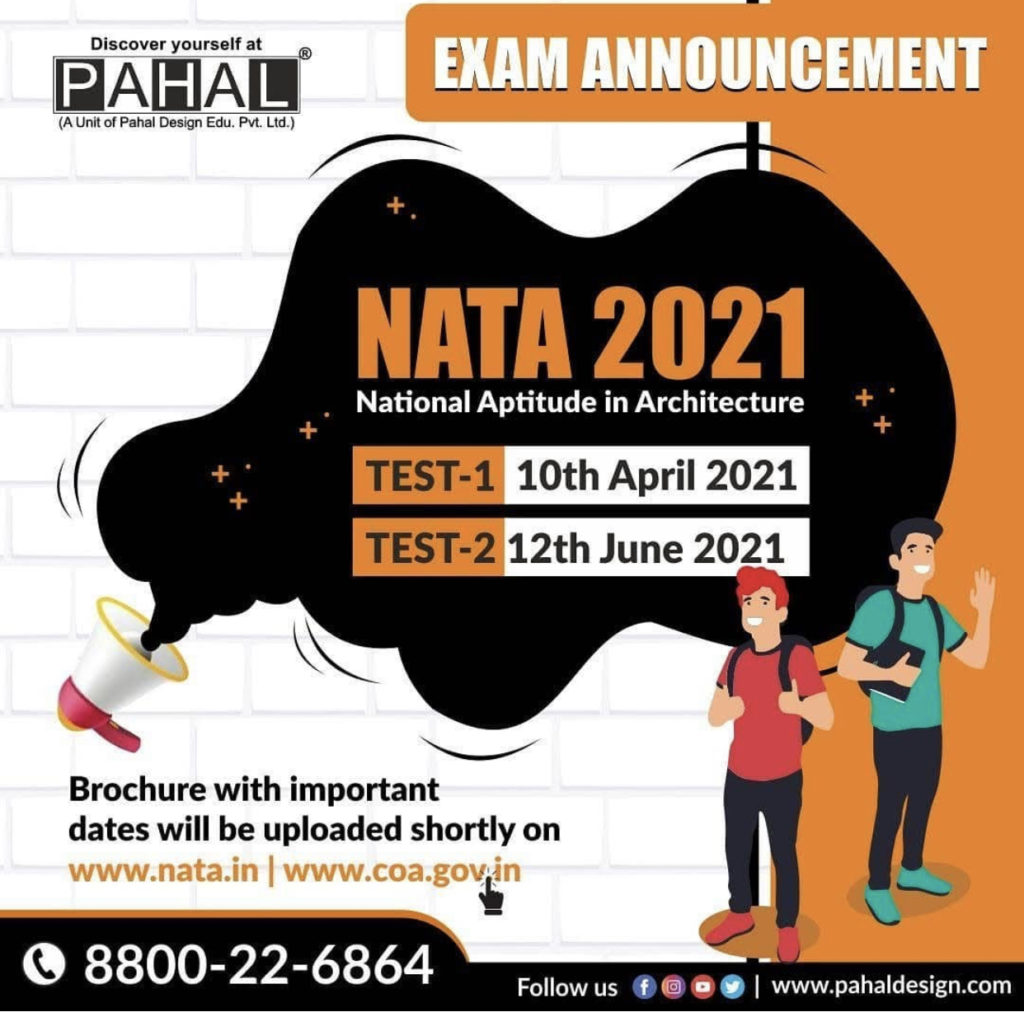
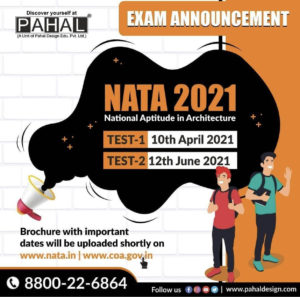
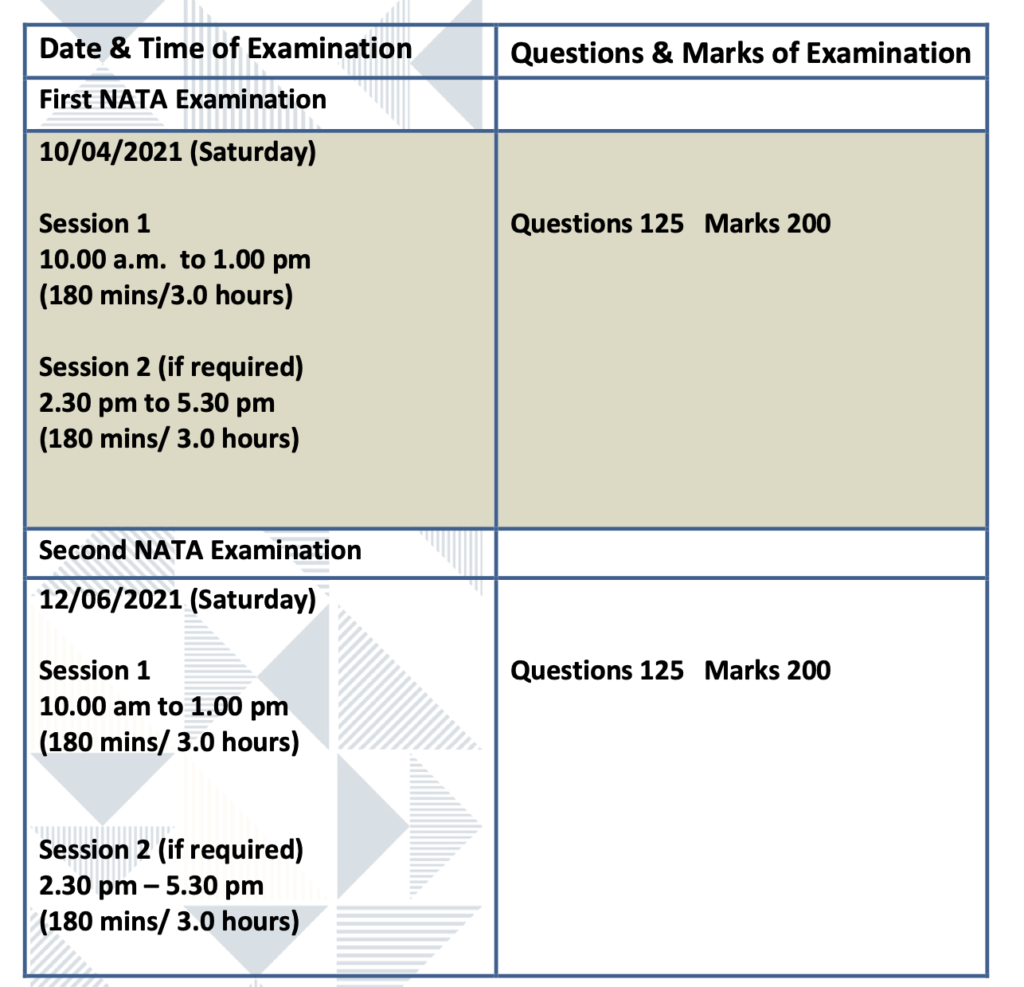
With the objective of giving opportunities to a greater number of bright aspirants, Council will be conducting NATA- 2021 for admission to B.Arch. in the academic session 2021- 2022 twice this year. Candidates who miss out the first test due to some reason or other or wish to improve upon their NATA score can register for the second test. Both the first and second test will be conducted on different dates as computer-based examinations and a candidate shall be allowed to appear for NATA 2021 for a maximum of two times.

Outline of Aptitude Test

The aptitude test will comprise of questions that could be of the Multiple-Choice type (MCQ), Multiple Select type (MSQ), Preferential Choice type (PCQ) and Numerical Answer type (NAQ).

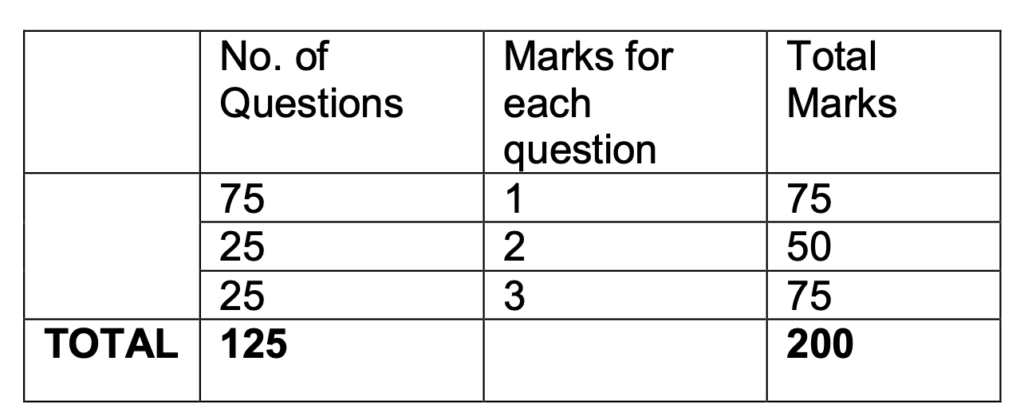
The questions will carry either 1 mark,2 marks or 3 marks and 125 questions have to be answered in 180 minutes.
The medium of Aptitude test will be the English language.

The aptitude of the candidate will be assessed using some or all of the following techniques:

  • Diagrammatic Reasoning – Tests the ability of logical reasoning, using diagrams and scenarios
  • Numerical Reasoning – Tests mathematical ability through simple problems
  • Verbal Reasoning – Assesses the ability to assess verbal logic.
  • Inductive Reasoning – Tests the ability to see patterns and analyse given data
  • Situational Judgment – Tests problem-solving ability.
  • Logical Reasoning – Tests ability to recognise patterns, sequences or relationships between shapes andimagery.
  • Abstract Reasoning – Will assess general knowledge, and ability to utilise knowledge in new situations.Questions could be asked in various topics that assess candidates on basic concepts in mathematics, physics and geometry, language and interpretation, elements and principles of design, aesthetic sensitivity, colour theory, lateral thinking and logical reasoning, visual perception and cognition, graphics and imagery, building anatomy and architectural vocabulary, basic techniques of building construction and knowledge of material, general knowledge and current affairs, etc. and are may not be limited to those outlined.
  1. Candidates who have completed their 10 + 2 examination with Physics, Chemistry and Mathematics or 10+ 3 Diploma with Mathematics as subject of study can appear for NATA 2021. Candidates appearing for 10+2 examination with Physics, Chemistry and Mathematics as subjects of study or 10+3 Diploma with Mathematics in the current year may also provisionally appear for NATA-2021.

“No candidate shall be admitted to architecture course unless she/ he has passed an examination at the end of the 10+2 scheme of examination with Physics, Chemistry & Mathematics subjects or passed 10+3 Diploma Examination with Mathematics as compulsory subject.”


Outline of Aptitude Test

The aptitude test will comprise of questions that could be of the Multiple-Choice type (MCQ), Multiple Select type (MSQ), Preferential Choice type (PCQ) and Numerical Answer type (NAQ).

The questions will carry either 1 mark,2 marks or 3 marks and 125 questions have to be answered in 180 minutes.
The medium of Aptitude test will be the English language.

The aptitude of the candidate will be assessed using some or all of the following techniques:

  • Diagrammatic Reasoning – Tests the ability of logical reasoning, using diagrams and scenarios
  • Numerical Reasoning – Tests mathematical ability through simple problems
  • Verbal Reasoning – Assesses the ability to assess verbal logic.
  • Inductive Reasoning – Tests the ability to see patterns and analyse given data
  • Situational Judgment – Tests problem-solving ability.
  • Logical Reasoning – Tests ability to recognise patterns, sequences or relationships between shapes and

    imagery.

  • Abstract Reasoning – Will assess general knowledge, and ability to utilise knowledge in new situations.

    Questions could be asked in various topics that assess candidates on basic concepts in mathematics, physics and geometry, language and interpretation, elements and principles of design, aesthetic sensitivity, colour theory, lateral thinking and logical reasoning, visual perception and cognition, graphics and imagery, building anatomy and architectural vocabulary, basic techniques of building construction and knowledge of material, general knowledge and current affairs, etc. and are may not be limited to those outlined.

    Candidates who have completed their 10 + 2 examination with Physics, Chemistry and Mathematics or 10+ 3 Diploma with Mathematics as subject of study can appear for NATA 2021. Candidates appearing for 10+2 examination with Physics, Chemistry and Mathematics as subjects of study or 10+3 Diploma with Mathematics in the current year may also provisionally appear for NATA-2021.

“No candidate shall be admitted to architecture course unless she/ he has passed an examination at the end of the 10+2 scheme of examination with Physics, Chemistry & Mathematics subjects or passed 10+3 Diploma Examination with Mathematics as compulsory subject.”


Dear Parent/Student,

Greetings for the Day!

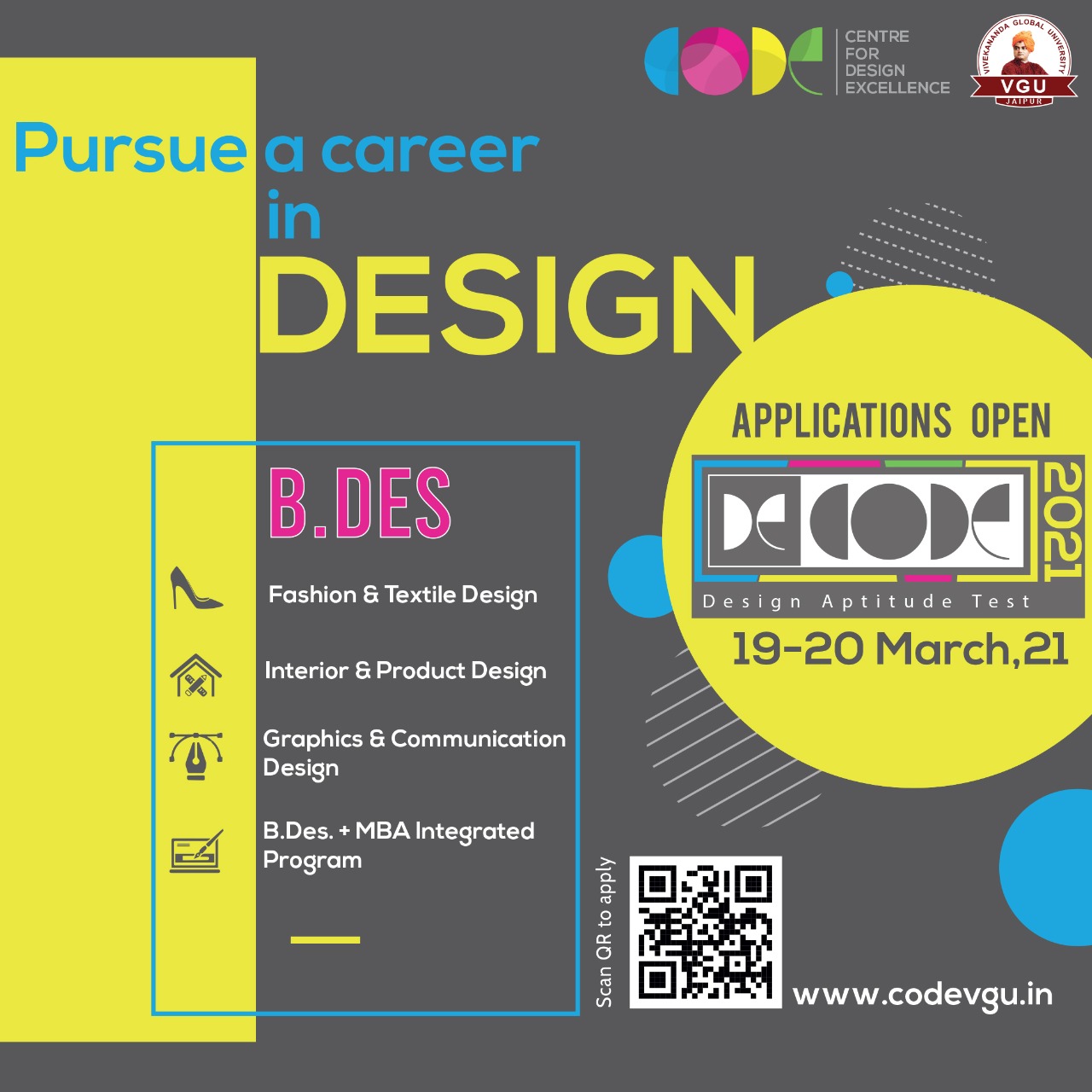
Excellence is a way of life and believing in the true strength of the design profession to create a futuristic India we take the privilege to introduce you to CODE-VGU.

Admissions for the Session 2021 are open now for Undergraduate and Postgraduate Programmes at Centre for Design Excellence (CODE), Vivekananda Global University, Jaipur.

CODE – A Forum for learning and experiencing various domains of Design and Architecture is created by professionals and academicians from all across INDIA. We are a constituent body of Vivekananda Global University (VGU), Jaipur (Established by Rajasthan State Assembly Act 11/2012 and covered under 2(f) of UGC ACT, 1956).
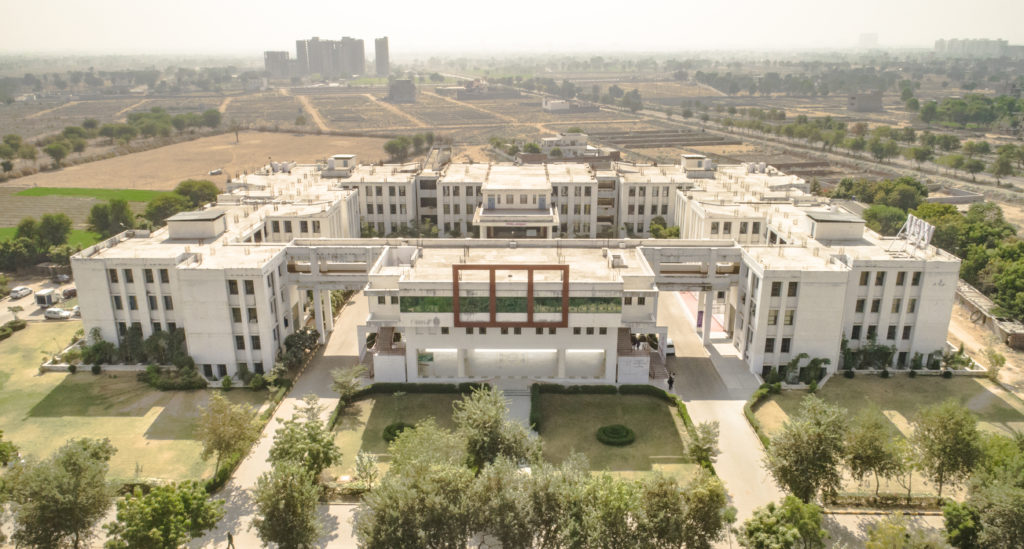
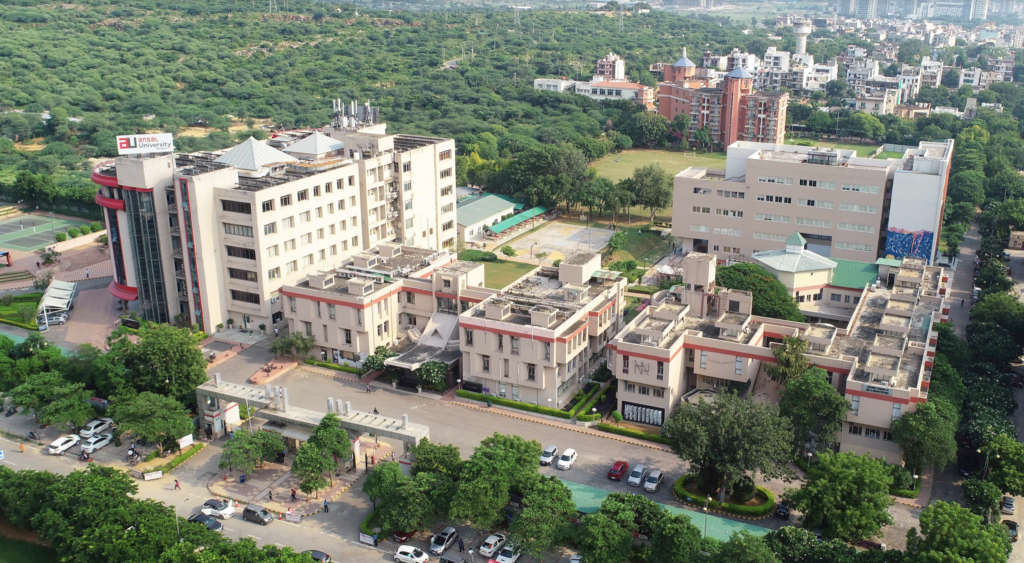
Hosted at VGU campus, recognized as a “Great place to Study in India” by FORBES , CODE boasts of advanced labs and individual mentorship based degree programs.

The Institute offers Under-Graduate and Post-Graduate Programs in:

1. B.Arch. (recognized by COA, India)

2. B.Des. (Recognized by UGC) with specialization in
a. Fashion & Textile Design (FTD)
b. Interior & Product Design (IPD)
c. Graphic & Communication Design (GCD)
d. B.Des + MBA (5yr Integrated Program)

3. M.Des.
a. Sustainable Design
b. UX Design

4. M. Plan
5. PhD

At CODE, we understand that the field of designers cannot be restricted to the 6-8 hours of teaching learning regime. VGU provides a well planned campus along with on-campus fully furnished hostel facility for outstation students.

So, before you say YES to join the fascinating field of design, do visit www.codevgu.in and experience a redefined Design Education.

To know more about CODE-VGU, pls speak to your centre incharge or book a counseling session with academicians from CODE.

Thanking you!

Regards,
Team CODE

Application link:
https://vgu.ctpl.io/?source=PAHAL

Sushant University was established in 2012 under the Haryana Private Universities Act 2006. Located in the heart of Gurgaon, India’s largest hub of National and Fortune 500 companies, it has seven schools offering programmes in Architecture, Planning, Design, Law, Management, Hospitality, Engineering and Health Sciences.

Sushant University was awarded with the National Education Excellence award “Best Private University in Northern India 2017” along with “CSR Excellence in Education”award for 2 consecutive years i.e. 2017 and 2018. Sushant School of Art and Architecture at Sushant University is the flagship school which was started in 1989 and has been consistently ranked No. 1 Private Architecture School in India by the Outlook Magazine.
We are a university with the core ideology of being futuristic and the mission “AHEAD. FOR LIFE”. The curriculum design is guided by inter and trans-disciplinary approach incorporating pedagogies that expand learning opportunities and ensure achieving higher order learning outcomes.

Various schools under the University have carved a niche by offering contemporary programmes with renowned faculty acclaimed nationally and internationally, state-of-the-art infrastructure and facilities to promote academic excellence. The has collaborated with some of the finest Universities and Institutions in USA, Canada, Australia, France and UK like the University of Warwick, Art University of Bournemouth, University of West England, University of Westminster, London, The Barlett School of Architecture, UCL and Vatel International, in the areas of Curriculum Development, Student and Faculty Exchanges, Joint PhD supervisions, joint research conferences, seminars and study semesters abroad.

Established as the flagship higher education institute of the Chiranjiv Charitable trust in 1989, School of Art and Architecture (SAA) has positioned itself as one of the Best Architecture Colleges in India. SSAA has been offering a five-year undergraduate degree in Architecture and varied two-years M.Arch programmes. The school is recognized by the Council of Architecture (COA), All India Council of Technical Education (AICTE) and University Grant Commission (UGC).

Through the alumni and faculty networks, the schools have cultivated associations with several international universities. International relationships ensure that SAA commands its respected status within the global design community. We aspire to be amongst the world’s most advanced architecture and planning institutes known for their stimulating, innovative and outstanding learning environment. Here, best faculty apply innovative pedagogical techniques and encourage young minds to explore the frontiers of research, creating knowledge that will equip them for the challenges of our collective future. Unlike other Architecture Colleges in Delhi, Sushant University offers new programmes to be introduced with the intention of filling gaps that are perceived in the architecture and planning industry:

The school is also running summer / winter school programmes to educate school-goers about architecture and planning. SAA has strong association with institutions such as the American Institute of Indian Studie (AIIS), Indian Institute of Remote Sensing (IIRS), International Council on Monuments and Sites (ICOMOS), Indian Green Building Council (IGBC), Indian National Trust for Art and Cultural Heritage (INTACH) to facilitate exchange of resources and expertise.


The Indian real estate industry in Dec 2020 was estimated to be, rising income levels, urbanization and the rapid growth of the IT sector are the key drivers for the Indian real estate sector. Currently as the economy is facing a slump due to global downturn, the real estate sector is facing difficulties. However, in the next 2-3 years most of the larger players are anticipated to expand aggressively across the country. With this slump considered momentary, Indian real estate industry is likely to witness huge growth again. With increase in growth, demand for allied services like architecture, interior design & landscape architecture is likely to increase.


Architectural Design

Market
• Architecture is a highly competitive and multi-disciplinary profession, involving a variety of tasks.
• As a field, it covers myriad disciplines, including spatial design, aesthetics, project management and material management.
• There are many Institutions in the country offering undergraduate & post graduate courses in Architecture.
• From our survey, out of the total number of designers working in the country, this discipline accounts for the most with 81.25%.
• Majority of the architects belong to the age group of 20-35 & hold B.Arch as their degree of qualification.35
• Mumbai leads in terms of having maximum number of architects followed by Pune and Delhi.
• In terms of placements, maximum numbers of architects are placed in the private sector followed by being self employed & in public sectors.
Current Activities
• In terms of outsourcing, architectural services are gaining traction with scope including design development, detailed architectural plans, construction documentation, as-built drawings, shop drawings, and visualization (3D views & walk-through).
• Architectural outsourcing service in India has the potential to grow to $12 billion in the next four to six years, from its current level of $3.5 billion.36
• Annual requirement projections of architects’ stands over 10,000 which is expected to rise further but the training facilities available are still short.

Interior Design

  1. One key aspect of architecture, which is coming up and expected to play an increasing role in architectural design is environmental friendly buildings and structures. Green buildings will soon be a feature and a part of people lives.
  2. Interior design is a multi-faceted profession wherein creative and technical solutions are applied within a structure to achieve a built interior environment.
  3. Interior decoration and designing in India are getting popular with a lot of people opting for the services of trained interior designers for their houses / offices, etc.
  4. Reason can also be attributed to the changing definitions of homes and modern residential houses, which now symbolize more with the personalities of their owners.
  5. Interior design is also gaining popularity among workplaces and is being considered as a science helping to reduce stress and fatigue thereby increasing productivity.
  6. The services provided by interior decorators and designer cover a wide range of areas and include Interior decoration services, furniture and furnishings, facilities design, mechanical designing, residential interior architecture, etc.
  7. Keeping in mind the demand & separate need from architecture courses, various Institutions like University of Pune and Anna University (Chennai) have announced specialized courses in Interior design as B.Arch (Interior design).

Urban Design and Landscape Design

  1. Landscape architects consider how a place to be used and understand what kind of natural ingredients from grass to stone to falling water will serve best.
  2. The scope of the profession includes site planning, housing estate development, environmental restoration, town or urban planning, urban design, parks, landscape urbanism and recreation planning.
  3. The work also includes conducting Environmental Impact Assessment (EIA) studies for a region (analyzing impact of development on natural resources in a region and taking steps to mitigate damage) and also assessing urban growth, need for open spaces, and developing suitable strategies to enhance the green cover of cities.
  4. The Industry is at a nascent stage in India, but with each year there seem to be new opportunities pouring in.
  5. To become a landscape architect, one needs to do an undergraduate course in architecture, followed by a two-year master’s program in landscape architecture.
  6. Application-oriented knowledge of plant systems and processes, plants and design, landscape engineering, eco-system analysis and field ecology is imperative as is knowledge of design history and culture.
  7. The demand for landscape architects is not just limited to architectural firms. One can find job with builders, government authorities like DDA, NDMC, and CPWD apart from working with architects.

Furniture Design

  1. Furniture designers create the designs that people use as furnishings in residential and commercial properties throughout the world.
  2. Furniture design is a blend of multiple disciplines & is much like fashion design, as the materials, textiles, metals, etc. used to make a piece of furniture can be comparable to materials used to make a piece of clothing. Furniture design also is much like architecture in that the furniture must prove stable and safe.
  3. Furniture designers either work for large manufacturing industries or in batch production companies. Many set up their own design and batch production studios, undertaking custom- designed furniture. Others contribute to interior design teams, working on projects for the service sector, besides corporate organizations.
  4. Furniture design programs teaches an integrated approach to furniture as a part of living, work spaces and habitat and challenges and defines the boundaries of such objects in systems context.
  5. The Furniture design programs provide students an opportunity to challenge and redefine the boundaries of furniture, as much as to develop its traditions. The programs ensure that students are able to perform at all levels of production of furniture in various materials, mass production industries, to the small scale and craft sectors.
Jaipur

Address:- 2nd Floor, F 18, Gautam Marg, Vaishali Nagar, Jaipur, Rajasthan -302021
Contact Person: Mr. Aman and Mr. Akbar
Contact No: 97721-99911, 0141-6656509
Email: jaipur@pahaldesign.com

About Pahal Design Jaipur Rajasthan

Pahal Design’s 40th Centre & 1st branch in Jaipur located at 2nd Floor F-18, Gautam Marg, Vaishali Nagar, Jaipur, Rajasthan 302021, Jaipur. A walking distance from Amrapali Circle, 22 minutes far from main railway station, 28 minutes far from Jaipur International Airport and 30 minutes’ drive from main bus stand. Kiran Jewellers, D- Decor, DAV Centenary Public School and Digambar Jain temple are the nearest landmarks to reach the centre. The centre offers entrance coaching for all the reputed design colleges in India and overseas. The centre is equipped with highly experienced design educationalists, expert faculty and visiting faculties, preparing and counselling design career enthusiasts for B. Des & M. Des entrance tests and professional career counselling for NID, NIFT, NATA, U/CEED, JEE-Arch and Fine Arts. Get ready to leave your footsteps and make your mark in the world of designing, communication and fashion. We are pleased to inform you that with this new year Pahal Design has added another cap in its feather and the inaugural ceremony at Jaipur Centre was successfully organized at 16th January, 2021.


About Jaipur

The capital of Rajasthan, built proudly by Maharaja Sawai Jai Singh II is famous for its majestic forts, opulent Havelis, beautiful lakes, and dunes. Jaipur is part of the famous Golden Triangle Tourist circuit that includes Delhi and Agra. But Jaipur is not only endowed with wonderful tourist attractions but the city also has an excellent infrastructure to support the tourism. Jaipur has some of India’s best hotels, which compliments the scenic and architectural beauty of the Pink City.
The historic walled city of Jaipur, was founded in 1727 A.D. by the Rajput ruler Sawai Jai Singh of Kacchawah dynasty. The city is roughly divided into nine rectangular sectors with straight roads intersecting only at right angles and is enclosed within massive wall to protect the city in a total area of 709 hectares.

The wall encircles the city and 9 city gates are present to provide the access to the city from various directions. Several iconic monuments and temples are housed within this walled city area with two main North South axes crossing to form 3 main pubic squares (Badi Chaupar, Choti Chaupar and a 3rd one Ramganj Chaupar extending on the eastern side) on the East West axes that define the overall grid iron city plan. It has a total of 12 main bazaar areas across the main axial streets.
The design of the new city was a breath taking departure from the prevalent practices in city development in the sub-continent. Its urban morphology reflected the coming together of cultural elements from eastern and western planning, expressing a culture of a ‘trade and commerce city’ and townscape that is unparalleled anywhere in South Asia.
Envisaged as a trade capital, the main avenues of the city are designed as markets, which remain characteristic bazaars of the city till date. Chaupar, or designed large public squares at the intersection of roads, is another feature that is distinct to Jaipur as are its single to multicourt havelis and haveli temples.
Besides an exemplary planning, its iconic monuments such as the Govind Dev temple, City Palace, Jantar Mantar and Hawa Mahal excel in artistic and architectural craftsmanship of the period. Jaipur is an expression of the

astronomical skills, living traditions, unique urban form and exemplary foresighted city planning of an 18th century city from India.

Jaipur is considered one of the most prolific examples of a planned city, it exemplifies approaches to city planning, sustainability and spatial manifestation of the social fabric through architecture. The lessons that can be learned by understanding this place are deep rooted in its context and are beautiful. Each place has lessons that can teach us about the importance of foresight, planning and mindful use of resources. An effort should be made to make it an inherent part of education and moreover an integral part of design education.


The newly prominent architectural buildings of Jaipur are a blend of advanced technology and exquisite design with a touch of traditional art. World Trade Park of Jaipur is a world-class infrastructure designed by renowned architects who have several architectural wonders in his account like the world’s biggest pillar-less rooftop (Sabha Mandap of Govind Devji Temple, which is notified by The Guinness Book of Records), first revolving tower of Rajasthan and many more. The Satsang hall within the Govind Devji’s Temple has a reinforced concrete cement flat roof with a simple soan of 119 ft.
With people from all over the country going to Jaipur for studies, today it has become an education hub also. If you are searching for a good education, then there cannot be a place better than Jaipur. A place where there is no political disturbance, no goons to threaten you here and there, a place to give you a busy life when you need it, a place which would give you the country’s heritage to enjoy any time you need, a place which would give you the mountains and the lakes for a relaxing tour, and the most comfortable evening for studies.

Within the context of formal education, the Art and design as a subject on the curriculum supports personal, social, moral, spiritual, cultural, and creative development, and enables participants to engage with and explore visual, tactile, and other sensory experiences and how to recognize and communicate ideas and meanings. These opportunities enable them to work with traditional and new media so that they develop confidence, competence, imagination, and creativity. Through these opportunities, they learn to appreciate and value images and artifacts across times and cultures, and to understand the contexts in which they were made. A fine arts education—be it in music, theatre, dance, creative writing, visual arts, or art history and visual studies—is not always an easy sell. The social utility and financial feasibility of the arts are often underrated. Innovation and adaptability are essential components of any fine arts education.

Experiences in art, craft, and design enable them to learn how to reflect critically on their own and others’ work. They learn to think and act as artists, makers, and designers, working creatively and intelligently. They develop an appreciation of and engagement in art, craft, and design as critical consumers and audiences and an understanding of its role in the creative and cultural industries that shape and enrich their lives.

There are abundant government and private universities present in Jaipur which focusses on the School of Architecture and design. Arch College of Design & Business. INIFD Jaipur, Indian Institute of Gems and Jewellery Jaipur, Indian Institute of Crafts & Design, IIFA INDIA are some of the best examples. As per the latest update among top colleges, the second-best private institute; Pearl Academy Jaipur for Fashion Design is recognized by India Today for the past three consecutive years. Pearl awards Professional Diploma from Pearl Academy and B. Des. Degree from Rajasthan ILD Skill University (RISU). Sounds exciting? Enroll in Pahal design and prepare for a better future in design and technology. Get the best practical experience with the rich heritage of Jaipur and let us help you to make your dreams come true in this beautiful city.

Pahal Design Jaipur – Vaishali Nagar

Address:- 2nd Floor, F 18, Gautam Marg, Vaishali Nagar, Jaipur, Rajasthan -302021
Contact Person: Mr. Aman and Mr. Akbar
Contact No: 97721-99911, 0141-6656509
Email: jaipur@pahaldesign.com

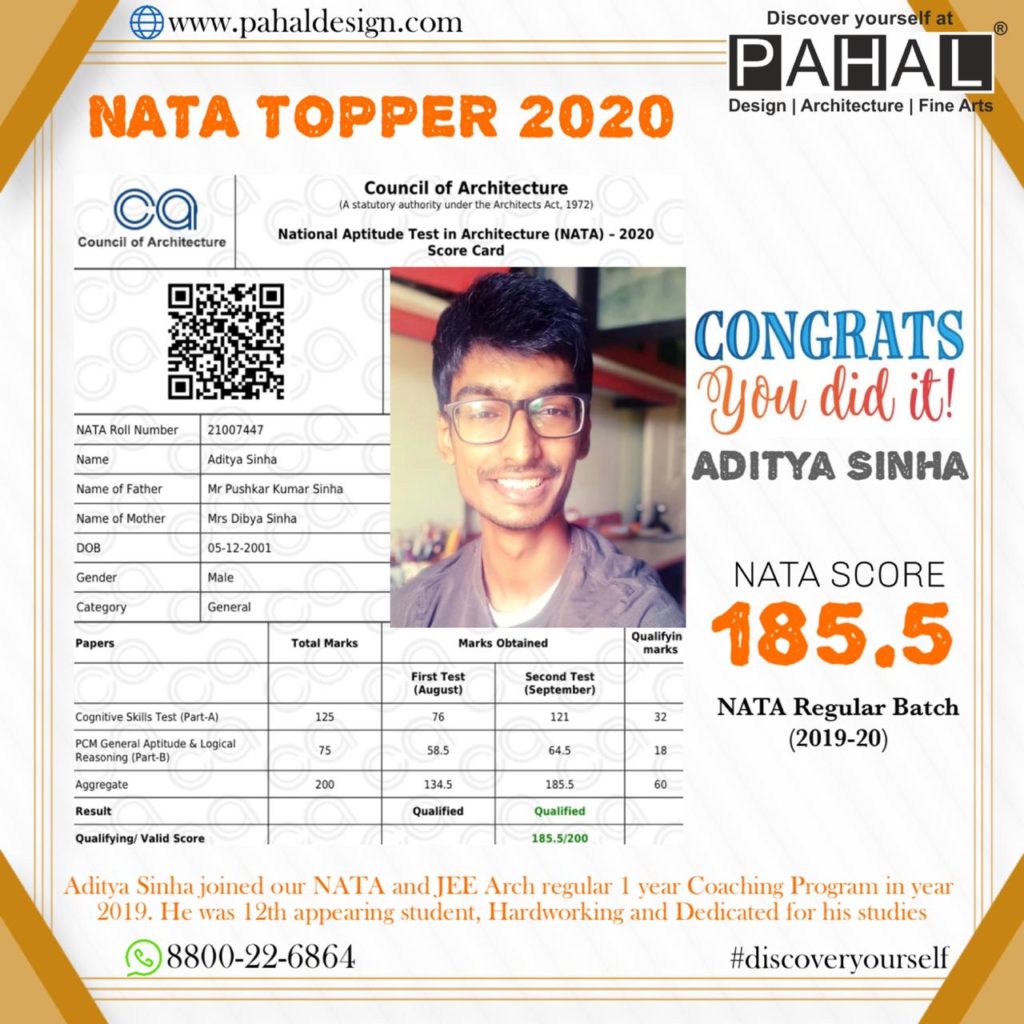
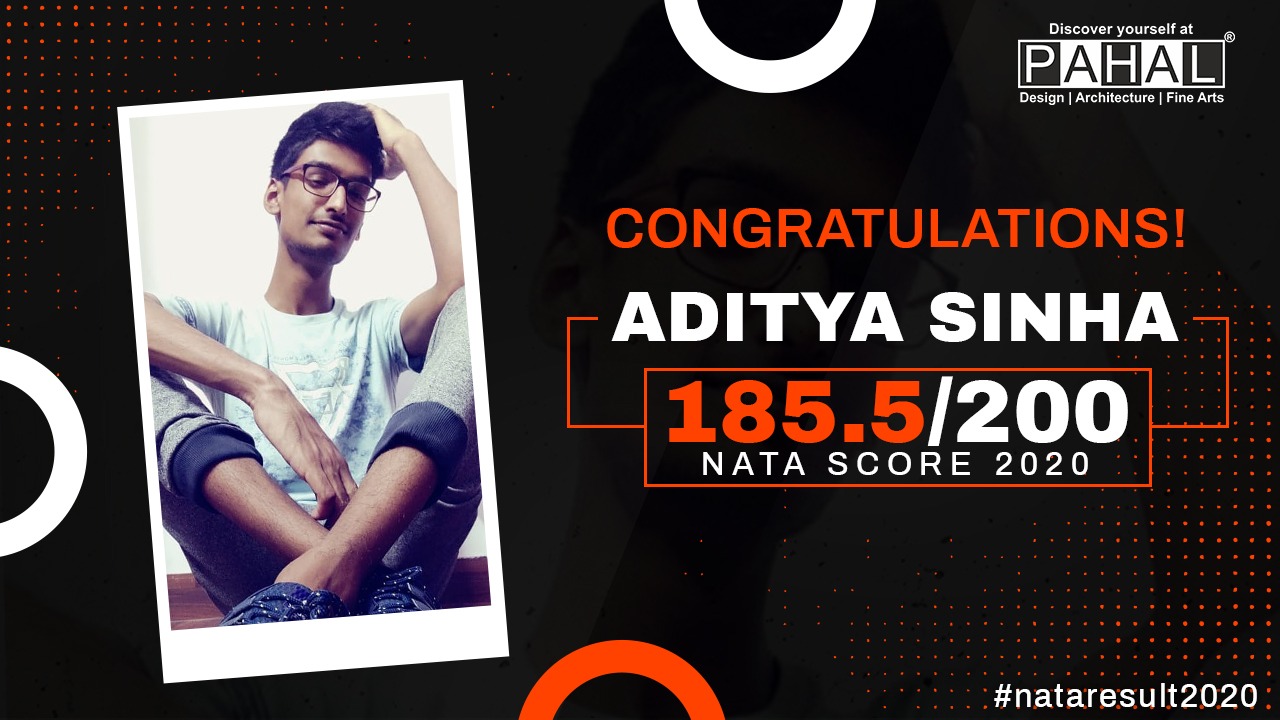
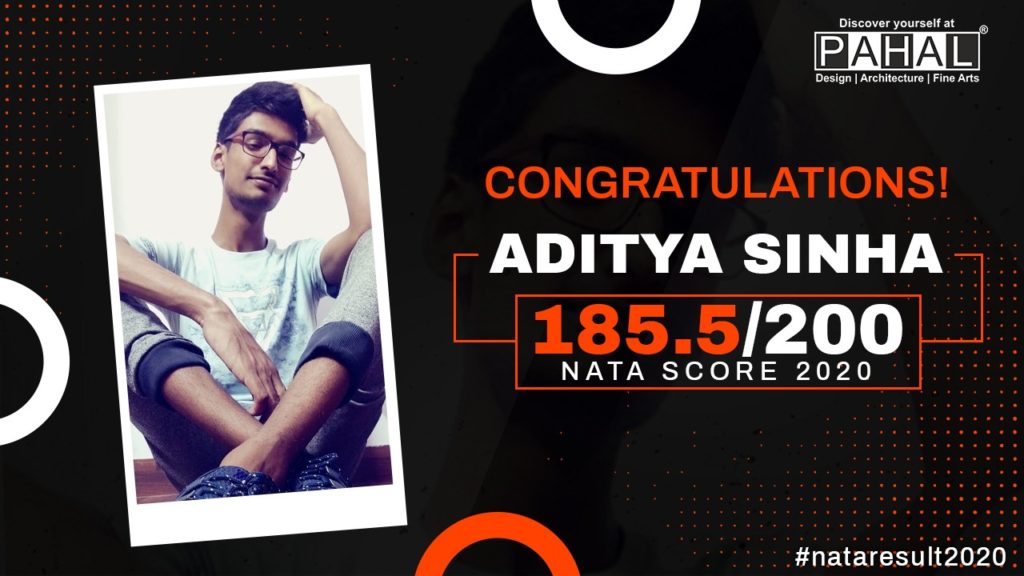
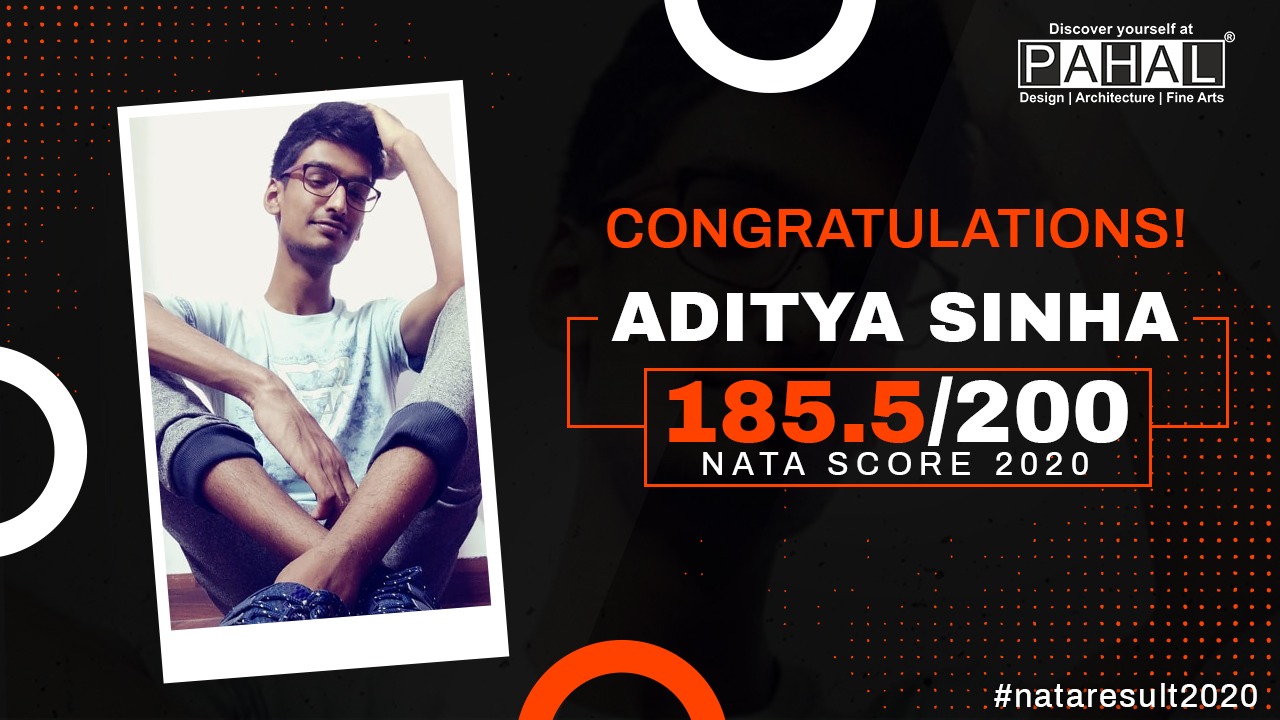
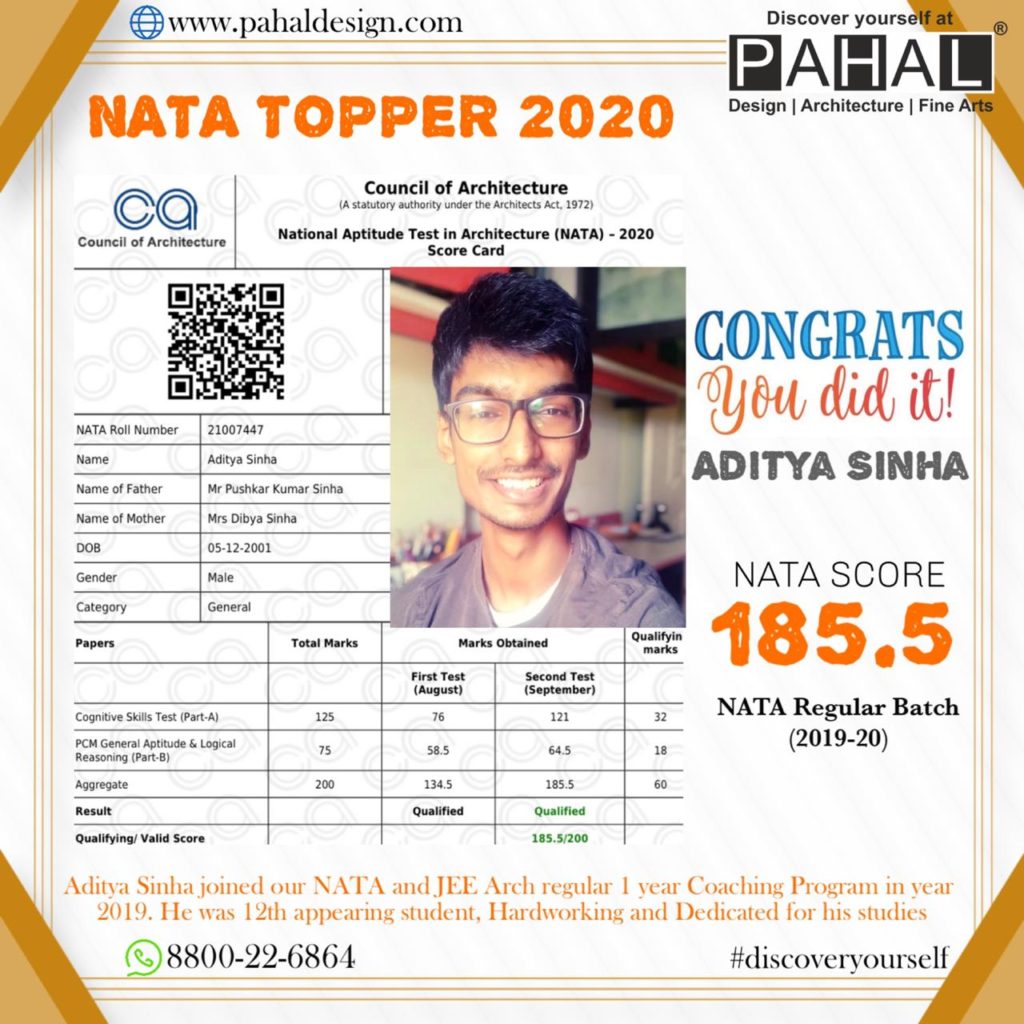
Aditya Sinha, the all India topper of (NATA) 2020 entrance test, believed in the simple philosophy of ‘Be inspired; nothing is impossible’ to achieve this feat. Depending on rigorous efforts, the NATA topper from Delhi shares that he focused on enhancing his analytical skills and practised sketching as much as possible and worked on Architecture Aptitude.

Aditya Sinha was a student of Pahal Design regular Architecture Batch of the year 2019-20 and he really worked hard and have shown that nothing is impossible and his dedication and score is one of the example for this.

For NATA one has to start early for better preparation and good score as getting this score is all about time management, Analytical Skills and Architecture Aptitude.

Aditya Sinha also Scored 89 Percentile in JEE B Arch. 


About NATA 2020

National Aptitude Test in Architecture (NATA) is being conducted by COA since 2006, in terms of the provisions of CoA (Minimum Standards of Architectural Education) Regulations, 1983, published in the Gazette of India. It is implied that a separate aptitude test in Architecture should be conducted and such test should not be combined with the tests for admissions to Engineering, Pharmacy, Medicine and other disciplines. Being the competent authority for fixing the norms and standards for architectural institutions, COA has the necessary expertise to hold a Common Aptitude Test in Architecture, at national level to provide a single window system for appearing in aptitude test and to facilitate institutions, students and public at large for admission to First year of 5 year B.Arch. Degree Course at all recognized Institutions all over country. The purpose of conducting NATA is to provide a single scheme of examination for holding aptitude test and to facilitate prospective students all over the country to apply for admissions in architecture seats in institutions spread across the country and to avoid appearing in multiple aptitude tests. However, the actual admissions shall be carried out only by the concerned competent authorities of the respective states/institutions based on valid NATA score. The NATA also ensures that the eligibility criteria for admission to five-year Bachelor of Architecture (B.Arch.) degree course, as prescribed by CoA and duly approved by the Central Government, are strictly adhered to and followed all over the country in Architectural Institutions.

In view of the prevalent situation arising out of Corona Virus Pandemic (COVID-19) and consequent directives of the Government of India for ensuring public health related social distancing and other measures, the Council of Architecture, has decided to conduct both Parts A (Cognitive skills for Drawing and Visual Composition Test) and B (Test on Scientific Ability & General Aptitude) of NATA as a comprehensive online aptitude test The candidate has the option to appear for comprehensive online test of NATA 2020 either from their respective place of residence/stay or at the Council allotted centres in case they do not have internet connectivity or technical/ hardware resources such as laptop/PC, web cam/ microphone etc. The candidates will soon be provided an option in their respective login accounts to opt for their preference for place of examination for NATA 2020.

Part-A Test (Cognitive skills for Drawing and Visual Composition Test), due to exceptional circumstances, has been redevised as a preferential/multiple choice type test to be answered on PC/laptop. The syllabus for Part-A Drawing Test accordingly has been revised as Cognitive Skills for Drawing and Visual Composition Test and is specified in the brochure. This substitutes the Paper based test for this year.

NATA measures the aptitude of the applicant for specific field of study, i.e. Architecture. The test makes an assessment of cognitive skills required for drawing and composition observation skills, sense of proportion, aesthetic sensitivity, Physics, Chemistry and Mathematics at 10+2 level and critical thinking ability that have been acquired by the candidate over the past few years and are related to the specific field of study.

NATA plays an important role in selecting candidates having necessary aptitude to become competent architects to serve the society and to build the nation in coming decades, especially in view of the Govt. of India mission of Smart Cities, Housing for All and Green and Energy efficient Buildings.

With the objective of attracting a greater number of bright aspirants for studying Architecture and practicing the same as a profession in future, Council like every year will be conducting NATA-2020 for admission to B.Arch. in the academic session 2020-2021. NATA-2020 shall be conducted twice a year, thus giving opportunity to those students who miss out the first test due to some reason or other or wish to improve upon their NATA score in the first test by re-appearing the second test. Both the first and second test will be conducted on different dates as totally computer-based examinations all over the country.

The test shall consist of two parts, both to be answered on a PC/Laptop – Part-A tests Cognitive skills required for drawing and visual composition and Part-B (Scientific ability and General Aptitude) comprises Multiple Choice Questions (MCQ) on Physics, Chemistry, Mathematics and general aptitude. This total computer-based examination has been devised for this year alone in view of the current COVID situation and to enable candidates to take the test preferably at their place of residence/ stay or by their choice at a Test center allotted by the Council.

Schedule of Examination

Examination shall be conducted in two sessions on the date of the first test and depending on the number of candidates registering for the second date of the test, it will be decided whether there will be one or two sessions. While the candidates will be given the choice of the two sessions on date 1 of the test on a first come first basis, the candidates opting for taking the test from Council allotted test centres shall be allocated only to the second session.

Part-B shall be conducted first followed by Part-A; both parts as computer-based examinations. The schedule of NATA 2020 Examination shall be as under:


CONNECT NOW

Pahal Design Books & Study Material is ideal for self-starters who like to study at their own pace. The comprehensive and regularly updated NID, NIFT, NATA, UCEED, CEED, BFA exam books and mocks would prove to be beneficial for all kinds of aspirants.

The comprehensive study material is prepared by most experienced faculties of Pahal Design which focuses on developing advance level skills in student. It intends to provide extensive support in preparation of students for prestigious Design, Architecture and Fine Art exams like NID, NIFT, NATA, JEE B Arch, IIT-UCEED, IIT-CEED, BFA. 

Pahal Study Material Features:

1. Test Series :

A. Monthly Test – The monthly test enables student to track their progress in most efficient way and pay attention to the section required.
B. Mock Test –Its mandatory for all students to attempt mock test after competition of syllabus .The student can book their slot at any of Pahal Design Branch or choose online mode in order to appear in Mock Test Series. Each mock test will give you complete performance analysis, All India Ranking, practice to updated exam pattern and section wise performance report.

2. Doubt clearance & Feedback sessions : Students can attend doubt clearance session with our expert by booking their slot at nearest Pahal design centre or choose online mode for same .

3. Digital Learning Program (DLP) : Access to digital learning platform which has complete learning solution for the students .The Platform will enable students to avail video lectures ,Quiz practice sessions ,any time access to practice sets and tests with more than 5000+ questions .The student will be allotted with unique User Id and Password for their DLP account which they login from Pahal Digital.com or PD app .

4. Expert Team: Each student will get expert guidance for design career and will be assisted to explore their course interest. The team will also analyse and review the student’s performance and help them to improve their performance.

5. Preparation for other Design colleges : Student can get connect to us for the design college counselling or inform us regarding the colleges they are applying for and Pahal Design Team will provide complete guidance according to the updated exam pattern.

The study material is also available for Foundation Batch (2 Years) Program which aims at building strong foundation among Design and Architecture aspirants which is suitable for 10th and 11th appearing students. Study material package focuses on boosting confidence of student for facing National level competition by providing subject wise & topic wise Question Bank based on latest pattern, in addition to previous year question papers and formula booklets.

The content of the study material is deeply researched and developed as per new exam pattern by NID, NIFT, SPA, IDC, IIT, NIT’s and many more. The advance level problems along with each topic are specially designed to give the students an in-depth understanding of the particular subject and prepare them to stay ahead in the competition.

Hauz Khas (Corporate Branch)
 
Address:- G-8, G Block Market, 2nd Floor, Hauz Khas, New Delhi-110016
Contact No: 88-00-22-6864
Contact Person: Ms Karishma Gupta
Email: corporate@pahaldesign.com

CONNECT US


The best coaching institute for NIFT Entrance exam in South Delhi is undoubtedly Pahal Design. They have two centres in South Delhi one is in Hauz Khas and Other is in South Ex. These 2 centres are location at prime location of Delhi which is well connected to metro and Hostel facilities are also available for outstation students. Hauz Khas centre is just 500m for NIFT first and best campus at Hauz Khas. Many renowned markets of Delhi such as Sarojini Nagar Market, Green Park Market, Lajpat Nagar Market, South Extension, Kotla Mubarakpur, M-block Market, etc. and malls such as Ansal Plaza, DLF, MGF Metropolitan, Select Citywalk, Malviya Nagar, etc. are located in South Delhi. The IIT, AIIMS, NIFT, three of the country’s premier institutes in the field of technology, medicine and fashion respectively lie in the Hauz Khas locality of South Delhi. The Indian Institute of Foreign Trade of Delhi is located in the Qutub Institutional Area of South Delhi. Sangam Vihar is also located in South Delhi, which has the highest population in the State. The top Central University Jamia Millia Islamia is situated at Jamia Nagar area of South Delhi. The administrative district had 20% Green Cover, as of 2009. It has several spacious green parks, wildlife sanctuary, biodiversity parks, and green belts. Deer Park and Rose Garden in Hauz Khas, Asola Wildlife Sanctuary close to Delhi’s southern border on the Aravallis foothills are few examples. It has a good mix of concrete and greens. Jahaz Mahal, Zafar Mahal, Tughlaqabad, Hauz Khas Complex, Bijay Mandal, Qutub Minar, Mehrauli Archaeological Park, and the Safdarjung Tomb comprise some of South Delhi’s most scenic heritage sites.

Most of the affluent and upmarket residential areas of South Delhi were established in the early 1960’s. Today, Colonies such as

PAHAL DESIGN

Greater Kailash, Defense Colony, South Extension, Green Park, Neeti Bagh, Gulmohar Park, Hauz Khas, Safdarjung Development Area, Vasant Vihar,Sarvodaya Enclave, Anand Niketan, Jasola and Panchsheel Park are among the most expensive pin codes of New Delhi. All these colonies are categorized in either category ‘A’ or category ‘B’ which highlights the fact that residents of these colonies come under the very affluent and upper-middle-class sections of the society. Newly built builder floors and independent villas sell for as high as INR 10-80 crores in South Delhi. All these colonies are ‘planned colonies’ and therefore have proper connectivity to major roads and metro networks. They all also host their own markets such as Greater Kailash-1, M block Market, Green Park Market, Hauz Khas village area, South Extension Market and Defense Colony Market which are considered to be the poshest markets of Delhi. There are also numerous dedicated recreational areas around these colonies which is a luxury in today’s heavily urbanized and congested New Delhi.

SOUTH DELHI CENTRES:

Hauz Khas (Corporate Branch)

Address:- G-8, G Block Market, 2nd Floor, Hauz Khas, New Delhi-110016
Nearest Metro Station Hauz Khas Gate No-3, Mayfair Garden / RBI Colony
Landmark – Near Punjab National Bank
Contact No: 88-00-22-6864, 011-40106405
Contact Person: Ms Yashika
Email: corporate@pahaldesign.com

South Extension Part – 1

Address:- E-17, Ground Floor, South Extension Part 1, New Delhi – 110049
Landmark: Mcdonald’s Lane, Nearest Metro – South Ex Metro Gate No 2
Contact No : 98994-29749, 011-41350505
Contact Person : Ms. Neha Siddiqui
Email : info@pahaldesign.com


ngg_shortcode_0_placeholder

Schedule a free counselling session WhatsApp WhatsApp