*Why Fashion Matters* spans Old Delhi charms in its *eighth edition*.
*Why Fashion Matters* spans Old Delhi charms in its *eighth edition*.NATA 2021 is a 3 hour (180 minutes) test within which 125 questions have to be answered. There will be 1 mark, 2 marks and 3 marks questions. Candidates will have to answer 75 one mark questions, 25 two marks questions and 25 three marks questions as outlined in table below:

The questions will be of the MCQ (Multiple Choice Question type), MSQ (Multiple Answer Select Question type), PAQ (Preferential Answer type Question) and NAQ (Numerical Answer type Question) and they could be either 1 mark, 2 marks or 3 marks questions.

1. MCQ- MCQ is a Multiple Choice Question in which 4 answer choices are provided; of which one is the correct answer.
2. MSQ- MSQ is a Multiple Answer Select type question where 8 to 10 answer choices are provided and 4 or 5 answer choices is the correct answer. If a candidate gets all the 4 or 5 correct choices right as the case may be, the full mark is awarded.
3. PAQ- PAQ is the Preferential Answer type question where each answer choice has a mark awarded. The mark is awarded based on the candidate’s choice of answer.
4. NAQ- NAQ is the Numerical Answer type Question where no answer choices are given. The candidate has to provide a numerical answer. Alternatively, it could also be a fill in the blank question where the candidate has to fill in the blanks. The correct answer entered will be awarded the mark.
No. Drawing test does not form a component in NATA 2021. Knowledge gained in the required subjects of study such as mathematics, physics and geometry over the years of schooling as well as in the areas of logical reasoning and general aptitude will be tested as relevant to Architecture as a field of study.
Knowledge gained in the required subjects of study such as Mathematics, Geometry and Physics over the years of schooling will be tested as relevant to the field of Architecture. The candidates will be tested on their overall knowledge of concepts only.
As NATA 2021 is completely a computer-based test, there will not be a Part A and Part B.
The general knowledge and conceptual knowledge in the subjects such as mathematics, physics and geometry gained by the candidate over the years of schooling culminating with the 10+ 2 /10+ 3 Diploma examination as well as General aptitude and Logical Reasoning as relevant to Architecture as a field of study are tested as one comprehensive examination.
Originally established in 1962 as the School of Architecture, Faculty of Architecture, CEPT University, is one of the vital centers of thought and education in the field of Architecture in India. It continues to aim for excellence in its teaching and research programs in the field of Architecture. The Faculty enjoys an excellent reputation nationally as well as internationally.
Architects play significant roles in the design and production of built environments. Those who focus on design are commissioned by clients to lead the work of the many experts who are required to put buildings and places together. When playing this leadership role architects ensure that the end product is architecturally meaningful, while meeting prosaic functional requirements. Many architects refrain from playing this expansive leadership role and prefer instead to focus on some aspect of the built environment. Others refrain from design altogether and focus instead on the study and critique of built environments in a bid to enrich architectural discourse. Yet others choose to proactively work with disadvantaged communities to improve living conditions.
Professional architects can build careers as independently practicing architects, as architects working within architectural firms, as academics focused on teaching and research, or within non-governmental organizations. In India, the architectural profession is regulated by the Council of Architecture (CoA), which was established by Parliament through the Architects Act, 1972.
This five-year long program leads up to the award of the B. Arch. degree. It equips students with the competencies necessary for being effective professional architects and exposes them to the aesthetic, technical, social, political and ethical dimensions of the built environment. Though the B. Arch degree is sufficient for professional registration with the CoA, many architects pursue postgraduate and doctoral studies. When doing this, one can continue focusing on architecture, concentrate on fields such as architectural conservation or urban design or shift to allied professions such as urban planning or construction management.
The first year is called the CEPT Foundation Program. Here the focus is on developing basic architectural design skills. The following two years focus on advanced skill development. It is possible to exit the program at this stage with a B.Sc. in Building Design. The fourth and fifth years allow students to focus on areas and practice domains of their choice. During this period, students can choose to intern for any one of the four semesters with approved architectural offices anywhere in the world and also undertake research projects or design studios.
The program is centered on ‘studios’ where students are expected to resolve life-like design problems on their own. Studios operate as learning communities where teachers take on the role of coaches supporting students in their learning quests. In studios students develop capacities and come up with technically and architecturally meaningful designs to communicate their ideas. Many group exercises are structured to develop leadership capacities.
Courses, seminars, and workshops, which run parallel to studios, expose students to technology, history, architectural theory and various other dimensions of architecture. Four times, during breaks between semesters, students are required to sign up for study tours or courses organized as part of the Summer and Winter School programs.
To enable students to pursue individual interests only three quarters of the total academic workload is mandated. Students choose courses from the many available electives to complete the rest. Teachers are drawn from practicing professionals who bring practical experience to the classroom and academics who complement teaching with more theoretical and critical approaches.
This almost sixty year old program is internationally recognized. Its alumni are amongst the most successful architects of India, work at the foremost architectural practices across the world, teach and do research at the most reputable global universities and are amongst the most notable social entrepreneurs of the country. Many long lasting exchange programs link this program to other architectural programs in Europe, USA and Australia providing unparalleled opportunities to enrolled students.
1) Bachelor’s in Architecture Course, candidates who have cleared the qualifying examination from an eligible Board from the
NATA MOCK TESTS
school located in India (Including Gujarat State) with minimum eligibility criteria as prescribed by AICTE/Council from time to time and have obtained valid score in NATA as prescribed by the Council.
For admission to 1st year of 5-year B.Arch. Degree Course, as prescribed by Council of Architecture, a candidate should have passed in 10+2 scheme of examination with PCM subjects or pass in 10+3 Diploma* with Mathematics, as the case may be and have qualified the aptitude test i.e. NATA shall be eligible for admission to B.Arch. course for the academic session 2020-2021.
* – A candidate shall have passed the Diploma (I0+ 3) of any stream with Mathematics as a compulsory subject from,-
(a) The Technical Examination Board, Gujarat State or
(b) A University established or incorporated by or under a Central or a State Act or an institution declared to be deemed as a University under section 3 of the University Grants Commission Act. 1956 (3 or 1956)
2) Candidates who have cleared the qualifying examination from school located outside
India with minimum eligibility criteria as prescribed by AICTE/Council from time to time and equivalency defined by Association of Indian Universities (AIU), New Delhi shall be eligible for admission.
3) The candidate shall have to pass all the subjects of the qualifying examination from a single Board.

Eligibility for seats to be filled in by GoG:
Eligibility for seats to be filled in by ACPC, GoG:
Please refer to official website of Admission Committee for Professional Courses of Government of Gujarat. www.jacpcldce.ac.in
Note: Additionally, the student will have to meet the minimum qualifying marks for the National Aptitude Test in Architecture (NATA) test for the corresponding year as per the Council of Architecture.
Seat:
| Program | 50% of total seats to be filled in by ACPC, GoG | 50% of total seats to be filled in by CEPT University (All India Seats) | Total Seats |
| Bachelor’s in Architecture (B Arch) |
40 | 40 | 80 |
|
CEPT has a comprehensive scheme for scholarship. It is the endeavor of the University that no student be denied opportunity to pursue their studies for want of adequate financial resources. However no financial aid or scholarship would be automatic and will be subject to norms and criteria laid down by the University. Pending sanction of financial aid / award of scholarship students are required to make payment of fees and charges on the due dates.
Address:- 9, 1st Floor, Sunrise Centre-II, Sunrise Park, Bodakdev,
Ahmedabad, Gujarat-380015
Landmark: Off Drive-in-Road
Contact No: 78029-49620, 079-40398630
Contact Person: Ms Manisha Malkani
Email: ahmedabad@pahaldesign.com

NATA measures the aptitude of the applicant for specific field of study, i.e. Architecture, through assessment of cognitive skills, visual perception and aesthetic sensitivity tests, logical reasoning and critical thinking ability, etc., besides the learning that the candidate has acquired over the past few years and is related to the specific field of study.
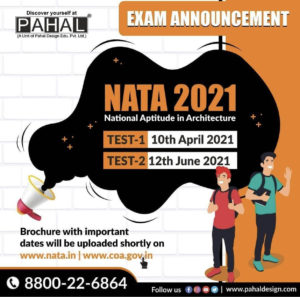
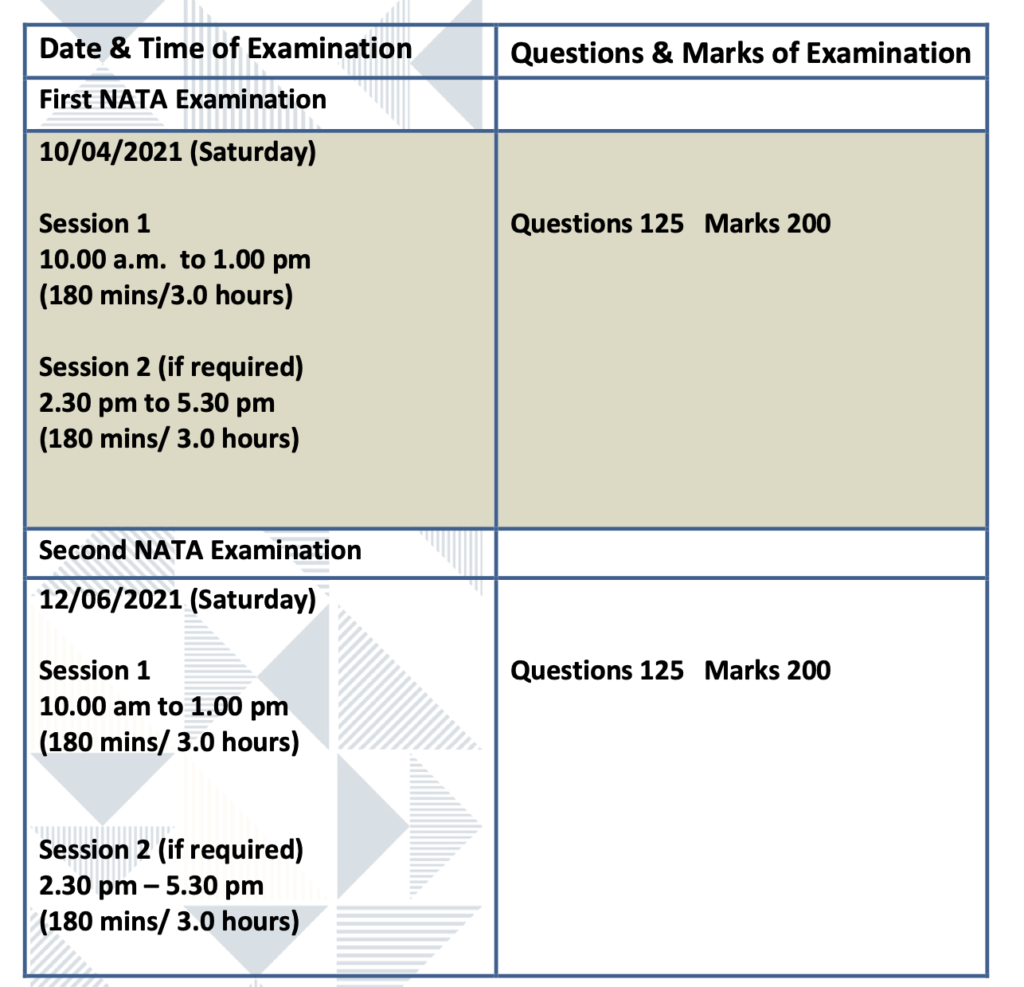
With the objective of giving opportunities to a greater number of bright aspirants, Council will be conducting NATA- 2021 for admission to B.Arch. in the academic session 2021- 2022 twice this year. Candidates who miss out the first test due to some reason or other or wish to improve upon their NATA score can register for the second test. Both the first and second test will be conducted on different dates as computer-based examinations and a candidate shall be allowed to appear for NATA 2021 for a maximum of two times.
The aptitude test will comprise of questions that could be of the Multiple-Choice type (MCQ), Multiple Select type (MSQ), Preferential Choice type (PCQ) and Numerical Answer type (NAQ).
The questions will carry either 1 mark,2 marks or 3 marks and 125 questions have to be answered in 180 minutes.
The medium of Aptitude test will be the English language.
The aptitude of the candidate will be assessed using some or all of the following techniques:
Abstract Reasoning – Will assess general knowledge, and ability to utilise knowledge in new situations.
Questions could be asked in various topics that assess candidates on basic concepts in mathematics, physics and geometry, language and interpretation, elements and principles of design, aesthetic sensitivity, colour theory, lateral thinking and logical reasoning, visual perception and cognition, graphics and imagery, building anatomy and architectural vocabulary, basic techniques of building construction and knowledge of material, general knowledge and current affairs, etc. and are may not be limited to those outlined.
Candidates may note that NATA 2021 is the qualifier for admission to B.Arch. program offered by Universities/ Institutions in the country, subject to the fulfillment of eligibility criteria as prescribed by the Council.
QUALIFYING IN NATA- 2021 DOES NOT CONSTITUTE A RIGHT/ GUARANTEE IN FAVOUR OF THE CANDIDATE FOR ADMISSION TO ANY ARCHITECTURE COURSE UNLESS THE CANDIDATE HAS FULFILLED ALL THE PRESCRIBED REQUIREMENTS AS SPECIFIED BY RESPECTIVE COMPETENT AUTHORITIES IN COMPLIANCE WITH THE ELIGIBILIY CRITERIA LAID DOWN BY THE COUNCIL.
Address:- 9, 1st Floor, Sunrise Centre-II, Sunrise Park, Bodakdev,
Ahmedabad, Gujarat-380015
Landmark: Off Drive-in-Road
Contact No: 78029-49620, 079-40398630
Contact Person: Ms Manisha Malkani
Email: ahmedabad@pahaldesign.com
FREQUENTLY ASKED QUESTIONS“No candidate shall be admitted to architecture course unless he has passed an examination at the end of the 10+2 scheme of examination with at least 50% aggregate marks in Physics, Chemistry and Mathematics and also at least 50% marks in aggregate of the 10+2 level examination or passed 10+3 Diploma Examination with at least 50% marks in aggregate.”
Candidates can register themselves either for first test or second test OR for both by filling in the application form appropriately.
6. Will the test fee be refunded for any valid reason?
No. The fee paid cannot be adjusted or refunded.
Session 1 – 10.00 a.m. to 1.00 pm (180 mins/3.0 hours)
Session 2 (if required) – 2.30 pm to 5.30 pm (180 mins/ 3.0 hours)
125 questions have to be answered in 180 minutes (3 hours). Questions will carry either 1, 2 or 3 marks. Questions could be of the Multiple-Choice type (MCQ), Multiple Select type (MSQ), Preferential Choice type (PCQ) and Numerical Answer type (NAQ).
Cities / test centre location will be based, as far as possible, on the choices given by the candidate during filling up the form online. However, it is the discretion of the Council to allocate the examination centre for smooth conduct of the test.
Mobile Phones, Bluetooth devices, Calculators, Slide Rules, Log Tables, Electronic Watches or any other electronic gadget with facilities of Calculator are not allowed in the Examination
2
Hall. Possession of such items during the Examinations may lead to cancellation of candidature.
Candidates found carrying any textual material, printed or written, bits of papers or any other material will be debarred from appearing the examination.
(a) Report to the Examination Center by 9.00 am
(b) Opening gate to the examination hall at 9.15 am
(c) Registration of candidate to be completed by 9.45 am (d) Closing gate to the examination hall at 10.00 am
(e) Commencement of examination at 10.00 am
(f) Duration of examination: 10.00 am to 1.00 pm
EMAIL: nata.helpdesk2021@gmail.com
NATA HELP DESK NO.: 9560707764, 9319275557
Please see brochure for further specifications at www.nata.in.
If a candidate appears for both tests, the best of the two test scores will be considered for score generation.
However, a candidate may provide different centre preferences if he/she is opting for Test 2 at a later date separately.
The general knowledge and conceptual knowledge in the subjects such as mathematics, physics and geometry gained by the candidate over the years of schooling culminating with the 10+ 2 /
27. 10+ 3 Diploma examination as well as General aptitude and Logical Reasoning as relevant to Architecture as a field of study are tested as one comprehensive examination.
28. What is the pattern of NATA examination?
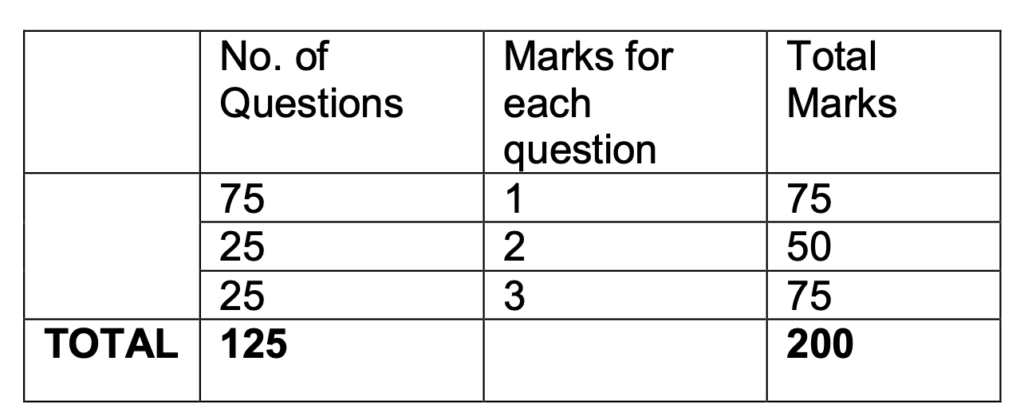
NATA 2021 is a 3 hour (180 minutes) test within which 125 questions have to be answered. There will be 1 mark, 2 marks and 3 marks questions. Candidates will have to answer 75 one mark questions, 25 two marks questions and 25 three marks questions as outlined in table below:
No. of Questions
75 25 25
TOTAL 125
Marks for Total each Marks question
1 75
2 50 3 75
200
28.The questions will be of the MCQ (Multiple Choice Question type), MSQ (Multiple Answer Select Question type), PAQ (Preferential Answer type Question) and NAQ (Numerical Answer type Question) and they could be either 1 mark, 2 marks or 3 marks questions.
What is meant by MCQ, MSQ, PAQ and NAQ?
1. MCQ- MCQ is a Multiple Choice Question in which 4 answer choices are provided; of which one is the correct answer.
2. MSQ- MSQ is a Multiple Answer Select type question where 8 to 10 answer choices are provided and 4 or 5 answer choices is the correct answer. If a candidate gets all the 4 or 5 correct choices right as the case may be, the full mark is awarded.
3. PAQ- PAQ is the Preferential Answer type question where each answer choice has a mark awarded. The mark is awarded based on the candidate’s choice of answer.
4. NAQ- NAQ is the Numerical Answer type Question where no answer choices are given. The candidate has to provide a numerical answer. Alternatively, it could also be a fill in the blank question where the candidate has to fill in the blanks. The correct answer entered will be awarded the mark.
Will instructions be provided before the commencement of test?
Yes. The candidates will have a ten minute portal to read the instructions before the commencement of the test. Candidates are required to read the instructions very carefully before commencing the test.
The candidates are therefore advised to reach the test center in good time and take their seat in the examination hall at least 15 minutes ahead of the commencement of the examination.
My 10+2/10+3 Board/authority Name is not available in the list? What process should I follow to get my board name added in the list?
In case any board/authority name conducting 10+2 or 10+3 examination is not appearing in the NATA application form of the NATA portal, the candidate may forward a scanned copy of the same to NATA Helpdesk, which upon verification, will be added in the portal.
Is the allotment of seats to architectural institutions done through NATA OR by the Council of Architecture?
Qualifying in NATA is a mandatory requirement to gain admission into any Institution/ University offering a B.Arch. degree program in the country.
A qualifying score will help a candidate to seek admission into any institution/ University offering a B.Arch. degree program. These admissions are done by competent authorities of the State/ Central governments such as Directorates of Technical Education/ Admission authorities, Universities, etc.
The Council of Architecture does not allot seats in architectural institutions for qualifying candidates.
How can a candidate get admission in to a B.Arch. degree program once qualified for NATA?
After passing NATA, candidates need to apply with their score cards to various institutions approved by the Council for imparting 5-year B.Arch. degree course all over the country. The actual admissions shall be carried out only by the concerned competent admission/counselling authorities of the respective states/universities/institutions, as per the eligibility criteria prescribed by the Council.
How much weightage will be given to marks obtained in NATA and marks obtained in Qualifying Board Examination in the admission process?
As per Council norms, the admission authority may give a maximum weightage of 50% to marks obtained in NATA and a maximum weightage of 50% to marks obtained in qualifying examination i.e. 10+2 examination or 10+ 3 Diploma.
Is there any minimum passing mark prescribed for passing NATA? Qualifying marks for NATA- 2021 is 75 marks out of 200 marks.
Is there any relaxation/ concession for Reserved Category candidates to qualify NATA? No relaxation in the NATA qualifying mark is given for reserved categories.
Can other test centers apart from Dubai be identified for candidates residing abroad?
Presently, the Council is only able to provide Test centres at Dubai only. However, the Council is exploring options/feasibility for having centres in other gulf countries such as Saudi Arabia, Qatar, Muscat etc. and will depend on the number of candidates.
Is there a list of institutions recognized by the Council of Architecture all over India for imparting recognized B Arch degree program?
The list of approved/ recognized institutions by the Council of Architecture is available on Council’s website www.coa.gov.in.
What is Council of Architecture?
The Council of Architecture is a statutory authority established under the Architects Act, 1972 (enacted by the Indian Parliament) to lay down and monitor the standards required to be maintained by the Architectural Institutions for imparting recognized architectural qualifications in the country.
The Council registers qualified individuals as Architects and also monitors their professional conduct, etiquette. For further details please visit Council’s website www.coa.gov.in
39. My Fees are deducted twice while making online payment. When will my fees be refunded and what is the process?
In case NATA fee is deducted twice during online payment, the candidate is advised to take up the issue with the bank and wait for at least 4-5 working days. If no refund is issued after that, the candidate may approach the NATA Helpdesk with request for refund and the same shall be processed by the Council within 7 working days.
About NATA 2021National Aptitude Test in Architecture (NATA) is being conducted by COA since 2006, in terms of the provisions
of CoA (Minimum Standards of Architectural Education) Regulations, 1983, published in the Gazette of India.
Further, the Council has prescribed the Council of Architecture (Minimum Standards of Architectural Education) Regulations, 2020, with the approval of the Central Government in terms of Sections 21 & 45 of the Architects Act, 1972. The Regulations were published in the Gazette of India on 11.08.2020 and came into force w.e.f. 01.11.2020. These Regulations prescribe that the candidate needs to qualify an Aptitude Test in Architecture conducted by the Council for admission to the Architecture degree course.
The actual admissions shall be carried out only by the concerned competent authorities of the respective states/institutions based on valid NATA score. The NATA ensures that the eligibility criteria for admission to five-year Bachelor of Architecture (B.Arch.) degree course, as prescribed by CoA and duly approved by the Central Government, are strictly adhered to and followed all over the country in Architectural Institutions.
NATA 2021 will be conducted as a comprehensive online aptitude test at the Council allotted centers in identified cities in the country.
Unlike any other entrance examination, NATA is an Aptitude test that assesses a candidate’s innate ability through a variety of testing formats and cannot be taught, learnt or induced. Therefore, attending coaching classes will not substantially improve the aptitude of a candidate.
NATA measures the aptitude of the applicant for specific field of study, i.e. Architecture, through assessment of cognitive skills, visual perception and aesthetic sensitivity tests, logical reasoning and critical thinking ability, etc., besides the learning that the candidate has acquired over the past few years and is related to the specific field of study.
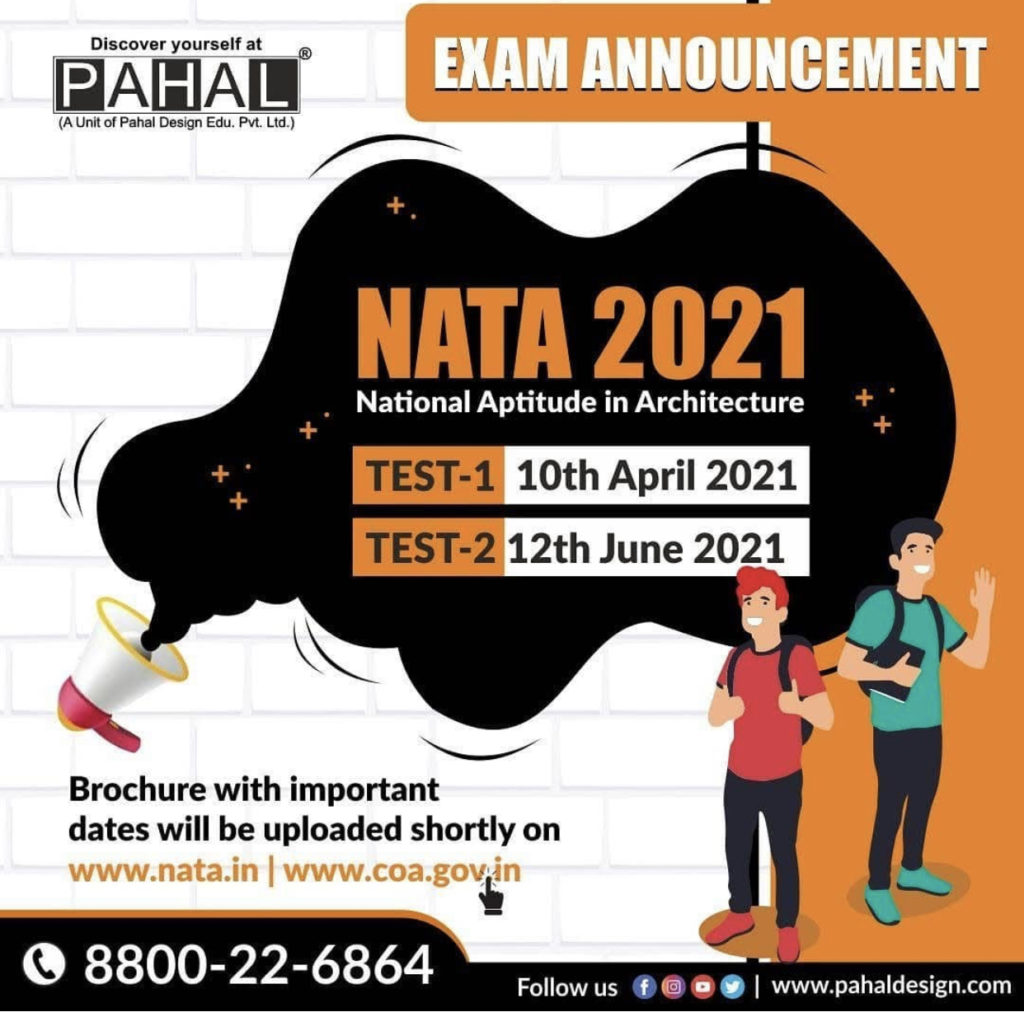
With the objective of giving opportunities to a greater number of bright aspirants, Council will be conducting NATA- 2021 for admission to B.Arch. in the academic session 2021- 2022 twice this year. Candidates who miss out the first test due to some reason or other or wish to improve upon their NATA score can register for the second test. Both the first and second test will be conducted on different dates as computer-based examinations and a candidate shall be allowed to appear for NATA 2021 for a maximum of two times.
Outline of Aptitude TestThe aptitude test will comprise of questions that could be of the Multiple-Choice type (MCQ), Multiple Select type (MSQ), Preferential Choice type (PCQ) and Numerical Answer type (NAQ).
The questions will carry either 1 mark,2 marks or 3 marks and 125 questions have to be answered in 180 minutes.
The medium of Aptitude test will be the English language.
The aptitude of the candidate will be assessed using some or all of the following techniques:
“No candidate shall be admitted to architecture course unless she/ he has passed an examination at the end of the 10+2 scheme of examination with Physics, Chemistry & Mathematics subjects or passed 10+3 Diploma Examination with Mathematics as compulsory subject.”


The aptitude test will comprise of questions that could be of the Multiple-Choice type (MCQ), Multiple Select type (MSQ), Preferential Choice type (PCQ) and Numerical Answer type (NAQ).
The questions will carry either 1 mark,2 marks or 3 marks and 125 questions have to be answered in 180 minutes.
The medium of Aptitude test will be the English language.
The aptitude of the candidate will be assessed using some or all of the following techniques:
imagery.
Questions could be asked in various topics that assess candidates on basic concepts in mathematics, physics and geometry, language and interpretation, elements and principles of design, aesthetic sensitivity, colour theory, lateral thinking and logical reasoning, visual perception and cognition, graphics and imagery, building anatomy and architectural vocabulary, basic techniques of building construction and knowledge of material, general knowledge and current affairs, etc. and are may not be limited to those outlined.
Candidates who have completed their 10 + 2 examination with Physics, Chemistry and Mathematics or 10+ 3 Diploma with Mathematics as subject of study can appear for NATA 2021. Candidates appearing for 10+2 examination with Physics, Chemistry and Mathematics as subjects of study or 10+3 Diploma with Mathematics in the current year may also provisionally appear for NATA-2021.
“No candidate shall be admitted to architecture course unless she/ he has passed an examination at the end of the 10+2 scheme of examination with Physics, Chemistry & Mathematics subjects or passed 10+3 Diploma Examination with Mathematics as compulsory subject.”
Dear Parent/Student,
Greetings for the Day!
Excellence is a way of life and believing in the true strength of the design profession to create a futuristic India we take the privilege to introduce you to CODE-VGU.
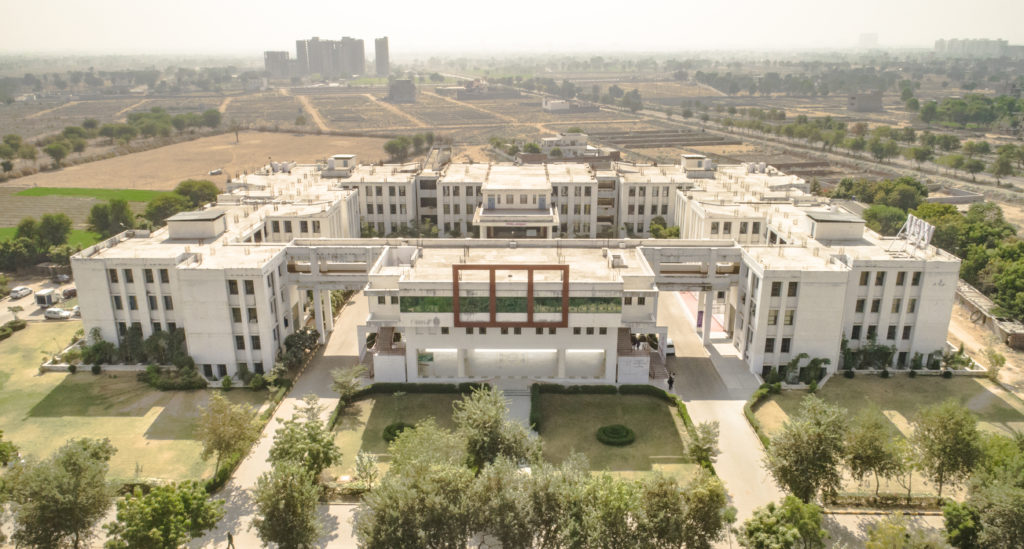
Admissions for the Session 2021 are open now for Undergraduate and Postgraduate Programmes at Centre for Design Excellence (CODE), Vivekananda Global University, Jaipur.
CODE – A Forum for learning and experiencing various domains of Design and Architecture is created by professionals and academicians from all across INDIA. We are a constituent body of Vivekananda Global University (VGU), Jaipur (Established by Rajasthan State Assembly Act 11/2012 and covered under 2(f) of UGC ACT, 1956).
Hosted at VGU campus, recognized as a “Great place to Study in India” by FORBES , CODE boasts of advanced labs and individual mentorship based degree programs.

1. B.Arch. (recognized by COA, India)
2. B.Des. (Recognized by UGC) with specialization in
a. Fashion & Textile Design (FTD)
b. Interior & Product Design (IPD)
c. Graphic & Communication Design (GCD)
d. B.Des + MBA (5yr Integrated Program)
3. M.Des.
a. Sustainable Design
b. UX Design
4. M. Plan
5. PhD
At CODE, we understand that the field of designers cannot be restricted to the 6-8 hours of teaching learning regime. VGU provides a well planned campus along with on-campus fully furnished hostel facility for outstation students.
So, before you say YES to join the fascinating field of design, do visit www.codevgu.in and experience a redefined Design Education.


To know more about CODE-VGU, pls speak to your centre incharge or book a counseling session with academicians from CODE.
Thanking you!
Regards,
Team CODE
Application link:
https://vgu.ctpl.io/?source=PAHAL
Sushant University was established in 2012 under the Haryana Private Universities Act 2006. Located in the heart of Gurgaon, India’s largest hub of National and Fortune 500 companies, it has seven schools offering programmes in Architecture, Planning, Design, Law, Management, Hospitality, Engineering and Health Sciences.
Sushant University was awarded with the National Education Excellence award “Best Private University in Northern India 2017” along with “CSR Excellence in Education”award for 2 consecutive years i.e. 2017 and 2018. Sushant School of Art and Architecture at Sushant University is the flagship school which was started in 1989 and has been consistently ranked No. 1 Private Architecture School in India by the Outlook Magazine.
We are a university with the core ideology of being futuristic and the mission “AHEAD. FOR LIFE”. The curriculum design is guided by inter and trans-disciplinary approach incorporating pedagogies that expand learning opportunities and ensure achieving higher order learning outcomes.
Various schools under the University have carved a niche by offering contemporary programmes with renowned faculty acclaimed nationally and internationally, state-of-the-art infrastructure and facilities to promote academic excellence. The has collaborated with some of the finest Universities and Institutions in USA, Canada, Australia, France and UK like the University of Warwick, Art University of Bournemouth, University of West England, University of Westminster, London, The Barlett School of Architecture, UCL and Vatel International, in the areas of Curriculum Development, Student and Faculty Exchanges, Joint PhD supervisions, joint research conferences, seminars and study semesters abroad.
Established as the flagship higher education institute of the Chiranjiv Charitable trust in 1989, School of Art and Architecture (SAA) has positioned itself as one of the Best Architecture Colleges in India. SSAA has been offering a five-year undergraduate degree in Architecture and varied two-years M.Arch programmes. The school is recognized by the Council of Architecture (COA), All India Council of Technical Education (AICTE) and University Grant Commission (UGC).
Through the alumni and faculty networks, the schools have cultivated associations with several international universities.
International relationships ensure that SAA commands its respected status within the global design community. We aspire to be amongst the world’s most advanced architecture and planning institutes known for their stimulating, innovative and outstanding learning environment. Here, best faculty apply innovative pedagogical techniques and encourage young minds to explore the frontiers of research, creating knowledge that will equip them for the challenges of our collective future. Unlike other Architecture Colleges in Delhi, Sushant University offers new programmes to be introduced with the intention of filling gaps that are perceived in the architecture and planning industry:
The school is also running summer / winter school programmes to educate school-goers about architecture and planning. SAA has strong association with institutions such as the American Institute of Indian Studie (AIIS), Indian Institute of Remote Sensing (IIRS), International Council on Monuments and Sites (ICOMOS), Indian Green Building Council (IGBC), Indian National Trust for Art and Cultural Heritage (INTACH) to facilitate exchange of resources and expertise.
The Indian real estate industry in Dec 2020 was estimated to be, rising income levels, urbanization and the rapid growth of the IT sector are the key drivers for the Indian real estate sector. Currently as the economy is facing a slump due to global downturn, the real estate sector is facing difficulties. However, in the next 2-3 years most of the larger players are anticipated to expand aggressively across the country. With this slump considered momentary, Indian real estate industry is likely to witness huge growth again. With increase in growth, demand for allied services like architecture, interior design & landscape architecture is likely to increase.
Market
• Architecture is a highly competitive and multi-disciplinary profession, involving a variety of tasks.
• As a field, it covers myriad disciplines, including spatial design, aesthetics, project management and material management.
• There are many Institutions in the country offering undergraduate & post graduate courses in Architecture.
• From our survey, out of the total number of designers working in the country, this discipline accounts for the most with 81.25%.
• Majority of the architects belong to the age group of 20-35 & hold B.Arch as their degree of qualification.35
• Mumbai leads in terms of having maximum number of architects followed by Pune and Delhi.
• In terms of placements, maximum numbers of architects are placed in the private sector followed by being self employed & in public sectors.
Current Activities
• In terms of outsourcing, architectural services are gaining traction with scope including design development, detailed architectural plans, construction documentation, as-built drawings, shop drawings, and visualization (3D views & walk-through).
• Architectural outsourcing service in India has the potential to grow to $12 billion in the next four to six years, from its current level of $3.5 billion.36
• Annual requirement projections of architects’ stands over 10,000 which is expected to rise further but the training facilities available are still short.
Urban Design and Landscape Design
Furniture Design
Address:- 2nd Floor, F 18, Gautam Marg, Vaishali Nagar, Jaipur, Rajasthan -302021
Contact Person: Mr. Aman and Mr. Akbar
Contact No: 97721-99911, 0141-6656509
Email: jaipur@pahaldesign.com