
 About Pahal Design Jaipur Rajasthan
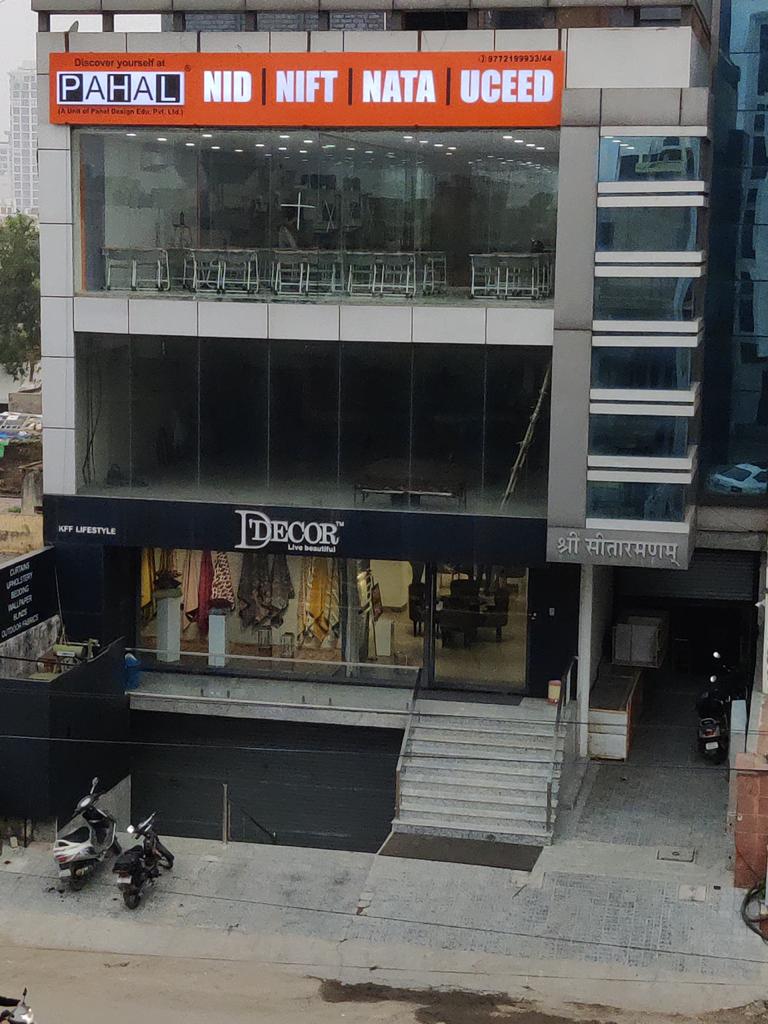
Pahal Design’s 40th Centre & 1st branch in Jaipur located at 2nd Floor F-18, Gautam Marg, Vaishali Nagar, Jaipur, Rajasthan 302021, Jaipur. A walking distance from Amrapali Circle, 22 minutes far from main railway station, 28 minutes far from Jaipur International Airport and 30 minutes’ drive from main bus stand. Kiran Jewellers, D- Decor, DAV Centenary Public School and Digambar Jain temple are the nearest landmarks to reach the centre. The centre offers entrance coaching for all the reputed design colleges in India and overseas. The centre is equipped with highly experienced design educationalists, expert faculty and visiting faculties, preparing and counselling design career enthusiasts for B. Des & M. Des entrance tests and professional career counselling for NID, NIFT, NATA, U/CEED, JEE-Arch and Fine Arts. Get ready to leave your footsteps and make your mark in the world of designing, communication and fashion. We are pleased to inform you that with this new year Pahal Design has added another cap in its feather and the inaugural ceremony at Jaipur Centre was successfully organized at 16th January, 2021.
About Jaipur
 The capital of Rajasthan, built proudly by Maharaja Sawai Jai Singh II is famous for its majestic forts, opulent Havelis, beautiful lakes, and dunes. Jaipur is part of the famous Golden Triangle Tourist circuit that includes Delhi and Agra. But Jaipur is not only endowed with wonderful tourist attractions but the city also has an excellent infrastructure to support the tourism. Jaipur has some of India’s best hotels, which compliments the scenic and architectural beauty of the Pink City.
The historic walled city of Jaipur, was founded in 1727 A.D. by the Rajput ruler Sawai Jai Singh of Kacchawah dynasty. The city is roughly divided into nine rectangular sectors with straight roads intersecting only at right angles and is enclosed within massive wall to protect the city in a total area of 709 hectares.
The wall encircles the city and 9 city gates are present to provide the access to the city from various directions. Several iconic monuments and temples are housed within this walled city area with two main North South axes crossing to form 3 main pubic squares (Badi Chaupar, Choti Chaupar and a 3rd one Ramganj Chaupar extending on the eastern side) on the East West axes that define the overall grid iron city plan. It has a total of 12 main bazaar areas across the main axial streets.
The design of the new city was a breath taking departure from the prevalent practices in city development in the sub-continent. Its urban morphology reflected the coming together of cultural elements from eastern and western planning, expressing a culture of a ‘trade and commerce city’ and townscape that is unparalleled anywhere in South Asia.
Envisaged as a trade capital, the main avenues of the city are designed as markets, which remain characteristic bazaars of the city till date. Chaupar, or designed large public squares at the intersection of roads, is another feature that is distinct to Jaipur as are its single to multicourt havelis and haveli temples.
Besides an exemplary planning, its iconic monuments such as the Govind Dev temple, City Palace, Jantar Mantar and Hawa Mahal excel in artistic and architectural craftsmanship of the period. Jaipur is an expression of the
astronomical skills, living traditions, unique urban form and exemplary foresighted city planning of an 18th century city from India.
 Jaipur is considered one of the most prolific examples of a planned city, it exemplifies approaches to city planning, sustainability and spatial manifestation of the social fabric through architecture. The lessons that can be learned by understanding this place are deep rooted in its context and are beautiful. Each place has lessons that can teach us about the importance of foresight, planning and mindful use of resources. An effort should be made to make it an inherent part of education and moreover an integral part of design education.
The newly prominent architectural buildings of Jaipur are a blend of advanced technology and exquisite design with a touch of traditional art. World Trade Park of Jaipur is a world-class infrastructure designed by renowned architects who have several architectural wonders in his account like the world’s biggest pillar-less rooftop (Sabha Mandap of Govind Devji Temple, which is notified by The Guinness Book of Records), first revolving tower of Rajasthan and many more. The Satsang hall within the Govind Devji’s Temple has a reinforced concrete cement flat roof with a simple soan of 119 ft.
With people from all over the country going to Jaipur for studies, today it has become an education hub also. If you are searching  for a good education, then there cannot be a place better than Jaipur. A place where there is no political disturbance, no goons to threaten you here and there, a place to give you a busy life when you need it, a place which would give you the country’s heritage to enjoy any time you need, a place which would give you the mountains and the lakes for a relaxing tour, and the most comfortable evening for studies.
Within the context of formal education, the Art and design as a subject on the curriculum supports personal, social, moral, spiritual, cultural, and creative development, and enables participants to engage with and explore visual, tactile, and other sensory experiences and how to recognize and communicate ideas and meanings. These opportunities enable them to work with traditional and new media so that they develop confidence, competence, imagination, and creativity. Through these opportunities, they learn to appreciate and value images and artifacts across times and cultures, and to understand the contexts in which they were made. A fine arts education—be it in music, theatre, dance, creative writing, visual arts, or art history and visual studies—is not always an easy sell. The social utility and financial feasibility of the arts are often underrated. Innovation and adaptability are essential components of any fine arts education.
Experiences in art, craft, and design enable them to learn how to reflect critically on their own and others’ work. They learn to think and act as artists, makers, and designers, working creatively and intelligently. They develop an appreciation of and engagement in art, craft, and design as critical consumers and audiences and an understanding of its role in the creative and cultural industries that shape and enrich their lives.
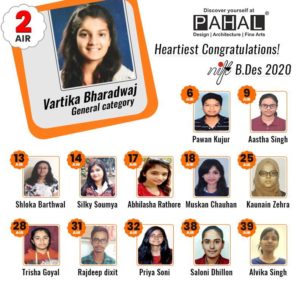 There are abundant government and private universities present in Jaipur which focusses on the School of Architecture and design. Arch College of Design & Business. INIFD Jaipur, Indian Institute of Gems and Jewellery Jaipur, Indian Institute of Crafts & Design, IIFA INDIA are some of the best examples. As per the latest update among top colleges, the second-best private institute; Pearl Academy Jaipur for Fashion Design is recognized by India Today for the past three consecutive years. Pearl awards Professional Diploma from Pearl Academy and B. Des. Degree from Rajasthan ILD Skill University (RISU). Sounds exciting? Enroll in Pahal design and prepare for a better future in design and technology. Get the best practical experience with the rich heritage of Jaipur and let us help you to make your dreams come true in this beautiful city.
Pahal Design Jaipur – Vaishali Nagar
Address:- 2nd Floor, F 18, Gautam Marg, Vaishali Nagar, Jaipur, Rajasthan -302021
Contact Person: Mr. Aman and Mr. Akbar
Contact No: 97721-99911, 0141-6656509
Email: jaipur@pahaldesign.com
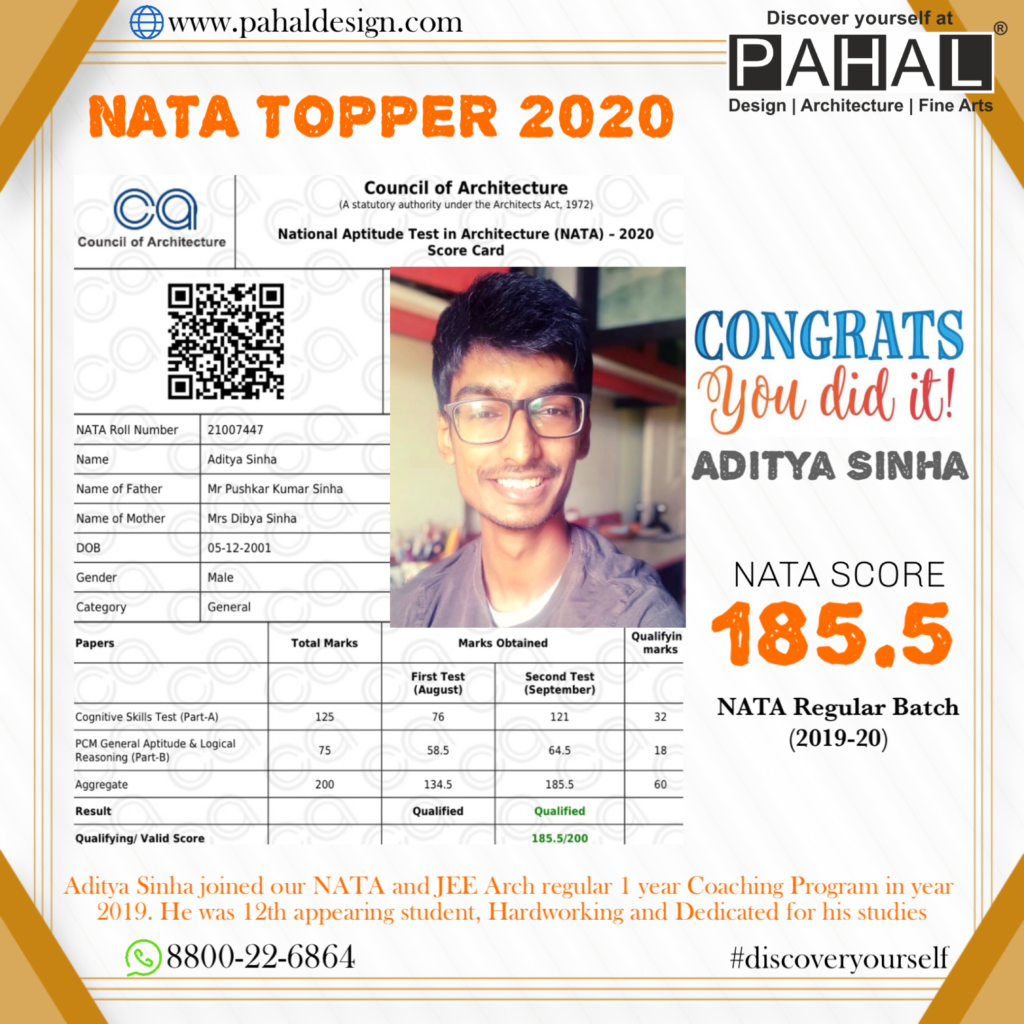 Aditya Sinha, the all India topper of (NATA) 2020 entrance test, believed in the simple philosophy of ‘Be inspired; nothing is impossible’ to achieve this feat. Depending on rigorous efforts, the NATA topper from Delhi shares that he focused on enhancing his analytical skills and practised sketching as much as possible and worked on Architecture Aptitude.
 National Aptitude Test in Architecture (NATA) is being conducted by COA since 2006, in terms of the provisions of CoA (Minimum Standards of Architectural Education) Regulations, 1983, published in the Gazette of India. It is implied that a separate aptitude test in Architecture should be conducted and such test should not be combined with the tests for admissions to Engineering, Pharmacy, Medicine and other disciplines. Being the competent authority for fixing the norms and standards for architectural institutions, COA has the necessary expertise to hold a Common Aptitude Test in Architecture, at national level to provide a single window system for appearing in aptitude test and to facilitate institutions, students and public at large for admission to First year of 5 year B.Arch. Degree Course at all recognized Institutions all over country. The purpose of conducting NATA is to provide a single scheme of examination for holding aptitude test and to facilitate prospective students all over the country to apply for admissions in architecture seats in institutions spread across the country and to avoid appearing in multiple aptitude tests. However, the actual admissions shall be carried out only by the concerned competent authorities of the respective states/institutions based on valid NATA score. The NATA also ensures that the eligibility criteria for admission to five-year Bachelor of Architecture (B.Arch.) degree course, as prescribed by CoA and duly approved by the Central Government, are strictly adhered to and followed all over the country in Architectural Institutions.
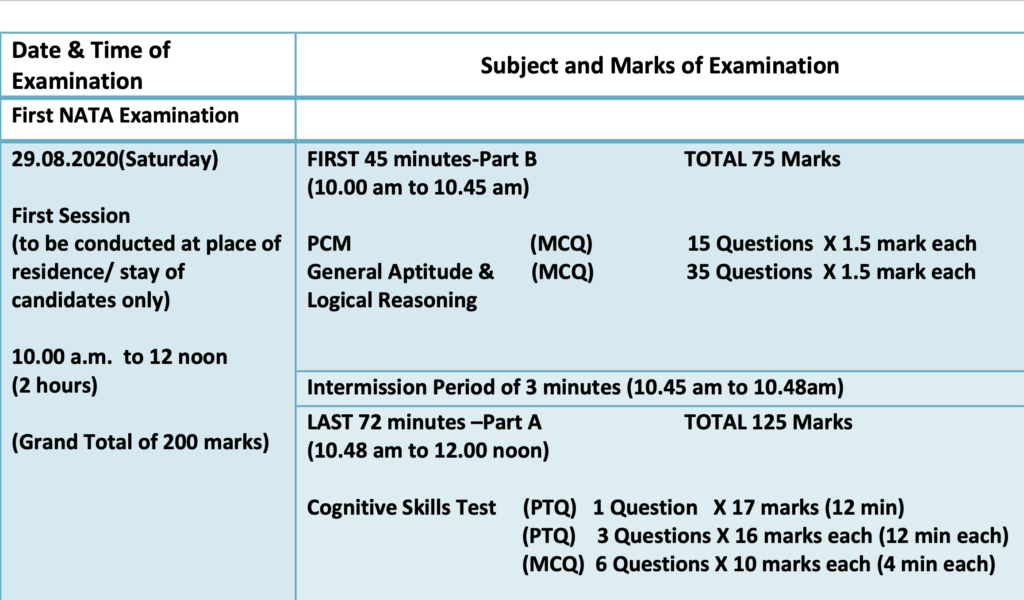
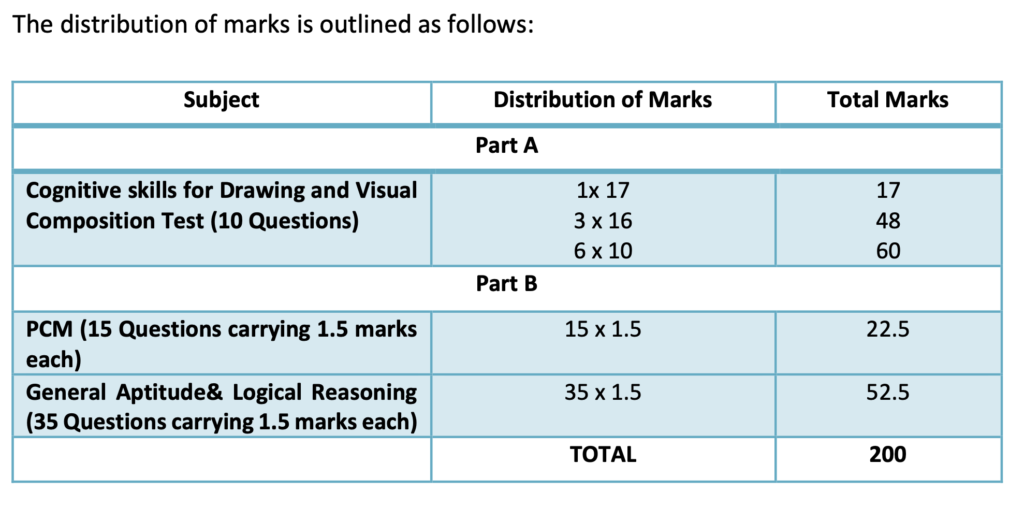
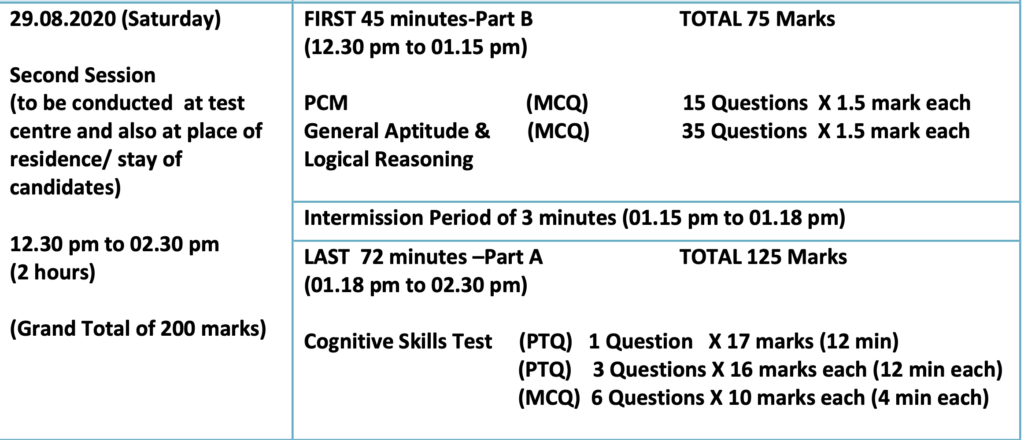
 With the objective of attracting a greater number of bright aspirants for studying Architecture and practicing the same as a profession in future, Council like every year will be conducting NATA-2020 for admission to B.Arch. in the academic session 2020-2021. NATA-2020 shall be conducted twice a year, thus giving opportunity to those students who miss out the first test due to some reason or other or wish to improve upon their NATA score in the first test by re-appearing the second test. Both the first and second test will be conducted on different dates as totally computer-based examinations all over the country.

 students .The Platform will enable students to avail video lectures ,Quiz practice sessions ,any time access to practice sets and tests with more than 5000+ questions .The student will be allotted with unique User Id and Password for their DLP account which they login from Pahal Digital.com or PD app .



 In view of the prevalent situation in the country arising out of pandemic Corona Virus (COVID-19), the competent authority of the Council of Architecture has decided to postpone the ensuing First Test of NATA 2020 examination scheduled for August 01, 2020.
 interpretation and perception to test graphical similarities and other properties; Ability to understand spatial relationship between objects, and to visualize images and scenarios; Tests for cognitive ability: perception, attention, recognition, memory etc.”





 PahalDesign Education Private Ltd. comes up with its Online platform called Pahal Live. Pahal Design is the Original Pioneer in conducting coaching classes for NID, NIFT, NATA, UCEED, CEED, JEE ARCH, Fine Arts, BFA, MFA and Portfolio Preparation for Overseas and Private Colleges. These Online classes can be attended live from the comfort of your home. The program is delivered through a series of pre-scheduled live and recorded online lectures and has extensive course coverage. The objective behind these classes is to provide a real classroom experience at your home and time, thus allowing the students to raise any doubts or queries and have them answered instantly by our expert mentor. Even if you get further any doubt after live session, you may get them answered from the faculty or expert via the dedicated Telegram/WhatsApp group of your batch.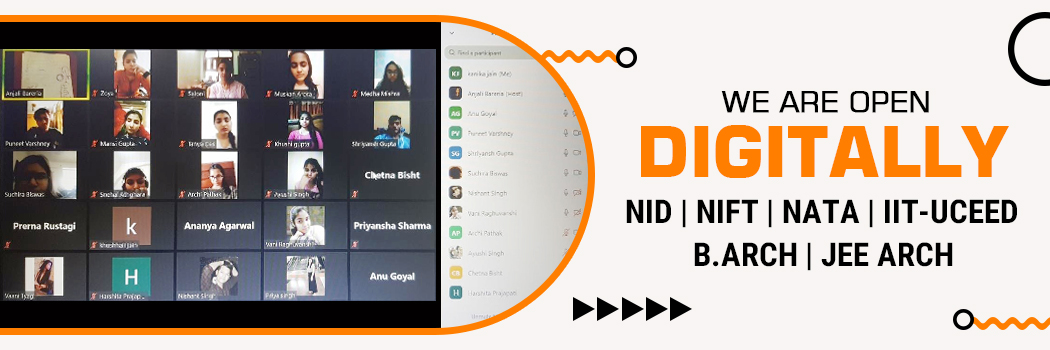

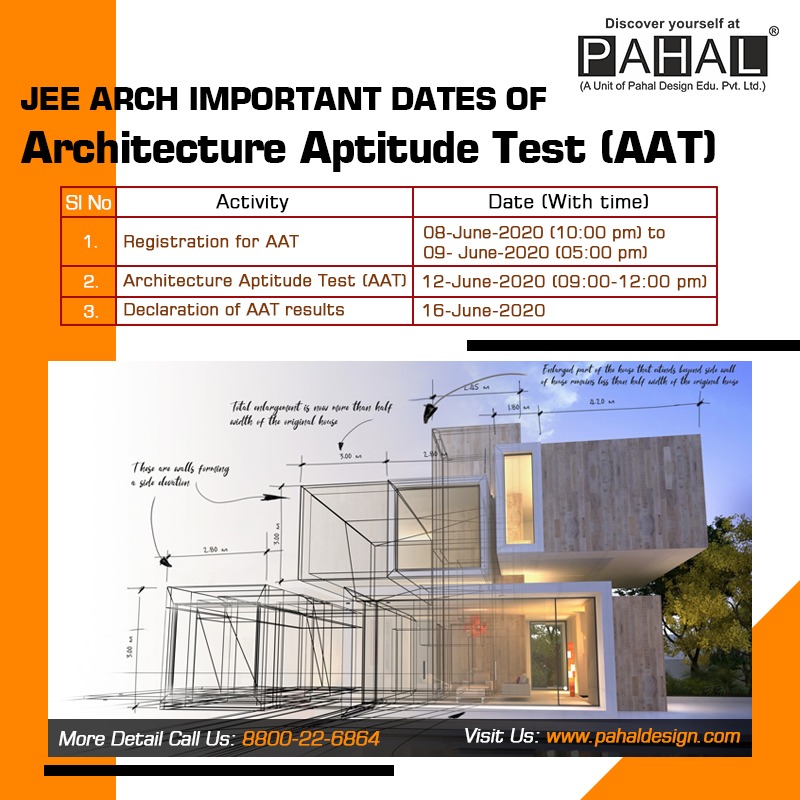 Architecture Aptitude Test (AAT) is for the candidates who qualify JEE Advanced and wish to take admission in the B. Arch. program offered by IIT Kharagpur and IIT Roorkee only. Note that the admission in B.Arch courses is not as per AAT rank or score, it is based on JEE Advanced AIR. However, passing AAT is mandatory for being considered for B.Arch seat allotment. To appear in AAT candidates need to register separately after JEE Advanced 2020 Result. This exam is also held at a national level to appear in which the candidates have to use their JEE Advanced 2020 Admit Card.
 NATA measures the aptitude of the applicant for specific field of study, i.e. Architecture. The test makes an assessment of drawing and observation skills, sense of proportion, aesthetic sensitivity, Physics, Chemistry and Mathematics at 10+2 level and critical thinking ability that have been acquired by the candidate over the past few years and are related to the specific field of study.