College of Art is an institution established in1942 for advanced training in Visual Art (Creative and Applied) leading to the Bachelor of Fine Art Degree of the University of Delhi, further providing advance training in Master in Fine Art course (except Art History) in

  • Applied Art
  • Art History
  • Painting
  • Printmaking
  • Sculpture and
  • Visual Communication.

Visual Communication with emphasis on studio practicals, prescribed theory subjects and research in selected fields.
The College is under the Faculty of Music & Fine Art, University of Delhi, for all academic matters and wholly administrated by the Government of National Capital Territory of Delhi.

The objective of the syllabus/teaching programmes in the College is to achieve an overall refinement of the student perception not confined to the skills of the profession alone but also to create the kind of intellect as well as emotional cultivation to arrive at a level of composite creativity and thought. It aims to prepare the students for creative and applied responsibilities in the world of art and design. In its span of existence of nearly 83 years of the College has gradually grown to ensure an exalted position in the teaching of fine art in the country and comparable to any other art institution in the World. In future proposals, patronage is envisaged to orient our teaching programmes to bond relationship with Industry, Commerce and Professionals including NGOs. This is in addition to the already existing extensive student research development projects, illustrated lectures/demonstrations by invited guests, workshops, educational study tours etc. in all the departments to create a catalyst for a richly rewarding learning experience and the future successes of the students.

The Faculty are practicing artists – painters, sculptors and graphic designers of national, international repute, and also a selected group of visiting Faculty who enrich the teaching programmes with their expertise, thus providing the students with the opportunity of discussion and interaction with eminent and contemporary artists, designers and entrepreneurs.

Hauz Khas (Corporate Office)
Address:- G-13,Ground Floor, Hauz Khas, New Delhi-110016
Nearest Metro Station Hauz Khas Gate No-3, Mayfair Garden / RBI Colony
Landmark:
Near Nirula’s
Contact No: 8800-22-6864
Contact Person: Karishma Gupta
Email: corporate@pahaldesign.com

Architecture is a multifaceted profession that combines creativity, engineering, and management to create functional and aesthetically pleasant spaces and Architects are responsible for designing buildings, considering factors like safety, functionality, sustainability, culture, and the two most essential one’s time and money. They need to work holistically to get the desired results. Architecture is not just about designing, but also knowing how to run a business, and how to create a social impact. It requires a strong foundation in both art and business, making it a dynamic and rewarding profession. The field is diverse having various options to choose from as a career in architecture such as interior designing, content writing, graphic designing, Municipal jobs, and more, making it a highly desirable profession.

NATA is an aptitude test that assesses a candidate’s innate ability through a variety of testing formats and cannot be taught, learnt or induced. NATA measures the aptitude of the applicant for specific field of study i.e. Architecture, through assessment of cognitive skills, visual perception and aesthetic sensitivity tests, logical reasoning and critical thinking ability, etc., besides the learning that the candidate has acquired over the past few years and is related to the specific field of study.

Architecture is a noble profession which deals with the well-being of human beings and Society. Its routes are as ancient as the civilization. Popularly defined as combination of Arts and Technology, it ensures creation of built environment ensuring health, hygiene, safety and happiness of the occupants as well as visitors.

The career of an Architect is very promising and satisfying, being a ‘Professional’, one is capable of starting the practice, in the modern terms ‘start-up’ at the earlier stage of life with minimal investment. Hence, Architects are popularly known as ‘Job Givers’ rather than ‘Job Seekers’.

As aptly described by Hon’ble Prime Minister, Shri Narendra Modi Ji, this is the ‘Amrit Kal’ of Indian Civilisation and in the days to come, we would be the biggest service providers of the world. The construction and infrastructure activities across India are at its peak and the Architects have to positively contribute to the development of Nation as never before.

NATA is the first step towards this glorious career and those who wish to join Architecture profession will have to qualify NATA, a test especially designed to assess the aptitude of the candidate towards architecture profession.

The candidates can appear for maximum of 3 attempts in NATA 2024 in one academic year. The best score out of all the attempts shall be considered for declaration of results. The score of NATA Test would be valid for a period of 2 academic years.

Examination shall be conducted on all weekends starting from April to July, 2024 in two sessions, subject to number of candidates registered for the session. The candidates need to indicate their preference for session & city of examination while registering at NATA portal www.nata. in. The session during which the candidate will take the test as well as the Test Centres, shall be allotted by the Council, as far as possible, on the basis of cities and sessions preferred by the candidate in the application form. However, the decision of the Council in allotting Test Centre and session to candidates shall be final.

Qualifying Criteria


The Qualifying Marks for the NATA 2024 would be based on the following Rules:

  1. A minimum of 20 marks must be secured in PART A
  2. A minimum of 30 marks must be secured in PART B
  3. Overall qualifying marks for NATA 2024 shall be 70 marks out of 200 as aggregate of Part A and Part B.

IMPORTANT LINKS

Pahal Design NATA Course 2024 :

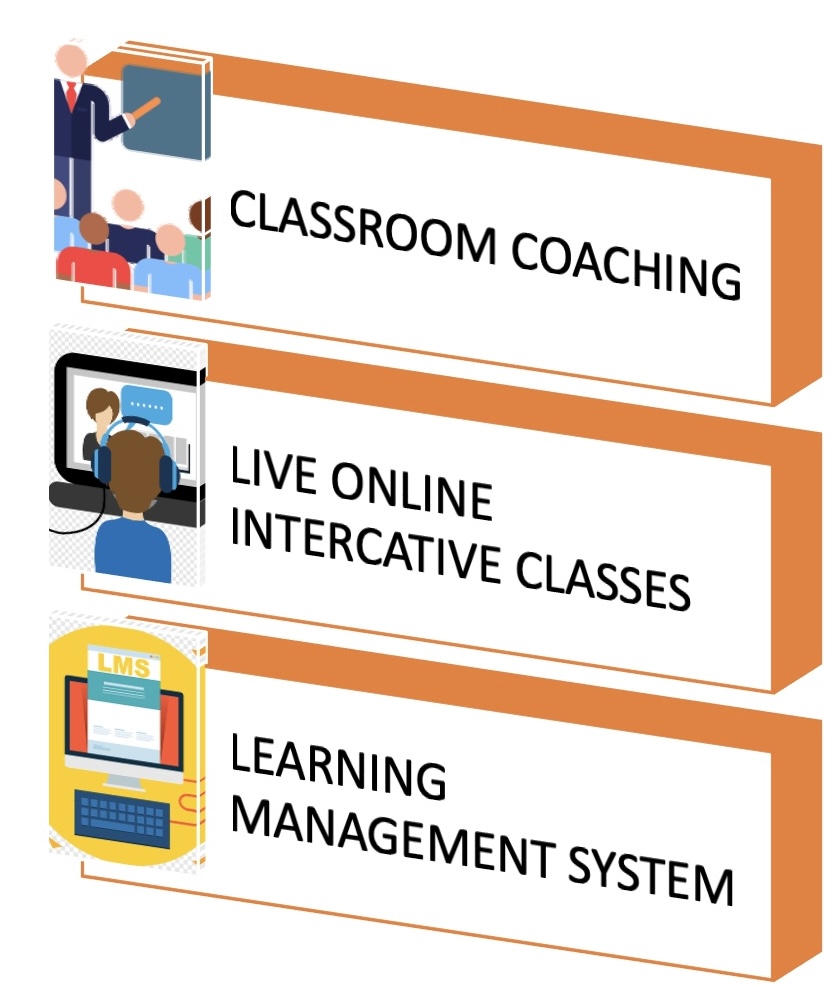
  1. Classroom Coaching : Pahal Design is offering Classroom coaching at 30 Centres across India.

https://pahaldesign.com/contact-us/

  1. Live Online Intercative Classes : If you want Online Classes then this is available with ffull study material.
  2. Learning Management System : The students can solve assignments, Quizzes, NATA Exam papers, assignments using their ipad, Tablet or Laptop anytime anywhere.
  3. Full Study Material – NATA Study Material is available at pahaldlp.com
Indira Nagar[Bengaluru Head Office]

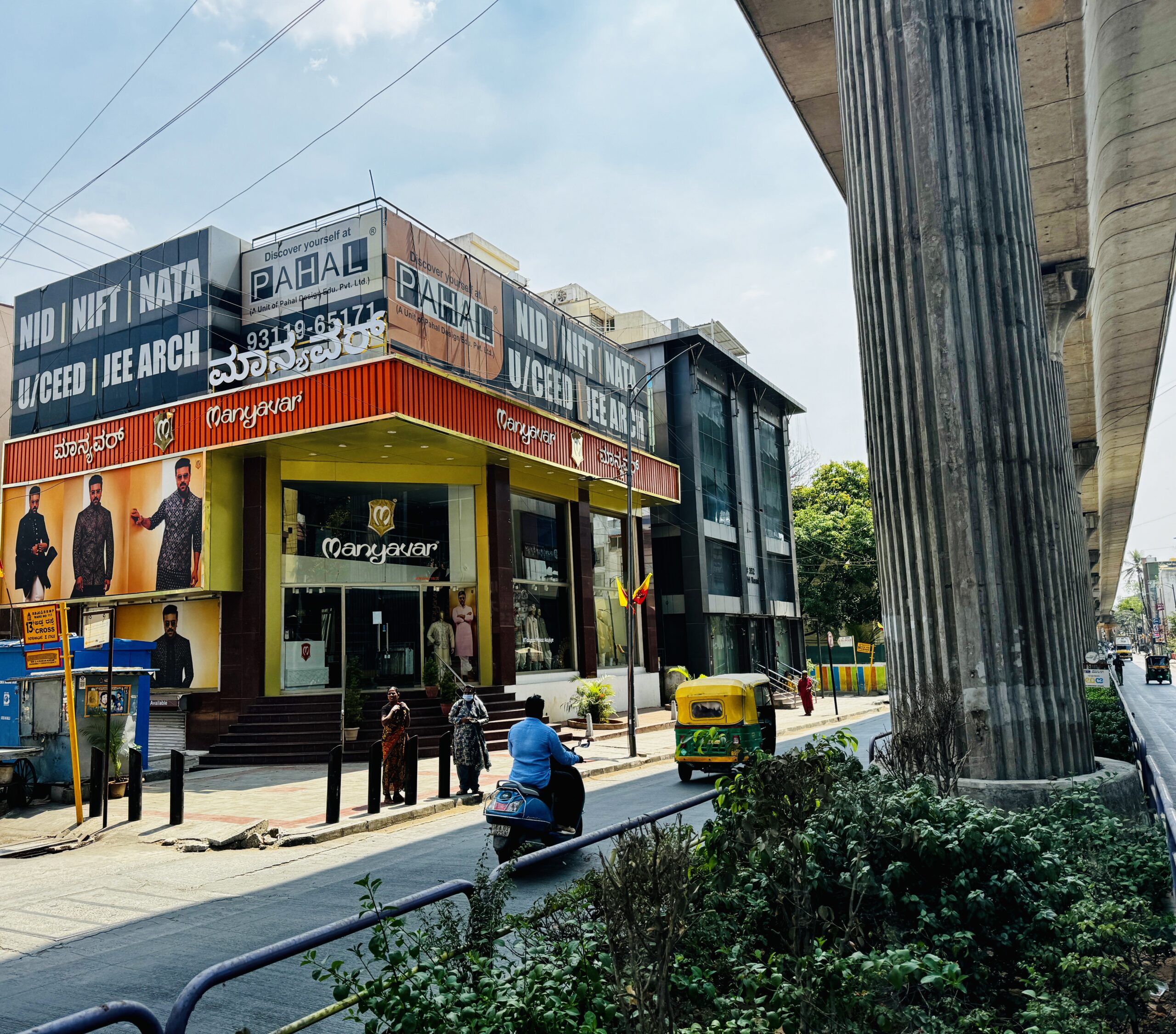
Address:- 1st Floor, 393, Chinmaya Mission Hospital Rd, near HDFC bank,2nd Stage, Binnamangala, Hoysala Nagar, Indiranagar, Bengaluru – 560038, Above Manyavar
Contact No: 9821-651-399
Contact Person: Ms.Etisha
Email: corporate@pahaldesign.com

Admissions to the Bachelor of Design (BDes) programmes at IIT Bombay, IIT Delhi, IIT Guwahati, IIT Hyderabad, IIT Roorkee and IIITDM Jabalpur are done through the Undergraduate Common Entrance Exam for Design (UCEED). Many institutes also recognize the UCEED Score Card for admissions to their BDes program. Only those students who have passed Class XII (or equivalent) in 2023 in all subjects or are appearing in 2024 in ANY STREAM (Science, Commerce, or Arts & Humanities) for the first time are eligible to appear for the UCEED 2024. UCEED 2024 score is valid only for admission to the programmes in the academic year 2024-2025.

The BDes programme in IDC emphasises skill-based components in the fundamentals of design in the first two years. In the third year, the students have a choice of a large number of elective courses that provide an opportunity to specialize in the various areas of design that IDC is known for. The potential for design lies in solving real-world problems. A series of design projects (one in each semester), often enriched through field trips and real-world experiences, enables students to engage with design issues and develop an understanding of design methodology. In the last two semesters of the BDes programme, the students do semester-long degree projects that demonstrate the abilities that they have acquired.

UCEED is a test centre-based examination and has two parts: Part-A is computer-based and Part-B contains question related to sketching that needs to be attempted on the provided sheet. It is compulsory for the candidates to attempt both the parts in the given time.

The total time for the examination (that includes both Part-A and Part-B) is THREE hours.

UCEED 2024 PARTICIPATING INSTITUTES

  • Indian Institute of Technology Bombay (IITB),
  • Indian Institute of Technology Delhi (IITD),
  • Indian Institute of Technology Guwahati (IITG),
  • Indian Institute of Technology Hyderabad (IITH),
  • Indian Institute of Technology Roorkee (IITR)
  • Indian Institute of Information Technology Design and Manufacturing Jabalpur (IIITDMJ)

IIT – UCEED SYLLABUS

UCEED 2024 will have two parts.
Part-A will have questions on the following topics:

  • Visualization and spatial reasoning: Ability to visualise and transform 2D shapes and 3D objects and their spatial relationships.
  • Practical and scientific knowledge: Know-how of scientific principles and everyday objects.
  • Observation and design sensitivity: The capacity to detect concealed properties in daily life and think critically about them. Attention to detail, classification, analysis, inference and prediction.
  • Environment and society: General awareness of environmental, social and cultural connections with design.
  • Analytical and logical reasoning: Ability to analyse qualitative and quantitative information.
  • Language: Proficiency in reading and comprehending Standard English.
  • Creativity: Grasp of verbal and non-verbal analogies, metaphors, signs and symbols. Part-B will have questions on the following topics:

Drawing: Ability to draw products, people or scenes in proportion with good line quality, composition, proportion, perspective and shading.

Design aptitude: Capability to practically and appropriately respond to problems/situations with ingenuity and empathy.

UCEED 2015-24 Original Last 10 Years Exam Papers


Indira Nagar[Bengaluru Head Office]

Address:- 1st Floor, 393, Chinmaya Mission Hospital Rd, near HDFC bank,2nd Stage, Binnamangala, Hoysala Nagar, Indiranagar, Bengaluru – 560038, Above Manyavar
Contact No: 9821-651-399
Contact Person: Ms.Etisha
Email: corporate@pahaldesign.com


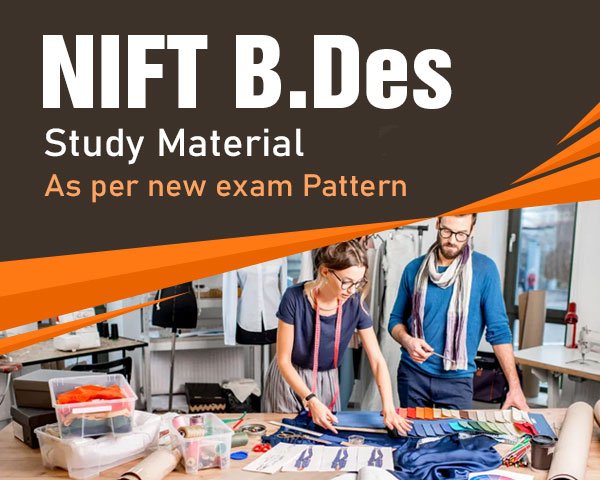
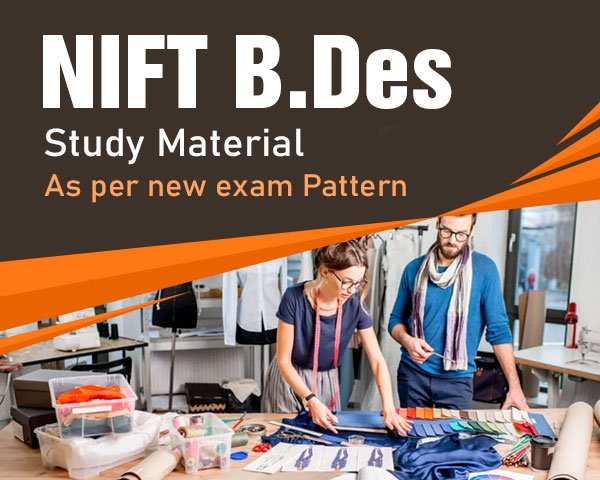
NIFT (B.Des)

4,000.00

Total Booklets

  1.  Quantitative Ability – 7 Booklets
  2.  Verbal & Analytical Ability – 4 Booklets
  3.  Communication Ability & English Comprehension – 2 Booklets
  4. General Knowledge and Current Affairs – Monthly
  5. Creative Booklet – 5 (1 Booklet in Hard Copy and 4 Booklets on LMS )
  6. Online Portal Access – 24 x 7 
  7. NIFT B.Des Previous Year Question Papers – The last 5 years’ original exam papers will be available over LMS.
  8. 5 Mock Tests as per the new Exam Pattern will be available over LMS.
  9. Monthly Tests will be available over LMS.
  10. NIFT Guide Book. 

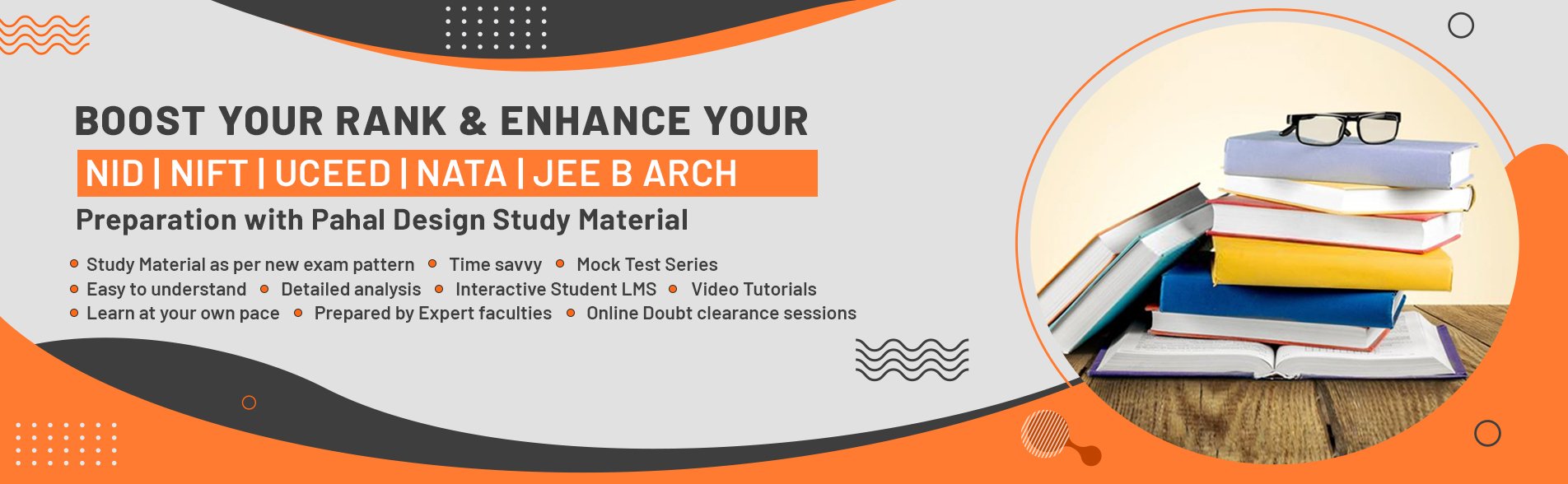
Key Features of DLP by Pahal Design

  1. Study Material as per new exam pattern
  2. Detailed analysis
  3. Prepared by Expert faculties
  4. Easy to understand
  5. Time savvy
  6. Interactive student LMS
  7. Learn at your own pace
  8. Mock Test Series

S.N. Course Subjects Study Materials Description
1. NIFT (B.Des)  Quantitative Ability Booklet – 1 Booklet – 2 Booklet – 3 Booklet – 4 Booklet – 5 Booklet – 6 Booklet – 7 Quantitative Ability 7 booklets have various categories that deal with all important topics with concept, explanation, practice exercises, and Model Test Papers. It has important tips and tricks which facilitate students to increase the solving speed in a superior way.
  Verbal & Analytical Ability Booklet – 1 Booklet – 2 Booklet – 3 Booklet – 4 These 4 booklets include all topics of analytical reasoning which help students to identify key information, apply logic and find patterns.
Communication Ability & English Comprehension Booklet – 1 Booklet – 2 This section is very important for NIFT B.des exam. Booklet 1 & 2 will cover all the topics with intensive practice exercises.
General Knowledge and Current Affairs Monthly Wise The GK and CA are made by experts on latest NIFT exam pattern. Monthly booklet will be shared with the students which will have all important events, facts and happenings in the country and across the globe. It also has exclusive series of fashion and business news. Available on LMS.
  Creative Workbook – 1 Workbook – 2 Workbook – 3 Workbook – 4 Workbook – 5 Workbooks 1 and 3 will be available in hard copy. workbooks 2, 4 and 5 will be available over LMS.
NIFT B.Des Previous Year Question Papers   The last 5 years original exam papers will be available over LMS.

2. Test Series (A) Monthly Test: The monthly test enables students to track their progress in most efficient way and pay attention to the section required. (B) Mock Test: It’s mandatory for all students to attempt mock test after competition of syllabus. The student can appear the mock test online. Each mock test will give you complete performance analysis, All India Ranking, practice to updated exam pattern, and section-wise performance report.

3. Doubt clearance & Feedback sessions: Students can attend doubt clearance sessions with our expert by booking their slot at nearest Pahal design centre or choose online mode for same.

4. Digital Learning Program (DLP): Access to digital learning platform which has complete learning solution for the students . The Platform will enable students to avail video lectures , Quiz practice sessions, any time access to practice sets and tests with more than 3000+ questions. The student will be allotted with unique User Id and Password for their DLP account which they login from pahal.design/login/index.php.

5. Expert Team: Each student will get expert guidance for design career and will be assisted to explore their course interest. The team will also analyse and review the student’s performance and help them to improve their performance.

6. Preparation for other colleges: Students can get connect to us for the design college counseling or inform us regarding the colleges they are applying for and Pahal Design Team will provide complete guidance according to the updated exam pattern.

7. Situation Test Kit: The Pahal Design study material includes the preparation for the Nift second phase as well. Once student gets the result for NIFT first-round exam, the Situation Test kit gets delivered at his/her doorstep.

Features of Situation Test Kit
Situation Test  Kit * Situation Test Hand Book * Video for step-by-step preparation * Access to LIVE classes *Access to classroom sessions. * E-book on creative write-up guidance * Last 15 years of exam papers * Material kit * Practice Set * Mock Test * Feedback and doubt clearance session.

NID (B.Des)

5,000.00

Total Booklets

  1.  Quantitative Ability – 7 Booklets
  2.  Verbal & Analytical Ability – 4 Booklets
  3.  Non –Verbal reasoning – 1 Booklet
  4.  NID – Aptitude – 2 Booklet
  5.  Communication Ability & English Comprehension – 2 Booklets
  6.  General Knowledge and Current Affairs – Monthly
  7.  Creative Booklet – 3 
  8.  Online Portal Access – 24 x 7 
  9.  NID B.Des Previous Year Question Papers – The last 5 years original exam papers will be available over LMS.
  10.  NID Guide book for Design
  11.  5 Mock Tests as per the new Exam Pattern will be over LMS.
  12.  Monthly Tests will be conducted over LMS.


Key Features of DLP by Pahal Design

  1. Study Material as per new exam pattern
  2. Detailed analysis
  3. Prepared by Expert faculties
  4. Easy to understand
  5. Time savvy
  6. Interactive student LMS
  7. Learn at your own pace
  8. Mock Test Series

Sl No. Course Subject Study materials Descriptions
1. NID (B.Des) 


 Quantitative Ability Booklet – 1
Booklet – 2
Booklet – 3
Booklet – 4
Booklet – 5
Booklet – 6
Booklet – 7
Quantitative Ability- 7 booklets have various categories that deals with all important topics with concept, explanation, practice exercises and Model Test Papers. It has important tips and tricks which facilitate student to increase the solving speed in a superior way.
    Communication Ability & English Comprehension Booklet – 1
Booklet – 2
Booklet 1 and 2 will cover all the topics which are important for NID exam with intensive practice exercises.
    Verbal & Analytical reasoning Booklet – 1
Booklet – 2
Booklet – 3
Booklet – 4
These 4 booklets include all topics of analytical reasoning which help students to identify key information, apply logic, and find patterns.
    Non –Verbal reasoning Booklet – 1  
    NID – Aptitude Booklet – 1
Booklet – 2
Fine Arts Aptitude booklet 1 (Hard Copy) Booklet 2 Available on LMS.
     General Knowledge and Current Affairs Month Wise The GK and CA are made by experts on latest NID exam pattern. Monthly booklet will be shared with the students which will have all  Important events, facts and happenings in the country and across the globe.
    Creative Creative Descriptive Booklet. 

Workbook – 1
Workbook – 2
Workbook – 3

Book provides a brief topic-wise description with suitable illustration and references.
Workbooks 1 and 3 will be available in hard copy. Workbook 2 will be available over LMS.
    NID B.Des Previous Year Question Papers   The last 5 years’ original exam papers will be available over LMS.
    NID Guide Book Booklet 1 The booklet will provide an overview of the National Institute of Design.

2. Test Series :
(A) Monthly Test:  The monthly test enables student to track their progress in most efficient way and pay attention to the section required.
(B) Mock Test: It’s mandatory for all students to attempt mock test after completion of syllabus. The student can appear the mock test online. Each mock test will give you complete performance analysis, All India Ranking, practice to updated exam pattern, and section-wise performance report.
3. Doubt clearance & Feedback sessions:  Students can attend doubt clearance session with our expert by booking their slot at nearest Pahal design centre or choose online mode for the same.
4. Digital Learning Program (DLP): Access to digital learning platform which has a complete learning solution for the students. The Platform will enable students to avail video lectures, Quiz practice sessions, any time access to practice sets and tests with more than 5000+ questions. The student will be allotted with unique User Id and Password for their DLP account which they login from pahal.design/login/index.php
5. Expert Team: Each student will get expert guidance for design career and will be assisted to explore their course interest. The team will also analyse and review the student’s performance and help them to improve their performance.
6. Preparation for other Design colleges: Students can get connect to us for the design college counseling or inform us regarding the colleges they are applying for and Pahal Design Team will provide complete guidance according to the updated exam pattern.
7. DAT Mains: The Pahal Design study material includes the preparation for the NiID second phase as well. Once student gets the result for NID first-round exam, the studio test kit gets delivered to his/her doorstep.

DAT Mains preparation includes: 

1. DAT Mains Hand Book.
2. Video for step by step preparation.
3. Access to LIVE classes.
4. Access to classroom sessions on prior appointment.
5. 3D Model Making and Material Manipulation/Studio Test preparation.
6. Studio Test Material kit.
7. Design Concept based practice exercises.
8. Practice exercises on Observation Tests/Audio-Visuals & Visualization Tests.
9. Portfolio Development under design expert supervision.
10. LIVE Interactive /interview practice sessions.
11. E-book on creative write up guidance.
12. Previous years exam papers.
13. Practice Set.
14. Mock Test-10.
15. Feedback and doubt clearance sessions.

Hauz Khas (Corporate Office)
Address:- G-13,Ground Floor, Hauz Khas, New Delhi-110016
Nearest Metro Station Hauz Khas Gate No-3, Mayfair Garden / RBI Colony
Landmark:
Near Nirula’s
Contact No: 8800-22-6864
Email: corporate@pahaldesign.com

Pahal Design has been training and mentoring students for more than 25 years in Design and Architecture, like NID, NIFT, NATA, UCEED, JEE Paper 2, BFA. With 7 centres in Delhi, no students is too far from Pahal Design Centre, each of which is located at just walking distance from the metro. Pahal Design offering Weekdays and Weekends Batch for the students. We have Classroom Coaching, Online Live Coaching and Study material available for the students. The batch size of the classes conducted here is kept small so that each student receives individual attention by the faculty and all their doubts are resolved before the exam. 

National Institute of Design is internationally acclaimed as one of the finest educational and research institutions for Industrial, Communication, Textile and IT Integrated (Experiential) Design. It is an autonomous institution under the aegis of the Ministry of Commerce and Industry, Government of India. NID has been declared ‘Institution of National Importance’ by the Act of Parliament, by virtue of the National Institute of Design Act 2014.

Pahal Design IIT UCEED | NID Course 2024 :

  1. Classroom Coaching : Pahal Design is offering Classroom coaching at 30 Centres across India.

https://pahaldesign.com/contact-us/

  1. Live Online Intercative Classes : If you want Online Classes then this is available with full study material.
  2. Learning Management System : The students can solve assignments, Quizzes, UCEED | NID Exam papers, assignments using their ipad, Tablet or Laptop anytime anywhere.
  3. Full Study Material – IIT UCEED | NID Study Material is available at pahaldlp.com
WEST DELHI
Janakpuri

Address:- 2nd Floor, S-4/63A, Shivaji Marg, New Mahavir Nagar, Janakpuri, New Delhi – 110018
Opposite – Metro Pillar No. 552, Landmark – Janakpuri East Metro Station
Contact Person: Mr. Dev Budhani
Contact No: 90311-70312
Email: corporate@pahaldesign.com


Pahal Design Bangalore Centre Offers Weekdays and Weekends batch for CEED Students. Weekends Batches are generally suitable for working Professionals or Final year appearing students. CEED Students Bangalore can also Join Classroom Coaching and Online Coaching. Pahal Design Bangalore Centre is at heart of city which is Indira Nagar.

The objective of the Common Entrance Exam for Design (CEED) is to assess the candidate’s aptitude for design involving visual perception ability, drawing skills, logical reasoning, creativity, communication, and problem solving skills. CEED is conducted by IIT Bombay. It is a qualifying examination for admission to Master of Design (MDes) programmes at IISc Bangalore, IIT Bombay, IIT Delhi, IIT Guwahati, IIT Hyderabad, IIT Jodhpur, IIT Kanpur, IIT Roorkee, IIITDM Jabalpur, IIITDM Kancheepuram and PhD programmes at several IITs and design schools. Qualifying in CEED alone does not guarantee admission to any of these programmes. Admitting institutes may conduct further tests and/or interviews for the final selection/admission.

CEED 2024 examination will consist of two parts, Part-A and Part-B. Candidates must attempt questions from both the parts.

Part-A contains objective questions of three types: Numerical Answer Type (NAT), Multiple Choice Question (MCQ), and Multiple Select Question (MSQ). Answers to Part-A have to be given on the computer. These will be design aptitude type questions that evaluate visual and spatial ability, environmental and social awareness, analytical and logical reasoning, language, observation and design sensitivity of the candidates.

Part-B consists of five questions that are aimed at testing design, drawing and writing skills. The questions in Part-B will be displayed on the computer screen and the answers are to be written in the answer book provided by the invigilator.

The final CEED score will be calculated by giving 25% weightage to marks obtained in Part-A and 75% weightage to marks obtained in Part-B, after the above calculation.

CEED qualified students are eligible to apply for the MDes and PhD programmes in various institutes. The CEED 2024 score is valid for a period of one year from the date of declaration of the result.

EXAMINATION CITIES

CEED 2024 will be held in the following cities :

Ahmedabad, Bengaluru, Bhopal, Bhubaneswar, Chandigarh, Coimbatore, Chennai, Dehradun, Delhi, Ernakulam, Guwahati, Hyderabad, Jaipur, Kolkata, Kozhikode, Lucknow, Mumbai, Mysuru, Nagpur, Noida, Panaji, Patna, Pune, Raipur, Thiruvananthapuram, Thrissur, and Visakhapatnam.

Question Paper and Evaluation

Question Paper Structure
Part-A (Total marks: 150; Maximum time: 1 hour)

  • This part will be administered through a computer-based test.
  • This part will consist of three sections.

    Section 1: NAT (Numerical Answer Type): 8 questions (4 marks each; no negative marks). For these questions, the answer is a number that needs to be entered using a virtual keyboard on the computer screen. No choices will be shown for these questions.

    Section 2: MSQ (Multiple Select Question): 10 questions. Each MSQ may have one or more than one correct choice(s) out of the four given. The following is the marking scheme:

    Full Marks: + 4 If only (all) the correct option(s) is(are) chosen and NONE of the incorrect options is chosen.

    Partial Marks: + 3 If all the four options are correct but ONLY three options are chosen.

    Partial Marks: + 2 If three or more options are correct but ONLY two options are chosen, both of which are correct and NONE of the incorrect options is chosen.

    Partial Marks: + 1 If two or more options are correct but ONLY one option is chosen and it is a correct option and NONE of the incorrect options is chosen.

    Zero Marks: 0 If NONE of the options is chosen (i.e., the question is unanswered).

    Negative Marks: -1 In all other cases.

    Section 3: MCQ (Multiple Choice Question): 26 questions (3 marks each for the correct answer; 0.5 negative marks for incorrect answers). Each MCQ will have four choices, out of which only one is the correct answer.

Part-B (Total marks: 100; Maximum time: 2 hours)
Part-B consists of five questions to test design, drawing and writing skills. The questions in Part-B will be displayed on the computer screen, and the answers should be written in the answer book provided by the invigilator (NOT into the Computer). However, you need to tick the appropriate box on the computer screen to indicate that you have answered the same. In the case of PwD candidates availing the use of a scribe, assistance in attempting Part-B is not permitted, as the question is aimed at evaluating their drawing skill.

  • Part-B answer booklets will be collected at the end of the examination.
  • Part-B questions are mandatory.
  • The entire paper (Part-A and Part-B) must be finished within the stipulated time for each part.

Eligibility

Candidates must have completed a degree/diploma/post graduate degree programme of minimum THREE years (after 10+2 level), or must be appearing for the final examination of such a program by July 2024, or must have passed the GD Arts diploma programme (10+5 level) by July 2024.

Note that the eligibility criteria for admission to various institutes may differ from those for appearing for CEED. Before applying for CEED, candidates must check whether they meet the required eligibility criteria for admission to various institutes.

There is no age limit to appear for CEED. Also, a candidate can appear for CEED any number of times.

KARNATAKA
 
Indira Nagar[Bengaluru Head Office]

Address:- 1st Floor, 393, Chinmaya Mission Hospital Rd, near HDFC bank,2nd Stage, Binnamangala, Hoysala Nagar, Indiranagar, Bengaluru – 560038, Above Manyavar
Contact No: 9821-651-39
Contact Person: Ms. Purva
Email: corporate@pahaldesign.com

Online Counselling


UCEED 2024 will be conducted by the Indian Institute of Technology Bombay under the guidance of the UCEED-CEED Implementation Committee 2024 (henceforth referred to as the UCI Committee).

UCEED 2024 is open to all nationals (Indian/Foreign). Candidates seeking admission to the Bachelor’s Degree programme in Design (BDes) at Indian Institute of Technology Bombay (IITB), Indian Institute of Technology Delhi (IITD), Indian Institute of Technology Guwahati (IITG), Indian Institute of Technology Hyderabad (IITH), Indian Institute of Technology Roorkee (IITR) and Indian Institute of Information Technology Design and Manufacturing Jabalpur (IIITDMJ), must appear for UCEED 2024.

Pahal Design Bangalore is offering weekdays and weekends batch. Students can join Classroom Coaching and Online Coaching.

Syllabus

UCEED 2024 will have two parts.

Part-A will have questions from the following topics:

  • Visualization and spatial reasoning: Ability to visualise and transform 2D shapes and 3D objects and their spatial relationships.
  • Practical and scientific knowledge: Know-how of scientific principles and everyday objects.
  • Observation and design sensitivity: The capacity to detect concealed properties in daily life and think critically about them. Attention to detail, classification, analysis, inference and prediction.
  • Environment and society: General awareness of environmental, social and cultural connections with design.
  • Analytical and logical reasoning: Ability to analyse qualitative and quantitative information.
  • Language: Proficiency in reading and comprehending Standard English.
  • Creativity: Grasp of verbal and non-verbal analogies, metaphors, signs and symbols.

Part-B will have questions on the following topics:

  • Drawing: Ability to draw products, people or scenes in proportion with good line quality, composition, proportion, perspective and shading.
  • Design aptitude: Capability to practically and appropriately respond to problems/situations with ingenuity and empathy.

UCEED 2024 will be held only in the following 27 cities in India:

Ahmedabad, Bengaluru, Bhopal, Bhubaneswar, Chandigarh, Chennai, Coimbatore, Dehradun, Delhi, Ernakulam, Guwahati, Hyderabad, Jaipur, Kolkata, Kozhikode, Lucknow, Mumbai, Mysuru, Nagpur, Noida, Panaji, Patna, Pune, Raipur, Thiruvananthapuram, Thrissur, and Visakhapatnam.

Question Paper Structure for UCEED 2024

  • There will be ONE question paper of total THREE hours duration.
  • The question paper will be in English only.
  • The question paper will carry a total of 300 marks.
  • The question paper will consist of two parts: Part-A and Part-B. It is compulsory to attempt questions from both the parts.
  • Utmost care is taken to prepare an error free question paper. However, if an error is detected in the question paper, the UCI Committee shall take an appropriate decision after the examination, which shall be final.

Details of the two parts of the question paper are given below:

Part-A (Total marks: 200; Maximum time: 2 hours)

  • This part will be administered through a computer-based test.
  • This part will consist of three sections.

Section 1:NAT (Numerical Answer Type): 14 questions (4 marks each; no negative marks).
For these questions, the answer is a number that needs to be entered using a virtual keyboard on the computer screen. No choices will be shown for these questions.

Section 2: MSQ (Multiple Select Question): 15 questions.
Each MSQ may have one or more than one correct choice(s) out of the four given. The following is the marking scheme:

Full Marks: + 4

    • If only (all) the correct option(s) is(are) chosen and NONE of the incorrect options is chosen.

Partial Marks: + 3

    • If all the four options are correct but ONLY three options are chosen and NONE of the incorrect options is chosen.

Partial Marks: + 2

    • If three or more options are correct but ONLY two options are chosen, both of which are correct and NONE of the incorrect options is chosen.

Partial Marks: + 1

    • If two or more options are correct but ONLY one option is chosen and it is a correct option and NONE of the incorrect options is chosen

Zero Marks: 0

    • If none of the options is chosen (i.e., the question is unanswered).

Negative Marks: -1

    • In all other cases.

Section 3: MCQ (Multiple Choice Question): 28 questions (3 marks each for the correct answer; 0.71 negative marks for incorrect answers). Each MCQ will have four choices, out of which only one is the correct answer..

Part-B (Total marks: 100; Maximum time: 1 hour)

  • Part-B consists of TWO questions to test the candidates’ drawing skills and design aptitude. This will require subjective evaluation. The questions in Part-B will be displayed on the computer screen, and the answer must be written/drawn in the answer book provided by the invigilator. In the case of PwD candidates availing the use of a scribe, assistance in attempting Part-B is not permitted, as the question is aimed at evaluating their drawing skill.
  • Part-B answer booklets will be collected at the end of the examination.
  • Part-B question is mandatory.
  • The entire paper (Part-A and Part-B) must be finished within the stipulated time for each part.
KARNATAKA
 
Indira Nagar – Bengaluru Head Office

Address:- 1st Floor, 393, Chinmaya Mission Hospital Rd, near HDFC bank,2nd Stage, Binnamangala, Hoysala Nagar, Indiranagar, Bengaluru – 560038, Above Manyavar
Contact No: 9821-651-399
Contact Person: Ms. Purva
Email: corporate@pahaldesign.com

Online Counselling


Today the National Institute of Design is internationally acclaimed as one of the finest educational and research institutions for Industrial, Communication, Textile and IT Integrated (Experiential) Design. It is an autonomous institution under the aegis of the Ministry of Commerce and Industry, Government of India. NID has been declared ‘Institution of National Importance’ by the Act of Parliament, by virtue of the National Institute of Design Act 2014.

Pahal Design NID Course 2024 :
 
  1. Classroom Coaching : Pahal Design is offering Classroom coaching at 30 Centres across India.

https://pahaldesign.com/contact-us/

  1. Live Online Interactive Classes : If you want Online Classes then this is available with ffull study material.
  2. Learning Management System : The students can solve assignments, Quizzes, NID Exam papers, assignments using their ipad, Tablet or Laptop anytime anywhere.
  3. Full Study Material – NID Study Material is available at pahaldlp.com

NID Coaching in Bangalore offers weekdays and weekends Batch where NID and IIT Alumni for the classes. Pahal Design is a pioneer in education for Classroom Coaching as well as Online Coaching with 30 Centres across India.

Indira Nagar[Bengaluru Head Office]

Address:- 1st Floor, 393, Chinmaya Mission Hospital Rd, near HDFC bank,2nd Stage, Binnamangala, Hoysala Nagar, Indiranagar, Bengaluru – 560038, Above Manyavar
Contact No: 9821-651-399
Contact Person: Ms. Purva
Email: corporate@pahaldesign.com

https://pahaldesign.com/online-counselling/

India’s Best Design & Architecture Coaching award 1 2024

India’s Best Design & Architecture Coaching award 2024


National Aptitude Test in Architecture (NATA) is being conducted by COA since 2006, to qualify for the admission to Bachelor of Architecture.

NATA measures the aptitude of the applicant for specific field of study, i.e., Architecture, through assessment of cognitive skills, visual perception and aesthetic sensitivity tests, logical reasoning and critical thinking ability, etc., besides the learning that the candidate has acquired over the past years.

The candidates can appear for maximum of 3 attempts in NATA 2024 in one academic year. The best score out of all the attempts shall be considered for declaration of results. The score of NATA Test would be valid for a period of 2 academic years.

Examination shall be conducted on all weekends starting from April to July, 2024 in two sessions, subject to number of candidates registered for the session.

The medium of Aptitude test shall be in English and Hindi.

The aptitude of the candidate will be assessed using some or all of the following:

PART-A

Drawing and Composition Test

This is one and half hour (90 minutes) – 80 Marks Test where candidate has to attempt three questions. The content of the PART A Test is as follows:

  • A1 – Composition and Color -25 Marks: Creating suitable compositions for various situations and coloring them appropriately. Re-arranging various shapes in visually appealing manner and coloring it suitably.
  • A2 -Sketching & Composition (Black and White)-25 Marks: Ability to draw, visualize, depict a situation, involving buildings / its components, people, environment, products with an understanding of scale, proportions, textures, shades and shadow etc.
  • A3 – 3D Composition-30 Marks: Creating interesting 3D composition for the given situation using the provided kit.

    PART-B

    This is one and half hour (90 minutes), 120 Marks Test where candidate has to appear for online test. It shall have two type of Questions viz., B1 – 30 Questions of 2 Marks and B2 – 15 Questions of 4 Marks from the following topics:

  • Visual Reasoning Ability to understand and reconstruct 2D and 3D composition, knowledge about its composition and technical concepts.
  • Logical Derivation Ability to decode a situation, composition, context and generate meaning. Understanding the minute information hidden in a particular situation and drawing conclusions.
  • G.K., Architecture & Design General awareness of architecture and design, current issues, recent episodes etc., Knowledge about important buildings, historical progression, innovation in materials and construction technology.


  • Language Interpretation Ability to correctly & logically generate meaning of words, sentences, understanding about English grammar.
  • Design Sensitivity Ability to observe record and analyze, people, space, product, environment. Critical thinking, reasoning and ability to identify the subtle communications.
  • Design Thinking Ability to understand semantics, metaphors, problem identification and definition, analysis of a given situation.
  • Numerical Ability Basic Mathematics and its association with creative thinking. To unfold a space with use of geometry.

Qualifying Criteria


The Qualifying Marks for the NATA 2024 would be based on the following Rules:

  1. A minimum of 20 marks must be secured in PART A
  2. A minimum of 30 marks must be secured in PART B
  3. Overall qualifying marks for NATA 2024 shall be 70 marks out of 200 as aggregate of Part A and Part B.

IMPORTANT LINKS

Schedule a free counselling session WhatsApp WhatsApp