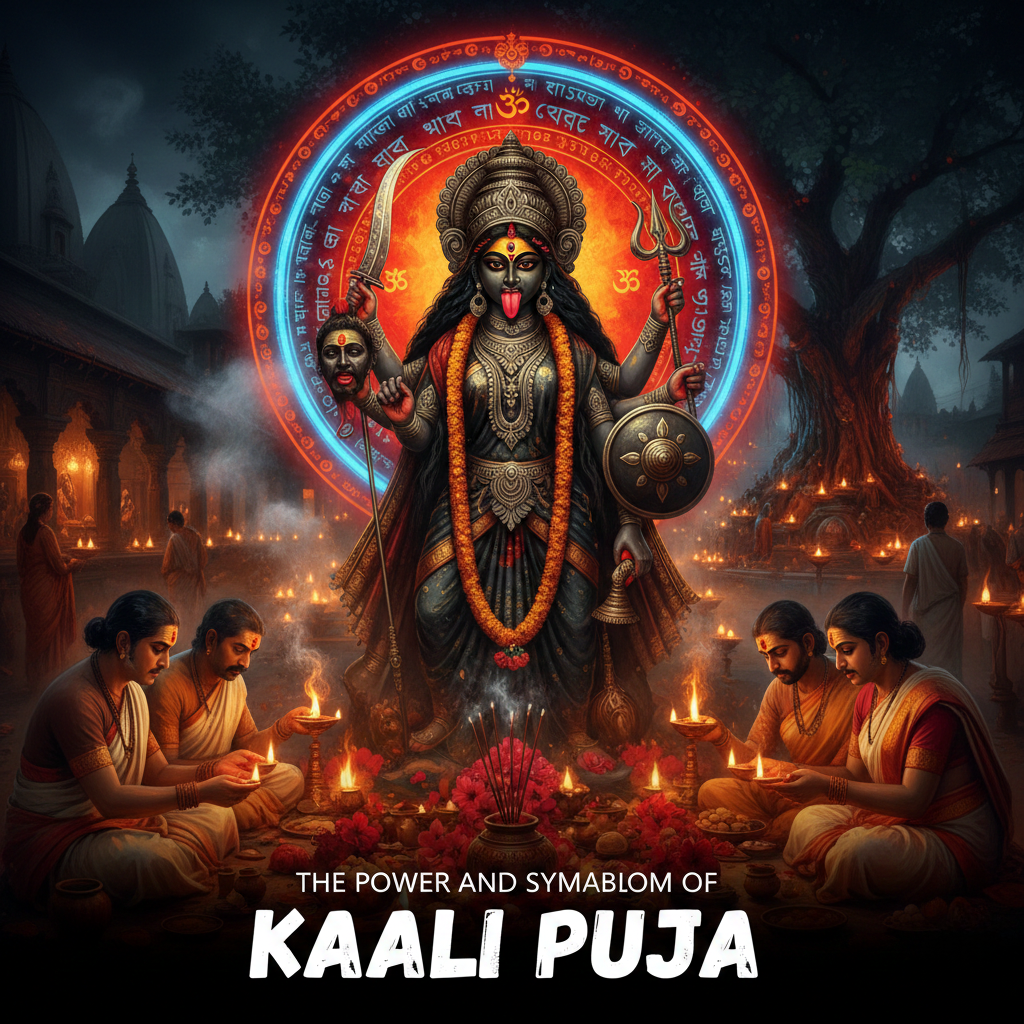
The Power and Symbolism of Kaali Puja: Beyond the Darkness

While much of the world illuminates the night of Diwali to welcome Goddess Lakshmi, the eastern heartlands of India—specifically West Bengal, Odisha, and Assam—prepare for a different kind of intensity. This is the night of Kaali Puja, a celebration of the fierce, the primordial, and the transformative.

In 2026, as we continue to seek balance in an increasingly chaotic world, the symbolism of Maa Kaali feels more relevant than ever. She isn’t just a deity of destruction; she is the ultimate personification of Shakti (divine energy) and the “Dark Mother” who birthed the universe.

The Divine Iconography: A Language of Transformation

To the uninitiated, Maa Kaali’s form—dark-skinned, disheveled hair, and a garland of skulls—can be startling. However, every element of her appearance is a profound philosophical teaching.   

The Dark Complexion: Just as the night sky contains all stars, Kaali’s dark hue represents the infinite void from which all creation emerges and eventually returns.

The Protruding Tongue: Legend says Kaali became so intoxicated by her battle with demons that she threatened to destroy the world. Lord Shiva lay in her path to stop her; upon stepping on her husband, she bit her tongue in a moment of sudden realization and modesty. Symbolically, this represents the taming of the ego and the balance between raw energy (Shakti) and pure consciousness (Shiva).

The Garland of Skulls: These are not symbols of death, but the 50 letters of the Sanskrit alphabet—the "seeds" of knowledge and the various states of the human mind that she liberates.

The Severed Head and Sword: The sword represents Gyan (divine wisdom) that severs the head of the "ego," allowing for true spiritual rebirth.

Why the New Moon?

Kaali Puja is held on Amavasya (the new moon night) of the month of Kartik. The choice of the darkest night is intentional. It signifies that the most profound spiritual work happens in the shadows. By worshipping the “Dark Mother” during the peak of darkness, devotees seek to:

Conquer Inner Shadows: Facing our own anger, greed, and attachments.

Destroy Negativity: Seeking protection from external "evil" and internal "ignorance."

Find Liberation: Breaking the cycle of time (Kala) to achieve Moksha.

Modern Relevance: The Empowerment of the "Wild"

In today’s context, Kaali Puja has evolved into a symbol of Nari Shakti (Feminine Power). She represents a form of the feminine that is unapologetic, fierce, and fiercely protective. For many, she is the guardian of those who feel marginalized or silenced—a reminder that there is power in being “untamed” when it is in the service of truth and justice.

How it is Celebrated

The rituals often take place at Nishita Kaal (midnight), the time when the veil between the physical and spiritual worlds is said to be thinnest.

Offerings: Red hibiscus flowers (symbolizing the heart's blood), sweets, and sometimes symbolic sacrifices like pumpkins or gourds.

The Atmosphere: In cities like Kolkata, the air is thick with the scent of incense, the sound of dhak (traditional drums), and the glow of thousands of oil lamps, creating a surreal blend of fearlessness and devotion.

CONCLUSION :

Kaali Puja reminds us that destruction is often the prerequisite for creation. To build a better version of ourselves or our society, we must first allow the “Dark Mother” to dismantle our illusions and fears. 

For more related info visithttps://www.incredibleindia.gov.in/en/festivals-and-events/kali-puja
Deepavali, or Diwali, is more than just a festival of lights; it’s a profound spiritual journey, a time to cleanse, reflect, and invite the divine light to shine brightly within us. As fireworks illuminate the night sky and diyas flicker in every home, we are reminded of the victory of light over darkness, good over evil, and knowledge over ignorance.

The Symbolism of Light

The most prominent symbol of Deepavali is light. Rows of earthen lamps, or diyas, adorn homes, each tiny flame representing a spark of the divine. This tradition isn’t merely decorative; it’s a powerful metaphor. Just as a single diya can dispel darkness, so too can the inner light of knowledge and wisdom banish the shadows of ignorance and negativity from our lives.

Victory of Good Over Evil

Deepavali celebrates several narratives, all echoing the central theme of triumph. In North India, it commemorates Lord Rama’s return to Ayodhya after fourteen years of exile and his victory over the demon king Ravana. In the south, it marks Lord Krishna’s defeat of the demon Narakasura. These stories serve as powerful reminders that no matter how formidable the challenges, righteousness and truth will ultimately prevail. They encourage us to confront our inner demons – anger, greed, ego – and strive for personal victory.

Prosperity and New Beginnings

For many, Deepavali also marks the beginning of a new financial year, making it an auspicious time for new ventures and seeking blessings for prosperity. Goddess Lakshmi, the deity of wealth and abundance, is worshipped, not just for material riches, but for the wealth of good health, peace, and spiritual growth. The cleaning and decorating of homes before Deepavali symbolize a fresh start, clearing away the old to make way for new positive energies.

The Inner Deepavali

Beyond the external celebrations, the true essence of Deepavali lies in its call to introspection. It’s an opportunity to:

Reflect and Release: Take stock of the past year. What darkness do you need to let go of? What negative patterns or thoughts are holding you back?

Ignite Inner Wisdom: Deepavali encourages us to seek knowledge and understanding. It’s a reminder to nurture our intellect and cultivate compassion.

Spread Joy and Love: The festive spirit is about sharing. Exchange sweets, gifts, and warm wishes. Extend kindness and forgiveness, truly embodying the spirit of unity.

Connect with the Divine: Through prayers, meditation, and lighting diyas, we create a sacred space to connect with the divine energy that resides within and around us.

This Deepavali, as you light each lamp, remember that you are not just illuminating your home, but also kindling the divine light within your own being. Let its glow guide you towards peace, prosperity, and profound spiritual awakening.

 PAHAL DESIGN wishing you a very Happy Deepavali!


If you’re dreaming of getting into top design colleges like IIT Bombay, IIT Delhi, IIT Guwahati, or IIT Hyderabad, then cracking UCEED (Undergraduate Common Entrance Examination for Design) is your first step!

UCEED 2026 will test not just your drawing skills, but also how you think, observe, imagine, and connect ideas with the world around you. The exam has two parts – Part A and Part B, and understanding the syllabus deeply will help you prepare smartly.

UCEED (2010-2025) Original Exam papers

Part A – Design and Analytical Thinking

Part A focuses on your observation, reasoning, and creativity through objective-type questions. It’s about how you see, analyze, and interpret the world — skills that every great designer needs.

🔹 1. Visualization and Spatial Reasoning

You’ll be tested on how well you can visualize and mentally manipulate 2D shapes and 3D objects. Imagine folding paper, rotating cubes, or understanding the geometry behind everyday objects.

🔹 2. Practical and Scientific Knowledge

Design and science go hand-in-hand. This section checks your understanding of basic scientific principles and how things work in real life — from levers to light to everyday gadgets.

🔹 3. Observation and Design Sensitivity

Great designers notice what others miss. This part tests your ability to observe minute details, identify patterns, and think critically about form, function, and context.

🔹 4. Environment and Society

Design isn’t just about aesthetics — it’s about solving real-world problems. Be ready to answer questions on environmental issues, culture, and how design impacts society.

🔹 5. Analytical and Logical Reasoning

Here, your reasoning and problem-solving skills take the spotlight. Expect puzzles, data interpretation, and logic-based questions that test your qualitative and quantitative thinking.

🔹 6. Language and Comprehension

You’ll need to understand and interpret Standard English texts — passages, conversations, or descriptions — to assess your comprehension and interpretive skills.

🔹 7. Creativity

This is where your imagination shines! You’ll face questions that test your ability to think out of the box, use analogies, and connect ideas through symbols, metaphors, and visual logic.

Part B – Drawing and Design Aptitude

Part B is hands-on. It tests your ability to sketch, visualize, and communicate ideas through drawing.

🔸 1. Drawing Skills

You’ll need to draw products, people, or scenes accurately with attention to proportion, perspective, and line quality. Composition, light, and shading also matter — because your drawing should tell a story.

🔸 2. Design Aptitude

This section measures how you apply creativity to real-life challenges. It’s about design thinking, empathy, and practical innovation — solving problems visually and meaningfully.


FAQ’s

What is the structure of the UCEED exam and what topics does it cover ?

The UCEED exam is divided into two parts, Part A and Part B. Part A focuses on design and analytical thinking, testing visualization, scientific knowledge, observation, environment, reasoning, language comprehension, and creativity. Part B emphasizes drawing skills and design aptitude, assessing the ability to sketch, visualize, and communicate ideas visually.

How should I prepare for Part A of the UCEED exam to enhance my chances of success ?

Preparation for Part A should include practicing visualization and spatial reasoning exercises, understanding basic scientific principles, improving observation skills, studying environmental and societal issues, enhancing logical reasoning abilities, strengthening language comprehension, and fostering creativity through various problem-solving activities.

What skills are assessed in Part B of the UCEED exam, and how can I improve my performance in this section?

Part B evaluates your drawing skills and design aptitude. To improve performance, practice sketching products, people, and scenes with attention to proportion, perspective, and shading. Additionally, develop your ability to think creatively, approach design challenges with empathy, and communicate ideas clearly through visual means.

Are there any specific requirements or instructions regarding the use of a scribe during the UCEED exam?

Yes, a scribe is allowed to assist candidates in reading questions or entering answers as per the candidate’s instructions. However, the scribe is not permitted to explain the questions or suggest solutions, ensuring that the exam remains fair and based on the candidate’s own abilities.

Will there be any spot round of counselling or admissions for UCEED candidates?

There are no spot admission rounds for IITs after the counseling process. However, IIITDM Jabalpur may conduct a spot round of admissions at the institutional level if there are remaining vacant seats after the main counseling process.

If you have any doubts then feel free to connect us at 8800-22-6864   

Visit:https://pahaldesign.com/our-centres/

On this World Standards Day, we celebrate the benchmarks that drive progress, innovation, and excellence.

At PAHAL Design, we believe that raising our standards — in creativity, design education, and integrity — is the key to elevating our world. 🌍✨

Let’s continue to set higher goals and inspire the next generation of design thinkers.

#WorldStandardsDay #PahalDesign #DesignExcellence #Innovation #CreativeEducation #Leadership #DesignThinking

Design Your Future: The Ultimate Guide to WUDAT 2026

Every iconic creation—from the smartphone in your hand to the architecture of a skyscraper—started with a single, brave step. If you are ready to turn your creative spark into a professional career, that step is WUDAT 2026.

The World University of Design Aptitude Test (WUDAT) is more than just an entrance exam; it is a gateway to India’s first university dedicated strictly to the creative domains. Here is everything you need to know about embarking on this journey.

What is WUDAT?

WUDAT is the national-level entrance exam for admission into the World University of Design (WUD). Unlike traditional entrance exams that focus on rote memorization, WUDAT is designed to identify “creative DNA.” It tests your aptitude for design, your ability to think laterally, and your visual intelligence.

🗓️ Mark Your Calendar: Key Dates

Timing is everything in design. Ensure you don’t miss these critical milestones for the 2026 academic cycle:

  • Exam Date: 4th January 2026 (Session 1)

  • Next Opportunity: If you missed the January cycle, keep an eye out for the April session (typically mid-April).

  • Mode of Exam: Online (Remote Proctored) – You can take the test from the comfort of your home!

The WUDAT Blueprint: What’s Inside the Exam?

Student Type: Class 12

Institute: Pahal Design

Exam Date: 21 December 2025 (Prelims)

Study Duration: 6 months (Oct 2025 – Mar 2026)

Perfect, thank you 🙌

You’re a Class 12 student with Pahal Design coaching (12 hrs/week), strong in Creative Thinking, and want to improve Time Management — and you’d like Weekly Mock Tests included.

Here’s your 6-Month Structured NID DAT (B.Des) 2026 Prelims Plan – Oct 2025 to Mar 2026

🗓️ MONTH 1: OCTOBER 2025 — FOUNDATION & CONSISTENCY

Goal: Strengthen sketching discipline + basics of design aptitude

Weekly Focus:

Week 1: Line quality, proportion, shading, basic objects (cups, bottles, furniture) Week 2: Human figures, gesture drawing, basic anatomy Week 3: Perspective (1-point, 2-point), indoor/outdoor spaces Week 4: Observation exercises — draw from life (daily 15–20 min)

Theory + Aptitude:

Daily 15–20 min GK (design, art, culture, logos, current affairs) 2 reasoning exercises (pattern, analogy, visual puzzles) each week

Mock Test: 1 every Sunday (2 hours)

→ Focus on completing all questions within time.

Creative Challenge: “Everyday Object, New Use” — redesign an object with a new function.

🗓️ MONTH 2: NOVEMBER 2025 — IDEA DEVELOPMENT & SPEED

Goal: Improve idea generation + learn to draw fast & clean

Weekly Focus:

Week 1: Storyboard sketches – create 4-frame visual stories Week 2: Product sketching – draw 10 everyday products in 30 mins Week 3: Scene composition – perspective + storytelling Week 4: Design thinking prompts (“How to reduce waste?”, “Redesign a classroom”)

Theory + Aptitude:

Logical reasoning: sequences, odd-one-out, spatial reasoning Visual GK: identify famous designs, logos, products

Mock Test: Every Sunday (3 hours full-length)

→ Target 90+% completion within time.

Creative Challenge: “Festival Reimagined” – redesign a festival logo/poster.

🗓️ MONTH 3: DECEMBER 2025 — EXAM SIMULATION PHASE

Goal: Full Prelims simulation, build confidence before exam

Weekly Focus:

2 full-length mocks per week Time practice: sketch completion in < 15 min per question Daily warm-up: 10-min object sketch + 1 creative idea prompt

Theory + Aptitude:

Quick revision: reasoning, GK (art movements, NID facts, design pioneers) Review all mock tests and note recurring mistakes

Mock Test:

Sunday = Full 3-hour DAT Prelims simulation Wednesday = Sectional speed test (Creative / Aptitude)

Creative Challenge: “Design for a Social Cause” – poster or visual concept.

🗓️ MONTH 4: JANUARY 2026 — FOUNDATION REVISIT + MAINS PREP START

Goal: Revisit weak areas + start early exposure to Studio Test-type activities

Weekly Focus:

Perspective + proportion refresh Quick idea thumbnails (draw 5 ideas for 1 topic) Basic model-making concepts (paper, clay, wire exercises)

Mock Test: 1 full paper weekly + 1 quick 60-min challenge midweek

Creative Challenge: “Redesign your school bag / workspace.”

🗓️ MONTH 5: FEBRUARY 2026 — ADVANCED IDEATION + MASTERY

Goal: Expand imagination and improve clarity in presentation

Weekly Focus:

Week 1: Product + environment combos Week 2: Comic strip storytelling Week 3: Unusual combinations (e.g., “Tree + Phone” design challenge) Week 4: Personal portfolio sketches

Theory + Aptitude:

Solve 1 reasoning set daily Design awareness flashcards (NID, NIFT, Indian crafts, famous logos)

Mock Test: 2 per week (alternate days)

Creative Challenge: “Nature + Technology” concept illustration.

🗓️ MONTH 6: MARCH 2026 — FINE-TUNING & MAINS BRIDGE

Goal: Maintain speed, polish creativity, and transition to Mains prep

Weekly Focus:

Time trials: finish full papers in 2.5 hours Focused improvement on weak areas from mock analysis Brainstorming drills (idea web, mind mapping)

Mock Test: Every Sunday (with peer or mentor review)

Creative Challenge: “Future Living” – visualize city life in 2050.

For any details call 8800-22-6864

Our Fashion Styling students had the incredible opportunity to assist Nora Fatehi during an editorial shoot for Cosmopolitan, held right here on campus.
At Istituto Marangoni Mumbai, we continuously strive to bridge the gap between academics and industry. This hands-on experience provided our students with real-world exposure to professional styling, creative direction, and the high standards of a leading editorial production.
Go behind the scenes : https://bit.ly/Norafateh
IMStudents #IndustryExperience #CosmopolitanIndia #NoraFatehi #FashionStyling #IstitutoMarangoniMumbai

World University of Design (WUD), Haryana, is India’s premier institution dedicated entirely to creative education, ranked A+ (Diamond Band) by QS I-GAUGE for academic excellence. Spread over 12 acres with specialized labs, hostels, and world-class studios, WUD offers 30+ programs across Design, Architecture, Fashion, Communication, Visual Arts, Performing Arts, and Business. The faculty includes alumni from NID, NIFT, IIT, and top global institutions.

With ₹10 crore worth of scholarships awarded annually and collaborations with 20+ international universities under Cumulus and Erasmus+, WUD empowers students to think, create, and innovate. Its outcome-based education model, industry memberships with CII, FICCI, and ASSOCHAM, and a vibrant, diverse student body from 22 Indian states make it a universe of creative possibilities.

Admissions to the Bachelor of Design (BDes) programmes at IIT Bombay, IIT Delhi, IIT Guwahati, IIT Hyderabad, IIT Indore, IIT Roorkee and IIITDM Jabalpur are done through the Undergraduate Common Entrance Examination for Design (UCEED). Students who have passed Class XII (or equivalent) in 2025, or appearing in 2026, in ANY STREAM (Science, Commerce, or Arts & Humanities) are eligible to appear for UCEED 2026.

Important Dates

Activity Date
   
Start date for Online Registration October 01, 2025, 01:00 pm
Last date for Online Registration with regular fee October 31, 2025
Last date for Online Registration with late fee November 07, 2025, 5:00 pm
Start date for Admit Card downloading January 02, 2026, 01:00 pm
Last date for rectification of discrepancies in Admit card January 08, 2026, 05:00 pm
UCEED 2025: date and time of exam January 18, 2026 (Sunday)
09:00 am to 12:00 noon
Release of Draft Answer Key and candidates’ response for Part-A January 20, 2026
Last date for uploading comments (if any)
on the Draft Answer Key in the candidate’s portal
January 22, 2026, 05:00 pm
Release of Final Answer Key for Part-A January 28, 2026, 05:00 pm
Announcement of cut-off marks for Part-A February 05, 2026
Declaration of results March 06, 2026
Start date for Score Card downloading March 10, 2026
Application Process for BDes Programme starts Admission Schedule »
Last date for Score Card downloading July 31, 2026

Note:

  • Any request for change in the examination date and time will not be considered.
  • The dates for the seat allotment rounds are tentative. The change in date(s) (if any) will be posted on the official website (www.uceed.iitb.ac.in).

Syllabus

UCEED 2026 will have two parts.

Part-A will have questions from the following topics:

  • Visualization and spatial reasoning: Ability to visualise and transform 2D shapes and 3D objects and their spatial relationships.
  • Practical and scientific knowledge: Know-how of scientific principles and everyday objects.
  • Observation and design sensitivity: The capacity to detect concealed properties in daily life and think critically about them. Attention to detail, classification, analysis, inference and prediction.
  • Environment and society: General awareness of environmental, social and cultural connections with design.
  • Analytical and logical reasoning: Ability to analyse qualitative and quantitative information.
  • Language: Proficiency in reading and comprehending Standard English.
  • Creativity: Grasp of verbal and non-verbal analogies, metaphors, signs and symbols.

Part-B will have questions on the following topics:

  • Drawing: Ability to draw products, people or scenes in proportion with good line quality, composition, proportion, perspective and shading.
  • Design aptitude: Capability to practically and appropriately respond to problems/situations with ingenuity and empathy.


Schedule a free counselling session WhatsApp WhatsApp