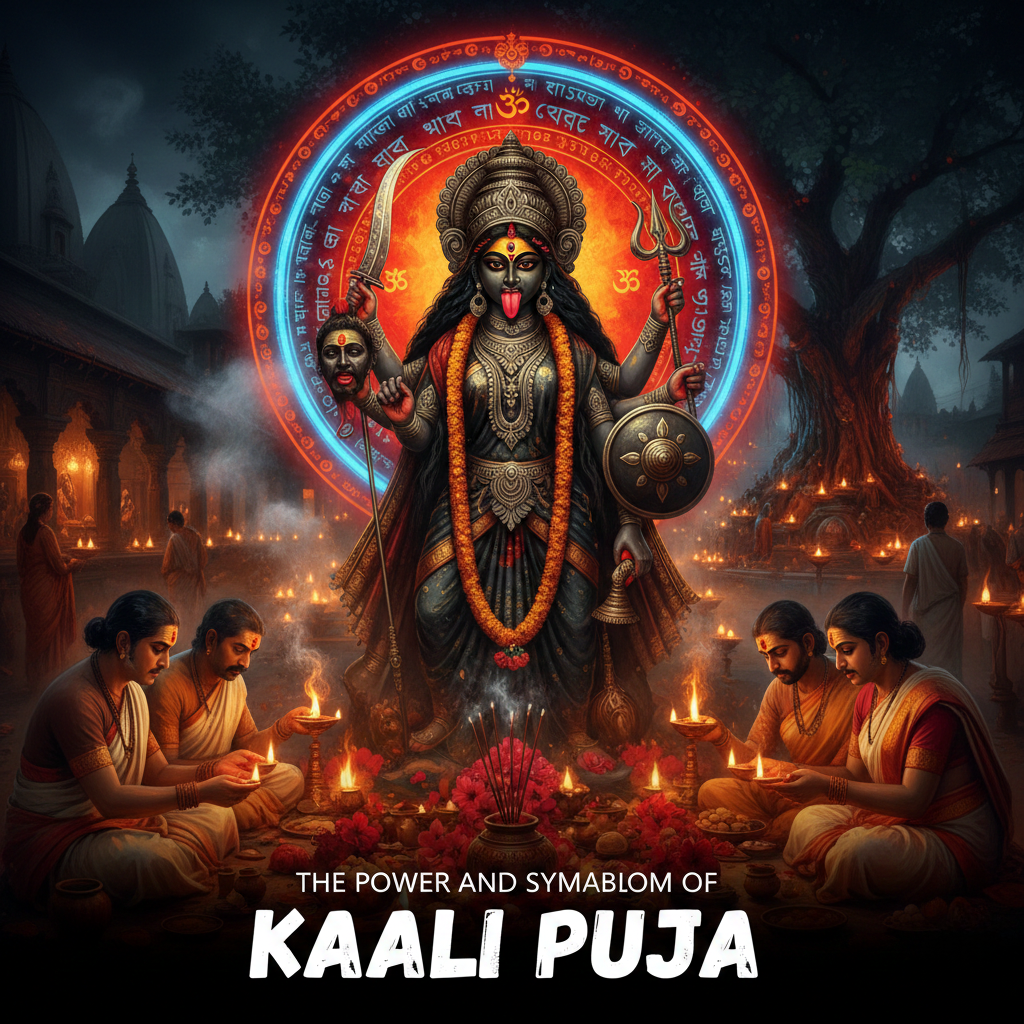
While much of the world illuminates the night of Diwali to welcome Goddess Lakshmi, the eastern heartlands of India—specifically West Bengal, Odisha, and Assam—prepare for a different kind of intensity. This is the night of Kaali Puja, a celebration of the fierce, the primordial, and the transformative.
In 2026, as we continue to seek balance in an increasingly chaotic world, the symbolism of Maa Kaali feels more relevant than ever. She isn’t just a deity of destruction; she is the ultimate personification of Shakti (divine energy) and the “Dark Mother” who birthed the universe.
To the uninitiated, Maa Kaali’s form—dark-skinned, disheveled hair, and a garland of skulls—can be startling. However, every element of her appearance is a profound philosophical teaching.
Kaali Puja is held on Amavasya (the new moon night) of the month of Kartik. The choice of the darkest night is intentional. It signifies that the most profound spiritual work happens in the shadows. By worshipping the “Dark Mother” during the peak of darkness, devotees seek to:
In today’s context, Kaali Puja has evolved into a symbol of Nari Shakti (Feminine Power). She represents a form of the feminine that is unapologetic, fierce, and fiercely protective. For many, she is the guardian of those who feel marginalized or silenced—a reminder that there is power in being “untamed” when it is in the service of truth and justice.
The rituals often take place at Nishita Kaal (midnight), the time when the veil between the physical and spiritual worlds is said to be thinnest.
Kaali Puja reminds us that destruction is often the prerequisite for creation. To build a better version of ourselves or our society, we must first allow the “Dark Mother” to dismantle our illusions and fears.
For more related info visit : https://www.incredibleindia.gov.in/en/festivals-and-events/kali-puja